IELTS consists of four test sections: Reading, Listening, Writing, and Speaking. Among these, the IELTS Reading test assesses your ability to understand information, identify key ideas, recognise specific details, and follow how ideas are developed across a passage.
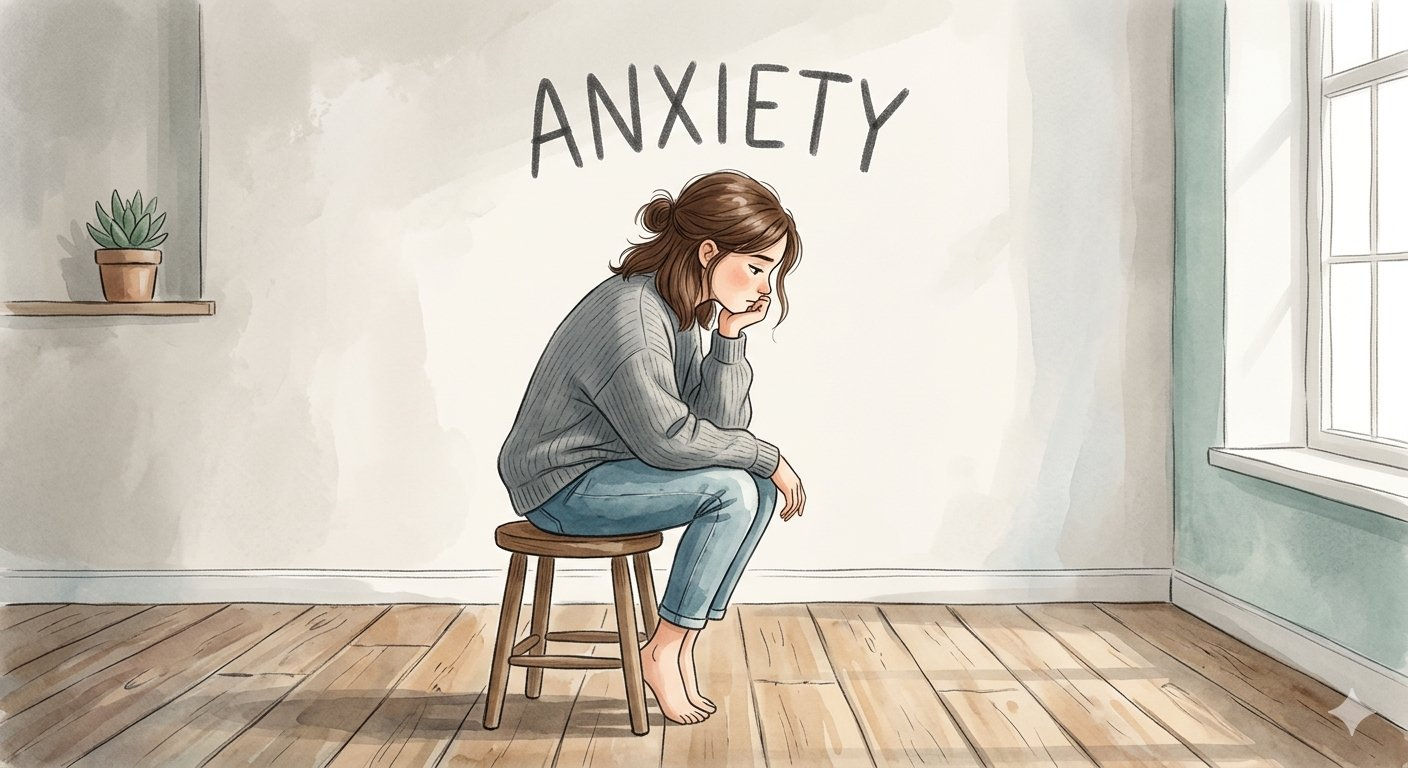
Anxiety is one such IELTS Academic Reading passage about why anxiety is a normal part of life, when it can become a disorder, and how it can be managed. It also discusses the causes of anxiety, its effects, and different treatment options.
The Anxiety IELTS Academic Reading passage appears as Academic IELTS Reading Sample 310 on IELTS Mentor and is also featured in online IELTS practice collections such as IELTSMaterial.com and IELTS Training Online. For your reference, here is the Anxiety IELTS Reading answer key:
Question Numbers
Anxiety IELTS Reading Answers
1
A
2
C
3
D
4
The amygdala
5
10%
6
Their personality
7
Graded
8
Therapist
9
Negative thoughts
10
Behaviour
11
Psychotherapy
12
Endorphins
13
Insomnia
These are the answers for the Anxiety IELTS Reading passage. You can now attempt the practice questions below and then check the answers with the explanations to understand how each response is supported by the passage.
Anxiety IELTS Reading Passage for Practice
Anxiety, the IELTS Reading Test Passage Test looks at why anxiety is a normal part of human life, when it can become a disorder, and how different treatments can help people manage it. The passage also discusses the causes of anxiety, its wider impact, and the role of therapy, medication, and exercise.
As you read, pay attention to the examples and explanations used to distinguish normal anxiety from anxiety disorders. These details will help you locate information and understand the ideas needed to answer the questions that follow.
The following is a practice version inspired by the original IELTS Reading passage. Now, read the passage carefully before attempting the questions.
Anxiety IELTS Reading Passage
A: Anxiety is an ordinary emotion that may also prove helpful under certain circumstances such as when one has to deal with an actual threat. It will enable to respond fast, defend your self. Nevertheless, however anxiety may also turn out to be an illness if they are much more severe than dangers they face; they last for an extended time period; they greatly affect people’s lives.
B: Everyone has anxiety at some point and there are valid reasons to it. The anxiety is evolved by humans due to its survival function. Anxiety was an adaptive reaction when faced with danger by primitive man. They would pause what they were doing, concentrate all their attention on the danger, and have a big burst of adrenaline and increased blood flow to the muscles. The body’s reaction made them quick to flee and attack a danger.
C: Some amount of stress is still relevant today and also during earlier times. It helps people focus on their work if there is a deadline to meet; it also enables them to react fast if something happens suddenly like driving fast while crossing roads. So anxiety isn’t inherently bad either. It is a problem if danger is imagined and exaggerated. A perceived threat that is much more serious than actual danger and persistent, debilitating anxiety may lead to an anxiety disorder. About 17 percent of people will suffer from an anxiety disorder at some point during their lives.
D: There are many reasons for anxiety and diagnosing it as an illness is hard to do. The scientists study genetic influences to some extent; they study environmental factors like pollution, stress (physical and mental), and diet. Various parts of the brain are responsible for generating fear and anxiety. With help from brain-imaging techniques and neurochemistry studies, researchers discovered that the amygdala is involved with various types of anxiety disorders. Knowledge about how to treat fear and anxiety better would be helpful for researchers to come up with better treatment options.
E: The cost of anxiety disorders is high to society. Some published estimates suggest that anxiety cost the United States around $60 billion in one year. It also included costs due to lost work output and unnecessary medical tests. A lot of people suffering from anxiety go for medical check-ups since they think their symptoms are due to some medical problem.
F: Although there is an effect from anxiety disorder, very few individuals suffering from it get help. Approximately 10 percent of those suffering from anxiety disorders are treated. It is probably due to people not knowing about treatment options that are effective. Some people think they suffer from anxiety all their lives so they consider it a personality trait. Thus they might think that they cannot change themselves, and have little chance for improvement.
G: The first psychotherapy treatment that proved successful was exposure therapy. Gradually it encourages individuals to go through things that are frightening for them, and stay there as long as possible. It will assist them to gain self-confidence for handling such circumstances. Therapist could be there to support and guide you through this process. Cognitive behavior therapy group therapy is effective. Talk therapy helps individuals realize that bad thoughts are linked with moods; it also teaches them how altering behaviors will assist with managing stress levels and regaining some control over life.
H: Medications may assist individuals with managing their anxiety. But it does not treat an anxiety disorder. On the other hand, drugs may help to manage this disease during psychotherapy treatment. Antidepressants, anxiolytics and beta blockers are some of the most commonly prescribed medications to treat anxiety disorders. With proper care, most individuals suffering from a mental disorder of anxiety are able to lead normal lives.
I: There are lots of studies showing how exercise helps to alleviate anxiety disorders. Stress affects brain and its many connections, so other parts of your body are impacted. Exercise leads to endorphin release from your body which acts like a natural painkiller. Physical exercise might be able to help people get sleep faster and better by causing fatigue. Because sleep problems are prevalent among those suffering from stress disorders like anxiety disorders, getting restful sleep will alter one’s perception of this problem significantly.
J: It’s normal and yet very personal to be anxious. While normal stress is beneficial and helpful to some extent, too much stress leads to great suffering among many individuals. Early detection and treatment of severe anxiety is vital since it can be very effective. Untreated anxiety is very hard to live a life.
Looking to strengthen your IELTS preparation before you take the test? Get practical guidance with upGrad’sfree IELTS course and work on your skills at your own pace.
Anxiety Reading Questions
You have now read the passage about anxiety, its causes, and the ways it can be managed. The questions below will test how well you can find specific information, understand what the passage says about anxiety disorders, and connect details with the right part of the text.
Read each question carefully. Some answers are stated quite directly, while others use different words from the passage, so focus on the meaning rather than looking only for the same words.
Questions 1–5: Matching Information
Which section, A–J, contains the following information?
Write the correct letter, A–J, in boxes 1–5.
1. A description of the physical reaction that helps a person respond to danger.
2. A reason why some people with anxiety do not believe that they can improve.
3. An estimate of the amount anxiety disorders cost the United States.
4. An explanation of how physical exercise may help people with sleep problems.
5. A description of a treatment that involves gradually facing things that cause fear.
Questions 6–9: True, False, Not Given
Do the following statements agree with the information given in the passage?
In boxes 6–9, write:
TRUE — if the statement agrees with the information FALSE — if the statement contradicts the information NOT GIVEN — if there is no information about this
6. Anxiety is harmful in every situation.
7. Researchers are studying environmental factors as possible causes of anxiety.
8. Medication can cure anxiety disorders without any other form of treatment.
9. People with anxiety disorders experience more sleep problems than people without anxiety disorders.
Questions 10–13: Multiple Choice
Choose the correct letter, A, B, C, or D.
10. When can anxiety develop into an anxiety disorder?
A. When it helps a person react quickly to danger B. When it occurs during a stressful situation C. When it is severe, persistent, and much greater than the actual danger D. When it causes the body to release adrenaline
11. What have researchers discovered about the amygdala?
A. It produces endorphins during physical exercise. B. It controls how quickly people recover from stress. C. It is involved in different types of anxiety disorders. D. It prevents people from responding to dangerous situations.
12. Why may some people with anxiety believe that they cannot improve?
A. They think anxiety is a permanent part of their personality. B. They believe anxiety can only be treated with medication. C. They do not experience symptoms that affect their daily lives. D. They believe anxiety is caused mainly by physical illness.
13. What does the passage say about medication for anxiety disorders?
A. It can permanently remove an anxiety disorder. B. It can help manage anxiety while a person receives psychotherapy. C. It can replace psychotherapy as the main form of treatment. D. It is mainly prescribed to treat physical symptoms unrelated to anxiety.
Once you have attempted the questions, use the Anxiety reading answers with location below to check your responses and see where you can find each answer in the passage.
The explanations also help you understand why the answer fits and clear up some of the details that may be easy to confuse.
Answers 1–5: Matching Information
Answer 1: B
Explanation: Paragraph B talks about what happens when a person faces danger. The body gets a burst of adrenaline, blood flow to the muscles increases, and the person becomes ready to run away or attack. These are the physical changes mentioned in the question.
Answer location: Paragraph B
Answer 2: F
Explanation: Paragraph F says that some people think anxiety has always been part of their personality. Because they see it this way, they may feel that they cannot change themselves or get better. This is the reason given in the passage.
Answer location: Paragraph F
Answer 3: E
Explanation: Paragraph E gives the amount that anxiety disorders cost the United States. It says the cost was around $60 billion in one year. It also mentions lost work output and unnecessary medical tests.
Answer location: Paragraph E
Answer 4: I
Explanation: Paragraph I says that exercise can make people tired, which may help them fall asleep faster and sleep better. The paragraph also talks about endorphins, but the question is asking about sleep, so look at the part about physical tiredness.
Answer location: Paragraph I
Answer 5: G
Explanation: Paragraph G talks about exposure therapy. In this treatment, people slowly face the things that frighten them and stay in those situations for as long as possible. A therapist can also support and guide them.
Answer location: Paragraph G
Answers 6–9: True, False, Not Given
Answer 6: FALSE
Explanation: The statement says anxiety is harmful in every situation. But Paragraph A says anxiety can be helpful when a person faces a real threat. Paragraph C also says that some anxiety can help people focus and react quickly. So the statement is false.
Answer location: Paragraphs A and C
Answer 7: TRUE
Explanation: Paragraph D says scientists study environmental factors when they look at the causes of anxiety. The passage gives pollution, physical and mental stress, and diet as examples. So the statement agrees with the passage.
Answer location: Paragraph D
Answer 8: FALSE
Explanation: Paragraph H says medication can help people manage anxiety, but it does not treat the anxiety disorder itself. It may be used while the person is having psychotherapy. So medication alone cannot cure the disorder according to the passage.
Answer location: Paragraph H
Answer 9: NOT GIVEN
Explanation: Paragraph I says sleep problems are common among people with anxiety disorders. But it does not say whether these people have more sleep problems than people without anxiety disorders. Since there is no comparison, the answer is NOT GIVEN.
Answer location: Paragraph I
Answers 10–13: Multiple Choice
Answer 10: C. When it is severe, persistent, and much greater than the actual danger
Explanation: Paragraphs A and C explain when anxiety can become a disorder. It is not simply because a person feels anxious or has a stressful situation. The anxiety becomes a problem when it is much more serious than the real danger, lasts for a long time, and affects the person’s life.
Answer location: Paragraphs A and C
Answer 11: C. It is involved in different types of anxiety disorders.
Explanation: Paragraph D says researchers found that the amygdala is involved with different types of anxiety disorders. They learned this through brain-imaging techniques and neurochemistry studies. The other options are not mentioned as findings about the amygdala.
Answer location: Paragraph D
Answer 12: A. They think anxiety is a permanent part of their personality.
Explanation: Paragraph F says some people think they have had anxiety all their lives. They may then see it as part of their personality and believe they cannot change themselves. This can make them feel that there is little chance of getting better.
Answer location: Paragraph F
Answer 13: B. It can help manage anxiety while a person receives psychotherapy.
Explanation: Paragraph H says medication may help manage anxiety, but it does not treat the disorder itself. The passage says drugs may be used during psychotherapy. So the answer is about managing anxiety during treatment, not curing it completely.
The Anxiety passage covers normal anxiety, anxiety disorders, their causes, and different ways of managing them. Some ideas are quite similar, so it is easy to mix up a detail or choose an answer that sounds right but is not actually stated in the passage.
Here are a few simple ways to approach the Anxiety Reading Questions:
1. Find the Main Detail Before Matching the Paragraph
For Matching Information: Start with the main idea in the question and then scan the passage for that information. Do not try to match the question with a paragraph just because you see one familiar word.
For example, if the question asks about the financial cost of anxiety disorders, look for the part that gives a money figure. The $60 billion mentioned in Paragraph E is a strong clue.
Keep in mind: Question detail → Paragraph → Check the full sentence
2. Look for the Reason Behind the Statement
Some questions ask about why people behave or think in a certain way. In these questions, finding the topic is not enough. You also need to find the reason given in the passage.
For example, Paragraph F says that some people see anxiety as a personality trait. Because of this, they may think they cannot change themselves or get better.
So, when the question asks why something happens, look for the reason, not just the topic.
3. Read the Whole Statement for True, False, Not Given
For True, False, Not Given, do not decide your answer after finding one matching word.
Read the complete statement and compare its meaning with the passage.
If the passage...
Your answer
Says the same thing
TRUE
Says the opposite
FALSE
Does not give enough information
NOT GIVEN
For example, Paragraph I says that sleep problems are common among people with anxiety disorders. It does not compare them with people who do not have anxiety. So, you cannot add that comparison yourself.
4. Be Careful with Words Like “Always” and “Only”
Small words can change the meaning of a statement.
The passage says that anxiety can be helpful in some situations. So, if a statement says “anxiety is always harmful”, it does not match the passage.
Similarly, Paragraph H says that medication can manage anxiety but does not treat the disorder itself.
A useful check: Before choosing TRUE or FALSE, look for words such as always, only, all, never, and completely.
5. Compare the Options with What the Passage Actually Says
For Multiple Choice: Some options may sound sensible even when they are not mentioned in the passage. Do not choose an answer just because it seems like a reasonable explanation.
For example, Paragraph F gives a clear reason why some people do not seek help: they may believe anxiety is part of their personality. That is the idea you need to match with the question.
Try this: Question → Relevant paragraph → What does the passage actually say? → Choose the matching option
6. Use Numbers and Key Terms as Scanning Clues
Numbers and specific terms can help you find the right part of the passage quickly.
In Anxiety, useful clues include:
17 percent → people who may experience an anxiety disorder
$60 billion → estimated cost in the United States
10 percent → people with anxiety disorders who receive treatment
Amygdala → linked with different types of anxiety disorders
The Anxiety passage explains how anxiety can be helpful in some situations but can also become a serious problem when it continues for a long time. It also covers the causes of anxiety and the different ways it can be treated.
While checking your Anxiety Reading Answers, go back to the passage when you are unsure about an answer. Looking at the exact information will help you understand your mistakes and get better at solving IELTS Reading questions.
Anxiety IELTS Reading passage explains why anxiety is a normal human response, when it can become a disorder, and how it affects people. Further, it talks about the major causes and treatments of anxiety.
How many questions are there in the Anxiety IELTS Reading test?
There are 13 questions on this practice test based on the passage. These questions are about Matching Information, True, False, Not Given, and Multiple Choice.
What types of questions are included in the Anxiety Reading test.
Matching Information, True, False, Not Given, and Multiple Choice are types of questions that are asked. Every one needs to be approached slightly differently locating information and comparing it to that given by a text.
How to use Anxiety Reading Answers for practice?
Try out every question first and then check your answers. Compare your answers to the answer key, read the explanation so that you know what is being asked for.
How to improve my score with Anxiety Reading Answers?
Answer for learning from mistakes not just scoring high. Go back to that section of this text for comparison with your question so that you can improve your accuracy and reading skills.
How to answer Matching Information questions from the Anxiety passage?
Secondly, find out what is being asked about; then look through this text to find out any relevant details. It might be phrased differently so try to find that concept instead of looking at specific terms only.
How to answer True, False, Not Given questions on Anxiety?
Read through this whole paragraph to find out what is being read. Is this paragraph supporting, contradicting and providing enough information for that statement. Pay attention to words like always, only and every.
How do you answer Multiple Choice questions on Anxiety Reading test?
Read the problem statement, then figure out what is being asked. Check all options with this text, then discard any that provide more detail and contradict what’s said here.
What is the best way of review mistakes Anxiety Reading Answers?
Return to this paragraph where you got an answer, and compare it with your question. It will tell if there was something that you overlooked; misunderstood it completely; chose something which seemed reasonable.
Can I use the Anxiety passage as a timed IELTS Reading test?
Yes. Once you are familiar with the question types, try completing this passage and its questions within 20 minutes. Review your responses afterwards to see where you spent too much time and where you made errors.
Is the Anxiety passage useful for IELTS Reading preparation?
Yes. The Anxiety passage teaches you how to find information, understand paraphrased statements, compare them to what is said on a given question from an IELTS Reading passage.
upGrad Abroad Editorial Team |4991 articles published
We are a dedicated team of study-abroad experts, ensuring intensive research and comprehensive information in each of our blogs. With every piece written, we aim at simplifying the overseas education ...
Refer Your Friend & Earn upto ₹15000
Help your friend upgrade to a Global Career and earn rewards together.