There are four parts in IELTS: Reading, Listening, Writing, and Speaking. Of these, the IELTS Reading section evaluates your comprehension skills by testing you on your comprehension of information, main ideas, specific details, and idea development.
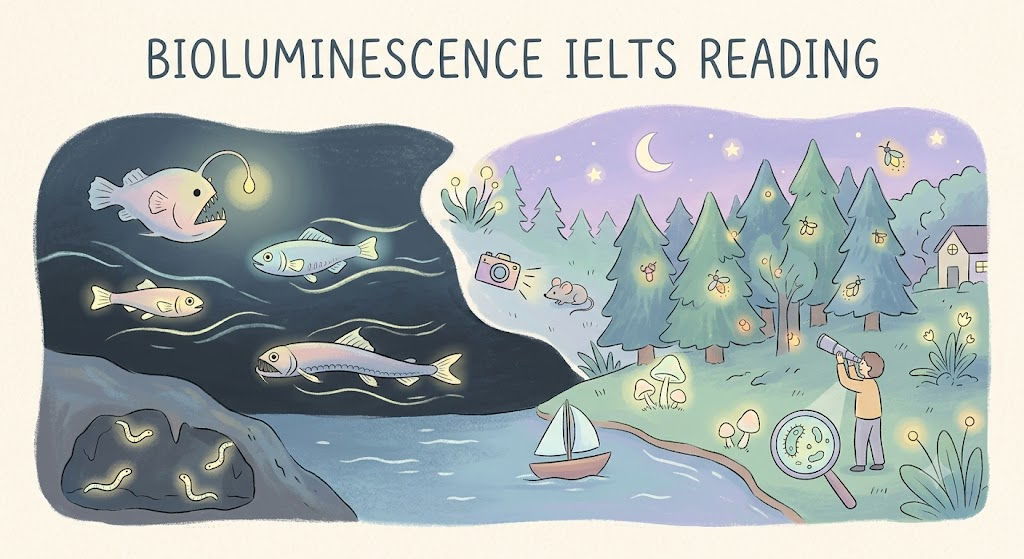
Bioluminescence is one of the IELTS Reading Academic passages about animals that are able to create light themselves and the various uses they make of it. It also focuses on the scientific use of bioluminescence and its potential uses in the future.
This passage has been taken from an IELTS Academic Reading section where Questions 1–13 have been asked from the types Matching Headings, Information Location, and Sentence Completion.
Here is the answer key for the Bioluminescence passage:
Question Numbers
Bioluminescence IELTS Reading Answers
1
(iii)
2
(ii)
3
(viii)
4
(vi)
5
(v)
6
A
7
C
8
F
9
G
10
DISORIENTATING
11
DNA PROTEIN
12
NATURAL PROCESSES
13
FORENSIC INVESTIGATORS / SCIENTISTS
14
G
15
A
16
E
17
D
18
E
19
C
20
F
21
NO
22
NOT GIVEN
23
YES
24
YES
25
NO
26
NOT GIVEN
27
D
28
C
29
B
30
C
31
A
32
E
33
MILITANT LINGUIST
34
FIRST RUSSIAN REVOLUTION
35
POSTMODERN CARICATURE
36
FORMAL
37
PERSONAL CHAMPION
38
B
39
D
40
F
These are the answers from the IELTS Reading answer key. You can now attempt the practice test below and then check the answers with the explanations to understand how each response is supported by the passage.
Bioluminescence IELTS Reading Passage for Practice
The bioluminescence IELTS Reading Test discusses the organisms that produce light and how they utilize bioluminescence to survive. The role of bioluminescence in scientific research is also discussed in the text along with its future applications.
The technique that might help you is focusing on the examples, applications, and usage of bioluminescence in the text. This information will help you determine the central theme of each paragraph and will enable you to find answers more easily.
We have created this IELTS Reading practice test for you. Read the passage carefully and try to answer the questions that follow:
Bioluminescence IELTS Reading Passage
Paragraph A
In the pitch-black waters of the ocean's aphotic zone – depths from 1,000m to the seafloor - Rood eyesight does not count for very much on its own. Caves, also, often have the same issue: no natural light at any time of the day. However, some organisms have turned these inhospitable environments into their home and, in doing so, have developed their own forms of light, one of the most amazing visual phenomena in the biological universe -bioluminescence.
Paragraph B
Bioluminescence will be experienced by many people at some time in their life, likely as a form of a glowworm, which is present on most continents. North and South America are home to the "firefly", a glowing beetle which is known as a glow-worm during its larval stage. Other species of glow-in-the-dark beetles and worms are also living in Europe, Asia, Australia, and New Zealand. Less common flies, centipedes, molluscs, and snails have bioluminescent qualities as well, as do some mushrooms. The most spectacular bioluminescent displays. However, they are located at the deepest layers of the ocean, and they don't get any sunlight. In this place, anglerfish, cookie-cutter sharks, flashlight fish, lantern fish, gulper eels, viperfish and many other species have evolved in different and ingenious ways to help in their survival through bioluminescence.
Paragraph C
Bioluminescence exists in nature in numerous applications, and organisms have become very inventive in their methods of use. Bioluminescence is used mostly for reproductive purposes in the Firefly; their flashing patterns are a sort of advertisement of their readiness to breed. It is used by some fish as an effective spotlight to find their food. Others employ it as a bait or decoy; the anglerfish, for instance, hangs a lighted lure that attracts foolish little fish, and the anglerfish is able to automatically snap off the prey at the precise moment it is convenient. Sometimes, bioluminescence is used to resist predators. When they are startled, the vampire squid spills a dense stream of glowing liquid from the end of their arms that can confuse them. Other species use a single, bright flash to temporarily blind their attacker, with an effect similar to that of an oncoming car which has not dipped its headlights.
Paragraph D
Humans have been able to capture and harness bioluminescence by developing a technology over the past decade called Bioluminescence Imaging (BLI). BLI comprises isolation of a DNA-protein from a bioluminescent organism and its incorporation into a laboratory animal using the technique of transgenesis. Researchers have been able to use luminescent pathogens and cancer cell lines to track the respective spread of infections and cancers. BLI allows cancers and infections to be observed without influencing their individual development. That is, although an ultra-sensitive camera and bioluminescent proteins give the image, they don't interfere with or alter the natural processes. Consequently, researchers can only test one aspect of the progression of a therapy when testing drugs and treatments.
Paragraph E
Once scientists learn how to engineer bioluminescence and keep it stable in large quantities, a number of other human uses for it will become available. Glowing trees have been suggested to replace electric lights along busy streets, for instance, to reduce our reliance on non-renewable resources. The technology used in Christmas trees to be used in the family home would also remove the fire hazard associated with electrical fairy lights. It could also be that in the future plants and crops can glow when they need watering, and milk and meat can "tell us” when contaminated with bacteria. Likewise, Forensic investigators might identify bacterial species on a corpse by bioluminescence. Last but not least, the game itself is brand new. Children's toys and stickers frequently have glow-in-the-dark properties, and a biological form would enable pets, such as the rabbit, mouse, fish, and others, to glow too.
Now that you have read the passage, move on to the questions below and test your understanding of the information about bioluminescence.
Bioluminescence Reading Questions
The following are some reading questions based on the passage for your practice. The questions are designed to evaluate your ability to locate the main idea of the passage, to locate specific information in the passage, and to fill in the blanks using information from the passage.
Make sure you read the instructions before you begin doing the questions on Matching Headings, Locating Information, and Sentence Completion.
After completing the practice test, compare your answers to the answers and explanations given below.
Questions 1–5: Matching Headings
The passage has five paragraphs, A–E.
Choose the most suitable heading for each paragraph from the list of headings below.
Write the correct Roman numeral, i–viii, in boxes 1–5.
List of Headings
i. The development of light in places without sunlight ii. A range of organisms with the ability to glow iii. How living creatures use light for different purposes iv. Using bioluminescence to observe disease v. Possible developments beyond scientific research vi. The challenge of surviving without natural light vii. The role of bioluminescence in reproduction viii. Future possibilities for engineered organisms
1. Paragraph A ______
2. Paragraph B ______
3. Paragraph C ______
4. Paragraph D ______
5. Paragraph E ______
Questions 6–9: Locating Information
Which paragraph contains the following information?
Choose the correct letter, A–E.
6. A process that enables scientists to follow the spread of a particular health problem. ______
7. An example of light being used to make another creature approach. ______
8. A mention of bioluminescent organisms found across several continents. ______
9. A possible use of bioluminescence for checking whether a food product has been affected by bacteria. ______
Questions 10–13: Sentence Completion
Complete the sentences below.
Choose NO MORE THAN TWO WORDS from the passage for each answer.
10. Fireflies use their flashing patterns to show that they are ready to ______.
11. The anglerfish uses a lighted ______ to attract smaller fish.
12. BLI allows researchers to observe infections and cancers without altering their natural ______.
13. In the future, plants and crops may produce light when they need ______.
The Bioluminescence Reading Answers section helps you check each answer and see where it comes from in the passage. It covers Matching Headings, Locating Information, and Sentence Completion.
The explanations also point out the clues that can help you reach the right answer, which is most useful when the question uses different words or when two details in the passage seem close.
Answers 1–5: Matching Headings
Answer 1: i. Light that is generated in areas where there is no sunlight
Answer location: Paragraph A
Explanation: In paragraph A, the places where the natural light is almost nil are the first to be mentioned. It speaks of the deepest of the sea and of the caves. The paragraph then describes the way that some organisms have evolved to live in these dark environments by creating their own light. The main idea is throughout the paragraph, so heading i is the best.
Answer 2: ii. A range of organisms with the ability to glow
Answer location: Paragraph B
Explanation: Paragraph B is about the various kinds of organisms that can give off light. It begins with glowworms and fireflies and then provides examples of beetles, worms, mushrooms and some sea animals. This paragraph also includes information about other regions of the world where they can be located. The main interest is the diversity of bioluminescent organisms, so heading ii is more appropriate.
Answer 3: iii. The different ways organisms utilize light
Answer location: Paragraph C
Explanation: Paragraph C discusses the various forms of bioluminescence used by animals. Fireflies communicate by making flashes. Light is used by some fish to light up a food source, and it is used by anglerfish to attract prey. Other creatures use light to deceive or frighten their predators. The heading iii is the most suitable since it addresses more than one usage.
Answer 4: iv. Observing disease using bioluminescence
Answer location: Paragraph D
Explanation: Bioluminescence Imaging (BLI) is introduced in paragraph D, and its application in medical research is explained. This technique can be applied to monitor the spread of infection and cancer cells. They are also able to witness these processes without altering their process of development. The main idea of the paragraph is the use of bioluminescence to study disease, so the answer is iv.
Answer 5: v. Possible developments other than scientific research
Answer location: Paragraph E
Explanation: Paragraph E looks at what bioluminescence could be used for in the future. The examples are from everything from glowing trees and crops to food which may indicate bacterial contamination. It also includes mentions of forensics, toys and glowing pets. These are some practical examples, and so v best describes the paragraph as a whole.
Answers 6–9: Locating Information
Answer 6: D. A process that enables scientists to follow the spread of a particular health problem
Answer location: Paragraph D
Explanation: Main idea: Following the spread of health problem. In Paragraph D, researchers observe the spread of infections and cancers with bioluminescence. The question is not exactly word for word the same as the passage but has the same meaning. This results in paragraph D.
Answer 7: C. An example of light being used to make another creature approach
Answer location: Paragraph C
Explanation: The question is to give an example of a situation in which light causes another animal to approach. This example is provided in paragraph C: “Uses a lighted lure to attract small fish”. This is exactly the same as the question, which means that the answer is C.
Answer 8: B. A mention of bioluminescent organisms found across several continents
Answer location: Paragraph B
Explanation: There are various locations mentioned in paragraph B where bioluminescent organisms are found. These include North America and South America, Europe, Asia, Australia, and New Zealand. The continent detail is relevant as it refers to organisms from different continents; this points to Paragraph B.
Answer 9: E. A possible use of bioluminescence for checking whether a food product has been affected by bacteria
Answer location: Paragraph E
Explanation: The words food and contamination by bacteria are the clue. In an effort to find out when they are contaminated with bacteria, milk and meat may one day be able to tell us, says Paragraph E. This is the use of the food that was described in the question, and hence the answer is E.
Answers 10–13: Sentence Completion
Answer 10: breed
Answer location: Paragraph C
Explanation: Refer to the part of paragraph C that describes the flashing patterns of fireflies. These patterns show their readiness to breed. The question asks what the fireflies are ready to do, so breed is the correct answer.
Answer 11: lure
Answer location: Paragraph C
Explanation: This is the explanation for how the anglerfish attracts smaller fish (paragraph C). It employs a lighted lure to draw them in and then catches them. The question is about what the anglerfish uses for this purpose, so the answer should be "lure".
Answer 12: processes
Answer location: Paragraph D
Explanation: This answer is based on the explanation of how BLI works. According to paragraph D, the technology enables researchers to watch the infection or cancers without disrupting or altering those processes. The same idea is used in the question; therefore, processes completes the sentence.
Answer 13: watering
Answer location: Paragraph E
Explanation: The clue is the reference to plants and crops. Paragraph E suggests that they could produce light when they need watering. The question asks what the plants may need, so watering is the correct answer.
How to Approach Bioluminescence IELTS Reading Questions?
When reading the Bioluminescence questions, try using a slightly different approach for each question type to help you practice different reading skills. Read for the main idea in headings, for specific clues to find information, and for exact wording to complete sentences.
Here are a few simple ways to approach the questions and avoid common mistakes while finding the Bioluminescence IELTS Reading answers:
Match Headings with the Main Idea
When matching headings, look at the overall message of the paragraph rather than matching a heading with one familiar detail. A paragraph may contain several examples, but the correct heading should cover the main point that connects them.
Example: Paragraph C mentions reproduction, finding food, attracting prey, and defending against predators. A heading about reproduction may seem suitable at first, but it covers only one part of the paragraph.
If a heading describes only one example while another heading covers the entire paragraph, the broader heading is usually the better match.
Locate Specific Information in the Passage
For Locating Information questions, identify the main clue in the statement and look for the same idea in the passage. The wording may change, so focus on meaning rather than searching for an exact phrase.
Example: “follow the spread” in the question connects with “track the spread” in Paragraph D.
Once you find the matching idea, read the surrounding sentence to make sure the information answers the question completely.
Complete Sentences Using the Correct Words
For Sentence Completion questions, first notice what the sentence needs and then find the relevant information in the passage. The answer should come from the passage and fit naturally into the sentence.
Example: The passage says that fireflies show their “readiness to breed.” If the question asks what they are ready to do, the answer is breed.
Remember: Check both the meaning and the grammar before finalising your answer.
Identify Paraphrased Information
IELTS questions often express the same information using different words, so an exact word match is not always necessary. Look for familiar ideas presented in a different way.
In the question
In the passage
follow the spread
track the spread
make another creature approach
attract smaller fish
affected by bacteria
contaminated with bacteria
When you cannot find the exact words from the question, look for a phrase that expresses the same idea.
Follow the Word Limit Carefully
The Sentence Completion questions require NO MORE THAN TWO WORDS, so the word limit should be checked before you write the answer.
Bioluminescence links information about light-emitting creatures, their survival techniques, research, and possible future uses. When trying to answer the questions, take note of how these concepts are being introduced within the passage and find the right pieces of evidence by using them as guides.
As you check your answers in Bioluminescence Reading Answers, you must be more interested in the process behind the answer than simply choosing the correct answer. It will make you better at identifying paraphrases, help you understand the details more quickly, and increase your confidence in taking the IELTS Reading exam.
1. How many questions does the Bioluminescence IELTS Reading practice test have?
There are 13 questions in the Bioluminescence IELTS Reading practice test, and the questions are numbered 1 to 13. They include Matching Headings, Locating Information, and Sentence Completion question types based on the passage.
2. What IELTS Reading skills will I be able to practice using Bioluminescence?
Through the use of Bioluminescence, you will be able to practice identifying the main ideas, finding specific information, paraphrasing ideas, and completing sentences through information obtained from the passage.
3. How can I improve my score through Bioluminescence Reading Answers?
You should use the answers to Bioluminescence as a review rather than simply checking if you are right or wrong. Go through the passage and find out the information that supports the answers.
4. Is Bioluminescence beneficial for practising IELTS Academic Reading?
Yes. The passage provides you with practice of different question types and also information in the scientific field about organisms, light usage by organisms, and possible applications of bioluminescence.
5. What should I consider while verifying Bioluminescence Reading Answers?
Look for the location of the answer in the passage and compare the wording of the question with the information from the passage. Look out for any paraphrasing done in the passage and ensure that your answer is within the given word limit.
6. How can I prevent myself from making mistakes in answering Bioluminescence IELTS Reading Questions?
Do not just pick up an option because you have seen a familiar word in the passage. Consider the whole meaning of the question and go through the passage before deciding on your answer.
7. Can I take the Bioluminescence Reading practice test as a timed test?
Yes. Try to solve the passage and questions within a specific period of time after you feel confident enough about the pattern of the test.
8. How should I review the Bioluminescence Reading mistakes?
Go back to the passage for every wrong answer and try to find out if you missed out on any important detail or misunderstood the question and answered based on some information which appeared relevant.
9. How do I get better at matching headings questions with the Bioluminescence passage?
Concentrate on the idea expressed by each paragraph instead of finding an interesting example in it. Look at the whole paragraph and see which heading corresponds to the main idea of that paragraph.
10. How do I prepare for Locating Information questions with Bioluminescence?
Look for the main clue in the question and find this idea in the text. The wording may be different, but look for a paraphrase of it and then check it in the next sentence.
11. How can I practice sentence completion questions with the Bioluminescence passage?
First of all, determine what kind of information is missing in the sentence. Then find the appropriate information in the text and put in the exact words.
upGrad Abroad Editorial Team |5019 articles published
We are a dedicated team of study-abroad experts, ensuring intensive research and comprehensive information in each of our blogs. With every piece written, we aim at simplifying the overseas education ...
Refer Your Friend & Earn upto ₹15000
Help your friend upgrade to a Global Career and earn rewards together.