Studying abroad after 12th means choosing a destination and course, checking the eligibility and English-test requirements for that country, and preparing your documents, transcripts, SOP, and test scores, before applying to universities and then the visa.
That's the outline. The real decisions sit underneath it: which country actually fits your budget, what marks and scores you need to clear, and how much a full year abroad costs once rent, food, and flights get added on top of tuition.
This guide walks through exactly that, country by country, cost by cost, so you're planning with real numbers instead of guesswork.
How to Study Abroad After 12th
Most students trying to figure out how to study abroad after 12th from India get stuck at the same point: too many countries, too many options, no clear order to follow. Here's the sequence that actually works.
Shortlist your country and course based on your budget, the field you want to study, and where you'd actually want to live for 3-4 years.
Check the university's eligibility criteria including your Class 12 percentage, subject requirements, and whether entrance tests like SAT or ACT apply.
Book and clear your English proficiency test, usuallyIELTS orTOEFL, well before your application deadline.
Put together your documents, transcripts, SOP, and letters of recommendation.
Apply through the university portal or a common platform, and pay the application fee.
Accept your offer once it arrives, checking deadlines and scholarship terms carefully.
Apply for your student visa with proof of funds and, where needed, a visa interview.
Sort accommodation and book flights, ideally a few months out so costs don't spike closer to departure.
Preparation Timeline (What to Do, and When)
If you're serious about studying abroad after 12th, the planning really needs to start about a year out, not three months before your flight.
Timeline
What to Focus On
12 months before
Research countries, courses, and universities. Compare tuition, curriculum, and post-study work options
9 months before
Estimate your total budget and start hunting for scholarships, grants, or an education loan
6-9 months before
Shortlist universities, gather documents (SOP, LORs, transcripts, test scores), and apply before deadlines
3-6 months before
Apply for your visa, lock in accommodation, and book flights
Eligibility Criteria to Study Abroad After 12th
Before you fall in love with a university, check whether you're actually eligible. Requirements vary by country, but most follow a similar pattern.
Academic and English Proficiency Requirements
Universities look at two things first, your Class 12 marks and your English score.
Minimum marks: most universities ask for 60-75% aggregate in Class 12 from a recognised board, though top-ranked universities set the bar higher.
English proficiency:IELTS (usually 6.0-6.5 bands),TOEFL, orPTE is required almost everywhere English is the medium of instruction. Some universities waive this if you studied in an English-medium school.
Exams to Study Abroad After 12th
Beyond English tests, a few countries ask for standardised entrance exams too, so it helps to know upfront which exams to study abroad after 12th actually apply to you.
SAT orACT: required by many universities in US, and some in Canada.
Financial proof: bank statements or a loan sanction letter showing you can cover tuition and living costs.
Visa documents: vary by country, but usually include an acceptance letter, passport, and proof of funds.
Medical insurance: mandatory in countries like Canada, Australia, and Germany.
Best Countries to Study Abroad After 12th
Each country plays to a different strength. US wins on STEM and research, Germany on low cost, UK on shorter degrees, and Canada and Australia on post-study work pathways. Here's how they actually stack up.
United States
Home to MIT, Harvard, and Stanford, US is still the strongest pick for STEM, IT, and business degrees, with deep research opportunities and OPT (Optional Practical Training) letting you work after graduation.
Cost Head
Annual Amount (USD)
Amount (INR)
Tuition Fee
$11,000 – $60,000
₹10.4L – ₹56.7L
Accommodation & Food
$12,000 – $15,000
₹11.3L – ₹14.2L
Transportation
$780
₹73.7K
Books & Coursework
$1,240
₹1.2L
Miscellaneous
$2,000 – $3,000
₹1.9L – ₹2.8L
Worth knowing before you apply:F-1 visa approval odds have shifted noticeably in 2026, with expanded STEM-OPT scrutiny affecting Indian applicants more than in past years. Non-STEM fields and Master's applicants are currently seeing stronger approval odds than STEM undergrads, so factor that into your planning rather than assuming a flat approval rate.
UK, Canada, and Australia
These three get grouped together for a reason, they all offer strong post-study work visas and comparatively simpler application routes.
UK: 3-year bachelor's degrees via UCAS, strong in finance, law, and humanities.
Canada: affordable tuition at universities like University of Toronto and UBC, with a work-friendly student visa policy.
Australia: top research facilities at ANU and Melbourne, plus generous PSW (Post-Study Work) visas.
Cost Head
UK (GBP)
UK (INR)
Canada (CAD)
Canada (INR)
Australia (AUD)
Australia (INR)
Tuition Fee
£9,000-£38,000
₹11.6L-₹48.9L
CAD 16,000-59,000
₹11L-₹40.4L
AUD 20,000-50,000
₹13.7L-₹34.3L
Accommodation & Food
£12,000-£15,000
₹15.5L-₹19.3L
CAD 10,000-15,500
₹6.9L-₹10.6L
AUD 16,800-30,000
₹11.5L-₹20.6L
Germany and Ireland
If cost is your biggest constraint, this is where you look first.
Germany: public universities charge close to zero tuition, just a semester fee of €200-€400 (₹21.6K-₹43.3K). You'll still need to open a blocked account with €11,904 (₹12.9L) to prove funds for your visa, and regular Indian board students often need a foundation year (Studienkolleg) first.
Ireland: a rising IT and finance hub, with universities like Trinity College Dublin offering strong post-study work options.
H2: Cost of Studying Abroad After 12th (Country-Wise Breakdown)
Total yearly costs, tuition plus living expenses, typically fall between ₹16 lakh and ₹40 lakh across the popular destinations. But that's a starting range, not a ceiling. US tuition alone can touch ₹56.7L before you've paid a single rupee in rent, so treat the lower end of this range as the budget-friendly path (think Germany or a mid-tier Canadian university), not the default.
Here's the full country-wise picture.
Germany
Germany's public universities keep tuition close to zero, so most of your budget goes toward living costs instead.
Cost Head
Annual Amount (EUR)
Amount (INR)
Tuition Fee
€0 – €30,000
₹0 – ₹32.5L
Accommodation & Food
€12,000
₹13L
Transportation
€600
₹64.9K
Books & Coursework
€360 – €600
₹38.9K – ₹64.9K
Miscellaneous
€1,200 – €2,400
₹1.3L – ₹2.6L
Ireland
Ireland costs more upfront on tuition than Germany, but living expenses stay fairly moderate outside Dublin.
Cost Head
Annual Amount (EUR)
Amount (INR)
Tuition Fee
€10,000 – €35,000
₹10.8L – ₹37.9L
Accommodation & Food
€8,160 – €15,000
₹8.8L – ₹16.2L
Transportation
€1,200
₹1.3L
Books & Coursework
€500 – €1,000
₹54.1K – ₹1.1L
Miscellaneous
€2,000 – €4,000
₹2.2L – ₹4.3L
Note: figures vary depending on the specific city and university you choose, so treat these as planning ranges, not fixed numbers.
Scholarships for Indian Students Studying Abroad After 12th
A good scholarship can knock a real chunk off that cost table above. Here's where to start looking, country by country.
Country
Scholarship
Eligibility & Coverage
United States
Tata Scholarship for Cornell University
Eligibility: Indian students admitted to Cornell. Coverage: financial aid for tuition, living costs, and other expenses.
United Kingdom
Reach Oxford Scholarship
Eligibility: students from low-income countries with outstanding academic records. Coverage: full tuition, college fees, living costs, and one return airfare a year.
Germany
Deutschlandstipendium
Eligibility: high-achieving students at any German university. Coverage: €300 (₹32.5K) per month.
Australia
Deakin Vice-Chancellor's International Scholarship
Eligibility: international students with 85%+ academic performance. Coverage: 50-100% of tuition fees.
Canada
Lester B. Pearson International Scholarship
Eligibility: exceptional international students applying to University of Toronto. Coverage: full tuition, books, and residence costs for four years.
Ireland
Global Excellence Undergraduate Scholarship (Trinity College)
Eligibility: international students with outstanding academic records. Coverage: partial tuition waivers of €5,000-€10,000 (₹5.4L-₹10.8L).
Once you know how to go abroad for studies after 12th from India on paper, the actual application splits into two separate tracks, getting into a college, and then getting your visa.
H3: Applying to Universities
Step 1: Shortlist Universities & Programs Look at ranking, accreditation, course content, and career outcomes, not just the university's name recognition.
Step 2: Check Eligibility Confirm your Class 12 marks, English test requirements, and whether SAT or ACT applies to your target course.
Step 3: Gather Documents You'll typically need Class 10 and 12 transcripts, test scores, anSOP, 2-3LORs, and a resume if the course asks for one.
Step 4: Submit Applications Apply via the university's own portal or a common platform like Common App (USA), UCAS (UK), or OUAC (Canada), and pay the application fee.
Step 5: Track and Respond Some universities schedule interviews as part of selection. Keep checking your email and respond quickly to any requests.
Applying for Your Student Visa
Once your offer letter is in hand, the visa process kicks in, and it looks a little different in each country.
USA: apply for anF-1 visa after receiving your I-20 form.
Canada: apply for aStudy Permit with your Letter of Acceptance and proof of funds.
UK: apply for aStudent Visa after receiving your CAS (Confirmation of Acceptance for Studies).
Australia: apply for aSubclass 500 visa, meeting the Genuine Temporary Entrant requirement.
Germany: apply for astudent visa, which needs proof of your blocked account.
Most countries also ask for a medical exam and, in some cases, biometrics before the visa is approved. Processing can take anywhere from a few weeks to a few months, so build that buffer into your timeline.
Challenges of Studying Abroad After 12th (And How to Handle Them)
Nobody talks about this part enough. Studying abroad isn't just applications and visas, it's also homesickness, harsh winters, and a genuinely competitive process. Here's what actually trips students up.
Homesickness and culture shock: leaving family and familiar surroundings hits harder than most students expect. Joining Indian student communities or international student groups helps a lot in the first few months.
Extreme weather: Canada and Germany bring long winters, Australia brings brutal summers. Sort out proper winter clothing before you leave, not after you land.
High living costs: cities like London or New York add real weight to your budget. Part-time work and smart budgeting help, but plan for it from day one.
Competitive applications: some universities admit fewer than 10% of applicants, so your SOP and LORs genuinely need to stand out.
Visa delays: incomplete documentation is the most common reason applications get held up or rejected. Double-check everything before you submit.
Career Benefits of Studying Abroad After 12th
Beyond the degree itself, studying abroad after 12th changes your career trajectory in ways a local degree often doesn't.
Global job access: companies like Google, Microsoft, and Goldman Sachs actively recruit from top universities in US, UK, Canada, Australia, and Germany.
Higher earning potential: graduates from institutions like Harvard, Stanford, or Oxford often land salaries 2-3 times higher than what a local degree would fetch.
Work visa and PR pathways: countries likeCanada,Australia, and Germany offer post-study work visas that can lead to permanent residency.
Stronger professional network: exposure to peers, professors, and industry leaders from different backgrounds opens doors a local network simply doesn't.
Independence and adaptability: managing life alone in a new country, finances, deadlines, daily logistics, builds a kind of resilience that's hard to teach any other way.
Study Abroad Virtually With upGrad
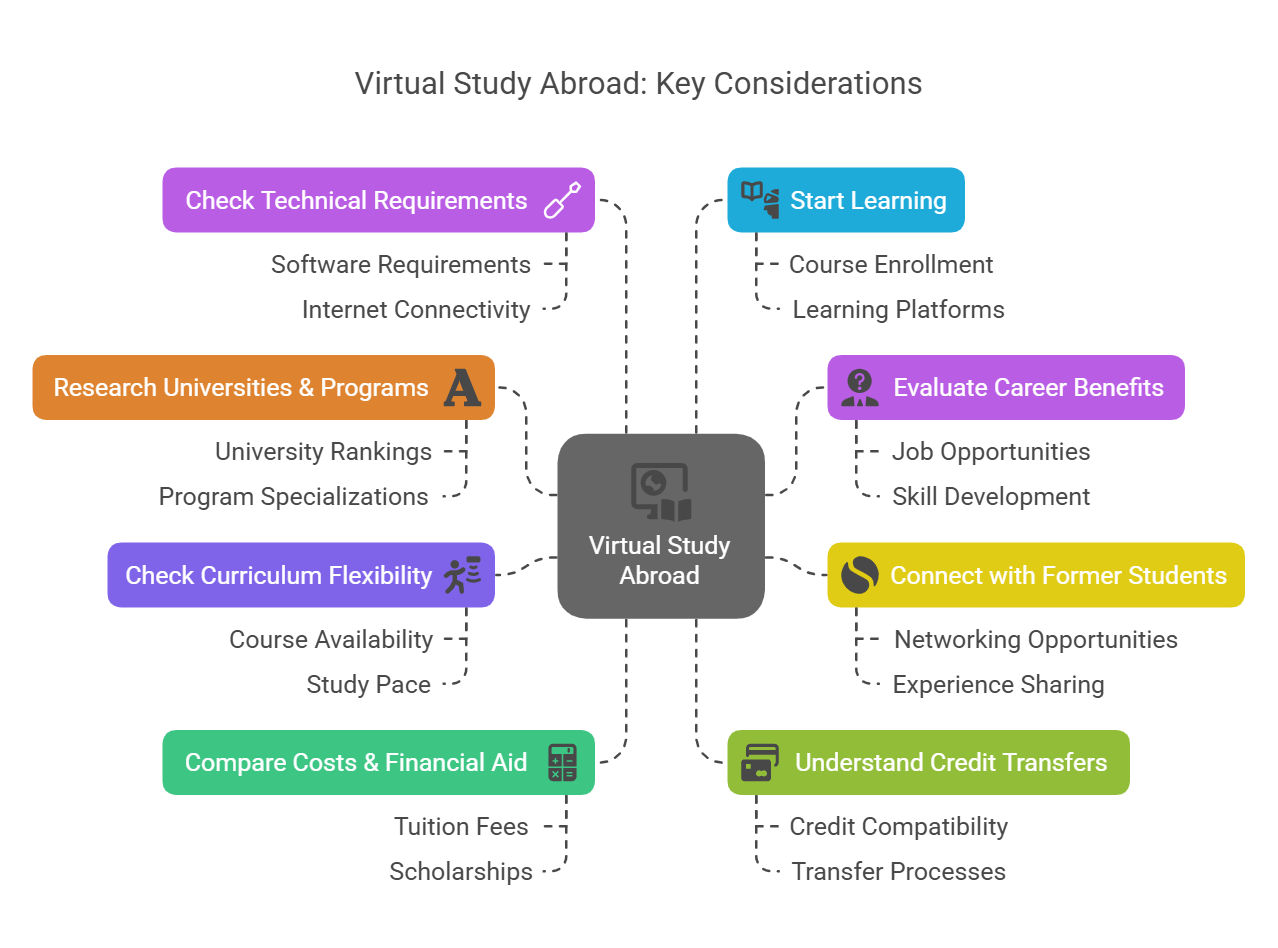
If flying out right after 12th feels premature, or the budget isn't there yet, upGrad lets you start your degree online and transfer to the physical campus later, earning credits from day one that count toward your final degree.
Access to global university partners across USA, UK, Canada, Australia, and more.
Personalised guidance on course selection, applications, and visa documentation.
A flexible entry point if you're not ready to move abroad immediately after 12th.
Conclusion
So here's the whole picture in one place. Study abroad after 12th comes down to five real decisions: which country fits your budget, whether you can clear the English and entrance tests on time, how much the full year (not just tuition) will actually cost you, whether a scholarship can close that gap, and whether you're mentally ready for a few tough months of adjustment before it gets easier.
A quick way to think about where you stand:
If budget is your biggest constraint, Germany or Ireland make more sense than US or UK, near-zero tuition changes the entire math.
If you're set on US specifically, go in with eyes open on the current visa climate, non-STEM and Master's applicants are seeing smoother approvals than STEM undergrads right now.
If post-study work and PR matter to you long-term, Canada and Australia are still your strongest bets.
If your Class 12 marks and IELTS/TOEFL scores are already solid, you're genuinely ahead of most applicants, the paperwork from here is mostly logistics.
If none of that feels urgent yet, starting online through a platform like upGrad buys you time without losing a year.
Everything else, honestly, is detail. Get these five right and the rest of the process is just follow-through.
Start by shortlisting a country and course that fit your budget and academic interests, then clear an English test like IELTS or TOEFL along with any entrance exam the university asks for. Once you have your Class 12 transcripts, SOP, and LORs ready, apply through the university portal and follow up with your student visa once you get an offer.
How to go abroad for studies after 12th from India?
The process stays largely the same regardless of destination: research universities, meet the eligibility bar, apply with the right documents, and secure your visa. The details, tuition, visa type, intake dates, shift depending on which country you pick, so it helps to lock in your destination early.
How to study abroad after 12th?
Begin with research on courses and countries around a year in advance, then move through eligibility checks, English proficiency tests, applications, and visa processing in that order. Students who start early usually have more scholarship options and better university choices by the time deadlines arrive.
How to study abroad after 12th with a scholarship?
Look for scholarships tied specifically to the university you're applying to, since many, like the Tata Scholarship at Cornell or Deakin's Vice-Chancellor's Scholarship, are awarded automatically at the time of admission. Apply well before deadlines, since most scholarships close months before the actual course intake.
How to get a scholarship to study abroad after 12th?
Most scholarships weigh your Class 12 academic record heavily, so strong marks matter more here than almost anywhere else in the process. Beyond university-specific awards, government and external scholarships like the Deutschlandstipendium in Germany are worth checking separately from your university application.
Which course is best after 12th for going abroad?
It really depends on what you're aiming for. STEM fields like computer science and engineering do well in US and Germany, while business and finance degrees hold more weight in UK, and healthcare and IT are strong picks in Canada and Australia.
Which country is best to study in after 12th?
There's no single right answer, it comes down to your budget and goals. Germany suits students prioritising low cost, Canada and Australia work well if post-study work and PR matter to you, and US remains strong for research-heavy or STEM-focused degrees.
Can students go abroad after 12th?
Yes, plenty of Indian students head abroad straight after Class 12 for undergraduate degrees, provided they meet the academic and English proficiency requirements. Some countries, like UK, even offer shorter three-year bachelor's programmes, which makes the timeline work out faster than staying back for a local degree first.
What documents are required to study abroad after 12th?
You'll typically need your Class 10 and 12 mark sheets, English test scores, a Statement of Purpose, two to three Letters of Recommendation, and a valid passport. Some countries also ask for a financial proof document and, depending on the course, a resume.
Is IELTS compulsory to study abroad after 12th?
Not always. Some universities in Germany, Canada, and UK waive IELTS or TOEFL if you've studied in an English-medium school, though this varies by institution, so it's worth confirming directly with your shortlisted university.
What is the best time to start planning to study abroad after 12th?
Ideally around 12 months before your intended intake, since that gives enough runway for research, test prep, applications, and visa processing without last-minute pressure. Starting late doesn't rule things out, but it does narrow your scholarship and university options considerably.
upGrad Abroad Editorial Team |5018 articles published
We are a dedicated team of study-abroad experts, ensuring intensive research and comprehensive information in each of our blogs. With every piece written, we aim at simplifying the overseas education ...
Refer Your Friend & Earn upto ₹15000
Help your friend upgrade to a Global Career and earn rewards together.