Why is a Gap Certificate Required?
A certificate serves as official proof that your academic break was genuine and properly explained. Universities and other institutions request this document to maintain transparency during admissions or document verification.
It may be required in situations such as:
- Study abroad applications: Many overseas universities ask applicants to justify an academic gap before granting admission.
- College admissions: Some Indian colleges also require a gap document during admission.
- Government jobs: Certain recruitment authorities request proof of educational gaps during document verification.
- Professional courses: Medical, engineering, law, management, and other professional programs may require a certificate to verify academic continuity.
Not every university requires this document, so always check the official admission guidelines before applying.
When Do You Need a Gap Certificate?
You may need a gap papers whenever there is a noticeable break between two stages of your education and the university asks you to explain it.
Common situations include:
- Taking a year off after Class 12 before starting university.
- A break after graduation before applying for a master's abroad.
- Preparing for competitive exams such as UPSC, NEET, JEE, CAT, or GATE.
- Recovering from a medical condition or illness.
- Working before pursuing higher education overseas.
- Managing family or personal responsibilities.
- Building skills through certifications or relevant work experience.
If you are applying to study abroad after an academic gap, having a properly prepared certificate and supporting documents can help ensure a smoother admissions process.
How to Apply for a Gap Certificate?
Applying for a certificate affidavit is a simple legal procedure. It involves drafting a declaration on stamp paper, notarizing it, and submitting it to the institution or authority requesting proof of your gap. Following the correct steps ensures your certificate is valid and accepted.
Steps to Apply:
- Draft the Affidavit: Write a declaration explaining the reason and duration of your gap. Use a standard certificate format to keep it professional.
- Print on Stamp Paper: The affidavit must be printed on non‑judicial stamp paper, usually valued between ₹100–₹500 depending on state rules.
- Attach Supporting Documents: Include identity proof (Aadhaar, PAN, Passport) and academic or employment records to validate your claim.
- Get Notarization: Visit a notary public to have the affidavit legally attested. This step makes the certificate valid.
- Submit to Institution/Authority: Provide the notarized certificate to the college, employer, or visa office. Many institutions also accept a gap certificate format PDF or scanned copy.
- Language Option: Depending on regional requirements, you may prepare the affidavit in English or as a gap certificate in Hindi.
Considering a study break before university? Learn about deferred entry and how it works.
Documents Required to Get a Gap Certificate
To obtain a gap affidavit, applicants must provide certain documents that validate their identity, academic or employment history, and the reason for the gap. These gap certificate document ensure the certificate is legally valid and accepted by universities, employers, or visa authorities. A Certificate is just one part of your application. Make sure you have all the required documents for studying abroad.
You generally need the following documents while applying for a gap certificate:
- Non-Judicial Stamp Paper – Forms the legal basis of the affidavit (₹100–₹500, depending on the state).
- Identity Proof – Confirms the applicant's identity (Aadhaar Card, PAN Card, Passport, or Voter ID).
- Academic Certificates – Verifies the last educational qualification (mark sheets, degree certificate, or transfer certificate).
- Employment Records (if applicable) – Explains employment-related academic gaps (experience certificate or relieving letter).
- Gap Certificate Affidavit – Clearly states the duration and reason for the academic gap.
- Notary Attestation – Legally validates the affidavit and is generally mandatory for official acceptance.
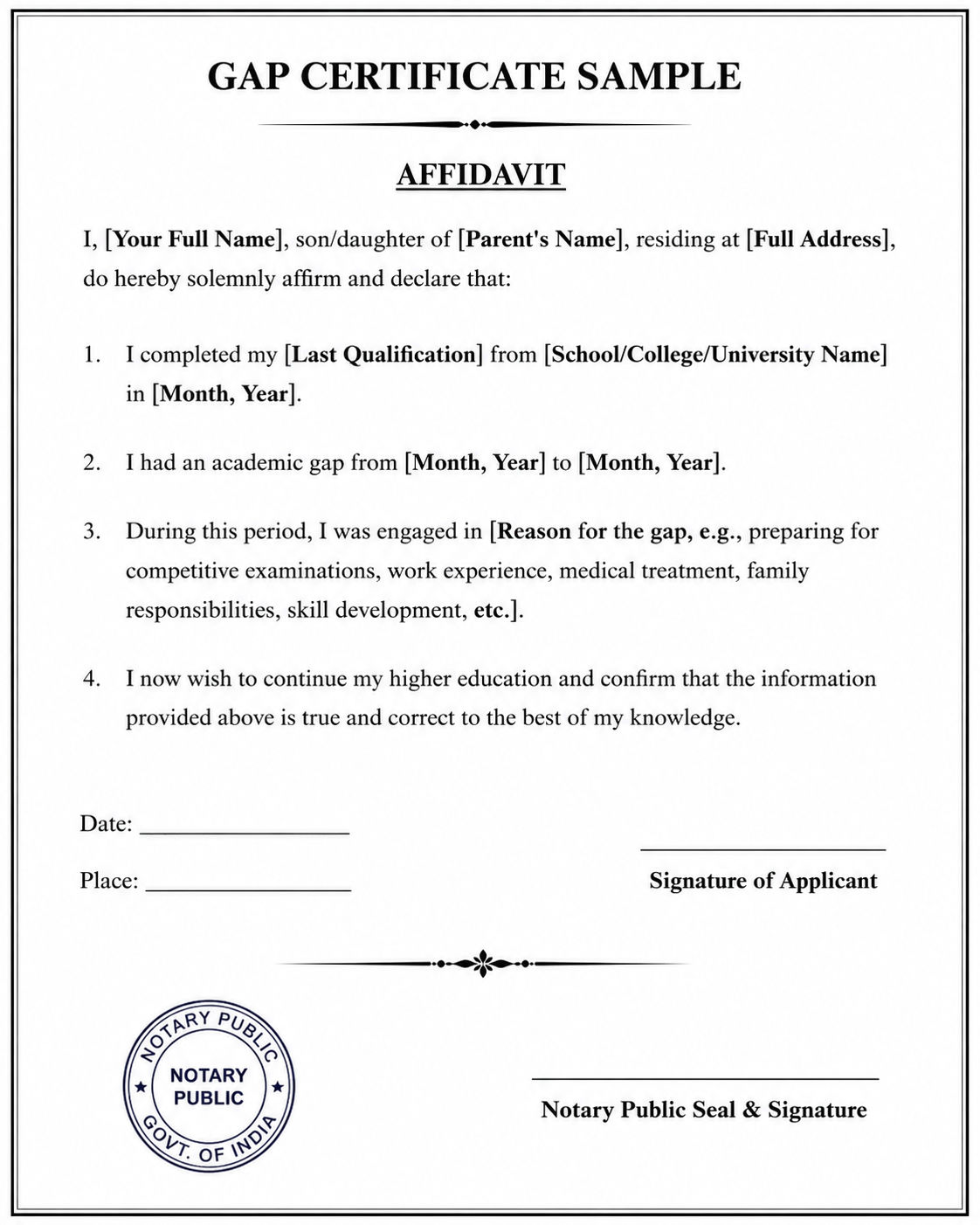
Gap Certificate Format & Sample
A certificate format is generally simple and follows a standard legal affidavit structure. While the exact wording may vary depending on the notary or institution, most colleges and universities, including those abroad, expect the document to clearly explain your academic gap and include all essential details.
A standard gap document format should contain the following information:
- Applicant Details: Full name, date of birth, and residential address.
- Educational Qualification: Your most recent academic qualification and the institution attended.
- Gap Duration: The exact period of the academic break, including start and end dates.
- Reason for the Gap: A brief explanation, such as exam preparation, work experience, medical reasons, family responsibilities, or skill development.
- Declaration: A statement confirming that the information provided is true and accurate.
- Signature and Notary Seal: The applicant’s signature, date, and notarization to validate the document.
If you are applying to study abroad, your gap year certificate should match the information provided in your application, academic records, and supporting documents. A properly prepared certificate helps universities verify your study gap and process your application more smoothly.
Information Included in a Gap Certificate
A certificate should contain complete and accurate information to ensure it is accepted by universities and other institutions. If you are applying to study abroad, the details in your certificate should match your application form and supporting documents.
A standard gap documents generally includes:
- Full name of the applicant
- Father's or mother's name
- Residential address
- Educational qualifications and institution attended
- Duration of the academic gap (start and end dates)
- Reason for the educational break
- Self-declaration confirming the information is true
- Date and place of issue
- Applicant's signature
- Notary public's signature and official seal
Tip: Before submitting your gap document to an overseas university, verify that all information is consistent with your academic transcripts, passport, and other admission documents to avoid delays during the application process.
Wondering if your study gap is acceptable? Find out how much gap is acceptable for studying in Australia.
Gap Certificate Sample
A certificate is usually prepared as a notarized affidavit and should clearly explain the duration and reason for your academic break. If you are applying to study abroad, ensure the information in your certificate matches your university application and supporting documents.
Below is a simple sample format: