What Are the Components of Data Science?
By Sriram
Updated on Jun 26, 2026 | 5 min read | 1.82K+ views
Share:

All courses
Certifications
More
By Sriram
Updated on Jun 26, 2026 | 5 min read | 1.82K+ views
Share:
Table of Contents
Components of data science form the foundation of every data-driven project, from collecting raw information to building predictive models and communicating insights. Each component plays a specific role, and together they help organizations turn data into meaningful decisions. Whether you're a beginner exploring the field or a professional looking to strengthen your fundamentals, understanding these building blocks is the first step toward mastering data science.
Data science isn't one skill. It's a system. Behind every product recommendation, fraud alert, or market forecast is a set of interworking components that collect, clean, analyze, and interpret data at scale.
This blog breaks down each component of data science in plain terms. You'll understand what each piece does, why it matters, and how they connect to form a working data pipeline.
Explore upGrad's Data Science programs to build practical skills in data collection, data preprocessing, exploratory data analysis, machine learning, data visualization, statistical analysis, and solving real-world business problems using data.
Popular Data Science Programs
Every successful data science project relies on multiple disciplines rather than a single skill. Data scientists don't just analyze numbers. They clean messy datasets, write code, apply statistics, build machine learning models, communicate findings, and work with business teams to solve real problems.
That's why understanding the primary components of data science is important before learning advanced algorithms.
Component |
Core Function |
| Data Collection | Gathering raw data from various sources |
| Data Cleaning | Fixing errors, gaps, and inconsistencies |
| EDA | Exploring patterns and forming hypotheses |
| Statistics | Validating findings with mathematical rigor |
| Machine Learning | Building predictive and pattern-finding models |
| Data Visualization | Communicating results visually |
| Data Engineering | Building and maintaining data infrastructure |
| Domain Knowledge | Applying industry context to analysis |
| Communication | Translating insights into decisions |
Also read: Data Science for Beginners: Prerequisites, Learning Path, Career Opportunities and More
Free Courses
Data science rests on a few foundational pillars. Let's walk through each one and be honest about what they actually involve.
Without data, there's nothing to analyze.
Data collection is the process of gathering raw information from various sources. Those sources can be structured (like databases or spreadsheets) or unstructured (like social media posts, images, or audio files).
Data Source |
Description |
Example |
| Web Scraping | Collects website data | Competitor pricing |
| APIs | Retrieves platform data | Twitter, Google Analytics |
| Sensor Data (IoT) | Captures device data | Smart sensors, wearables |
| CRM/ERP Systems | Uses internal business data | Customer and sales records |
| Surveys and Forms | Collects user responses | Customer feedback |
More data doesn't automatically mean better outcomes. Collecting the wrong data, or data with gaps and inconsistencies, sets you up for bad analysis downstream. This is a step where quality matters just as much as quantity.
Source Type |
Example |
Format |
| Structured | SQL database | Tables, rows |
| Semi-structured | JSON from APIs | Key-value pairs |
| Unstructured | Customer reviews | Free text, images |
Raw data is messy. Real-world datasets come with missing values, duplicate entries, inconsistent formatting, and outliers that can skew your entire analysis. Data cleaning is the process of fixing those problems before you do anything else.
Data Preprocessing goes a step further. It transforms the cleaned data into a form that machine learning models can actually work with. Think of it as converting ingredients into something a recipe can use.
Task |
Purpose |
| Handle Missing Values | Fill or remove null data |
| Remove Duplicates | Eliminate repeated records |
| Normalize Data | Scale numeric values |
| Encode Categories | Convert text into numbers |
| Train-Test Split | Prepare data for model training and evaluation |
This is often the most time-consuming part of any data project. Data scientists typically spend 60 to 80 percent of their time here. Not on modeling. Not on insights. On cleaning.
If you skip or rush this step, your model learns from broken patterns.
Also read: Data Cleaning Techniques: 15 Simple & Effective Ways To Clean Data
Before you build anything, you need to understand what you're working with.
EDA is the phase where data scientists dig into the data, look for patterns, spot anomalies, and form hypotheses. It's not a formal process with rigid steps. It's more like detective work.
Tools used during EDA:
Here's something that doesn't get said enough. EDA often kills bad ideas early. You might go in thinking customer age drives purchasing behavior, and the data shows you it's actually device type. That shift in direction, before you've spent weeks building a model, saves enormous time.
EDA is also where domain knowledge starts to matter. A good data scientist doesn't just look at numbers. They ask whether the patterns make sense in the real world.
You don't need a PhD to work in data science. But you do need a working understanding of statistics. Statistics is what turns raw patterns into reliable conclusions. Without it, you're guessing.
The key areas that come up repeatedly:
Why does this matter practically? Say you're testing whether a new email subject line performs better than the old one. A basic A/B test tells you one version got more clicks. But statistical significance tells you whether that difference is real or just random noise.
That distinction is everything in data-driven decision-making.
Concept |
What It Tells You |
| Mean / Median | Central tendency of data |
| Standard Deviation | How spread out values are |
| p-value | Whether a result is statistically significant |
| Correlation | Strength of relationship between two variables |
| Regression | How one variable predicts another |
Don't skip math because it feels hard. Lean into the parts you'll use daily and build from there.
Must read: Data Collection Types Explained: Methods & Key Steps
This is the part most people associate with data science. It's also the most misunderstood.
Machine learning is a method of teaching computers to learn from data instead of following explicit rules. The model finds patterns on its own by training on historical examples, then applies those patterns to new data.
There are three main types:
In supervised learning, the model learns from labeled data. You give it input-output pairs and it learns to map one to the other. Examples include email spam filters and house price prediction.
No labels. In unsupervised learning, the model finds its own structure. Customer segmentation is a classic use case. You don't tell the model what groups to create. It finds them.
In reinforcement learning , the model learns through trial and error, receiving rewards for good decisions. This powers game-playing AI and certain robotics applications.
A model is only as good as the data it was trained on and the problem it was designed to solve. Bad problem framing leads to impressive-looking models that answer the wrong question.
Build job-ready data science skills with upGrad's Master's Degree in Data Science from Liverpool John Moores University (LJMU). Learn Python, statistics, machine learning, data visualization, and AI through hands-on projects designed for real-world applications.
Insight means nothing if you can't communicate it. Data visualization is the process of translating analysis into charts, graphs, dashboards, and visual formats that non-technical stakeholders can actually understand and act on. It's a bridge between the data team and the business.
The most common tools used for visualization:
Good visualization is about clarity, not decoration. The goal isn't to make something look impressive. It's to make a complex pattern obvious at a glance.
Here's a real tension that comes up constantly. Data scientists often fall in love with their analysis and overcrowd a dashboard with every finding. The result is noise. The best visualizations strip away everything except the one thing the reader needs to see.
Data doesn't move from source to model on its own. Someone has to build the pipes.
Data engineering is the component of data science that handles the architecture, storage, and movement of data. It's less visible than modeling or visualization, but without it, nothing works at scale.
Key responsibilities in data engineering:
Concept |
What It Means |
| ETL | Extract, Transform, Load pipeline |
| Data Warehouse | Central storage for structured data |
| Data Lake | Raw storage for structured and unstructured data |
| Pipeline | Automated flow of data from source to destination |
| Orchestration | Scheduling and managing pipeline runs |
In smaller organizations, a data scientist often handles some of this themselves. At larger companies, dedicated data engineers own this layer. Either way, understanding it is necessary, even if you don't build it.
Do read: Data Science Methodology: A Simple and Detailed Guide
Domain knowledge refers to subject matter expertise in the industry you're applying data science to. A healthcare data scientist needs to understand clinical workflows. A fintech analyst needs to understand how risk is assessed in lending.
Without domain knowledge, you might build a technically perfect model that solves the wrong problem.
Real example: a retail chain built a model to predict stockouts. The model worked well technically. But it didn't account for promotional periods where demand spikes weren't "anomalies" but planned events. The predictions were accurate on regular days and completely wrong on sale days. A business expert in the room would have caught that immediately.
Domain knowledge also helps you ask better questions of the data. It tells you which variables might be proxies for something else, which correlations are spurious, and which findings are actually new versus things the business already knew.
This is the component that separates data scientists who get things done from those who produce beautiful work that nobody acts on.
You can run the most sophisticated model in the world. If you can't explain the output to a product manager in three sentences, it won't change anything.
Storytelling with data means building a narrative around your findings that connects to a decision. It's not about dumbing things down. It's about choosing the right level of detail for the right audience.
Skills that matter here:
Strong communicators in data science advance faster. Not because communication is more valuable than technical skill, but because it's what makes technical skill visible and usable.
Do read: Top Machine Learning APIs for Data Science Projects in 2026
Data Science Courses to upskill
Explore Data Science Courses for Career Progression
IIIT Bangalore
Executive Post Graduate Certificate in Data Science & AIPlacement Assistance
None of these components work in isolation. A typical data science project moves through them in sequence, and often loops back.
Here's how a real project might flow:
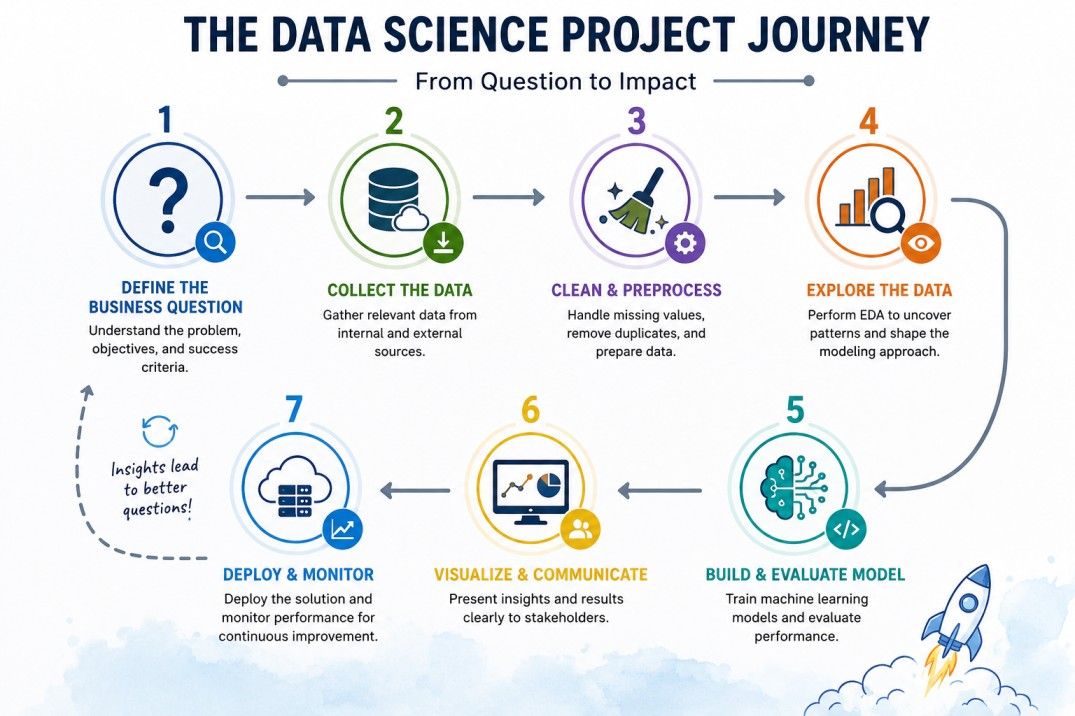
Miss any step and the project stalls. Rush data cleaning and your model is unreliable. Skip EDA and you waste weeks building the wrong thing. Build a great model but communicate it poorly and the business never adopts it.
That's the reality of working in data science. It demands technical depth, practical judgment, and cross-functional thinking all at once.
Must read: How to Implement Machine Learning Steps: A Complete Guide
The components of data science that make or break real projects are often data cleaning, communication, and domain understanding. Modeling is important, yes. But it's one piece of a larger system.
If you're learning, build skills across all components. Spend time on SQL, statistics, storytelling, and EDA. Don't just chase algorithms.
The most effective data scientists aren't the ones who know the fanciest models. They're the ones who understand the full picture and know which tool to reach for at each stage.
The components of data science work together to convert raw information into meaningful insights and better decisions. Data collection, cleaning, programming, statistics, machine learning, visualization, domain knowledge, and communication each solve a different problem, yet none delivers full value in isolation.
Learning these key components of data science gives you a strong foundation for advanced topics and prepares you to solve real-world business challenges with confidence.
Ready to start your journey? Book a free consultation with upGrad today to find the best path for your career.
The main components of data science include data collection, data cleaning, exploratory data analysis (EDA), statistics, machine learning, data visualization, data engineering, domain knowledge, and communication. Together, these components help convert raw data into actionable insights and prepare beginners for real-world data science projects.
The answer depends on your background. Beginners often find statistics and machine learning challenging because they involve mathematical concepts and algorithms. However, many professionals consider data cleaning the most demanding task since it requires patience, problem-solving, and attention to detail across large, messy datasets.
Real-world data usually contains missing values, duplicate records, inconsistent formats, and errors that must be corrected before analysis. Data scientists often spend most of their project time cleaning and preparing data because even advanced machine learning models cannot deliver reliable results with poor-quality input.
Yes, you can understand the concepts without coding, but programming becomes essential for practical implementation. Learning Python, SQL, or R allows you to automate data processing, perform analysis, build machine learning models, and work efficiently with large datasets used in industry.
The components of data science refer to the core skills and disciplines required, such as statistics, machine learning, and visualization. The data science lifecycle describes the sequence of activities in a project, including business understanding, data preparation, modeling, deployment, and continuous monitoring.
Most projects involve the primary components of data science, but the emphasis varies depending on the objective. A dashboard project may focus heavily on visualization and analysis, while an AI application may require advanced machine learning, feature engineering, and scalable data engineering infrastructure.
Domain knowledge helps data scientists interpret results correctly and ask meaningful business questions. Understanding healthcare, finance, retail, or manufacturing ensures models solve practical problems instead of identifying patterns that have little or no value in real-world decision-making.
No. Many data science and analytics roles focus on data exploration, statistical analysis, SQL, reporting, and visualization rather than predictive modeling. Machine learning becomes essential for roles involving recommendation systems, forecasting, automation, computer vision, or natural language processing applications.
Different components rely on different tools. Python, R, and SQL support analysis and modeling, while Excel is widely used for quick exploration. Tableau and Power BI help create dashboards, and cloud platforms such as AWS, Azure, or Google Cloud support data engineering and deployment workflows.
The timeline depends on your experience and learning approach. Most learners develop a solid understanding of the core components within six to twelve months through structured courses, hands-on projects, and consistent practice with real datasets and business case studies.
Start with programming fundamentals, SQL, basic statistics, and data visualization before moving to machine learning. Building a strong foundation in these areas makes it easier to understand advanced concepts and develop practical problem-solving skills required for real-world data science projects.
730 articles published
Sriram K is a Senior SEO Executive with a B.Tech in Information Technology from Dr. M.G.R. Educational and Research Institute, Chennai. With over a decade of experience in digital marketing, he specia...
Speak with Data Science Expert
By submitting, I accept the T&C and
Privacy Policy
Start Your Career in Data Science Today
Top Resources
Master's Degree
18 Months
Executive Diploma
12 Months
Bootcamp
6 Months