AI Orchestration: The Intelligent Workflow Management
By Sriram
Updated on Aug 11, 2026 | 7 min read | 2.78K+ views
Share:

All courses
Certifications
More
By Sriram
Updated on Aug 11, 2026 | 7 min read | 2.78K+ views
Share:
Table of Contents
Artificial intelligence is not about answering questions or making content anymore. These days companies use a lot of artificial intelligence models and tools together. They also use databases and software systems. Managing all of these things is where artificial intelligence orchestration comes in. Artificial intelligence orchestration is different from automation.
In this guide, you will learn everything you need to know about intelligence orchestration. You will learn about the ideas and how artificial intelligence orchestration is used in the real world. You will see how companies use intelligence orchestration now and why it is so important for modern artificial intelligence systems.
Explore Agentic AI Courses Online from upGrad and learn how AI orchestration works.
Popular AI Programs
AI orchestration is the process of getting AI systems to work together. These systems include tools, models, and data sources. They all work together to get something done, like an orchestra, AI orchestration is similar, a conductor makes sure everyone plays at the same time.
Instead of musicians here, we have AI models, databases, APIs, and business applications all working together.
Sometimes organizations have a lot of AI tools with different roles, for example, one model looks at information, one comes up with ideas, another AI model helps customers, and a third AI model looks at data. If these systems work by themselves, they can cause problems.
When you have AI orchestration, all the parts work together and communicate with each other automatically. This means all the AI systems communicate and collaborate without needing someone to tell them what to do.
AI orchestration makes sure all the AI systems work together to get things done; it is crucial for making AI systems work together.
Imagine an online retailer receiving a customer query.
Without orchestration:
With AI orchestration:
Everything happens within a single coordinated workflow.
Also Read: What Is Agentic AI? The Simple Guide to Self-Driving Software
Every effective AI orchestration framework rest on six interconnected components that together enable autonomous, secure, and scalable intelligent operations.
Component |
Purpose |
| AI Models | Generate predictions and responses |
| Data Sources | Provide information for decisions |
| APIs | Connect different systems |
| Workflow Engine | Manages task flow |
| Monitoring Layer | Tracks performance |
| Security Controls | Ensures compliance and governance |
Organizations are using Artificial Intelligence systems than they ever have before.
Industry estimates reveal that the Artificial Intelligence market is going to get a lot bigger by the year 2033. This is because companies are starting to use Artificial Intelligence systems that have many parts working together and automated workflow management. The reason for this growth is that companies need to manage their Artificial Intelligence systems when they get vast and complicated.
As people start to use Artificial Intelligence more, something called orchestration becomes important. It is the part that connects all the Artificial Intelligence tools and turns them into a system that works together. This system is like a team that shares information, and that is what we call a connected Artificial Intelligence system.
Key benefits include:
Also Read: AI Automation Explained: Tools, Benefits, and How It Differs From Automation
Free Courses
To understand AI orchestration lets break it down by looking at how data flows through a workflow that is managed. The AI orchestration layer is like a manager. It figures out which AI model should do a task; it also finds out what data is needed.
The AI orchestration layer is the central AI coordinator; it decides how results should be put together. The AI orchestration layer determines what AI data is required and decides how AI results should be combined.
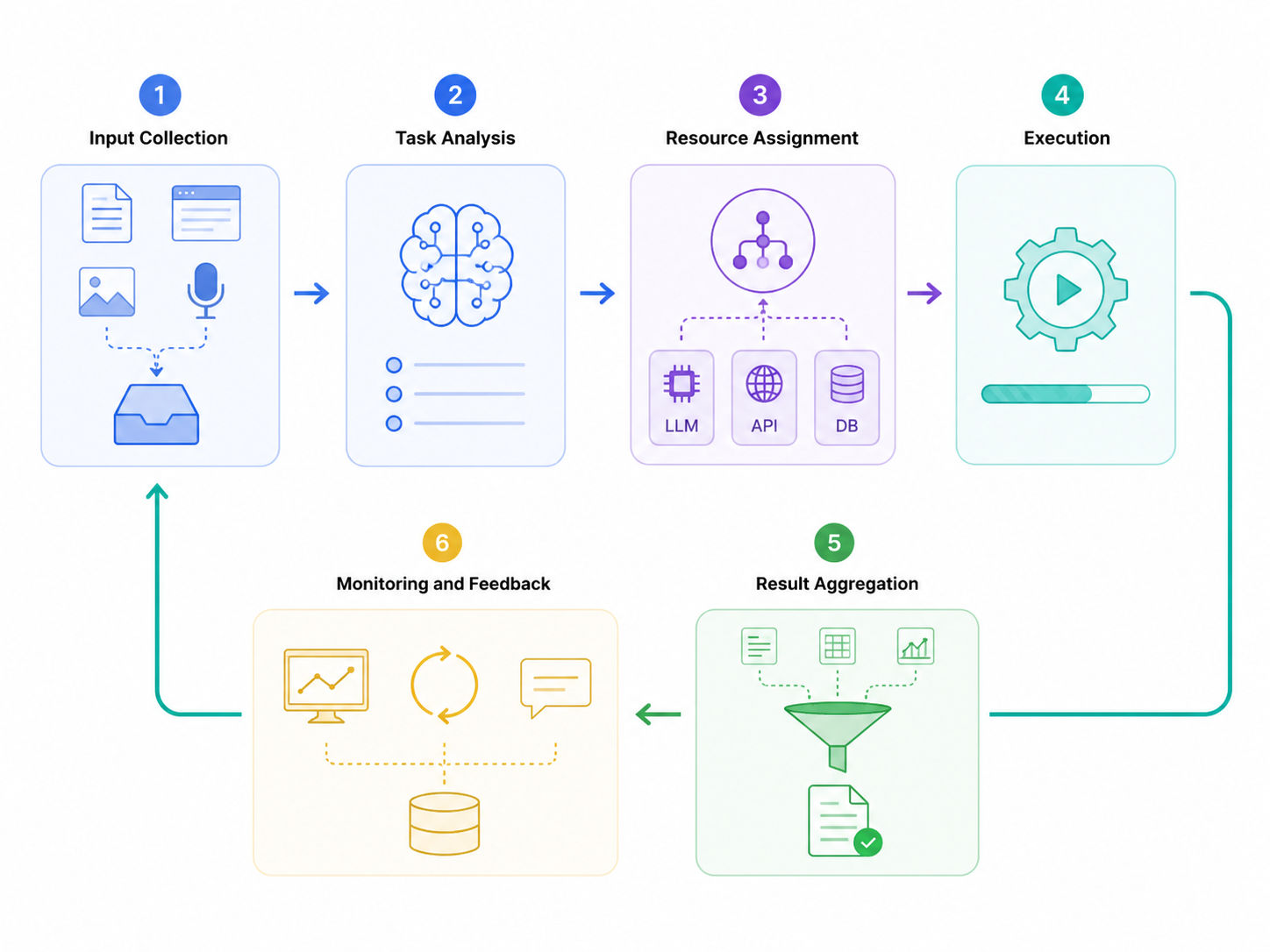
The system receives an input such as:
The orchestrator identifies:
The workflow engine selects:
Tasks run simultaneously or sequentially depending on requirements.
Outputs are combined into a final response or action.
Performance metrics are captured for future optimization.
Example: Sales Team Workflow
A sales representative requests customer insight. Instead of manually switching between tools, the workflow runs automatically.
The orchestrated system can:
Also Read: Agentic Workflows: A Guide to AI-Powered Autonomous Execution
As AI systems become more complex, learning how multiple agents communicate and coordinate tasks is becoming an important skill. This raises a practical question for learners about various AI Courses: Do these courses teach multi agent orchestration and workflows? So, Yes, upGrad’s Agentic AI programs cover concepts related to AI agent orchestration, multi-agent collaboration, and AI-driven workflows.
Depending on the program, learners can explore how specialised agents coordinate tasks and work together across multi-step workflows.
AI Courses to upskill
Explore Artificial Intelligence Courses for Career Progression
AI orchestration connects these systems and creates a unified workflow environment.
When companies invest in AI across different departments of the company, this ability to connect everything becomes important for the AI systems.
Today, organizations often operate:
One of the growing areas within AI orchestration is AI agent orchestration. AI agents are like systems that can operate on their own without people watching them all the time. They do not just follow instructions; AI agents can plan things, think about what to do, and then act on it. When you have many AI agents working together, they need to coordinate with each other.
That is where AI agent orchestration comes in; it helps AI agents work together smoothly.
AI agent orchestration is about managing AI agents that work together to achieve a goal like a team. Each AI agent has specific roles, so none does everything on their own.
The AI agents work together to reach a shared objective, and the orchestrator coordinates communication among all agents.
For example:
Agent |
Responsibility |
| Research Agent | Collects information |
| Analysis Agent | Evaluates findings |
| Content Agent | Creates output |
| Review Agent | Checks quality |
| Execution Agent | Performs actions |
Real-World Example
A marketing team launches a campaign. All agents will contribute while the orchestration layer manages priorities and dependencies.
An orchestrated agent workflow could involve:
Also Read: Agentic AI Architecture: Components, Workflow, and Design
AI agent orchestration enables organizations to assign tasks to purpose-built agents, each optimized for a specific function resulting in sharper accuracy and significantly faster execution across complex workflows.
When you look at how AI orchestrations are used in the real world, it becomes really clear how valuable it is. The value of AI orchestration is something that you can observe when people are implementing it.
AI orchestration is very useful when it is used in this way.
Organizations orchestrate:
Benefits:
Many AI-native GTM workflow orchestration companies are using orchestration platforms to coordinate marketing and sales activities. Its emergence reflects a broader shift toward integrated revenue operations powered by AI.
Common workflows include:
Applications include:
Banks use orchestration for:
Benefits include:
Popular AI Orchestration Capabilities in table
Capability |
Business Value |
| Workflow Automation | Faster execution |
| Multi-Agent Coordination | Better scalability |
| Data Integration | Unified insights |
| Governance | Reduced risk |
| Monitoring | Continuous improvement |
Subscribe to upGrad's Newsletter
Join thousands of learners who receive useful tips
AI orchestration is evolving from a technical capability into a strategic business requirement.
Several developments are shaping the future, such as:
Multi-Agent Systems
Organizations are moving from single AI assistants to coordinated teams of agents.
Real-Time Decision Making
AI workflows increasingly operate instantly rather than in scheduled batches.
Governance and Compliance
Stronger controls will become mandatory as AI adoption expands.
Industry-Specific Platforms
Specialized solutions are emerging for healthcare, finance, education, and retail.
Autonomous Operations
Future orchestration systems may require minimal human oversight for routine processes.
The rise of autonomous agents has also introduced new risks. A lot of people are talking about something that was in a report called "Disrupting the First Reported AI-Orchestrated Cyber Espionage Campaign" from Anthropic.
Anthropic describes it as a very sophisticated operation where AI agents are said to have performed much of the cyberattack lifecycle with limited humans involved. According to the report, AI handled a large portion of reconnaissance, vulnerability discovery, and operational execution.
This example shows how powerful and serious it is to use AI systems. When companies use machines that work on their own, they need to make sure they follow the rules and keep an eye on them all the time.
AI is becoming more powerful, but power alone does not create value. Organizations need a way to coordinate models, agents, data, and workflows efficiently. That is exactly what AI orchestration provides.
By connecting AI systems into a unified workflow, businesses can improve efficiency, accelerate decision-making, and scale intelligent operations. The rise of AI agent orchestration, autonomous workflows, and specialized platforms suggests that orchestration will become one of the most important layers in the AI technology stack.
Want personalized guidance on AI Orchestration? Speak with an expert for a free 1:1 counselling session today.
AI orchestration is the process of coordinating multiple AI tools, models, and systems, so they work together effectively. Instead of operating independently, different technologies communicate and collaborate through a centralized workflow. This helps organizations automate complex tasks and improve efficiency while maintaining control over AI operations.
Traditional automation follows predefined rules and fixed workflows. AI orchestration adds intelligence by dynamically selecting tools, models, and actions based on context. As a result, workflows become more adaptive, flexible, and capable of handling changing situations.
AI agent orchestration helps organizations manage multiple autonomous AI agents working toward a common objective. Each agent can specialize in a different task while remaining coordinated. This approach improves scalability, efficiency, and overall workflow performance.
Industries such as healthcare, finance, retail, manufacturing, and customer service benefit significantly from AI orchestration. These sectors often rely on multiple systems and large volumes of data, making orchestration especially valuable.
Yes. Small businesses can use orchestration platforms to connect customer support tools, marketing systems, analytics solutions, and operational software. This allows smaller teams to automate processes without needing large technical departments.
Many emerging software providers focus on combining AI, automation, and revenue operations into unified platforms. These AI-native GTM workflow orchestration companies help sales and marketing teams streamline execution. Their solutions often include lead management, customer engagement, and performance analytics.
The term AI orchestra is often used informally to describe multiple AI systems working together. In practical terms, it refers to a coordinated environment where AI tools collaborate under a management layer. The underlying concept closely aligns with AI orchestration.
Common challenges include system integration, data quality, governance, security, and performance monitoring. Organizations must ensure that orchestrated workflows remain transparent, reliable, and compliant with regulations.
AI orchestration connects customer data, support systems, recommendation engines, and communication channels into a unified workflow. This enables faster responses, more accurate recommendations, and personalized interactions.
The report on disrupting the first reported AI-orchestrated cyber espionage campaign highlighted how autonomous AI agents can coordinate complex cyber operations. It demonstrated both the potential power and the risks associated with advanced AI agent orchestration.
The future of AI orchestration will likely involve larger multi-agent systems, real-time decision engines, stronger governance frameworks, and industry-specific orchestration platforms. As organizations deploy more AI technologies, orchestration will become a central component of enterprise infrastructure.
730 articles published
Sriram K is a Senior SEO Executive with a B.Tech in Information Technology from Dr. M.G.R. Educational and Research Institute, Chennai. With over a decade of experience in digital marketing, he specia...
Speak with AI & ML expert
By submitting, I accept the T&C and
Privacy Policy
Top Resources
Master's Degree
18 Months
Executive Diploma
12 Months
IIIT Bangalore
Executive Programme in Generative AI & Agentic AI for LeadersIndia’s #1 Tech University
Dual Certification
5 Months