Scope of Operations Research: Levels, Applications, and Future Opportunities
By Rohit Sharma
Updated on Jul 24, 2026 | 5 min read | 3K+ views
Share:

All courses
Certifications
More
By Rohit Sharma
Updated on Jul 24, 2026 | 5 min read | 3K+ views
Share:
Table of Contents
Quick Overview:
Advance your decision-making skills strengthen your analytical expertise with upGrad's Data Science Course and learn how to transform data into actionable business insights.
Popular Data Science Programs
The scope of Operations Research (OR) refers to the range of problems, domains, and decision-making levels where OR methods can be applied. Unlike the nature of OR, which explains its scientific and system-based characteristics, the scope highlights where and how OR can be used to achieve optimal decisions.
Operations Research operates across three levels of decision-making:
Also Read: Top 20+ Data Science Techniques To Learn in 2026
Must Check - History of Operations Research
Operations Research follows a structured approach to solve complex business and operational problems using data, mathematics, and analytical techniques. This systematic process improves decision-making across industries and highlights the growing scope and application of operation research in real-world scenarios.
The wide scope of operation research in management allows businesses to optimize resources, improve productivity, reduce costs, and support strategic decision-making across functions such as finance, supply chain, healthcare, and manufacturing.
Also Read: Data Science Summarized In One Picture
Mathematical models and optimization techniques form the foundation of Operations Research. They help organizations analyze complex problems, compare different scenarios, and identify the most efficient solution based on available resources and constraints. This demonstrates the growing scope and application of operation research across industries.
Some of the most commonly used models and techniques include:
These techniques have wide-ranging applications of operation research in manufacturing, healthcare, finance, transportation, retail, and supply chain management. The expanding scope of operation research in management enables organizations to make data-driven decisions, improve operational efficiency, reduce costs, and achieve long-term business objectives.
Also Read: The Future of Data Science in India: Opportunities, Trends & Career Scope
Free Courses
The applications of operation research span multiple industries, helping organizations solve complex problems, optimize resources, and make better decisions. Its growing scope and application of operation research continues to improve efficiency, productivity, and business performance across various management functions.
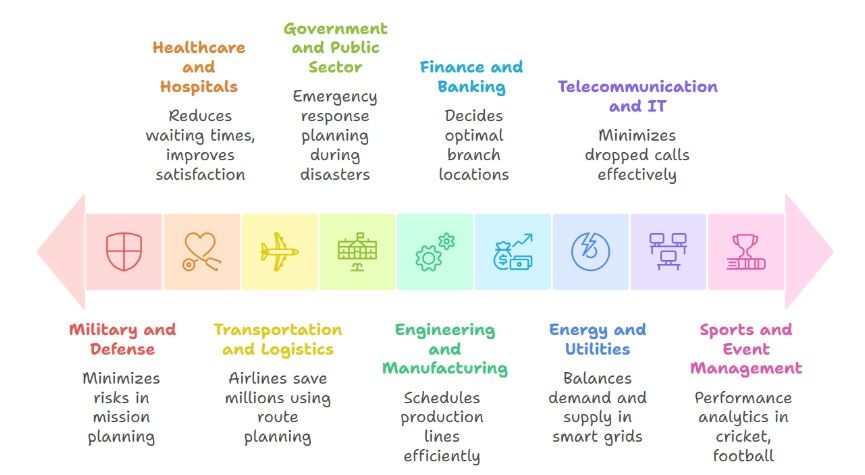
Also Read: NLP in Data Science: A Complete Guide
Build on your Operations Research knowledge with the Executive Diploma in Data Science & Artificial Intelligence from IIIT Bangalore. Learn analytics, AI, and machine learning to solve complex business challenges with confidence.
Also Read: Benefits of Data Science: Why It's Worth Learning
Also Read: 30 Must-Know Data Science Tools for 2026 & Steps to Pick the Right Ones
Data Science Courses to upskill
Explore Data Science Courses for Career Progression
IIIT Bangalore
Executive Post Graduate Certificate in Data Science & AIPlacement Assistance
Operations Research is no longer limited to linear programming or queuing theory—it’s now deeply integrated with modern technologies:
Operations Research helps organizations solve complex problems and improve decision-making. However, like any analytical approach, it has certain limitations. Understanding these challenges provides a balanced view of the scope and application of operation research and helps businesses apply it more effectively.
1. Dependence on Accurate Data
Operations Research relies on high-quality data. Inaccurate or incomplete information can lead to unreliable models and poor decisions, limiting the effectiveness of the applications of operation research.
2. Complex Mathematical Models
Many Operations Research techniques involve advanced mathematical and statistical models that require specialized knowledge. Organizations often need skilled professionals to develop and interpret these models.
3. High Implementation Costs
Adopting Operations Research may involve investments in software, technology, and expert resources. This can make implementation challenging for smaller organizations with limited budgets.
4. Assumptions May Not Reflect Reality
Mathematical models simplify real-world situations using assumptions. Unexpected changes in market conditions, customer behavior, or business environments can affect the accuracy of the results.
5. Time-Intensive Process
Data collection, model development, testing, and implementation can take significant time, especially when solving large-scale business problems.
6. Resistance to Change
Employees and decision-makers may hesitate to adopt recommendations generated through analytical models, particularly when they require changes to existing workflows or strategies.
7. Limited Focus on Human Factors
Operations Research primarily works with measurable data. Qualitative factors such as employee motivation, leadership, and organizational culture are difficult to quantify, even though they influence business outcomes.
Despite these challenges, the scope of operation research in management continues to expand as organizations combine analytical models with human expertise to make better strategic and operational decisions.
Also Read: Data Science Specializations in India 2026
Applying Operations Research effectively requires accurate data, realistic models, and continuous evaluation. Avoiding common mistakes while following best practices helps organizations maximize the applications of operation research and improve decision-making.
| Common Mistakes | Best Practices |
|---|---|
| Using inaccurate or outdated data | Use reliable, updated, and validated data |
| Defining unclear objectives | Clearly identify the problem and desired outcome |
| Ignoring real-world constraints | Build models that reflect practical business conditions |
| Relying only on mathematical models | Combine analytical results with expert judgment |
| Failing to monitor results | Regularly evaluate and refine implemented solutions |
| Overcomplicating the model | Keep models simple, practical, and aligned with business needs |
Following these practices strengthens the scope and application of operation research and supports better decision-making across business functions, highlighting the growing scope of operation research in management.
The scope of Operations Research extends across various industries and business functions, helping organizations solve complex problems through data-driven analysis. It supports better decision-making, efficient resource allocation, cost optimization, and productivity improvement.
As businesses increasingly rely on analytics, the scope of Operations Research continues to grow in areas such as supply chain management, finance, healthcare, manufacturing, transportation, and project management.
The scope of operations research (OR) is applying scientific and mathematical methods to improve decisions. It spans industries like business, healthcare, logistics, IT, and government. OR helps optimize resources, cut costs, and boost efficiency. From military roots, it now supports modern fields like AI, big data, and smart city planning.
The nature of OR explains its characteristics, such as being system-oriented and analytical. The scope highlights where these methods are applied. For example, nature defines OR as a problem-solving discipline, while scope shows its reach in healthcare, business, and IT. In short, nature is “what OR is,” scope is “where OR applies.”
Knowing the scope of OR helps identify areas where it creates the most value. Businesses use it for supply chains, governments for policy-making, and healthcare for patient care. For students, it highlights career opportunities in data science, consulting, and strategy. Scope shows OR’s relevance across industries and decision-making levels.
OR works across three levels:
At the strategic level, OR guides long-term, resource-heavy decisions. It applies forecasting and simulation for planning defense strategies, infrastructure projects, or energy systems. For example, governments use OR to plan metro expansions or energy grids. Its role ensures resources are wisely allocated to meet future demands.
Tactical OR focuses on mid-term decisions like budgeting, marketing, or resource allocation. Airlines use it to adjust seasonal schedules and pricing, while retailers manage inventory. It bridges long-term strategies and daily operations, keeping organizations efficient and adaptable.
Operational OR deals with short-term, routine tasks. It includes scheduling staff, routing deliveries, or managing queues. For example, Amazon optimizes delivery routes daily using OR algorithms, while hospitals use OR to allocate beds. Its focus is keeping day-to-day processes smooth and cost-effective.
Key industries include:
In manufacturing, OR improves scheduling, reduces waste, and enhances quality. It helps design plant layouts, allocate resources, and streamline supply chains. Companies like Toyota use OR in lean manufacturing. With Industry 4.0, OR integrates with IoT and AI, making factories smarter and more efficient.
Healthcare uses OR for hospital scheduling, bed allocation, and resource planning. During COVID-19, OR helped distribute vaccines efficiently. It also reduces patient wait times and supports outbreak forecasting. OR ensures limited resources deliver maximum healthcare benefits.
Transportation relies on OR for route optimization, fleet planning, and scheduling. UPS’s ORION system saves millions of miles annually. Public transport systems use OR to design efficient metro or bus schedules. In e-commerce, OR ensures faster, cost-effective, and sustainable deliveries.
In finance, OR supports portfolio management, risk analysis, and pricing. Banks apply OR to assess credit risk, while businesses use it for supply chain planning and marketing strategies. With big data, OR now works alongside AI to improve predictions and decision-making in finance and business.
Governments use OR for defense, disaster management, infrastructure, and energy planning. During floods or natural disasters, OR helps plan logistics for relief distribution. It ensures that policies and projects are data-driven, resource-efficient, and impactful for public welfare.
In IT and telecom, OR optimizes networks, allocates bandwidth, and manages data centers. Telecom firms use it to reduce congestion and improve connectivity. In cloud computing, OR ensures efficient server use. With 5G and IoT, its scope is expanding rapidly in digital infrastructure.
OR provides optimization frameworks, while AI and ML add predictive capabilities. Together, they solve complex problems. For example, Uber predicts ride demand with ML and uses OR for routing. E-commerce platforms combine AI and OR for product recommendations and logistics planning.
Yes, OR supports sustainability by optimizing renewable energy grids, managing water resources, and reducing waste. Logistics firms use OR to cut fuel use and emissions. By combining with technology, OR helps balance economic growth with environmental goals.
OR ensures efficient flow of goods through forecasting, inventory control, and transport optimization. E-commerce platforms like Amazon use OR to predict demand and adjust inventory. By working with big data, OR creates smarter and more resilient supply chains.
In education, OR helps with timetabling, resource allocation, and analyzing student performance. In research, it models complex systems in economics, engineering, and social sciences. For example, it studies traffic congestion or crop optimization, supporting both academic and practical advancements.
After learning Operations Research, you can explore data analytics, statistics, machine learning, artificial intelligence, optimization algorithms, supply chain management, and business analytics. These skills help you apply Operations Research techniques to solve real-world problems and prepare for careers in data-driven decision-making, consulting, and operations management.
The future of OR lies in blending with AI, blockchain, and quantum computing. It will shape areas like smart cities, autonomous vehicles, personalized medicine, and sustainable energy systems. OR will remain vital for organizations aiming for efficient, data-driven decisions in a technology-driven world.
888 articles published
Rohit Sharma is the Head of Revenue & Programs (International), with over 8 years of experience in business analytics, EdTech, and program management. He holds an M.Tech from IIT Delhi and specializes...
Speak with Data Science Expert
By submitting, I accept the T&C and
Privacy Policy
Start Your Career in Data Science Today
Top Resources
Master's Degree
18 Months
Executive Diploma
12 Months
Bootcamp
6 Months