Benefits of Data Science: Why It's Worth Learning
By Sriram
Updated on Jun 23, 2026 | 4 min read | 1.95K+ views
Share:

All courses
Certifications
More
By Sriram
Updated on Jun 23, 2026 | 4 min read | 1.95K+ views
Share:
Table of Contents
The benefits of data science are visible in almost every industry today. From healthcare and finance to e-commerce and education, organizations rely on data to understand customer behavior, improve operations, and make better decisions. Data science helps convert raw information into meaningful insights that drive measurable outcomes.
Data science turns raw numbers into decisions that actually matter. Companies use it to cut costs, find customers, predict failures before they happen, and build products people want. The benefits of data science aren't theoretical. They show up in business results, job offers, and salaries.
This blog breaks down what data science genuinely offers, both for individuals building a career and businesses solving real problems.
Explore upGrad's Data Science, AI, and Machine Learning programs to develop in-demand skills in data analysis, statistical modeling, machine learning, data visualization, and predictive analytics.
Popular Data Science Programs
Data is everywhere. Every online purchase, mobile app interaction, customer review, and business transaction generates valuable information. Without proper analysis, that information remains unused. Data science bridges that gap by uncovering patterns, trends, and opportunities hidden within large datasets.
The benefits of data science extend far beyond technical teams. Managers, business leaders, marketers, healthcare professionals, and policymakers use data-driven insights to improve outcomes and reduce uncertainty.
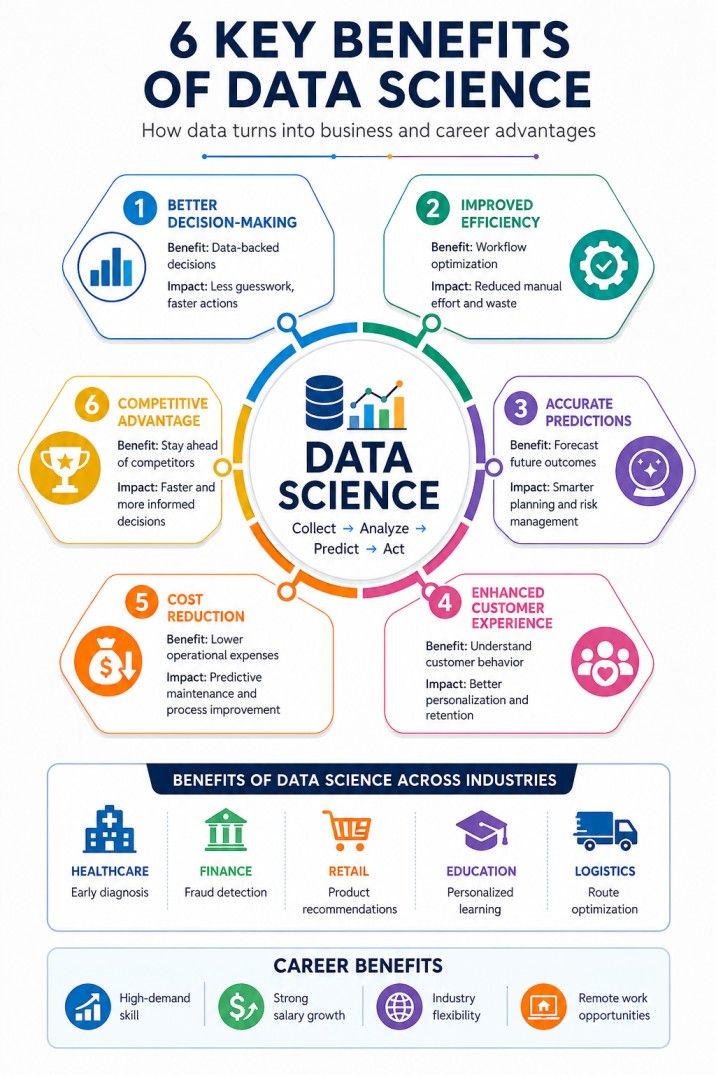
Here's what a data science actually offers:
Free Courses
The job market for data professionals has stayed strong even when other tech roles faced layoffs. Organizations don't stop needing insights just because hiring slows elsewhere.
Here's what a data science career actually offers:
Entry-level data scientists in India earn between 5 and 10 LPA. With two to three years of experience, that range shifts considerably upward. In the US, median salaries sit above $100,000.
Do read: Data Scientist Salary in India
You're not locked into one sector. Data science skills work in healthcare, finance, e-commerce, logistics, sports, and government. Pick an industry you care about and the skills transfer.
The World Economic Forum lists data analysts and scientists among the top roles in growth demand through 2027. It's one of the few fields where demand genuinely outpaces supply right now.
A lot of data work happens on a laptop. Many companies hire data scientists fully remote, which opens up global opportunities even if you're based in a smaller city.
That said, the path isn't instant. You'll need a solid grasp of statistics, at least one programming language (Python is the standard), and hands-on project experience before most companies will hire you. It takes real effort to get there.
Do read: Career in Data Science: Jobs, Salary, and Skills Required
Data Science Courses to upskill
Explore Data Science Courses for Career Progression
IIIT Bangalore
Executive Post Graduate Certificate in Data Science & AIPlacement Assistance
The benefits and uses of data science vary by industry, but the core principle is the same. You collect data, analyze it, and act on what you find.
Hospitals use data science to predict patient readmissions, identify high-risk cases early, and reduce diagnostic errors. Drug companies use it to speed up clinical trial analysis. One study from MIT showed that AI-assisted diagnosis matched expert-level accuracy in detecting certain cancers from imaging data.
Credit scoring, fraud detection, algorithmic trading, and risk modeling all run on data science. If your bank ever blocked a suspicious transaction before you reported it, that was a model catching an anomaly.
Recommendation engines, dynamic pricing, demand forecasting, and return prediction are all data science problems. What looks like a simple "customers also bought" suggestion is the output of collaborative filtering models running in the background.
Must read: Top 14 Data Analytics Real Life Applications Across Industries
Platforms like upGrad use data science to track learner progress, predict dropout risk, and personalize learning paths. That's how adaptive learning actually works, not as a concept but in practice.
Route planning, delivery time estimation, and warehouse layout optimization all depend on data models. Companies like Delhivery and Dunzo run on this.
Does every use case succeed? No. Poorly labeled data, biased training sets, and misaligned business goals cause plenty of data science projects to fail. The industry doesn't advertise that, but it's real.
Must read: Top 15 Data Science Highest Paying Jobs in India
Not all data science skills carry equal weight. Some get you hired faster. Some open doors to senior roles. Here's what actually matters.
Skill |
Why It Matters |
Key Tools/Concepts |
| Python | Core language for data science and machine learning. | Pandas, NumPy, Scikit-learn, TensorFlow |
| SQL | Used to extract, query, and manage data. | SELECT, JOIN, GROUP BY |
| Statistics & Probability | Supports data analysis and model building. | Distributions, Hypothesis Testing, Regression |
| Data Visualization | Turns data into clear, actionable insights. | Tableau, Power BI, Matplotlib |
| Machine Learning Fundamentals | Enables predictive modeling and pattern detection. | Regression, Classification, Clustering, Decision Trees, NLP |
One thing beginners get wrong is that they rush to learn advanced models before nailing the basics. A clean dataset and a simple regression often beat a complex model on messy data.
Also read: The Future of Data Science in India: Opportunities, Trends & Career Scope
Data science isn't just building machine learning models. Most of the job involves cleaning data, writing queries, communicating findings to non-technical stakeholders, and debugging pipelines that break in production.
People don't expect to spend three hours fixing a CSV import error.
Here are a few things worth knowing before you start:
None of this means data science isn't worth pursuing. It means going in with clear expectations saves you frustration later.
The benefits of data science extend far beyond data analysis. It helps organizations make smarter decisions, improve efficiency, reduce risks, understand customers better, and uncover growth opportunities. Across healthcare, finance, retail, education, and manufacturing, data science continues to shape how businesses operate and compete.
For professionals, it opens doors to diverse career paths, strong demand, and long-term growth opportunities. As organizations generate more data each year, the ability to extract meaningful insights will remain one of the most valuable skills in the modern workforce.
Ready to start your journey? Book a free consultation with upGrad today to find the best path for your career.
Yes, data science remains one of the most attractive career options for beginners in 2026. Organizations across industries continue to invest in analytics, AI, and automation. While competition has increased, candidates with practical projects, SQL, Python, and business understanding still have strong opportunities to enter the field.
Traditional business analysis often focuses on reporting past performance, while data science goes further by identifying patterns and predicting future outcomes. One of the key benefits of data science is its ability to combine statistical methods, machine learning, and automation to support proactive decision-making rather than reactive reporting.
The timeline depends on your background and learning pace. Someone with programming or mathematics experience may become job-ready within six to nine months. For complete beginners, it often takes nine to eighteen months of consistent learning, hands-on projects, and portfolio development to reach interview readiness.
Data science isn't limited to large enterprises. Small businesses can use customer data, sales trends, and operational metrics to improve decision-making. Many of the benefits of data science for business, such as demand forecasting, customer segmentation, and marketing optimization, are valuable regardless of company size.
Data quality remains one of the biggest obstacles. Many organizations struggle with incomplete records, duplicate entries, outdated information, and inconsistent formats. Data scientists often spend more time preparing and cleaning data than building models because accurate insights depend heavily on reliable datasets.
Absolutely. Generative AI depends on high-quality data, model evaluation, and performance monitoring. Data scientists play a critical role in preparing training data, validating outputs, identifying biases, and measuring business impact. As AI adoption grows, demand for strong data science foundations continues to increase.
Financial services, healthcare, retail, e-commerce, logistics, manufacturing, and technology companies are among the largest employers of data science talent. Government agencies and consulting firms are also expanding analytics teams as data-driven decision-making becomes a priority across sectors.
Many everyday digital experiences rely on data science. Streaming recommendations, navigation apps, online shopping suggestions, spam filters, ride-sharing platforms, and fraud detection systems all use data-driven models. These applications improve convenience, accuracy, and personalization for millions of users every day.
No. A common misconception is that data scientists spend most of their day creating advanced algorithms. In reality, a significant portion of the work involves data cleaning, SQL queries, stakeholder communication, exploratory analysis, and validating results before any machine learning model is deployed.
Beyond technical skills, employers increasingly value communication, business understanding, and problem-solving abilities. Professionals who can explain complex findings to non-technical teams often create greater business impact. Combining analytics expertise with domain knowledge can significantly accelerate career growth.
Organizations typically evaluate success through measurable business outcomes rather than model accuracy alone. Metrics may include revenue growth, cost savings, customer retention, fraud reduction, operational efficiency, or faster decision-making. The true benefits of data science are realized when insights translate into tangible business results.
730 articles published
Sriram K is a Senior SEO Executive with a B.Tech in Information Technology from Dr. M.G.R. Educational and Research Institute, Chennai. With over a decade of experience in digital marketing, he specia...
Speak with Data Science Expert
By submitting, I accept the T&C and
Privacy Policy
Start Your Career in Data Science Today
Top Resources
Master's Degree
18 Months
Executive Diploma
12 Months
Bootcamp
6 Months