Medallion Architecture: Build a Bronze, Silver and Gold Data Pipeline
By upGrad
Updated on Nov 15, 2026 | 6 min read | 5.91K+ views
Share:

All courses
Certifications
More
By upGrad
Updated on Nov 15, 2026 | 6 min read | 5.91K+ views
Share:
Quick Insights:
Want to have a career in data science? Learn SQL, Python, and data visualization through real projects and build a portfolio that gets noticed. Enroll in our online data science courses today!
Popular Data Science Programs
Medallion Architecture is a data design pattern used to organise and improve data in stages. It divides data into three layers: Bronze, Silver and Gold. Each layer has a specific role in preparing data for analysis and business use.
Think of an online shopping company that collects customer details, order records and payment information every day. This data may contain missing details, duplicate entries or different formats. Medallion Architecture helps the company organise this information and make it ready for use.
Medallion Architecture follows a simple flow. Data moves from the Bronze layer to the Silver layer and then to the Gold layer.
Now the online shopping company first collects raw customer and order details. It then cleans the records and checks for errors. Finally, it prepares reports showing total sales, customer activity and popular products.
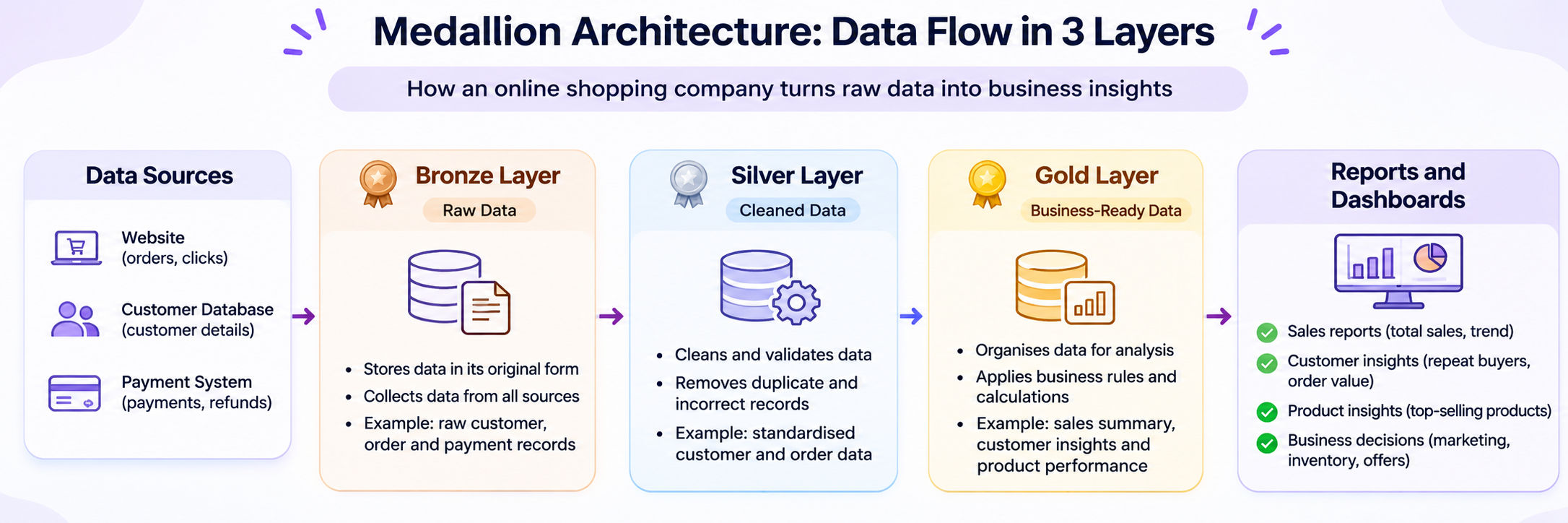
The diagram shows how data moves across the three layers. Each stage improves the quality of data and prepares it for the next step.
Take your interest in medallion architecture to the next level. Earn your online M.Sc. in Artificial Intelligence and Data Science and learn skills that employers want.
Free Courses
Medallion Architecture divides data into three layers: Bronze, Silver and Gold. Each layer has a different purpose. Data starts in its original form, gets cleaned and checked, and is finally prepared for business use.
The Bronze layer is the first stage of Medallion Architecture. It stores raw data collected from different sources without making major changes to it.
For example, an online shopping company may collect data from its website, customer database and payment system. This data may include customer details, order records, payment information and product searches.
The Bronze layer stores this information in its original form.
What happens in the Bronze layer?
Example: An online shopping company receives 500 customer orders in a day. The Bronze layer stores these order records as they arrive, even if some entries contain missing details or duplicate records.
Once data enters the Bronze layer, it moves to the Silver layer for cleaning and validation. The main purpose of this layer is to improve data quality and make information more reliable.
For example, an online shopping company may have duplicate customer records or incomplete order details. The Silver layer helps identify and fix these issues before the data is used for analysis.
What happens in the Silver layer?
Example: The company may find that the same customer appears twice in its records. The Silver layer helps identify the duplicate entries and organise the customer information into a consistent format.
The Gold layer is the final stage of Medallion Architecture. It takes cleaned data from the Silver layer and prepares it for business use.
At this stage, data is organised to answer specific business questions. Companies can use it to study sales, understand customer behaviour and track product performance.
What happens in the Gold layer?
Example: The online shopping company can combine customer and order data to find its total monthly sales, most popular products and repeat customers. Teams can use this information to plan offers, manage stock and improve their marketing campaigns.
Before Proceeding further, also understand Data architecture with examples
All three layers work together, but they handle data at different stages.
Factor |
Bronze Layer |
Silver Layer |
Gold Layer |
| Main purpose | Stores raw data | Cleans and validates data | Prepares data for business use |
| Data quality | Raw data | Cleaned and organised data | Business-ready data |
| Main operations | Data collection and storage | Cleaning and validation | Calculations and data aggregation |
| Example | Raw customer and order records | Corrected customer and order records | Sales reports and customer insights |
| Main use | Data storage and future processing | Reliable data for analysis | Reporting and business decisions |
Understand: What Is Data?
Data Science Courses to upskill
Explore Data Science Courses for Career Progression
IIIT Bangalore
Executive Post Graduate Certificate in Data Science & AIPlacement Assistance
Now that we understand the three layers, let's see how they work together in a real data pipeline. Consider an online shopping company that wants to track customer orders, sales and product performance. It can use Medallion Architecture to collect, clean and organise this information in three steps.
The first step is to collect data from different sources and store it in the Bronze layer.
For an online shopping company, these sources can include:
The Bronze layer stores this information in its original form. It does not remove duplicate entries or correct missing details at this stage.
Example: Suppose the company receives 500 orders in one day. It stores all 500 order records in the Bronze layer, including entries that may have missing details or duplicate information.
Once the raw data is stored, it moves to the Silver layer. Here, the company checks the records and fixes common data issues.
The process includes:
Example: Out of the 500 order records, suppose some contain duplicate entries or incorrect customer details. The Silver layer helps identify these issues and prepares a cleaner set of records for analysis.
After cleaning and validation, the data moves to the Gold layer. The company now organises it to answer specific business questions.
For example, it can:
Example: The company combines cleaned customer and order records to find out which products sell the most and how much customers spend on average. The sales and marketing teams can use these insights to plan offers, manage inventory and improve their campaigns.
Here is a quick look at how the same data moves across all three layers:
| Layer | What Happens | Example Output |
| Bronze | Collects and stores raw data | Original customer, order and payment records |
| Silver | Cleans and validates records | Accurate and organised customer and order data |
| Gold | Prepares data for business use | Sales summaries, customer insights and product reports |
The three layers work together to turn raw information into useful business data. This makes it easier for teams to analyse information, track performance and make decisions.
Also Understand: Benefits and Advantages of Big Data
Medallion Architecture and Lakehouse Architecture are closely related, but they serve different purposes. Lakehouse Architecture provides a platform to store and manage data, while Medallion Architecture organises that data into different layers. Many organisations use both together to build and manage their data pipelines.
Lakehouse Architecture is a data management approach that combines features of data lakes and data warehouses.
A data lake stores large amounts of raw data in different formats. A data warehouse stores organised data that businesses can use for reporting and analysis. A lakehouse brings these capabilities together in one platform.
It allows businesses to store different types of data and use the same platform for data processing, analytics and reporting.
Databricks uses Medallion Architecture to organise data into three layers: Bronze, Silver and Gold. Each layer improves the quality of data and prepares it for the next stage.
The Databricks platform supports this process using tools and features such as:
These tools help organisations manage data across the three layers. However, Medallion Architecture is not limited to Databricks. It can also be used with other data platforms.
Also Read: Relational Database vs Non-Relational Databases
Although these two approaches often work together, their roles are different.
| Factor | Medallion Architecture | Lakehouse Architecture |
| Meaning | A way to organise and improve data in stages | A data platform approach that combines data lake and data warehouse features |
| Main purpose | Improves data quality across three layers | Stores, manages and processes different types of data |
| Structure | Uses Bronze, Silver and Gold layers | Combines data lake and data warehouse capabilities |
| Main focus | Data organisation and quality | Data storage, processing and analytics |
| Relationship | Can be used within a lakehouse | Can support the Medallion Architecture approach |
In simple terms, Lakehouse Architecture provides the platform, while Medallion Architecture provides a way to organise the data stored on it. Together, they help businesses manage data and prepare it for analysis and reporting.
Helpful Read: Difference Between Data Science and Data Analytics
Medallion Architecture helps businesses manage large amounts of data in an organised way. It improves data quality and makes information easier to use for reporting and analysis. However, setting up and managing these layers also comes with a few challenges.
Here are some key benefits of using Medallion Architecture:
Although this approach offers several benefits, businesses may face some challenges while setting it up and managing it.
Also Understand: Data Modeling for Big Data and Data Modeling for Data Integration
Businesses can follow these practices to build and manage their data pipelines more effectively:
Conclusion
Medallion Architecture helps businesses turn raw data into useful information using three layers: Bronze, Silver and Gold. Each layer has a clear role in collecting, cleaning and preparing data for business use. When planned and managed well, this approach makes data pipelines easier to organise and supports better reporting, analytics and business decisions.
Schedule a free consultation with our experts today to explore courses and have good career guidance!
Also Read:
Medallion Architecture is a way to organise data into three layers: Bronze, Silver and Gold. Each layer prepares the data for the next stage. It helps businesses turn raw data into clean and useful information for reporting and analysis.
The three layers are Bronze, Silver and Gold. The Bronze layer stores raw data, the Silver layer cleans and checks it, and the Gold layer prepares it for business use. Together, they help improve data quality at each stage.
The Bronze layer stores raw data collected from sources such as websites, databases and applications. It keeps the data in its original form without making major changes. This allows businesses to access the original records whenever they need to process the data again.
The Silver layer cleans and organises the raw data stored in the Bronze layer. It removes duplicate records, handles missing values and fixes data errors. This makes the information more accurate and reliable for further analysis.
The Gold layer prepares clean data for business use. It combines related information, performs calculations and creates datasets for reports and dashboards. Businesses use this data to study sales, customer behaviour and overall performance.
Medallion Architecture improves data quality by processing information in stages. The Bronze layer stores the original data, the Silver layer checks and cleans it, and the Gold layer prepares it for analysis. This helps businesses work with more organised and reliable information.
Lakehouse Architecture is a data platform approach that combines features of data lakes and data warehouses. Medallion Architecture is a way to organise and improve data using Bronze, Silver and Gold layers. Businesses can use Medallion Architecture within a lakehouse to manage data more effectively.
No, Medallion Architecture is not limited to Databricks. It is a data design pattern that can be used with different data platforms. However, Databricks supports this approach and provides tools to build and manage data pipelines using its three layers.
Delta Lake helps store and manage data in tables across the Medallion layers. It supports reliable data updates and changes, which helps maintain data quality. It is commonly used with Databricks to manage data in Bronze, Silver and Gold layers.
ETL stands for Extract, Transform and Load. It is a process used to collect data, change it into a suitable format and load it into a target system. Medallion Architecture organises data into three layers and can use ETL processes to move and improve data across them.
Yes, Medallion Architecture can support both batch and streaming data processing. This means businesses can process data collected at regular intervals as well as data that arrives continuously. For example, an online shopping company can use it to process new orders and update sales information.
Some common challenges include higher storage costs, increased processing needs and managing data pipelines across all three layers. Businesses also need to maintain data quality, security and access controls. Proper planning and regular monitoring can help manage these challenges.
1354 articles published
We are an online education platform providing industry-relevant programs for professionals, designed and delivered in collaboration with world-class faculty and businesses. Merging the latest technolo...
Speak with Data Science Expert
By submitting, I accept the T&C and
Privacy Policy
Start Your Career in Data Science Today
Top Resources
Master's Degree
18 Months
Executive Diploma
12 Months
Bootcamp
6 Months