“A Remarkable Beetle” is an IELTS Academic Reading passage about the introduction of dung beetles to Australia and their role in managing cattle pastures. It looks at how different species were selected for Australia’s varied climates and how the beetles adapted to their new environment.
The passage also discovers the wider benefits of dung beetles, from controlling dung-breeding flies to improving soil and supporting dairy farming. The questions test your ability to locate specific information, distinguish between similar details, and connect information from different parts of the passage.
In the sections below, you’ll find “A Remarkable Beetle Reading Answers with explanations” for each question, along with practical tips to help you approach the different IELTS Reading question types.
A Remarkable Beetle Reading Passage
AnIELTS Reading passage is a text that tests how well you can find information, understand ideas, and connect details with the questions. A Remarkable Beetle is one of the passages you may come across while practising for theIELTS exam.
Before you start reading, take a moment to look through the questions.Read the questions first, then go through the passage, and return to the questions afterwards.
This gives you a better idea of which details to notice as you read. Look out for names, facts, scientific terms, and other information that relates to the questions. Once you reach the end, return to the relevant parts of the passage to check your answers.
Now, read the passage and keep the questions in mind:
Remarkable Beetle
A. More than 4,000 species of these remarkable creatures have evolved and adapted to the world’s different climates and the dung of its many animals. Australia’s native dung beetles are scrub and woodland dwellers, specialising in coarse marsupial droppings and avoiding the soft cattle dung in which bush flies and buffalo flies breed.Some of the most remarkable beetles are the dung beetles, which spend almost their whole lives eating and breeding in dung’.
B. In the early 1960s George Bornemissza, then a scientist at the Australian Government’s premier research organisation, the Commonwealth Scientific and Industrial Research Organisation (CSIRO), suggested that dung beetles should be introduced to Australia to control dung-breeding flies. Between 1968 and 1982, the CSIRO imported insects from about 50 different species of dung beetle, from Asia, Europe and Africa, aiming to match them to different climatic zones in Australia. Of the 26 species that are known to have become successfully integrated into the local environment, only one, an African species released in northern Australia, has reached its natural boundary.
C. Introducing dung beetles into a pasture is a simple process: approximately 1,500 beetles are released, a handful at a time, into fresh cow pats2 in the cow pasture. The beetles immediately disappear beneath the pats digging and tunnelling and, if they successfully adapt to their new environment, soon become a permanent, self sustaining part of the local ecology. In time they multiply and within three or four years the benefits to the pasture are obvious.
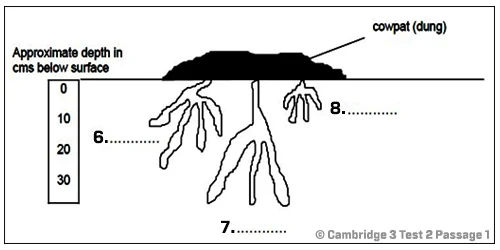
D. Dung beetles work from the inside of the pat so they are sheltered from predators such as birds and foxes. Most species burrow into the soil and bury dung in tunnels directly underneath the pats, which are hollowed out from within. Some large species originating from France excavate tunnels to a depth of approximately 30 cm below the dung pat. These beetles make sausage-shaped brood chambers along the tunnels. The shallowest tunnels belong to a much smaller Spanish species that buries dung in chambers that hang like fruit from the branches of a pear tree. South African beetles dig narrow tunnels of approximately 20 cm below the surface of the pat. Some surface-dwelling beetles, including a South African species, cut perfectly-shaped balls from the pat, which are rolled away and attached to the bases of plants.
E. For maximum dung burial in spring, summer and autumn, farmers require a variety of species with overlapping periods of activity. In the cooler environments of the state of Victoria, the large French species (2.5 cms long) is matched with smaller (half this size), temperate-climate Spanish species. The former are slow to recover from the winter cold and produce only one or two generations of offspring from late spring until autumn. The latter, which multiply rapidly in early spring, produce two to five generations annually. The South African ball-rolling species, being a subtropical beetle, prefers the climate of northern and coastal New South Wales where it commonly works with the South African tunnelling species. In warmer climates, many species are active for longer periods of the year.
F. Dung beetles were initially introduced in the late 1960s with a view to controlling buffalo flies by removing the dung within a day or two and so preventing flies from breeding. However, other benefits have become evident. Once the beetle larvae have finished pupation, the residue is a first-rate source of fertiliser. The tunnels abandoned by the beetles provide excellent aeration and water channels for root systems. In addition, when the new generation of beetles has left the nest the abandoned burrows are an attractive habitat for soil-enriching earthworms. The digested dung in these burrows is an excellent food supply for the earthworms, which decompose it further to provide essential soil nutrients. If it were not for the dung beetle, chemical fertiliser and dung would be washed by rain into streams and rivers before it could be absorbed into the hard earth, polluting water courses and causing blooms of blue-green algae. Without the beetles to dispose of the dung, cow pats would litter pastures making grass inedible to cattle and depriving the soil of sunlight. Australia’s 30 million cattle each produce 10-12 cow pats a day. This amounts to 1.7 billion tonnes a year, enough to smother about 110,000 sq km of pasture, half the area of Victoria.
G. Dung beetles have become an integral part of the successful management of dairy farms in Australia over the past few decades. A number of species are available from the CSIRO or through a small number of private breeders, most of whom were entomologists with the CSIRO’s dung beetle unit who have taken their specialised knowledge of the insect and opened small businesses in direct competition with their former employer.
Now that you have read the A Remarkable Beetle passage, let’s move on to the questions and see how you can find each answer from the text.
A Remarkable Beetle Reading Answers with Explanations
The A Remarkable Beetle questions cover three types: Yes, No, Not Given, Diagram Labelling, and Table Completion.
The first set checks whether statements match the writer’s views, while the other two require you to locate specific details about the beetle species and their characteristics.
Yes, No, Not Given Reading Answers 1–5
Questions 1–5 ask you to decide whether each statement agrees with, contradicts, or is not supported by the passage. Pay close attention to numbers, dates, and comparisons, as these can easily change the meaning of a statement.
Questions 1–5: Do the following statements agree with the information given in the Reading Passage?
In boxes 1–5 on your answer sheet, write:
YES if the statement agrees with the claims of the writer NO if the statement contradicts the claims of the writer NOT GIVEN if it is impossible to say what the writer thinks about this
1. Bush flies are easier to control than buffalo flies. 2. The CSIRO initially brought 4,000 species of dung beetles to Australia. 3. The CSIRO introduced dung beetles over a period of fourteen years. 4. At least 26 of the introduced dung beetle species became established in Australia. 5. The quality of a cow pasture improves immediately after dung beetles are introduced.
ANSWERS:
1. NOT GIVEN
Reference: Paragraph B
“...suggested that dung beetles should be introduced to Australia to control dung-breeding flies.”
Explanation: The passage explains why dung beetles were introduced, but it does not compare bush flies and buffalo flies or say which one is easier to control. So, there is not enough information to mark the statement YES or NO.
2. NO
Reference: Paragraph B
“Between 1968 and 1982, the CSIRO imported insects from about 50 different species of dung beetle...”
Explanation: The passage says that the CSIRO imported beetles from about 50 species, not 4,000. The figure of 4,000 refers to the number of dung beetle species that have evolved worldwide, not the number introduced to Australia.
3. YES
Reference: Paragraph B
“Between 1968 and 1982, the CSIRO imported insects from about 50 different species of dung beetle...”
Explanation: The beetles were imported from 1968 to 1982, which is a 14-year period. The statement matches the information in the passage.
4. YES
Reference: Paragraph B
“Of the 26 species that are known to have become successfully integrated into the local environment...”
Explanation: The passage confirms that 26 species successfully became integrated into the local environment. Therefore, the statement that at least 26 introduced species became established is supported by the text.
5. NO
Reference: Paragraph C
“In time they multiply and within three or four years the benefits to the pasture are obvious.”
Explanation: The benefits are not immediate. The passage says it takes three or four years before the improvements to the pasture become obvious. This contradicts the statement.
Diagram Labelling Reading Answers 6–8
For Questions 6–8, you need to match the tunnels shown in the diagram with the correct dung beetle species. The easiest way to do this is to look for clues such as tunnel depth and the way the dung is stored in the passage.
Questions 6–8
Label the tunnels on the diagram below.
Dung Beetle Types
French
Spanish
Mediterranean
South African
Australian native
South African ball roller
Choose your answers from the box below the diagram.
6. _____ 7. _____ 8. _____
ANSWERS:
6. South African
Reference: Paragraph D
“South African beetles dig narrow tunnels of approximately 20 cm below the surface of the pat.”
Explanation: The passage specifically describes the South African beetle as making narrow tunnels around 20 cm below the surface. This detail matches the corresponding tunnel in the diagram
7. French
Reference: Paragraph D
“Some large species originating from France excavate tunnels to a depth of approximately 30 cm below the dung pat.”
Explanation: The French species makes some of the deepest tunnels, reaching around 30 cm below the dung pat. This depth identifies the French beetle in the diagram.
8. Spanish
Reference: Paragraph D
“The shallowest tunnels belong to a much smaller Spanish species that buries dung in chambers that hang like fruit from the branches of a pear tree.”
Explanation: The Spanish species is identified by its shallow tunnels and the unusual chambers where it stores dung. The passage compares these chambers to fruit hanging from a pear tree, which helps distinguish this species from the others.
Table Completion Reading Answers 9–13
Questions 9–13 require you to pick out specific information about different beetle species and place it in the correct part of the table. Most of the answers come from the paragraph discussing their climate, active periods, and generations.
Questions 9–13
Complete the table below.
Choose NO MORE THAN THREE WORDS OR A NUMBER from the Reading Passage for each answer.
Species
Size
Preferred Climate
Complementary Species
Start of Active Period
Number of Generations per Year
French
2.5 cm
Cool
Spanish
Late spring
1–2
Spanish
1.25 cm
9. _____
10. _____
11. _____
2–5
South African ball roller
—
12. _____
13. _____
—
—
9. Temperate
Reference: Paragraph E
“...the large French species (2.5 cms long) is matched with smaller (half this size), temperate-climate Spanish species.”
Explanation: The Spanish species is described as a temperate-climate beetle. Since the table asks for its preferred climate, the answer is temperate.
10. Early spring
Reference: Paragraph E
“The latter, which multiply rapidly in early spring, produce two to five generations annually.”
Explanation: The table asks when the Spanish species begins its active period. The passage says that it multiplies rapidly in early spring, giving us the answer.
11. 2–5 / two to five
Reference: Paragraph E
“...produce two to five generations annually.”
Explanation: The Spanish species produces two to five generations each year. Both 2–5 and two to five convey the information given in the passage, provided they follow the answer-sheet instructions.
12. Subtropical
Reference: Paragraph E
“The South African ball-rolling species, being a subtropical beetle, prefers the climate of northern and coastal New South Wales...”
Explanation: The passage directly describes the South African ball-rolling species as subtropical. That tells us the climate it prefers.
13. South African tunnelling / South African tunneling
Reference: Paragraph E
“...where it commonly works with the South African tunnelling species.”
Explanation: The South African ball-rolling beetle commonly works alongside the South African tunnelling species. This is the complementary species required in the table.
Preparing for your IELTS test? Build your skills with upGrad’sfree IELTS course and get practical guidance at your own pace.
How to Approach A Remarkable Beetle Reading Answers?
A Remarkable Beetle includes Yes, No, Not Given, Diagram Labelling, and Table Completion questions. Since the passage contains several beetle species, measurements, dates, and climate details, it is easy to confuse similar pieces of information.
A clear approach for each question type can help you locate the right part of the passage without rereading everything.
Read the Statement Carefully for Yes, No, Not Given
For Yes, No, Not Given questions, focus on what the whole statement means, not just on individual keywords.
What to do:
Identify the main claim in the statement.
Find the relevant paragraph using names, numbers, or distinctive terms.
Check whether the passage supports or contradicts the claim.
If the passage mentions the topic but does not give enough information to confirm the statement, choose Not Given.
Be especially careful when the question changes a number or adds a comparison that is not in the passage.
Example from A Remarkable Beetle:
“Between 1968 and 1982, the CSIRO imported insects from about 50 different species of dung beetle…”
The question says that 4,000 species were initially brought to Australia. The passage actually says about 50 species were imported.
Answer → No
The 4,000 species mentioned elsewhere refers to the number of dung beetle species that have evolved around the world, not the number introduced into Australia.
Use Numbers and Descriptions to Match the Diagram
The diagram labelling questions become easier when you focus on the physical descriptions of the tunnels.
Look for:
Tunnel depth
Tunnel shape
Size of the beetle
Position of the chambers
Words such as shallowest, narrow, and approximately
For example, the passage says:
“South African beetles dig narrow tunnels of approximately 20 cm below the surface of the pat.”
It also states that French species excavate tunnels to approximately 30 cm.
These measurements help you distinguish between the different beetles shown in the diagram.
Match Species with Their Climate and Behaviour
The table completion questions require you to connect several details about the same species. Instead of searching for each blank separately, find the paragraph where the species is discussed and read the surrounding sentences.
For A Remarkable Beetle, Paragraph E contains information about:
French beetles
Spanish beetles
South African ball-rolling beetles
Their size and climate
When they become active
How many generations they produce
Which species work together
For example:
“…smaller (half this size), temperate-climate Spanish species.”
This gives the climate for the Spanish beetle, while the following information tells you that it multiplies rapidly in early spring and produces two to five generations annually.
Tip: Once you find the species in the passage, read a few lines around it. The answer may appear immediately before or after the sentence containing the species name.
Watch for Similar Beetle Names
Several beetles in the passage have similar or related names, so it is important not to mix them up.
For example:
Beetle
Detail about the Beetle
French
Tunnels about 30 cm deep
Spanish
Shallowest tunnels; active in early spring
South African tunnelling
Narrow tunnels around 20 cm deep
South African ball-rolling
Subtropical; works with the South African tunnelling species
Reading the full description of each species is more reliable than matching names alone.
Follow the Word Limit in Table Completion
Before writing an answer, check the instruction above the questions. In this set, the instruction is NO MORE THAN THREE WORDS OR A NUMBER.
For example:
✓ Temperate ✓ Early spring ✓ 2–5 ✗ Temperate-climate Spanish species — too many words
Even when the passage contains a longer phrase, your answer must fit the given word limit.
Common Mistakes to Avoid in A Remarkable Beetle IELTS Reading
The main difficulty in A Remarkable Beetle comes from the many species, numbers, and timelines mentioned in the passage. Some details are also easy to confuse, especially when answering the diagram and table questions.
Here are a few common mistakes to avoid:
✗ Common Mistake
✓ What to Do Instead
Confusing the 4,000 species with the beetles imported into Australia.
Remember that 4,000 refers to dung beetle species overall, while about 50 species were imported by the CSIRO.
Choosing NOT GIVEN just because the statement is not directly repeated.
Check whether the passage supports or contradicts the statement. If neither, choose NOT GIVEN.
Assuming the pasture improves immediately after the beetles are introduced.
Check the timeline. The passage says the benefits become obvious within three or four years.
Mixing up the different beetle species.
Match each species with its specific tunnel depth, climate, or activity period.
Choosing a diagram answer based only on the beetle's name.
Compare the shape and depth of the tunnel with the description in the passage.
Ignoring the word limit in the table completion questions.
Check the instructions and keep each answer within NO MORE THAN THREE WORDS OR A NUMBER.
It is suggested to quickly check answers where the passage contains similar numbers, species names, or timelines before moving on. These small details are often where avoidable mistakes happen.
Want more IELTS Reading practice? Use these answer guides to work through different passage topics and question types:
A Remarkable Beetle shows how a small insect can play an important role in controlling flies, improving soil, and supporting Australian farms. The passage also tests how carefully you can follow numbers, species, and details that appear across different paragraphs.
With regular IELTS Reading practice, try to focus on understanding the passage rather than simply searching for matching words. Building this habit can help you approach different question types with more confidence as you prepare for your study abroad plans.
1. What question types are included in A Remarkable Beetle Reading?
The passage includes Yes, No, Not Given, Diagram Labelling, and Table Completion questions. Each type requires a slightly different approach, so practising all three can help you become more comfortable with IELTS Reading.
2. Is A Remarkable Beetle a difficult IELTS Reading passage?
The passage is manageable if you read carefully, but the different beetle species, measurements, and details can make some questions confusing. Good keyword scanning and careful reading can make it easier to follow.
3. What IELTS Reading skills does A Remarkable Beetle test?
The questions test skills such as locating specific information, identifying whether a statement is supported by the passage, matching descriptions, and completing information from the text.
4. How much time should I spend on an IELTS Reading passage?
Try to manage your time across all three passages rather than spending too long on one. If a question is taking too much time, make your best choice, mark it mentally, and move on.
5. Should I read the whole passage before answering the questions?
You can quickly look through the questions first to understand what information you need to find. Then read the passage with those details in mind instead of trying to remember every sentence.
6. How can I improve my IELTS Reading accuracy?
Review your mistakes after each practice test. Look at why you selected the wrong answer and identify whether you missed a keyword, misunderstood a statement, or overlooked a detail.
7. Is it necessary to understand every word in an IELTS Reading passage?
No. You do not need to know the meaning of every word to answer the questions. Focus on the information connected to the question and use the surrounding sentences to understand unfamiliar terms.
8. How are IELTS Reading answers usually presented?
Answers depend on the question type. You may need to choose an option, identify a label, or write a word or number from the passage. Always follow the instructions given with the question set.
9. Can I use A Remarkable Beetle Reading Answers for IELTS practice?
Yes. After attempting the passage yourself, use the answers to check your work and understand where you went wrong. This is more useful than simply looking at the answers without attempting the questions first.
10. What is the best way to use A Remarkable Beetle IELTS Reading Answers?
First, complete the passage without checking the answers. Then compare your responses with the solutions and read the explanations for any questions you got wrong or found difficult.
11. Can A Remarkable Beetle Reading Answers help with other IELTS passages?
Yes. The passage can help you practise skills that are useful across IELTS Reading, such as finding keywords, recognising paraphrasing, following instructions, and checking details before selecting an answer.
upGrad Abroad Editorial Team |4935 articles published
We are a dedicated team of study-abroad experts, ensuring intensive research and comprehensive information in each of our blogs. With every piece written, we aim at simplifying the overseas education ...
Refer Your Friend & Earn upto ₹15000
Help your friend upgrade to a Global Career and earn rewards together.