An MBA in Switzerland gets you world-class leadership training, with real strength in luxury brand management, finance, and international business, and the salary outcomes reflect that specialisation. IMD Business School in Lausanne and the University of St. Gallen lead the pack here, and most programs wrap up in 1 to 2 years, though tuition can swing anywhere from CHF 24,000 (₹27.4 lakh) to over CHF 97,000 (₹1.11 crore) a year depending on where you land.
An MBA in Switzerland isn't structured like programs in most other countries. Programs are short, usually a year, sometimes less, and they're built around the idea that you already know how to work and just need to know how to lead. That's why work experience matters so much here, sometimes more than your test scores do.
In this article, we'll cover the best MBA colleges in Switzerland, tuition and living costs, eligibility and GMAT benchmarks, scholarships, the admissions process, visa requirements, and career outcomes after graduation.
Best MBA Colleges in Switzerland
MBA colleges in Switzerland make up a small but sharp landscape. You won't find hundreds of options like you would in us, but the ones that exist are genuinely well regarded, and a couple sit right at the top of European rankings.
Fee figures for these MBA universities in Switzerland are verified against each school's official pages, so treat this as your real budgeting starting point, not a rough estimate.
University / Business School
Program Duration
Tuition Fees (CHF / INR approx.)
IMD Lausanne
1 year
CHF 97,500 (all inclusive) / ₹1.11 crore
University of St. Gallen (HSG)
1 year (FT)
CHF 75,000 / ₹85.5 lakh
SBS Swiss Business School (Zurich)
1.5 years
CHF 35,000 / ₹39.9 lakh
SSBM (Geneva/Zurich)
12 to 18 months
CHF 24,000 / ₹27.4 lakh
Business School Lausanne (BSL)
1 to 2 years
CHF 36,000 to 38,000 / ₹41 to 43.3 lakh
EU Business School (Geneva, Montreux)
1 year
CHF 31,000 to 32,000 / ₹35.3 to 36.5 lakh
A quick note on IMD's number, since it trips people up. CHF 97,500 isn't just tuition, it's tuition plus mandatory fees rolled into one figure, and it covers books, coaching, even project travel. Compare that against schools quoting tuition only numbers and IMD looks pricier than it actually is once you factor in what's bundled in.
How the Course Is Structured
Don't expect a syllabus that reads like a textbook. Programs here are built around doing, not just learning, and most of your grade weight sits in projects, not exams.
Core modules: finance, marketing, strategy, operations, leadership, usual ground, taught with a heavier practical lean
Electives: sustainability, luxury brand management, digital transformation, hospitality, this is where Swiss schools genuinely stand apart
Experiential learning: live consulting projects and international study modules that take you outside the classroom
Capstone or thesis: an applied strategic project, usually built around an actual client
Internships: short placements with Swiss or multinational firms, typically slotted mid-program
Soft skills: negotiation and cross cultural leadership, woven through the year instead of taught as a standalone module
IMD, one of the best MBA colleges in Switzerland, puts students on live projects for companies like Ferrari and the International Olympic Committee. That's not marketing language. It's genuinely how the year is structured, you're solving real problems for real clients from month one.
Getting into an MBA in Switzerland isn't just about grades. Swiss business schools care a lot about who you've become professionally, not just what you scored on a test years ago.
Academic Background & Work Experience
You'll need a bachelor's degree from a recognised institution, that part's non negotiable everywhere. Work experience is where things get specific.
Most programs want 2 to 5 years of professional experience, though this varies by school
IMD sits at the higher end, its incoming class averages six years of work experience, some bring ten or more
Younger applicants with strong leadership potential can still get in, but the overall pool tends to be more seasoned than a typical US MBA cohort
GMAT & GRE Benchmarks by School
GMAT andGRE benchmarks vary a fair bit across MBA universities in Switzerland, and knowing the real numbers before you apply saves you from over or under preparing.
IMD's average incomingGMAT sits around 680, with accepted scores ranging from 555 to 755, so don't panic if you're below 680
University of St. Gallen doesn't publish an official average, but 650 is the commonly cited benchmark
SSBM and SBS, among a few other smaller private schools, offer GMAT waivers if your work experience is strong enough, worth checking with admissions directly before you spend months prepping
Language Proficiency
Language requirements here are simpler than people expect, but worth knowing exactly where they matter.
Almost every MBA program runs entirely in English, so you don't need German, French, or Italian to get through the coursework itself.
If you're hoping to work in Switzerland after graduating, especially in Zurich or Geneva, picking up basic local language skills genuinely helps.
Language proficiency won't get you admitted to a program, but it might get you hired once you're job hunting.
Cost of Studying
An MBA in Switzerland isn't the budget pick if cost is your primary constraint, but fees vary more between schools than people expect, so there's more flexibility here than the country's expensive reputation suggests.
Tuition & Fees
Tuition: CHF 24,000 to 97,500 a year (₹27.4 lakh to ₹1.11 crore), wide range mostly because IMD sits well above everyone else
Application fee: CHF 100 to 200 (₹11,400 to ₹22,800), one time and non refundable
Health insurance: CHF 300 to 500 a month (₹34,200 to ₹57,000), mandatory for every international student
Books and materials: CHF 1,000 to 2,000 a year (₹1.14 lakh to ₹2.28 lakh), often bundled into tuition at premium schools
Living Costs by City
Where you study matters almost as much as which school you pick, and it's worth comparing this against thecost of living in Switzerland more broadly before you commit to a city.
Zurich and Geneva: CHF 2,200 to 3,000 a month (₹2.5 lakh to ₹3.4 lakh), Switzerland's most expensive cities, full stop
Lausanne: CHF 2,000 to 2,500 a month (₹2.28 lakh to ₹2.85 lakh), slightly more manageable but still not cheap
St. Gallen: CHF 1,500 to 2,000 a month (₹1.7 lakh to ₹2.28 lakh), the most budget friendly of the major cities
Scholarships & Funding Options
Here's something worth clearing up first: Swiss Government Excellence Scholarships (FCS/ESKAS) don't fund MBAs. They're built for postgraduate researchers and PhD candidates with an academic supervisor and a formal research proposal, not coursework based programs. If you've seen this mentioned as MBA funding elsewhere, treat it with caution.
The good news is there's still real money on the table across most MBA colleges in Switzerland, it's just school specific rather than government funded.
University & School Scholarships
Merit based scholarships tied to your GMAT score, academic record, or professional achievements, offered at nearly every major school and usually covering anywhere from partial tuition up to a meaningful chunk of the total fee.
IMD's Nestlé Scholarship for Women, one of the more well known named scholarships in Swiss MBA education, aimed at female candidates with demonstrated leadership potential. IMD also runs broader merit scholarships that factor in diversity and leadership background, not just test scores.
Need based partial tuition waivers, available at most schools but requiring a separate financial disclosure during the application, this isn't something you opt into after admission, it typically needs to be flagged upfront.
Corporate & External Funding
Corporate sponsored scholarships from companies like Nestlé and UBS, usually tied to specific focus areas like sustainability, diversity in leadership, or industry relevant research, worth checking each company's current scholarship cycle since these aren't always open year round.
Employer sponsorship, if you're already working, some employers will part fund or fully fund an MBA in exchange for a return of service agreement, this is more common if you're being sponsored by a Swiss or multinational employer rather than an Indian one.
Education loans through Indian banks, the most reliable fallback when a scholarship doesn't come through, most major Indian lenders offereducation loans for Swiss MBA programs, though loan approval depends on the specific school's ranking and your co-applicant's financial profile.
Admissions Process
Getting from interested to enrolled at an MBA university in Switzerland takes months, not weeks, so timing your application right matters as much as the application itself.
Intakes
Most programs run on a single major intake in September, this is the primary start date for IMD, University of St. Gallen, and University of Geneva. A few schools offer more flexibility though.
September intake: the main start date across most top schools, including IMD, St. Gallen, and University of Geneva.
February, June, and October intakes: offered by EU Business School and a handful of smaller private schools, giving you more room to plan around existing work commitments.
Applying Step by Step
Shortlist programs based on actual fit, not just ranking, a school like SSBM might genuinely suit your budget and goals better than IMD or St. Gallen
Check eligibility specifics for each school since work experience thresholds and GMAT expectations vary
Prepare for GMAT or GRE if required, three to four months is a realistic runway from scratch
Gather your CV, transcripts, statement of purpose, and usually two letters of recommendation
Submit online with an application fee that typically runs CHF 100 to 200
Attend the interview, nearly every program does this, usually online, sometimes with a case component
Wait for your decision, offer letters generally arrive within a few weeks
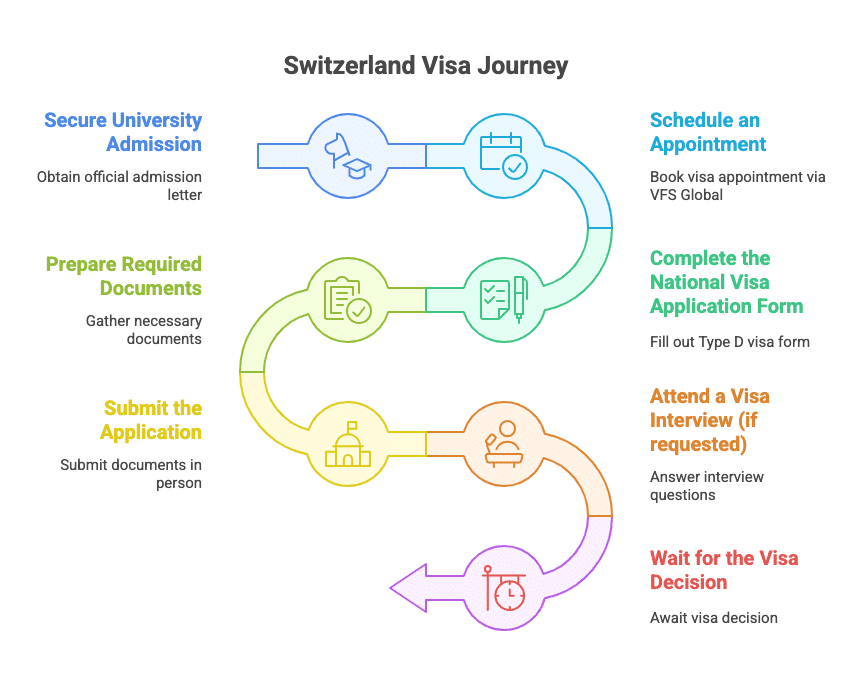
Start your visa and residence permit process the moment you're accepted, this alone takes 8 to 12 weeks
Student Visa Requirements
If you're not an EU or EFTA citizen, you'll need a Swiss student visa, technically a residence permit for education, and the documentation here is fairly strict compared to some other European countries.
Admission letter from your Swiss university or business school
Financial proof showing access to CHF 21,000 a year (₹23.9 lakh), sometimes closer to CHF 24,000 for Zurich or Geneva
Health insurance, a valid Swiss recognised policy arranged before your visa is finalised
Accommodation proof, a signed rental agreement or housing confirmation
Academic documents, degree certificates, transcripts, and an updated CV
Application fee of CHF 60 to 100 (₹6,840 to ₹11,400), payable at your local embassy or consulate
Processing typically takes 8 to 12 weeks, so apply the moment you have your admission letter. Don't wait until the last month, cantonal migration offices don't move fast, and a late visa can genuinely cost you your intake.
MBA salary in Switzerland tends to sit among the highest in Europe, largely because the corporate density means you're rarely more than a few kilometres from a major employer's headquarters, a trend that holds across broaderjob opportunities in Switzerland as well. Where you end up, and what you earn, comes down mostly to which sector you target.
Top Job Opportunities
MBA salary in Switzerland varies quite a bit by sector, and the country's job market rewards MBA grads well largely because the corporate density means you're rarely more than a few kilometres from a major employer's headquarters.
Management consulting: Strategy Consultant, Engagement Manager, CHF 130,000 to 160,000 (₹1.48 crore to ₹1.82 crore)
Financial services: Investment Banker, Wealth Manager, CHF 120,000 to 150,000 (₹1.37 crore to ₹1.71 crore)
Pharma and healthcare: Business Development Manager, Product Manager, CHF 110,000 to 140,000 (₹1.25 crore to ₹1.6 crore)
Technology: Product Manager, Digital Transformation Lead, CHF 115,000 to 145,000 (₹1.31 crore to ₹1.65 crore)
Luxury and hospitality: Brand Manager, Hotel General Manager, CHF 90,000 to 120,000 (₹1.03 crore to ₹1.37 crore), the most accessible entry point of the group
An MBA in Switzerland isn't a cheap decision, and it was never going to be. But the maths tends to work out for people who go in with a clear plan. Between IMD's CHF 97,500 all inclusive program and SSBM's much more accessible CHF 24,000 route, there's more range here than the country's expensive reputation suggests.
What matters more than the price tag is fit, whether you need the intensity and network of a school like IMD, or a smaller, more flexible MBA college in Switzerland that actually serves your goals better. Get your GMAT prep and visa timeline sorted early, and the rest of this becomes a lot more manageable than it looks on paper.
For most students, yes, provided you go in with a clear career plan. Swiss MBA grads land some of the highest starting salaries in Europe, and the country's corporate density means you're studying right next to future employers like Nestlé, UBS, and Novartis. The catch is the upfront cost, so it makes more sense if you're aiming for a European career rather than an India return.
How much does an MBA cost in Switzerland?
Tuition ranges from CHF 24,000 (₹27.4 lakh) at accessible schools like SSBM to CHF 97,500 (₹1.11 crore) at IMD, which is the priciest but also the most comprehensive in terms of what's bundled in. Add living costs of CHF 1,500 to 3,000 a month depending on the city, and total annual spend can run anywhere from around CHF 40,000 to well over CHF 1,30,000.
What is the cheapest country for an MBA?
Germany and France tend to be cheaper than Switzerland, especially at public universities where MBA-equivalent programs can cost a fraction of what Swiss private business schools charge. Switzerland isn't the budget option in Europe, it's positioned more for graduates prioritising salary and network over minimising cost.
Does Switzerland accept Indian students for MBA programs?
Yes, Indian students are a regular part of MBA cohorts at Swiss business schools, IMD alone typically has around 13 to 14 Indian students in its 90-person class each year. Admission depends on your profile, GMAT or GRE score, and work experience, not nationality, and Indian applicants apply through the same process as everyone else.
How do I apply for an MBA in Switzerland?
Start by shortlisting schools based on fit and budget, then check each one's specific eligibility around work experience and test scores. From there it's GMAT or GRE prep if required, gathering your documents, submitting online with the application fee, and sitting through an interview. Once accepted, your visa process starts immediately since that alone takes 8 to 12 weeks.
Can an engineering student do an MBA in finance in Switzerland?
Yes, Swiss business schools don't require an undergraduate background in business or commerce. Engineers are a common applicant pool, in fact, IMD's incoming classes regularly include strong representation from technical and manufacturing backgrounds. What matters more is your work experience and how well you can articulate your reasons for switching into finance.
Can an MBA from India help you land a job in Switzerland?
An Indian MBA alone rarely opens doors to the Swiss job market, since Swiss employers generally prioritise candidates with a Swiss degree, local network, and language skills. What can work is combining Indian work experience with a Swiss MBA, the local qualification plus international experience is a stronger combination than either on its own.
Can you stay in Switzerland after completing an MBA?
Non-EU and non-EFTA graduates get a six month window after graduation to look for work in Switzerland. If you secure a job within that window, your residence permit can usually be converted to a work permit, though this depends on your employer and the specific canton's rules.
What is the difference between an MBA in Switzerland and an MBA in the UK or Germany?
Switzerland is more expensive upfront but tends to deliver stronger post-MBA salaries and access to multinational corporate networks concentrated in Zurich and Geneva. Germany and the UK offer more affordable and varied program options, but Switzerland's smaller, more intensive programs like IMD carry a distinct global reputation that's hard to match elsewhere in Europe.
Do I need work experience to apply for an MBA in Switzerland?
Yes, this is one of the strictest requirements across Swiss business schools. Most programs expect 2 to 5 years of professional experience, and schools like IMD average six years or more in their incoming class. Fresh graduates with little to no work experience will find it very difficult to get admitted.
Is GMAT mandatory for an MBA in Switzerland?
It depends on the school. IMD and University of St. Gallen generally expect a GMAT or GRE score, with IMD's average sitting around 680. Smaller private schools like SSBM and SBS often offer waivers if your work experience is strong enough, so it's worth checking directly with admissions before committing to test prep.
Pragya Sharma is a content developer and marketer with 6.5+ years of experience in the education industry. She started her career as a social media copywriter for NIELIT, Ministry of Electronics & IT,...
Talk to Our Counselor
Refer Your Friend & Earn upto ₹15000
Help your friend upgrade to a Global Career and earn rewards together.