T Test vs Z Test: Differences, Uses, Formula, and Examples
By Sriram
Updated on Jun 19, 2026 | 9 min read | 2.33K+ views
Share:

All courses
Certifications
More
By Sriram
Updated on Jun 19, 2026 | 9 min read | 2.33K+ views
Share:
Table of Contents
T Test vs Z Test are two of the popular ways to test hypotheses; they help you figure out if there is a statistically significant difference between means. The key thing that decides which one to use is how much you actually know about the population. If you know the population's standard deviation, go with a Z-test. If you don't (which is most of the time in real-world scenarios), a T-test is the way to go.
If you have started learning statistics, you have probably heard debate around the t test and the z test. They help analysts, researchers, students, and businesses to figure out if the differences they see in the data are real or just a coincidence.
This blog will tell you everything you need to know about the t test and the z test, about their differences, formulas used, assumption needed, when to use, how to use, common mistakes people make etc. By the time you finish reading this article you will know how to choose between the tests. You will also be able to explain why you made your choice.
Want to master hypothesis testing? Explore Data Science Courses from upGrad and learn when to use Z-tests and T-tests confidently.
Popular Data Science Programs
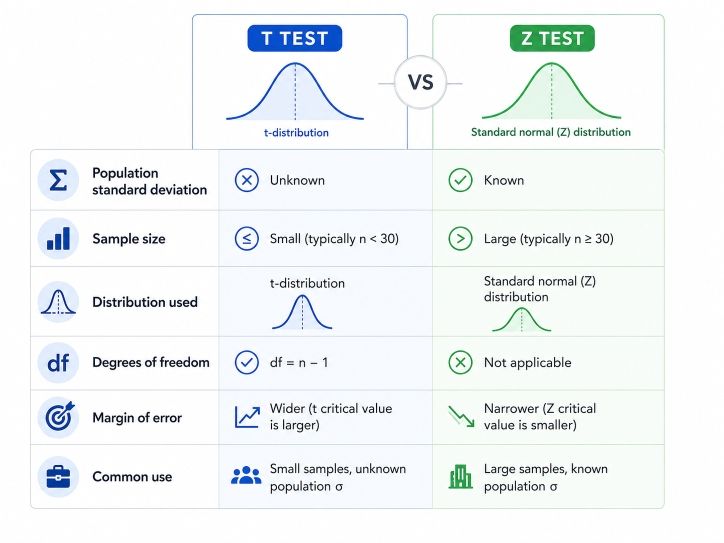
The biggest difference between a T test and Z test is the amount of information they need about the people or things being studied. They look at the information from a group of people or things and help figure out if the results are important. They work well, in different conditions.
Factor |
T-Test |
Z-Test |
| Population standard deviation | Unknown | Known |
| Sample size | Usually less than 30 | Usually greater than 30 |
| Distribution used | T-distribution | Normal distribution |
| Degrees of freedom | Required | Not required |
| Margin of error | Higher | Lower |
| Common use | Academic research | Large-scale studies |
Also Read: Difference between Training and Testing Data
The t-test relies on the students' t-distribution. The students' t-distribution is wider than the distribution. This is because the students' t-distribution accounts for uncertainty. This uncertainty is in samples of people.
For example, a professor wants to see if a new teaching method improves exam scores. The professor has 20 students. The professor will likely use a t-test. The t-test is used because the sample of students is small. The true population variance is also unknown. The professor uses the t-test to find out if the new teaching method really improves exam scores, for the students' T-distribution.
A t-test is a statistical test used when:
The z-test uses the normal distribution, which is also known as the z-distribution.
Suppose a telecom company talks to 10,000 customers. They already know the standard deviation of the whole population from other studies they did before. In a situation like this the telecom company should use a z-test because it is the choice for them to use.
The z-test is a choice when you already know the population standard deviation, like the telecom company does, in this case.
A z-test is used when:
Also Read: What is Hypothesis Testing in Statistics? Types, Function & Examples
Free Courses
Choosing the wrong test can affect your conclusions.
A Z test assumes greater certainty about population characteristics. Whereas a T test is more careful because it knows that small groups of people or things have a lot of uncertainty.
That is why it is important to understand the difference between a t test and a z test. It has an effect on the quality of your work and the decisions you make about t test and z test.
A Simple Memory Trick
Many students remember it this way:
Data Science Courses to upskill
Explore Data Science Courses for Career Progression
IIIT Bangalore
Executive Post Graduate Certificate in Data Science & AIPlacement Assistance
Knowing when to use a test is important but understanding how these tests work is even better.
Let's break down the formulas and assumptions in simple terms.
For a one-sample t-test: t = M – µ Sx
Sample mean (M) minus population mean you are comparing your sample to (µ), divided by the standard error (Sx).
Symbol |
Meaning |
| x̄ | Sample mean |
| μ | Population mean |
| s | Sample standard deviation |
| n | Sample size |
Since the population standard deviation is unknown, the sample standard deviation is used as an estimate.
For a one-sample z-test: divide the difference between the means by the standard error
z = (x – μ) / σ
Where:
Symbol |
Meaning |
| x̄ | Sample mean |
| μ | Population mean |
| σ | Population standard deviation |
| n | Sample size |
Here the key difference is that the Z test uses population standard deviation that is already known.
The good news is that t-tests are fairly robust. Minor departures from normality usually do not create major problems.
Before applying a t-test, make sure:
A z-test requires:
Because these requirements are stricter, z-tests are less common in everyday research.
Also Read: Hypothesis Testing in Statistics: Explained Simply
This is a concept that is unique to T tests, the degrees of freedom.
For a one-sample t-test: df = n - 1
Degrees of freedom affect the shape of T-distribution.
With samples, the T distribution has heavier tails. When the sample size gets bigger, the T distribution starts to look the same as the normal distribution.
Each test has its distinct features, and these variations explain why discussions around T test vs Z test are so common in research, analytics, and data science.
Researchers commonly use:
Common z-tests include:
One-Sample Z-Test: Compares a sample mean against a population mean.
Two-Sample Z-Test: Compares two large independent samples.
Proportion Z-Test: Used when comparing percentages or proportions.
Also Read: A Comprehensive Guide for Big Data Testing: Challenges, Tools, Applications
Subscribe to upGrad's Newsletter
Join thousands of learners who receive useful tips
This is the question most people really care about. The theory of T test vs z test is useful. But it is not effective for the practical world; in practice, analysts want a simple framework for making the right choice.
Choose a t-test if:
Choose a z-test if:
Situation |
Recommended Test |
| Sample size below 30 | T-Test |
| Sample size above 30 | Usually Z-Test |
| Population SD unknown | T-Test |
| Population SD known | Z-Test |
| Academic research | T-Test |
| Industry quality control | Z-Test |
In this 3-steps steps decision framework, it starts by asking 3 potential questions.
Ask these questions:
If you answer yes to the two questions, you should probably use a z-test. If you do not answer yes to these questions, it is usually better to use a t-test.
One experienced analyst once described statistics as "less about formulas and more about choosing the right tool." That's especially true when comparing T test vs Z test.
Some errors appear again and again:
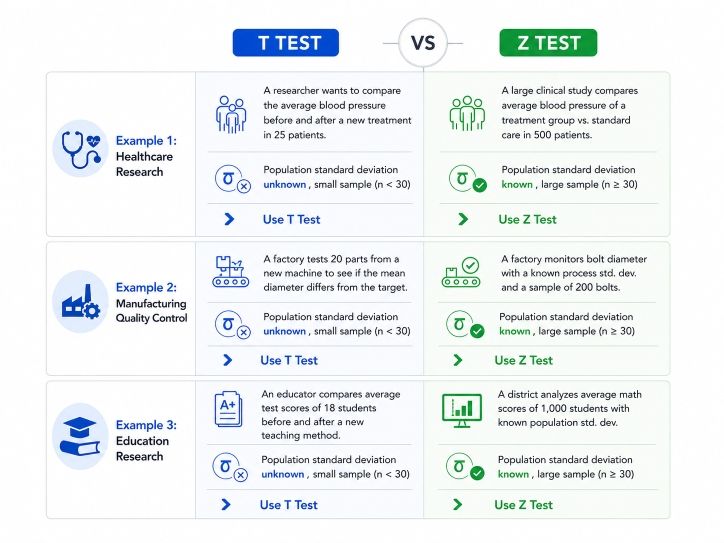
Understanding theory is one thing. Seeing how these tests are used in real situations makes the concept easier to remember.
A hospital wants to evaluate whether a new treatment reduces recovery time.
Data available:
A t-test would be used because the sample is small.
A factory monitors product weight.
Data available:
A z-test is more suitable.
A university compares student performance before and after introducing a new curriculum.
The same students are measured twice. A paired t-test is often the best choice.
Read: 52+ Top Database Testing Interview Questions and Answers to Pepare for 2025
Feature |
T-Test |
Z-Test |
| Small sample support | Excellent | Limited |
| Known population variance required | No | Yes |
| Research applications | Very common | Less common |
| Large-scale surveys | Good | Excellent |
| Ease of use | Moderate | High |
Advantages of T test include:
Limitations of T-Tests include:
Advantages of Z test include:
Limitations of Z-Tests include:
In modern analytics and research, t-tests are generally more common. The reason is simple.
Researchers rarely know the true population standard deviation. Because of this limitation, t-tests have become the default option in many academic, healthcare, social science, and business studies.
According to the National Institute of Standards and Technology (NIST), t-tests remain one of the most frequently applied inferential statistical methods across research disciplines.
Understanding the T test vs Z test is one of the most important skills in statistical analysis. Both tests serve the same broad purpose: helping you determine whether a result is statistically significant. The difference lies in the conditions under which they are used.
If you're ever unsure, start by checking whether you know the population's standard deviation. That single question often points you toward the correct test. Once you understand that principle, choosing between a t-test and a z-test becomes much more intuitive.
Want to explore more about T test vs Z test? Book your free 1:1 personal consultation with our expert today.
Use a z-test when the population standard deviation is known and the sample size is sufficiently large. Under these conditions, the normal distribution provides accurate probability estimates. Z-tests are common in manufacturing, quality control, and large-scale survey analysis.
A t-score is used when population variance is unknown and must be estimated from sample data. A z-score is used when population variance is known. The choice depends on the available information and the assumptions of the statistical analysis.
Begin by checking whether the population standard deviation is known. Then evaluate the sample size. If the standard deviation is unknown or the sample size is relatively small, use a t-test. If both conditions favor certainty, use a z-test.
Use a T-score when working with sample-based estimates and unknown population variance. Use a z-score when population parameters are already known. Selecting the correct score improves the accuracy and reliability of statistical conclusions.
Yes. A t-test can still be used for larger samples, especially when the population standard deviation is unknown. As sample size increases, the t-distribution becomes very similar to the normal distribution, producing nearly identical results.
The t-distribution accounts for additional uncertainty introduced by estimating population variance from sample data. This extra uncertainty creates heavier tails, making the distribution wider and more cautious when evaluating statistical significance.
No. Neither test is universally better. The correct choice depends on the data and assumptions. A z-test performs well when population variance is known, while a t-test is more suitable when working with limited information.
The interpretation of the p-value is the same in both tests. The difference lies in how it is calculated. A t-test uses the t-distribution, while a z-test relies on the standard normal distribution.
Yes. Popular tools such as Excel, Python, R, SPSS, and SAS support both tests. Most software packages can calculate test statistics, p-values, and confidence intervals with only a few commands.
Researchers rarely know the true population standard deviation. Because of this limitation, t-tests provide a practical solution. They allow analysts to make valid inferences using sample data while accounting for uncertainty.
These tests are often used during experimentation and model evaluation. Analysts use them to compare groups, validate A/B tests, assess feature importance, and determine whether observed performance differences are statistically significant.
727 articles published
Sriram K is a Senior SEO Executive with a B.Tech in Information Technology from Dr. M.G.R. Educational and Research Institute, Chennai. With over a decade of experience in digital marketing, he specia...
Speak with Data Science Expert
By submitting, I accept the T&C and
Privacy Policy
Start Your Career in Data Science Today
Top Resources
Executive Diploma
12 Months
Master's Degree
18 Months
Bootcamp
6 Months