If you're planning to apply for a student visa for UK, you'll first need an unconditional offer from a recognised UK university and a Confirmation of Acceptance for Studies (CAS). You'll also have to show that you have enough funds to pay for your tuition fees and living expenses. UK embassy fees for student visa is GBP 558 (approximately INR 64,170), and you'll need to pay an Immigration Health Surcharge (IHS) of GBP 776 (approximately INR 99,907) per year to access healthcare during your stay.
Before filling out the application form for UK student visa, it's important to understand the eligibility criteria, visa fees, and required documents, including a valid passport, CAS, proof of funds, and English language test scores. You should also check the minimum bank balance requirement before submitting your application.
In this guide, you'll learn how to apply for student visa in UK, including embassy fees, new rules for Indian students, UK student visa requirements, minimum bank balance criteria, required documents, and the complete application process.
Understanding Student Visa for UK
To study in UK, it is must understand the types of visas and their specific purposes. For example, if you’re applying from outside UK, you’ll need to apply for student visa in UK, which typically takes around 3 weeks to process.
As mentioned above, UK embassy fees for student visa i.e. GBP 558 (approximately INR 64,170) which is a significant cost you must factor in before applying. For Indian applicants, knowing the student visa fees for UK from India is important to plan your budget.
Here’s a quick overview about Student Visa for UK:
Aspect
Details
Processing Time
Applying from outside UK: Typically, a decision is made within 3 weeks.
Applying from inside UK: Decisions usually take up to 8 weeks.
Types of Student Visas
Student Visa: For individuals aged 16 or over intending to pursue further or higher education courses in UK.
Child Student Visa: For students aged 4 to 17 who wish to study at an independent school in UK.
Short-term Study Visa: For individuals enrolling in English language courses lasting between 6 to 11 months.
Work Rights
During Term Time: Students enrolled in full-time degree-level courses may work up to 20 hours per week.
During Vacation Periods: Full-time work is permitted.
Work Placements: Allowed if they are an integral and assessed part of the course, not exceeding 50% of the total course length.
Restrictions: Students cannot work in certain jobs, such as professional sportsperson or sports coach, and cannot be self-employed.
Student Visa Eligibility for International Students
To apply for this visa for UK, you must meet the eligibility requirements set by UK government. These include your age, course offer, financial proof, English language skills, and other supporting requirements.
The following data outlines all key eligibility requirements you must fulfill before starting your UK student visa application, in line with UK student visa requirements for Indian students and UK student visa new rules for Indian students.
Age Requirement
You must be 16 years or older to apply for a Student Visa for UK.
Course Offer
You must have an unconditional offer from a licensed UK student sponsor.
Your university will issue a Confirmation of Acceptance for Studies (CAS) after you meet all admission requirements.
Financial Requirements
You must show proof that you can pay your first-year tuition fees mentioned in your CAS.
You also need enough funds for living expenses:
GBP 1,529 (approximately INR 1.96 lakh) per month for up to 9 months if studying in London.
GBP 1,171 (approximately INR 1.51 lakh) per month for up to 9 months) if studying outside London.
The required funds must remain in your bank account for at least 28 consecutive days before applying.
English Language Requirements
You must prove your English language proficiency through an approved test (if required by your institution).
You must submit the right documents required for student visa UK, or your application could be delayed or even refused. For instance, your Confirmation of Acceptance for Studies (CAS) is non-negotiable, as it links directly to your visa type and course.
The list below outlines the essential documents you need to prepare for your student visa for UK.
Current Passport or Valid Travel Document
A valid passport is required to verify your identity and nationality.
Must be valid throughout your application.
Should have at least one blank page for your visa.
Confirmation of Acceptance for Studies (CAS)
The CAS confirms that you've received an unconditional offer from a licensed UK institution.
Issued by your licensed student sponsor.
Includes a unique CAS reference number required for your visa application.
Proof of Financial Support
You must prove that you can pay for your studies and living expenses.
Submit bank statements, education loan documents, or a sponsor's letter.
The funds should be enough to cover your tuition fees and living costs.
English Language Proficiency Evidence
You need to show that you meet the English language requirements.
Submit an approved Secure English Language Test (SELT) score, such as IELTS or PTE.
Some universities may assess your English proficiency based on your academic background.
Parental Consent (If Under 18)
Students under the age of 18 must provide written consent.
The letter should be signed by both parents or legal guardians.
It should confirm approval for your visa application, travel, and living arrangements in UK.
Proof of Relationship to Parent or Guardian (If Under 18)
You must prove your relationship with your parent or legal guardian.
Submit documents such as a birth certificate.
The document should clearly show the names of your parents or legal guardians.
A common concern for applicants is how much money do I need to spend for UK student visa for Indian students. Missing or miscalculating these fees can cause rejection or delays. Knowing the exact cost upfront helps you avoid surprises during the application stage.
The table below includes the latest UK visa fees for Indian students and other common expenses you may need to budget for.
Fee Type
Approximate Cost (GBP/ INR)
Notes
Student Visa Application Fee
GBP 558 (approximately INR 72,000)
Mandatory, non-refundable fee for all applicants.
Immigration Health Surcharge (IHS)
GBP 776 per year (approximately INR 1.00 lakh)
Mandatory; paid upfront for the full visa duration.
Biometric Appointment
Varies
Standard appointments are usually free, while premium services may cost extra.
TB Test (If Required)
GBP 70-120 (approximately INR 9,000-15,000)
Required only for applicants from countries where TB testing is mandatory.
Note: All income values are in GBP (£), with approximate conversions to INR based on exchange rates.
If you're in a hurry or applying close to your intake date, you can pay extra for faster processing services. Let’s explore your options in such a case in the next section.
Premium Services for Quick Visa Processing
If you need your visa quickly, you can choose a priority visa service for a decision in just few working days or a super priority visa for a decision by the next working day. These optional services can help during peak application periods.
Check the options below to decide which premium service fits your needs best.
Service
Approximate Fee (GBP/ INR)
Details
Priority Visa Service
GBP 500 (approximately INR 0.64 lakh)
Process your visa application within 5 working days.
Super Priority Visa Service
GBP 1,000 (approximately INR 1.29 lakh)
Offers a decision by the end of the next working day after providing biometric information.
On-Demand Mobile Visa (ODMV)
N/A
Provide visa documents & biometric information at a location of your choice.
Note: All income values are in GBP (£), with approximate conversions to INR based on exchange rates.
Once you understand the cost and speed options for your student visa for UK, it’s time to learn the exact steps to apply.
How to Apply for UK Student Visa?
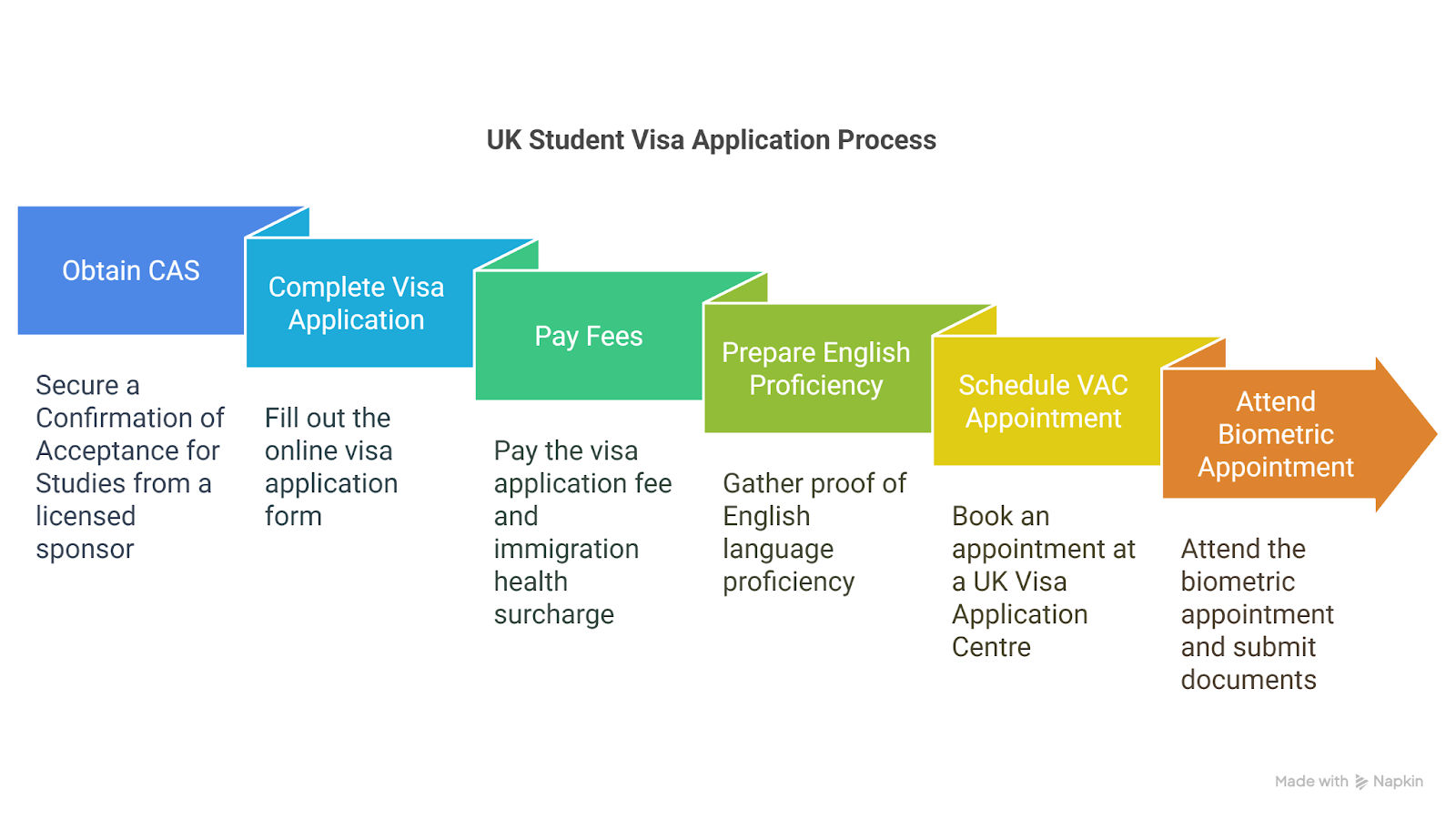
Once you have received your university offer and gathered the required documents, you can start your Student Visa for UK application. Follow the step-by-step process below to ensure your student visa for UK application is accurate and complete.
Step 1: Get Your CAS
Before you can apply, you must receive a Confirmation of Acceptance for Studies (CAS) from your university.
Accept your unconditional offer from a licensed UK student sponsor.
Meet all admission requirements and pay any required deposit.
Your university will then issue your electronic CAS reference number.
Step 2: Complete the Online Visa Application
The next step is to fill out the onlineapplication form for UK student visa.
Apply through the official GOV.UK Student Visa portal.
Enter your CAS reference number and complete all required details carefully.
Step 3: Pay the Visa Fees
You must pay the required government fees before booking your appointment.
Pay the Student Visa application fee of GBP 558 (approximately INR 64,170)
Pay the Immigration Health Surcharge (IHS) of GBP 776 (approximately INR 99,907) per year of your visa.
Step 4: Prepare Your Supporting Documents
Make sure all your documents are ready before submitting your application.
Keep your passport, CAS, academic transcripts, and financial documents ready.
Submit your English language test score (such as IELTS for UKVI or PTE Academic UKVI), unless your university has waived this requirement.
Step 5: Book Your Biometric Appointment
After submitting your application, you'll need to book a biometric appointment.
Schedule your appointment through VFS Global, the official UK visa partner.
Select your preferred Visa Application Centre (VAC) and appointment date.
Step 6: Visit the Visa Application Centre
You'll need to visit the VAC to complete your biometric process.
Provide your fingerprints and digital photograph.
Upload or submit your supporting documents, including your passport, financial proof, and academic records, as instructed.
Step 7: Track Your Application
After your appointment, you can monitor your application status.
Track your application through the VFS Global tracking system.
Wait for the official decision from UK Visas and Immigration (UKVI).
Step 8: Receive Your Visa and Travel to UK
Once your application is approved, you can prepare for your journey to UK.
You'll receive your passport with a 90-day visa vignette (entry sticker).
After arriving in UK, log in to your UKVI account to access and share your digital eVisa with employers or landlords when needed.
Once you know the process, your next step is to find where to submit your biometrics and documents.
Where to Submit Documents for UK Student Visa?
All biometric data and documents are submitted at UK Visa Application Centres (VAC). In India they’re managed by VFS Global, the official partner for UK Visas and Immigration.
These centers are located in major cities across the country, making it convenient for you to find one nearby. It's essential to schedule an appointment at your chosen VAC after completing your online visa application and fee payment.
Below is a list of UK Visa Application Centres in India, along with their addresses and contact information:
City
VFS Global Centre Address
New Delhi
VFS Global Services Pvt. Ltd., 27 Kasturba Gandhi (KG) Marg, Connaught Place, New Delhi - 110001
Mumbai (South)
1st Floor, Urmi Axis Building, Behind Famous Studio, Opp. E Moses Road, Mahalaxmi West, Mumbai - 400011
Mumbai (North)
First Floor, Trade Centre, G Block, Bandra Kurla Complex, Bandra (East), Mumbai - 400051
Office No. 312, 3rd Floor, Centrum Plaza, Golf Course Road, Near IILM Institute, Sector 53, Gurugram - 122002
Jaipur
7th Floor, World Trade Park, Jawahar Lal Nehru Marg, D Block, Malviya Nagar, Jaipur - 302017
Goa (Panjim)
Gera Imperium Star, 5th Floor, Office No. 508-511, Near Central Library, Patto Plaza, Panjim - 403001
After submitting your application, it's natural to be concerned about the outcome. Understanding common reasons for UK student visa rejections and how to avoid them can significantly increase your chances of approval.
UK Student Visa Rejection: Common Reasons & Tips
Rejections can disrupt your academic plans and lead to financial loss. Many Indian students face rejections due to incomplete paperwork or weak financial evidence. UK Home Office applies strict checks on every student visa for UK application.
Here are the most frequent reasons why UK student visas are refused, along with tips to fix or avoid them.
Insufficient Financial Evidence
If you don’t show proof of funds for tuition and living expenses, your visa will be denied.
Tip: Submit updated bank statements or financial sponsor letters covering the exact amount required.
Unclear Intentions or Weak Statement of Purpose (SOP)
If your study plan appears vague or disconnected from your academic or career path, the visa officer may question your intention.
Tip: Write a strong SOP that clearly explains why this UK course suits your background and future goals. Add specifics like course modules or faculty names.
Low English Language Proficiency Scores
Submitting ELP scores below the required level leads to rejection.
Tip: Take an approved SELT like IELTS UKVI or PTE Academic UKVI and ensure your score matches the requirement listed in your CAS.
Incorrect or Incomplete Documentation
Missing documents like the CAS, TB test report, or passport pages are among the most common causes of refusal.
Tip: Cross-check your document checklist from the official UKVI website and upload every page carefully during the online application.
Doubts About Return to Home Country
If your profile suggests you may overstay, the officer may reject the application.
Tip: Show strong ties to India like family responsibilities or a confirmed job opportunity post-study in your cover letter or SOP.
Incorrect Visa Application Form or Wrong Details
Entering wrong details such as your name, passport number, or CAS number leads to mismatches.
Tip: Review your application twice before submission and match every field with your official documents.
Late Visa Application
Applying too close to your course start date increases the risk of delays and rejection.
Tip: Apply at least 4 to 6 weeks before your course starts. UK allows visa applications up to 6 months in advance.
Conclusion
Applying for a Student Visa for UK is a straightforward process when you understand the eligibility requirements, prepare the necessary documents, and submit your application on time. From obtaining your Confirmation of Acceptance for Studies (CAS) and meeting the financial requirements to paying the visa fees and attending your biometric appointment, every step plays an important role in securing your visa. By planning ahead and ensuring your application is complete, you can avoid unnecessary delays and focus on preparing for your studies in UK.
What is the latest I can apply for UK student visa?
If you’re applying from outside UK, you must submit your student visa application no later than 6 months before your course starts, as mentioned on your CAS. If you’re applying from within UK to switch visas, your new course must begin within 28 days of your current visa’s expiry date.
Is UK student visa easy to get?
UK student visa is generally straightforward to get if you meet all the eligibility criteria. This includes a valid CAS, proof of finances, and English language proficiency.
What are the new rules for UK Student visa?
New rules states that higher financial maintenance funds, a fully digital e-Visa system, and restricted dependant options.
What if I fail to provide any of the required documents for UK student visa?
If you miss even one required documents such as your CAS, financial proof, or English test score, your UK student visa application could be rejected. Make sure to review your documents carefully before submission to avoid delays or denials.
After rejection, how much time should I take to reapply for UK student visa?
There's no official waiting period after UK student visa rejection. You can reapply immediately, but only after fixing the issues that caused your previous refusal.
Do I need a Tier 4 student visa to come and study in UK?
No, the Tier 4 student visa was replaced by UK Student visa route on October 5, 2020.If you're applying now, you’ll be using the new student visa system introduced under UK’s points-based immigration system.
How would I know if my UK student visa application got selected?
You’ll receive an official email from UK Visas and Immigration (UKVI) once a decision is made on your student visa for UK. If approved, your passport will be returned with a visa vignette sticker. You can also track your application status through the VFS Global portal used during your biometric appointment.
Is UK student visa valid for England or all UK countries?
UK student visa is valid for all four countries of the United Kingdom are England, Scotland, Wales, and Northern Ireland. You can study at an approved institution in any of these regions. Your visa allows you to live, study, and travel across UK while enrolled in a course with a licensed student sponsor.
Can I bring my family with me to UK after getting a student visa?
You can bring family members (dependants) to UK only if you are enrolled in a postgraduate research course or a program with a government-funded scholarship. Dependants include your spouse, partner, and children under 18.
How much does it cost to extend my student visa in UK?
Extending your UK student visa costs the same as initial application fee i.e. GBP 558 (approximately INR 64,170) and Immigration Health Surcharge (IHS), which is GBP 776 (approximately INR 99,907) per year of your visa.
How early can I arrive in UK before my course starts?
If your course lasts 6 months or less, you can arrive in UK up to 1 week before the course start date. For courses longer than 6 months, you may arrive up to 1 month before. However, you must not travel to UK before the start date given on your visa.
With over 12 years of experience in the education sector, Harjeet specializes in study abroad counseling and visa management. She has a proven ability to guide students through university applications...
Refer Your Friend & Earn upto ₹15000
Help your friend upgrade to a Global Career and earn rewards together.