Top 12 Stack Example in Real Life
By Mukesh Kumar
Updated on Aug 27, 2026 | 15 min read | 8.75K+ views
Share:

All courses
Certifications
More
By Mukesh Kumar
Updated on Aug 27, 2026 | 15 min read | 8.75K+ views
Share:
Table of Contents
Quick Overview
Step into the world of data with upGrad’s leading Online Data Science Course. Learn anytime, anywhere, no classrooms, no limits. Gain hands-on skills, work on real projects, and accelerate your career growth. Your data-driven future begins today.
Popular Data Science Programs
Let’s explore 12 practical stack example in real life that bring the LIFO principle to life.
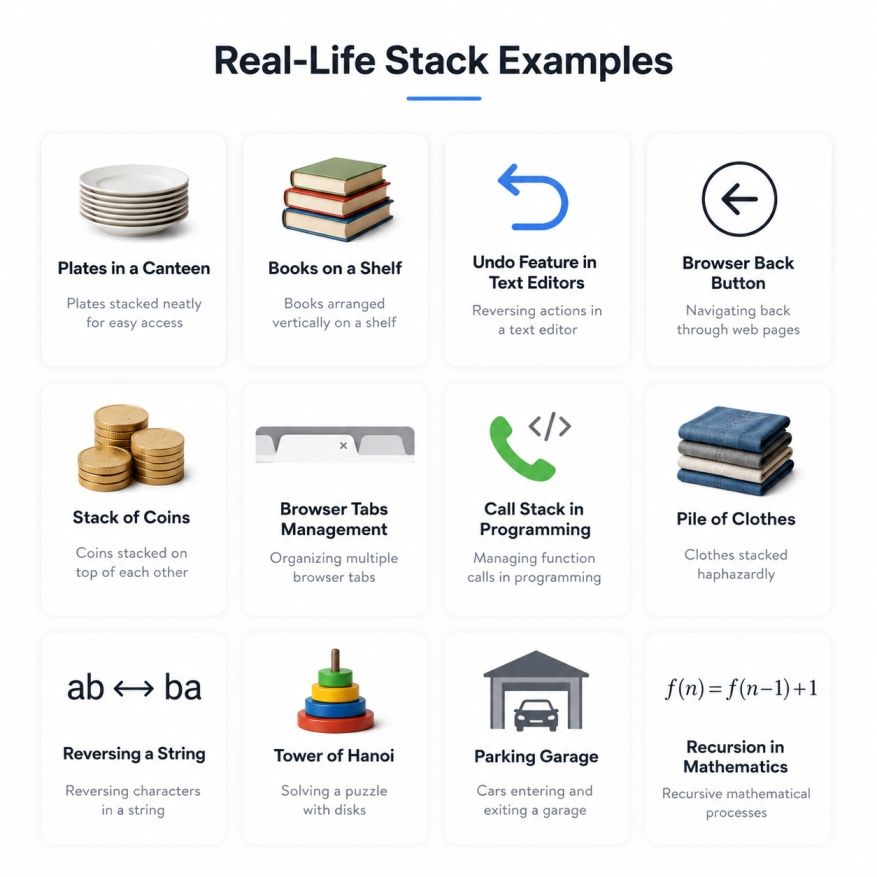
In a cafeteria, plates are arranged in a neat pile. Whenever someone needs a plate, they take the one from the very top. When new clean plates arrive, staff place them on top of the stack. You never take a plate from the middle or bottom because it would disturb the entire pile.
This makes it a classic stack example in real life:
Because it’s so easy to visualize, this example is often the first used by teachers to explain how stacks work.
When books are stacked vertically in a pile, the most recent book you placed ends up on the top. If you want to take one out, you’ll naturally grab the top book first. Trying to remove a book from the middle or bottom would disturb the entire stack.
This makes it a simple stack example in real life:
Also Read: Data Science Specializations in India 2026
Whenever you type, delete, or format text in an editor, each action is stored in a stack. The most recent change you make is always placed on the top of this stack. When you press Undo (Ctrl + Z), the editor removes or “pops” the last action, restoring the document to its earlier state.
This is a very practical stack example in real life because:
That’s why the undo feature feels natural, it directly follows the LIFO rule.
Build expertise in technology leadership, AI, digital strategy, and business management with the Chief Technology Officer Program – CTO & AI Course & Certification, designed for professionals preparing for senior technology roles.
When you browse the internet, every webpage you visit is stored in a stack. The current page you’re on sits at the top. When you click the Back button, the browser “pops” the current page from the stack and loads the previous one.
This makes the back button a clear stack example in real life:
It works exactly like a stack in programming, where the most recent entry is always the first one removed.
Also Read: Coding vs Programming: Difference Between Coding and Programming
When a program runs, each function call is stored in a special structure called the call stack. The most recent function called goes on top, and it must finish before the earlier ones can continue. If the program uses recursion, each new recursive call is also added to this stack until the base case is reached.
This makes the call stack an important stack example in real life for programmers:
This is a technical but very practical example of how stacks power the inner workings of code execution.
Also Read: What is Programming Language? Definition, Types and More
When you fold clothes and place them one over another, they naturally form a stack. The most recent item you place on top, like a shirt, jeans, or towel, is the one you’ll take first when you need it. If you want the item at the bottom, you must remove all the ones above it.
This makes it a very relatable stack example in real life:
Because everyone deals with piles of clothes daily, this example makes stacks easy to understand outside of a technical context.
Also Read: Top 20 Programming Languages of the Future
The Tower of Hanoi is a popular puzzle that directly shows how stacks work. It uses three rods and several disks of different sizes. The rules are simple: only one disk can be moved at a time, and a larger disk cannot sit on top of a smaller one. To move disks between rods, you can only take the top disk from any stack.
This puzzle is a clear stack example in real life because:
It’s often used in computer science classes to teach recursion and problem-solving, making it both a game and a teaching tool for stacks.
Also Read: Tower of Hanoi: A Symbol of Problem Solving and Creativity
In programming, reversing a string is a classic task where stacks come into play. The process works like this: each character of the string is pushed onto a stack one by one. Then, when you start removing or popping characters, they come out in reverse order because of the LIFO principle.
This makes string reversal a simple but powerful stack example in real life programming:
That’s why this method is often taught in beginner coding exercises, it directly links real coding logic to the concept of stacks.
Also Read: Difference Between Array and String
When you browse, tabs work like a stack.
Also Read: Stack in C++: Understanding the LIFO Data Structure
Coins arranged in a vertical stack perfectly show the LIFO principle.
A one-lane parking garage is a classic real-life example of stack behavior.
Recursive problems in mathematics, such as calculating factorials or Fibonacci numbers, rely on stacks behind the scenes.
Also Read: Fibonacci Series in Java: How to Write & Display Fibonnaci in Java
Before we summarize, here’s a quick look at all the examples we discussed:
Real-Life Example |
Stack Behavior |
LIFO in Action |
| Plates in Canteen | Plates stacked | Top plate removed first |
| Books on a Shelf | Books stacked | Top book picked first |
| Undo in Editors | Actions stacked | Last action undone first |
| Browser Back Button | Pages stacked | Last visited page shown first |
| Call Stack | Functions stacked | Last function resolved first |
| Pile of Clothes | Clothes stacked | Top cloth picked first |
| Tower of Hanoi | Disks stacked | Top disk moved first |
| Reversing a String | Characters stacked | Reverse by popping |
| Browser Tabs | Tabs stacked | Last tab closed first |
| Stack of Coins | Coins stacked | Top coin picked first |
| Parking Garage | Cars stacked | Last car leaves first |
| Recursion | Calls stacked | Last call resolved first |
A stack is a linear data structure where elements can only be added or removed from one end, called the top. Imagine a pile of plates or a stack of books, you always place new items on top and remove the top item first. This behavior follows the LIFO (Last In, First Out) principle, which is the core idea behind stacks.
A stack follows the Last In, First Out (LIFO) principle, where the last element added is the first one removed. All operations take place at the top of the stack, making insertion and deletion fast. A common real life example of stack in data structure is a stack of plates, where the last plate placed on top is the first one picked up.
Example:
Push 10
Stack: [10]

Push 20
Stack: [10, 20]

Push 30
Stack: [10, 20, 30]

Pop
Stack: [10, 20]The LIFO (Last In, First Out) principle means the newest item leaves the stack before older items. A simple stack real life example is a browser's Back button. The last webpage you visit is the first one displayed when you click Back.
Other stack real-life examples:
Example:
Stack after Push:
A
B
C ← Top

Pop()

Removed: C

Remaining:
A
B
Push adds an element to the top of the stack, while Pop removes the topmost element. These operations form the basis of every application of stack in real life, including undo operations, browser navigation, and expression evaluation.
Example:
Initial Stack:
[]

Push(5)
[5]

Push(10)
[5, 10]

Push(15)
[5, 10, 15]

Pop()

Removed: 15

Final Stack:
[5, 10]| Operation | Result |
|---|---|
| Push(5) | [5] |
| Push(10) | [5, 10] |
| Push(15) | [5, 10, 15] |
| Pop() | [5, 10] |
The Peek operation returns the top element without removing it from the stack. It allows a program to inspect the latest item while keeping the stack unchanged, making it useful in many stack-based algorithms.
Example:
Stack:
10
20
30 ← Top

Peek()

Output:
30

Stack After Peek:
10
20
30
Unlike Pop, the Peek operation only reads the top element and does not modify the stack.
Free Courses
You can implement a stack easily in Python using a list. Here’s a basic example:
stack = []

# Push elements onto the stack
stack.append('A')
stack.append('B')
stack.append('C')

print("Stack after pushes:", stack)

# Pop elements from the stack
print("Popped:", stack.pop())
print("Stack now:", stack)
Output:
Stack after pushes: ['A', 'B', 'C']
Popped: C
Stack now: ['A', 'B']
In this example, you can see how the Last In, First Out (LIFO) principle works in code. The last item added ('C') is the first one removed. This simple program mirrors every real life example of stack in data structure, from plates in a cafeteria to browser history or a pile of books. It helps beginners visualize how stacks operate both in programming and everyday scenarios.
After the Python example of a stack, it is also necessary to know what are the real life example of stack in data structure and programming languages. Let's explore stack applications in programming and software development.
Stacks have several practical uses in programming and software development. Some of the key applications are:
The function call stack keeps track of active function calls in a program. When one function calls another, the new function is placed on top of the stack. Once it finishes, it is removed and control returns to the previous function.
def first():
    second()

def second():
    third()

def third():
    print("Inside third function")

first()
Here, the calls are managed in this order:
first() → second() → third()
After third() finishes, the stack unwinds back through second() and first().
Recursion occurs when a function calls itself to solve a smaller version of the same problem. The stack stores each recursive call until the base condition is reached.
def factorial(n):
    if n == 1:
        return 1
    return n * factorial(n - 1)

print(factorial(5))
The calls are stored as:
factorial(5) → factorial(4) → factorial(3) → factorial(2) → factorial(1)
Once the base condition is reached, the calls are processed in reverse order.
Stacks help evaluate mathematical expressions and manage operators and operands. They are also useful when converting expressions between infix, postfix, and prefix forms.
def evaluate_postfix(expression):
    stack = []

    for item in expression.split():
        if item.isdigit():
            stack.append(int(item))
        else:
            b = stack.pop()
            a = stack.pop()

            if item == "+":
                stack.append(a + b)
            elif item == "*":
                stack.append(a * b)

    return stack.pop()

print(evaluate_postfix("2 3 + 4 *"))
Output:
20
The stack stores intermediate results and applies operators in the required order.
Backtracking uses a stack-like approach to explore different solutions and return to an earlier state when a chosen path does not work. It is commonly used in problems such as maze solving, puzzles, and generating combinations.
def generate_binary(n, result="", stack=None):
    if stack is None:
        stack = []

    if len(result) == n:
        stack.append(result)
        return

    generate_binary(n, result + "0", stack)
    generate_binary(n, result + "1", stack)

    return stack

print(generate_binary(2))
Output:
['00', '01', '10', '11']
The program explores one possibility, returns to the previous state, and then explores another.
Compilers use stacks to process programming language syntax, especially during parsing and expression evaluation. A compiler can use stacks to track operators, operands, parentheses, and nested structures.
For example:
expression = "(a + b) * c" stack = []

for char in expression:
    if char == "(":
        stack.append(char)
    elif char == ")":
        stack.pop()

print(stack)
Output:
[]
The stack tracks opening parentheses and removes them when the corresponding closing parentheses are encountered.
These examples show why the application of stack in real life example extends beyond physical objects such as plates or books. In software, the same LIFO concept helps manage function calls, recursion, expressions, backtracking, and compiler parsing.
Also Read: Career in Data Science: Jobs, Salary, and Skills Required
Data Science Courses to upskill
Explore Data Science Courses for Career Progression
IIIT Bangalore
Executive Post Graduate Certificate in Data Science & AIPlacement Assistance
Understanding the characteristics of stack data structure, along with its strengths and limitations, helps explain why stacks are widely used in programming. Many concepts become easier to understand when you relate them to a real life example of stack in data structure, such as browser history or a stack of plates.
The characteristics of stack data structure define how stack operations are performed and why stacks are useful in many algorithms.
The advantages of stack data structure make it suitable for many computing tasks and application of stack in real life.
Like every data structure, there are some limitations of stack data structure that affect where it can be used.
A stack real life example like a pile of books shows this limitation clearly, you can only remove or view the book on top without disturbing the others.
Also Read: Data Science Course Syllabus 2026: Subjects & Master’s Guide
A stack is one of the most important linear data structures because it follows the LIFO principle and supports fast data insertion and removal. Understanding its operations, characteristics, and application of stack in real life helps you solve many programming and algorithmic problems efficiently.
Learning a real life example of stack in data structure and comparing stacks with queues makes it easier to choose the right data structure. As you build more applications, knowing when to use a stack will strengthen your problem-solving and coding skills.
Do you need help deciding which courses can help you get your dream job? Contact upGrad for personalized counseling and valuable insights. For more details, you can also visit your nearest upGrad offline center.
Similar Reads:
The most relatable stack example is a pile of plates in a restaurant or kitchen. You always add clean plates to the top and take plates from the top. This natural behavior perfectly demonstrates the Last In, First Out principle that defines all stack operations.
Web browsers maintain a history stack where each webpage you visit gets pushed onto the stack. When you click the back button, the browser pops the current page and displays the previous one. This creates the familiar back navigation experience we use daily.
Call stacks manage function execution by storing information about active functions. When one function calls another, the calling function's details get pushed onto the stack. This enables proper memory management and allows programs to return to the correct execution point after function completion.
Software applications push each user action onto an undo stack. When you press undo, the application pops the most recent action and reverses it. This maintains the correct chronological order for undoing changes, making the interface intuitive and predictable.
When a stack reaches its maximum capacity, trying to push another element causes a stack overflow. In programming, this often results in an error or program crash. Physical stacks simply can't accept more items without falling over or becoming unstable.
No, stacks only allow access to the topmost element. This restriction is fundamental to stack behavior and ensures LIFO ordering. If you need random access to elements, you should use arrays or other data structures instead.
Mobile apps use navigation stacks where each screen gets pushed when opened. The back button pops the current screen and returns to the previous one. This creates consistent navigation patterns across different apps and platforms.
A physical pile of books naturally follows stack behavior, but you could theoretically remove books from the middle. A true stack data structure enforces the rule that you can only add or remove items from the top, making it more restrictive than physical piles.
Calculators convert mathematical expressions into postfix notation using stacks, then evaluate them efficiently. They also use stacks to match parentheses and ensure proper order of operations. This enables accurate calculation of complex mathematical expressions.
Stack memory automatically manages local variables and function parameters. When functions are called, their data gets pushed onto the memory stack. When functions return, their data gets popped off automatically, preventing memory leaks and ensuring efficient resource usage.
Notification systems display new notifications on top of existing ones, following stack ordering. When you dismiss notifications, you typically clear them from the top down. This ensures the most recent information gets priority attention.
Shipping, warehousing, and logistics industries frequently use stack-based loading. Cargo containers, truck loading, and inventory management often follow LIFO principles where items loaded last are unloaded first due to accessibility constraints.
Recursive algorithms implicitly use the call stack to manage function calls. Each recursive call gets pushed onto the stack, and as problems get solved, calls get popped off. This enables systematic problem-solving for complex recursive tasks.
Yes, stacks can be implemented using arrays or linked lists. Array-based implementations offer constant-time access but fixed size. Linked list implementations provide dynamic sizing but require more memory for pointers.
Compilers use stacks extensively for parsing code, managing symbol tables, and generating machine code. They handle operator precedence, bracket matching, and syntax analysis using stack-based algorithms, ensuring code gets compiled correctly.
Restaurants stack plates, trays, and serving dishes following LIFO principles. Staff add clean items to the top, and customers or servers take items from the top. This natural workflow ensures efficient operations and proper hygiene management.
Stack operations run in constant time because they only interact with the topmost element. There's no need to search through the entire structure or shift elements around. This makes stacks extremely fast for their intended use cases.
Email clients often display messages with newest emails at the top, following stack principles. Some email systems also use stacks for managing temporary storage during sending and receiving operations, ensuring messages get processed in the correct order.
Operating systems use stacks for process management, memory allocation, and interrupt handling. Each running program gets its own stack space, and the OS maintains system stacks for kernel operations. This enables multitasking and proper resource management.
Recognizing stack patterns in daily life helps programmers choose appropriate data structures for solving problems. It also makes abstract programming concepts more concrete and easier to understand, leading to better algorithm design and code implementation.
306 articles published
Mukesh Kumar is a Senior Engineering Manager with over 10 years of experience in software development, product management, and product testing. He holds an MCA from ABES Engineering College and has l...
Speak with Data Science Expert
By submitting, I accept the T&C and
Privacy Policy
Start Your Career in Data Science Today
Top Resources
Executive Diploma
12 Months
Master's Degree
18 Months
Bootcamp
6 Months