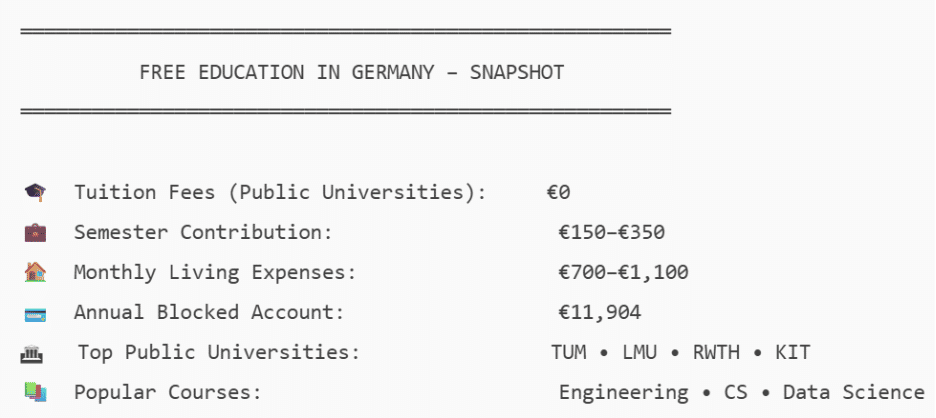
Public universities in Germany allow Indian students to pursue Bachelor’s and Master’s programs without paying tuition fees (except in Baden‑Württemberg). Students only pay a semester contribution of €150–€350 (INR 16K–37K).
While tuition is free, Indian students must show proof of annual living expenses through a blocked account amounting to €11,904 (INR 12.63L) for the German student visa.
In the sections ahead, you’ll learn everything about free education in Germany for Indian students, including top public universities, eligible courses, total study costs, scholarship options, application steps, and the documentation required for securing tuition‑free admission.
Top Public Universities for Free Education in Germany for Indian Students
Germany is home to several globally ranked public universities that offer high‑quality, tuition‑free education to Indian students across bachelor’s and master’s levels.
These universities are known for excellence in engineering, sciences, humanities, business, innovation, and research-driven learning environments.
Here is a QS‑verified list of the top public universities open to Indian students:
Top Public Universities in Germany for Free Education in Germany
These top public universities offer tuition‑free education, strong English‑taught programs, and globally recognized research opportunities, making Germany one of the best destinations for Indian students seeking affordable, high‑quality higher education.
Courses Available for Free Education in Germany for Indian Students
Germany offers a wide range of tuition‑free courses across engineering, management, sciences, and humanities at its public universities. Most programs are available at the master’s level in English, while bachelor’s programs may require German‑language proficiency.
Below are the major course categories Indian students commonly pursue:
Engineering and STEM Programs
Engineering and STEM remain the most popular choices for Indian students in Germany due to strong research output, advanced labs, and excellent employability.
Popular free programs include:
Mechanical, Electrical & Electronics Engineering
Automotive & Aerospace Engineering
Computer Science & Data Science
Civil & Environmental Engineering
Robotics & Mechatronics
Physics, Chemistry & Applied Sciences
Renewable Energy & Sustainable Engineering
Business and Management Courses
Public universities in Germany also offer several tuition‑free business and management programs, especially at the master’s level.
Common specializations include:
Master’s in Management (MiM)
International Business
Supply Chain & Logistics
Economics & Public Policy
Finance & Accounting
Marketing & Strategic Management
Humanities and Social Sciences
Germany provides a wide selection of tuition‑free courses in humanities and social sciences, making it a strong destination for research‑oriented students.
Popular areas of study include:
Psychology & Cognitive Science
Sociology, Anthropology & Political Science
Linguistics & German Studies
History, Philosophy & Cultural Studies
Media, Journalism & Communication
Education & International Relations
Cost of Studying in Germany for Indian Students
While tuition at German public universities is free, Indian students must still plan for living expenses, semester contributions, health insurance, and visa-related costs.
The breakdown below gives a realistic estimate of studying in Germany:
Tuition Fees in Public vs Private Universities in Germany:
University Type
Tuition Fees for Indian Students
Public Universities
Tuition-free
Semester Contribution
€150–€350 (INR 16K–37K)
Private Universities
€10,000–€20,000 per year (INR 10.61L–21.22L)
Living Expenses in Germany for Indian Students:
Expense Category
Estimated Monthly Cost
Accommodation
€350–€700 (INR 37K–74K)
Food & Groceries
€150–€250 (INR 16K–27K)
Transport
Typically included in semester ticket
Utilities & Internet
€100–€150 (INR 11K–16K)
Miscellaneous
€100–€150 (INR 11K–16K)
Total Monthly Estimate: €700–€1,100 (INR 74K–1.16L)
Total Yearly Living Cost: €8,400–€13,200 (INR 8.9L–14L)
Semester Contribution and Other Charges
Cost Type
Amount for Indian Students
Semester Contribution
€150–€350 (INR 16K–37K) per semester
Health Insurance (Public)
€80–€110 per month (INR 8.5K–12K)
Health Insurance (Private)
€30–€60 per month (INR 3K–6K)
German Student Visa Fee
€75 (INR 8K approx.)
Blocked Account Requirement
€11,904 per year (INR 12.63L)
Miscellaneous Academic Costs
€200–€500 yearly (INR 21K–53K)
Scholarships for Free Education in Germany for Indian Students
Scholarships help Indian students cover living expenses, accommodation, travel, and academic costs while studying tuition‑free at German public universities.
The table below summarizes the top government, university, and program‑specific scholarships available to Indian students:
Top Scholarships for Indian Students in Germany
Scholarship Name
Coverage
Best For
DAAD Scholarships
Monthly stipend, travel allowance, health insurance, and academic cost coverage
Master’s & research students seeking fully funded opportunities
Deutschlandstipendium
Merit-based monthly funding jointly provided by government & private sponsors
High-achieving UG & PG students across public universities
Erasmus Mundus Joint Master’s Scholarship
Fully funded: tuition, monthly stipend, travel, and insurance
Students pursuing multi-country joint master’s programs
Heinrich Böll Foundation Scholarship
Monthly stipend + funding for academic and living costs
Students in social sciences, political studies, sustainability, and humanities
Konrad-Adenauer-Stiftung Scholarship
Monthly funding, tuition support , networking & leadership training
Leadership-driven students in political science, public policy, law, and related fields
University‑Specific Scholarships (TUM
Tuition waivers, monthly allowances, research grants
Students with strong academic & research profiles applying to specific universities
These scholarships significantly lower the overall cost of living in Germany, enabling Indian students to access high‑quality, tuition‑free education with strong financial support.
Eligibility Criteria for Free Education in Germany for Indian Students
To study for free at German public universities, Indian students must meet specific academic, language, and documentation standards.
These requirements ensure that students are prepared for the academic rigor and visa obligations associated with studying in Germany.
Below is a structured overview of the key eligibility criteria:
Eligibility Criteria for Free Education in Germany for Indian Students
Requirement
Details
Academic Qualifications
Class 12 for UG; recognized bachelor’s degree with good grades for master’s.
German Language (if required)
B1/B2 for most bachelor’s; some master’s may need C1.
English Language (English‑taught programs)
IELTS 6.0–6.5 or TOEFL 80–90.
APS Certificate
Mandatory for all Indian students applying to German universities.
Entrance Exams
GRE/GMAT only for selected programs (recommended, not compulsory).
Documents Needed
SOP, LORs, CV, transcripts, passport, APS certificate, test scores.
Financial Proof (Visa)
Blocked account or scholarship letter showing required funds.
Additional Requirements
Portfolios (design), research proposals (thesis‑based courses).
How to Apply for Free Education in Germany for Indian Students?
Applying for free education in Germany involves selecting courses, preparing documents, meeting language requirements, and following the university and visa steps carefully.
The process below helps Indian students secure admission to Germany’s tuition‑free public universities smoothly:
1. Choose the Right Course and University
Begin by shortlisting tuition‑free programs at German public universities.
Explore English‑taught and German‑taught programs.
Use the DAAD course database to compare requirements.
Check whether your chosen program requires GRE/GMAT or portfolios.
2. Check Eligibility and Language Requirements
Eligibility varies by course level:
For bachelor’s: Class 12 + German language (for German‑taught programs).
For master’s: Recognized bachelor’s degree with good grades.
Language requirement: IELTS/TOEFL for English‑taught programs; B1–C1 German for German‑taught programs.
3. Obtain the APS Certificate (Mandatory for Indian Students)
The APS certificate is required for ALL Indian students applying to German universities.
Must be obtained before submitting a visa application.
Verifies your academic documents through the German Academic Evaluation Centre (AEC).
4. Apply Through Uni‑Assist or University Portals
Most German universities accept applications via:
Uni‑Assist (centralised application service)
OR direct university application portals
Documents usually required:
Academic transcripts
SOP & LORs
CV
Language test scores
Passport
APS certificate
5. Receive Admission Letter & Arrange Funding
Once admitted, students must:
Confirm their seat
Arrange funding for living costs (blocked account or scholarship)
Finalize accommodation arrangements
6. Apply for a German Student Visa
Submit your visa application after securing admission.
Required documents include:
Admission letter
Blocked account / funding proof
Passport & photographs
Insurance proof
APS certificate
Academic transcripts
Challenges of Free Education in Germany for Indian Students
Despite free tuition at public universities, Indian students may face certain academic, cultural, and administrative challenges while studying in Germany. Being aware of these issues helps students plan better and adjust smoothly to the German education system.
1. Language Barrier in Daily Life
Even if the program is taught in English, German is important for part‑time jobs, internships, daily communication, and long‑term career opportunities. Learning the language takes time and consistent effort.
2. Limited English‑Taught Bachelor’s Programs
Most bachelor’s degrees in Germany are offered in German. Indian students seeking English‑taught undergraduate programs may find fewer options and stricter admission criteria.
3. Competitive Admission for Popular Programs
Engineering, computer science, and STEM programs attract a high number of international applicants. Strong academic performance and well‑prepared documents are essential to stand out.
4. High Living Costs in Major Cities
Cities like Munich, Frankfurt, and Stuttgart have higher accommodation and day‑to‑day costs. Finding affordable housing can also be challenging for new students.
5. Strict Documentation Requirements
Germany follows a document‑heavy admission and visa process. APS certificate, blocked account funding, academic transcripts, SOPs, and notarised copies are mandatory and time‑consuming to prepare.
6. Academic Rigor and Independent Learning
German universities expect independent research, self‑study, and analytical assignments. Students may initially struggle to adapt to the less hand‑holding, more structured academic approach.
7. Limited On‑Campus Housing
Student dormitories fill up quickly, pushing many students to search for private accommodation, which can be expensive or hard to secure.
8. Part‑Time Job Competition
While part‑time work is allowed, job availability varies by region. Basic German skills are usually required for customer‑facing roles.
Conclusion
Germany offers Indian students world‑class, tuition‑free education through its highly ranked public universities, making it one of the most affordable study‑abroad destinations globally.
With free tuition, strong research opportunities, and excellent career prospects, Germany provides a high‑value academic experience without the burden of heavy fees.
While students must plan for living expenses, documentation, and language requirements, the overall cost remains far lower than other popular countries.
Yes, education is free in Germany for Indian students at public universities because they do not charge tuition fees for most bachelor’s and master’s programs. Students only pay a semester contribution and must manage their living expenses. With part‑time jobs and scholarships, many Indian students reduce these costs significantly.
How to get free education in Germany for Indian students?
Understanding how to get free education in Germany for Indian students starts with applying to tuition‑free public universities, meeting language and academic requirements, and securing the APS certificate. Students must prepare strong documents, choose eligible programs, and show proof of funds for living expenses through a blocked account or scholarship support.
Do Indian students need German language skills for free programs?
German language skills are mainly needed for bachelor’s programs taught in German. However, many public universities offer English‑taught master’s programs that require only IELTS or TOEFL. Learning German still helps students with part‑time jobs, internships, and daily life in Germany.
Which free courses are popular among Indian students in Germany?
Indian students commonly pursue free programs in engineering, computer science, data science, management, economics, social sciences, natural sciences, humanities, and environmental studies. These subjects offer strong job prospects, excellent research opportunities, and are widely available at tuition‑free public universities.
Why does Germany provide free education to international students?
Germany follows a publicly funded higher education system intended to promote equal access, attract skilled talent, and strengthen its workforce. By keeping tuition free for all nationalities, Germany increases its global academic reputation while supporting long‑term economic growth through highly trained graduates.
Are private universities free in Germany?
No, private universities in Germany charge full tuition fees and are not part of the free education model. Indian students seeking tuition‑free study should apply to public universities, which offer both bachelor’s and master’s programs without tuition fees except in Baden‑Württemberg.
What is the semester contribution in Germany?
The semester contribution is a mandatory administrative fee ranging from €150–€350. It covers student union services, campus facilities, and often a public transport pass. Although tuition is free at public universities, this semester fee must be paid every term by all students.
What is the APS certificate and why is it needed?
The APS certificate verifies Indian students’ academic documents and is compulsory for university applications and visa processing in Germany. Without APS approval, students cannot enroll in German universities or submit their visa application. It ensures transparency and authenticity in the admission process.
Can Indian students work part‑time while studying in Germany?
Yes, Indian students can work up to 20 hours per week during semesters and full‑time during vacations. Part‑time jobs help students cover living expenses but do not replace the required blocked account amount needed for visa approval. Knowing basic German improves job opportunities significantly.
What is a blocked account and why is it required?
A blocked account is a financial requirement for the German student visa. Indian students must deposit the yearly living expenses amount, which is released monthly after arrival. It ensures students can support themselves financially while studying in Germany’s tuition‑free public universities.
Are scholarships available for Indian students in Germany?
Yes, Indian students can apply for DAAD, Erasmus Mundus, Deutschlandstipendium, and university‑specific scholarships. These programs offer stipends to cover living costs, insurance, and travel expenses. Scholarships are especially helpful for students studying in high‑cost cities like Munich or Frankfurt.
Which German cities are budget‑friendly for Indian students?
Cities such as Leipzig, Dresden, Aachen, and Karlsruhe are more budget‑friendly with lower rent and living costs. Major cities like Munich and Frankfurt have higher expenses, so many students choose smaller or mid‑sized cities to manage their monthly budgets comfortably.
Are English‑taught programs free in Germany?
Yes, English‑taught programs at German public universities are tuition‑free for Indian students. However, admission to these programs can be competitive due to high international demand. Strong academic performance, good language scores, and well‑prepared application documents improve acceptance chances.
Can Indian students study in Germany without German language skills?
Yes, especially for English‑taught master’s programs that only require IELTS or TOEFL. However, students planning to work part‑time, interact locally, or pursue long‑term careers in Germany will benefit greatly from learning German at least up to B1 or B2 level.
What documents are required to apply for free education in Germany?
Indian students need academic transcripts, SOP, LORs, CV, APS certificate, passport, IELTS/TOEFL scores, and program‑specific documents such as portfolios or research proposals. Ensuring all documents meet university guidelines is essential for a smooth admission process.
How long does it take to get admission in German universities?
Admission decisions usually take 4–12 weeks, depending on the university, intake season, and application platform. Applying early increases the chances of timely acceptance and allows students enough time to arrange the APS certificate and the blocked account for the visa process.
Do Indian students need health insurance to study in Germany?
Yes, health insurance is mandatory for all students in Germany. Public student insurance is widely used and offers affordable coverage. Some international students may opt for private insurance based on age, program type, or university requirements.
When are the major intakes for German universities?
Germany has two primary intakes: Winter Intake (October), which is the main session with the most course options, and Summer Intake (April), which offers a smaller selection. Indian students should apply 6–10 months in advance to meet university and visa deadlines.
How competitive are admissions to free universities in Germany?
Admissions can be competitive, especially for engineering, management, and computer science programs. Strong academic records, well‑written SOPs, relevant experience, and timely submission of documents help improve acceptance chances in these high‑demand programs.
How to get free education in Germany for Indian students without knowing German?
One way how to get free education in Germany for Indian students without German skills is to apply for English‑taught master’s programs in public universities. Students must meet academic and language requirements, prepare the APS certificate, and submit strong application documents to secure admission.
She is an experienced writer and journalist who has extensively covered the education sector in India and Abroad. Now helping Indian aspirants realise their foreign education dream by providing them w...
Refer Your Friend & Earn upto ₹15000
Help your friend upgrade to a Global Career and earn rewards together.