Laurier enhances the largest co-op program for business degrees in Canada, enrolling over 2,700 undergraduate and graduate students. The program emphasizes experiential learning and career development.
The University of Ottawa offers co-op programs in English and French, with a placement success rate exceeding 98%. Students can choose from various fields, including arts, law, engineering, and business.
In 2025, the Co-operative courses scene in Canada continues to increase, with institutions like the University of Waterloo leading globally by enrolling over 20,000 undergraduate students in co-op programs. These factors collectively make Canada an attractive option for international students pursuing Co-op Program.
Several factors highlight Canada's appeal as a top destination for international students seeking co-op education in the best universities. Moreover, the economic contribution of international students to study in Canada has been substantial, with an estimated annual impact of CAD 22.3 billion (INR 1.36 LCr).
In this blog, you’ll explore the top co-op courses in Canada for 2025, the institutions offering them, their benefits, and how international students can use them to grow their careers
Co-op education in Canada spans various disciplines, including engineering, business, health sciences, and computer science. The duration of co-op programs typically extends the undergraduate degreeby 4 to 12 months.
Living expenses CAD 1,000–1,500 (INR 61K - 92.9K)/month
These co-op programs are structured to provide students with practical experience preparing them for successful careers post-graduation.
Let’s now highlight some programs that offer exceptional practical experiences.
Top 8 Co-Op Courses in Canada (2025)
All engineering programs at Université de Sherbrookeare offered in co-op, which provides students with work experience and financial support for their studies. In 2025, Canada's co-operative (co-op) education programs will continue to be a significant draw for new rules for international students.
Which Canadian colleges offer co-op programs similar to Conestoga?
Conestoga College is renowned for its strong co-op programs. Several other Canadian institutions offer co-op programs with similar structures and benefits, providing students with valuable work-integrated learning experiences.
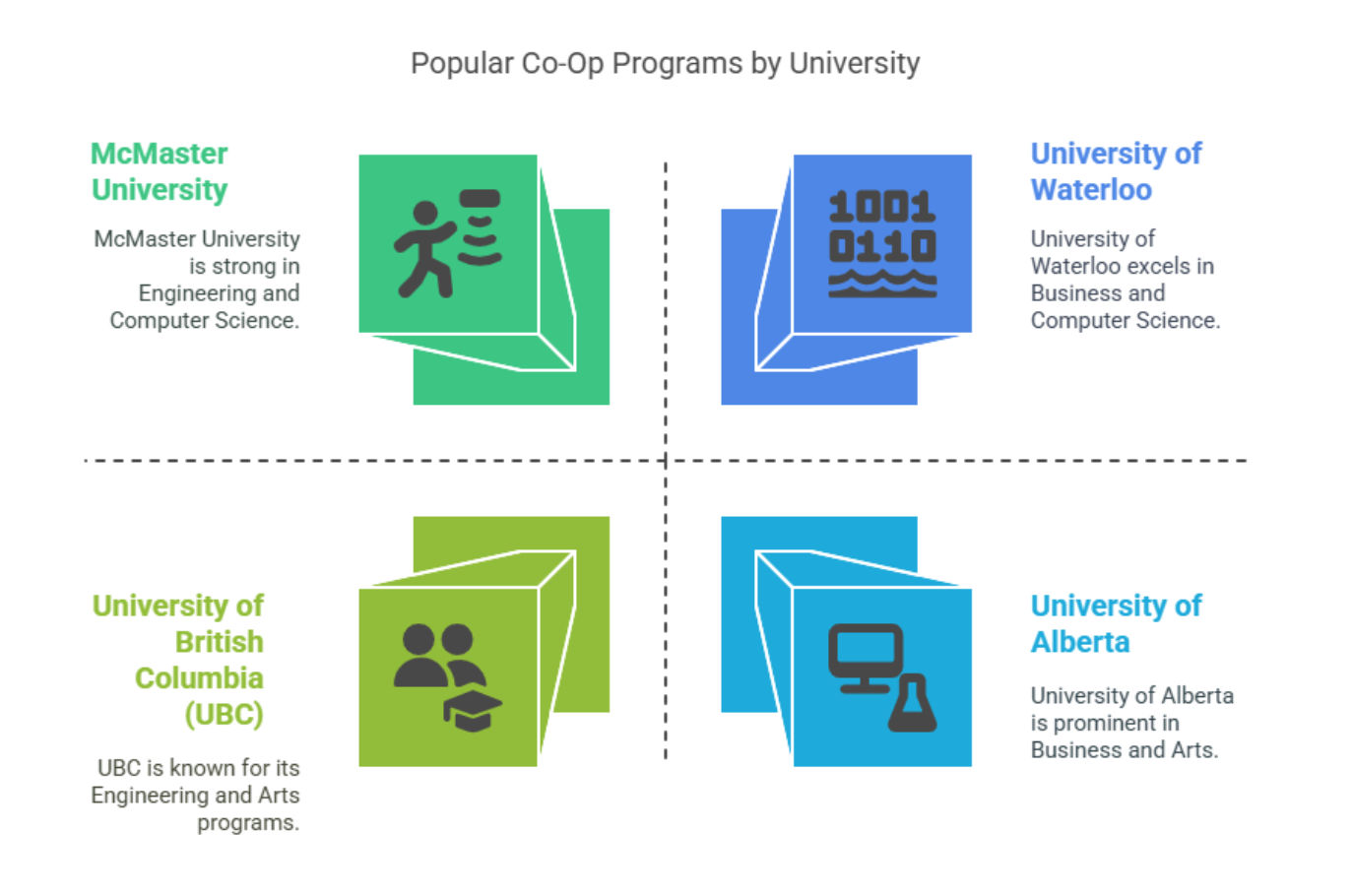
Below is a curated list of the top 8 co-op courses in Canada for 2025, highlighting the institutions offering them, popular programs, and associated tuition fees:
Admin Fee: CAD 496 (INR 30.35K) per term; Work Term Fee: CAD 496 (INR 30.35K) per term
Note: Tuition fees are approximate and may vary based on specific programs and courses. For the most accurate and up-to-date information, consult the university's official website.
Now that we've explored the top co-op programs in Canada, let's examine the eligibility criteria for international students aspiring to join them in 2025. If you're seeking co-op programs similar to Conestoga College's offerings, institutions like the University of Waterloo, Seneca Polytechnic, and Humber College provide robust co-op opportunities across various disciplines. These programs are designed to integrate academic learning with practical work experience, enhancing employability and industry readiness.
Eligibility for Co Op Courses in Canada
As of 2025, Canada hosts over 1 million international students, making it a top study destination. Co-op programs offer hands-on training and require IRCC eligibility.
Eligibility for Studying in Canada. As it is one of the top 10 countries to migrate from India, Canada offers a well-defined admission process, a strong academic system, and promising career opportunities for international students.
Let’s explore Co-Op courses in Canada meaning, structure, and how they differ from regular academic programs.
Academic Criteria
In 2025, Canadian universities will continue to uphold rigorous academic standards for admission into co-operative (co-op) education programs. These criteria ensure that students possess the necessary educational foundation.
To provide a more precise understanding, here's a comparison of the academic requirements for co-op programs at several top Canadian universities:
University
Minimum GPA Requirement
Additional Academic Requirements
University of Waterloo
Varies by program
Must be enrolled in a program with co-op as a component; the co-op application is separate from academic admission.
University of British Columbia
70% cumulative average
Must have third-year standing (completed at least 48 credits); enrolled in a program that includes co-op as a component.
Completion of Science 2C00: Skills for Career Success in Science in Year 2; good academic standing.
University of Alberta
Varies by program
Must be enrolled in a program with co-op as a component; the co-op application is separate from academic admission.
University of Ottawa
75% (B+) average
Must have begun studies at Ottawa before applying; co-op option available in four-year undergraduate programs.
University of Victoria
4.0 GPA
Completion of all courses listed in the first and second year of the model program; student in good standing.
Concordia University
Varies by program
They must maintain the minimum CGPA required for their program of study and maintain full-time status while a member of the Institute.
Note: GPA scales vary by institution; please refer to each university's official website for specific grading systems.
These academic criteria are designed to ensure that students are well-prepared for the challenges of co-op placements. Now, let’s have a look at the English language criteria.
English Language Criteria
As of 2025, Canada's co-op programs maintain English language proficiencystandards to ensure students can effectively engage in academic and professional environments.
In addition to academic and language requirements, Canadian co-op programs for international students necessitate fulfillment of several miscellaneous criteria.
Note: The above requirements are subject to change. It's advisable to consult the university's official website for the most accurate and up-to-date information.
These English proficiency standards ensure students can communicate and perform well in academic and co-op work settings. Up next, you'll explore Canada’s co-op course admission process with a step-by-step guide for applicants.
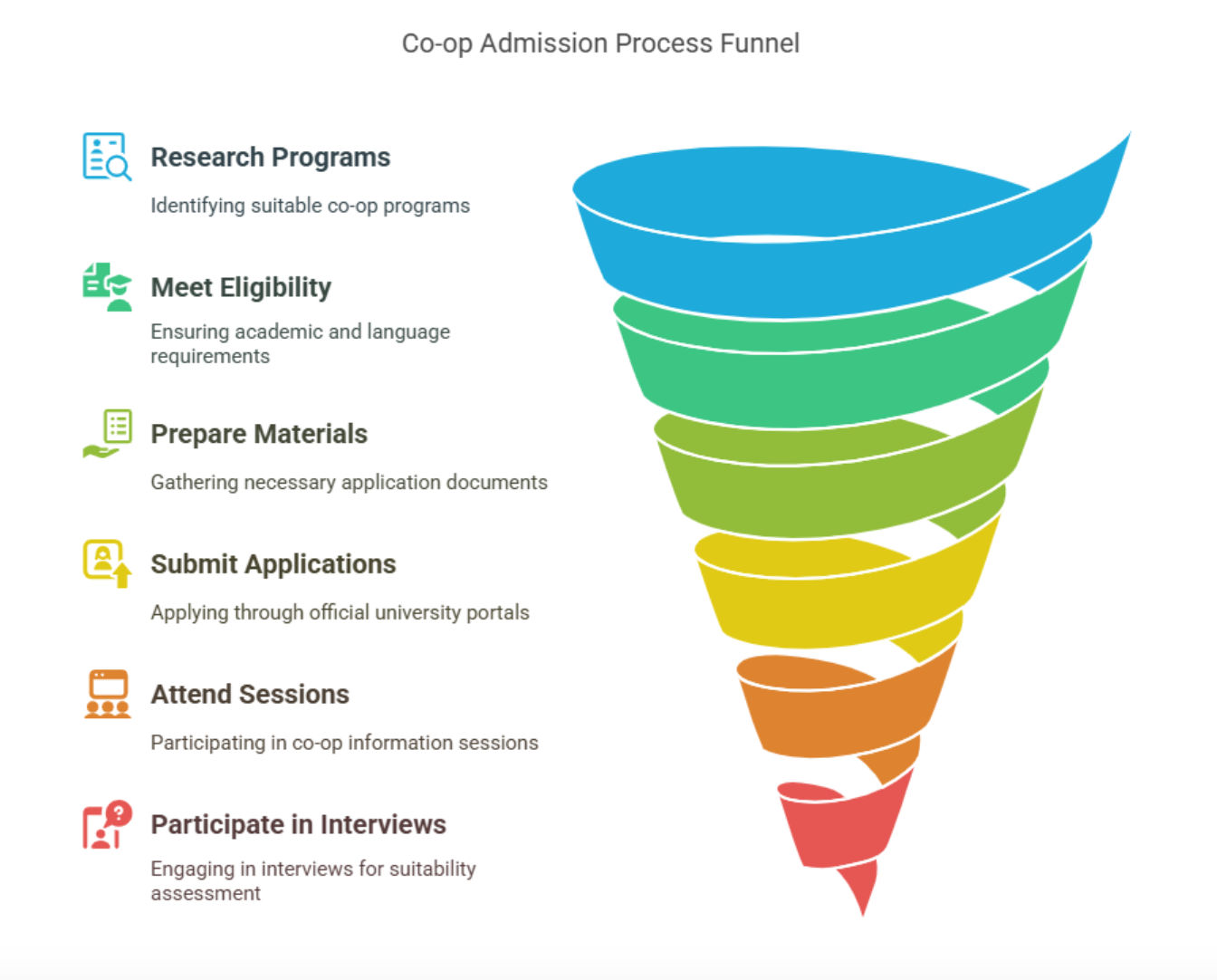
Admission Process for Co-op Courses in Canada
Over 75% of international students choosing Canadian co-op programs report a streamlined admission experience, highlighting Canada’s commitment to accessible education. Understanding the step-by-step admission process helps applicants prepare thoroughly.
Research and Shortlist Programs
Explore top Canadian universities offering co-op programs, such as the University of Waterloo, the University of Toronto, and Simon Fraser University.
For undergraduate programs, aim for an academic score of 75% or higher (or equivalent GPA). Co-op programs typically last 4–5 years, including multiple 4–8 month work terms.
Tuition fees for co-op programs range from CAD 20,000 to 30,000 (INR 11.8L–17.7L) annually, with additional fees of CAD 1,000–2,000 per term.
Prioritise universities with strong employer networks. Waterloo, for example, partners with 7,000+ employers globally, boosting chances for placement in the tech, finance, and engineering sectors.
Meet Eligibility Criteria
Ensure you meet the academic requirements, including GPA thresholds and prerequisite courses.
Verify English language proficiency through standardized tests like IELTS or TOEFL.
Check for any additional requirements specific to the program or university.
Prepare Application Materials
Gather necessary documents such as transcripts, letters of recommendation, and a statement of purpose.
Update your resume to highlight relevant academic achievements and extracurricular activities.
Craft a compelling purpose statement outlining your interest in the co-op program and career aspirations.
Submit Applications
Apply through the university's official application portal, adhering to all deadlines.
Pay attention to application fees and ensure all required documents are submitted.
Attend Information Sessions (if required)
Some universities, like York University, must attend co-op information sessions before applying.
These sessions provide valuable insights into the co-op program and its benefits.
Participate in Interviews
Shortlisted candidates may be invited for interviews to assess their suitability for the program.
Prepare by practicing common interview questions and demonstrating enthusiasm for the co-op experience.
Receive the Offer and Accept
Successful applicants will receive an offer of admission.
Accept the offer promptly and complete any required formalities, such as submitting an academic plan change form.
Apply for Co-op Work Permit (for international students)
International students must apply for a co-op work permit through Immigration, Refugees and Citizenship Canada (IRCC).
Ensure you have a valid study permit and a letter from your institution confirming the co-op requirement.
Register for Co-op Courses
Upon acceptance, register for co-op courses as per the university's guidelines.
Stay informed about co-op workshops and networking events to enhance your employability.
Begin Co-op Placement
Commence your co-op work term, applying academic knowledge in a practical setting.
Engage actively with employers and seek feedback to maximize learning opportunities.
In the next section, let’s discuss the cost of studying co-op courses in Canada, providing insights into tuition fees and additional expenses.
Cost of Studying Co-op in Canada
As of 2025, international students can expect significant expenses when pursuing co-op programs in Canada. For instance, the University of Waterloo charges a co-op fee of CAD 865 (INR 52,000) per term and standard tuition fees.
Living expenses vary by location. For example, Toronto's average monthly living cost is approximately CAD 1,300 (INR 78,000), compared to Vancouver, where it is slightly higher at around CAD 1,400 (INR 84,000).
The table below provides an overview of the estimated costs associated with studying co-op programs in Canada:
Expense Category
Average Cost (CAD)
Average Cost (INR)
Tuition Fees (per year)
CAD 20,000 - 30,000
INR 11.8L - 17.7L
Co-op Fees (per term)
CAD 1,000 - 2,000
INR 59,000 - 1.18L
Living Expenses
CAD 1,000 - 1,500
INR 59,000 - 88,500
Total Annual Cost
CAD 35,000 approx.
INR 20.65L approx.
Note: The above figures are approximate and can vary based on the university and location.
The following part will explore the financial aid and scholarship opportunities for international students pursuing co-op programs in Canada.
Co-op Courses in Canada: Financial Aid and Scholarships
Canadian universities and government bodies will offer a range of scholarships and study in Canada for free options to support international students pursuing co-op programs.
For instance, the University of Toronto provides the Lester B. Pearson International Scholarship, covering full tuition and living expenses. These financial aids aim to alleviate the financial burden on students and encourage academic excellence.
Complete coverage for undergraduate students at the University of Toronto with exceptional academics and leadership potential
Pierre Elliott Trudeau Foundation Scholarship
External
CAD 60,000 (INR 35.4L)/year for doctoral students in social sciences and humanities focused on public engagement and leadership
Ontario Graduate Scholarship (OGS)
Government
CAD 15,000 (INR 8.85L)/year for graduate students in Ontario universities demonstrating academic excellence
University of Ottawa Undergraduate Scholarships
University-Specific
Up to CAD 20,000 (INR 11.8L)/year for international undergraduate students at the University of Ottawa
Schulich Leader Scholarships
External
CAD 120,000 (INR 70.8L) for engineering and CAD 100,000 (INR 59L) for other STEM students entering participating Canadian universities
Mitacs Globalink Research Award
External
Up to CAD 6,000 (INR 3.5L) for undergraduate and graduate students conducting research with Canadian institutions
University of Calgary International Entrance Scholarship
University-Specific
CAD 60,000 (INR 35.4L) over 4 years for international undergraduate students at the University of Calgary
TD Canada Trust Scholarship for Community Leadership
External
Up to CAD 70,000 (INR 41.2L) for high school and CEGEP students entering university or college with outstanding community leadership
Loran Scholars Foundation
External
Up to CAD 100,000 (INR 59L) for high school graduates demonstrating leadership, service, and character
Quebec Merit Scholarships for Foreign Students
Government
Varies for international students pursuing master’s, doctoral, or postdoctoral studies in Quebec
Note: The INR values are approximate and based on the current exchange rate
The next part will discuss the career prospects available to students upon completing co-op programs in Canada.
Career Prospects after Co-op Course in Canada
Graduates of co-op programs in Canada often secure different positions across various industries. In 2025, the average salaries in Canadafor professionals in Canada will be approximately CAD 115,800 (INR 72.56 LCr).
The following table outlines some of the top job roles available to graduates of co-op programs in Canada:
Job Role
Average Annual Salary (CAD)
Average Annual Salary (INR)
Software Engineer
CAD 90,940
INR 55.3L
Mechanical Engineer
CAD 74,388
INR 45.3L
Pharmacist
CAD 100,753
INR 61.3L
Data Analyst
CAD 64,539
INR 39.3L
Project Manager
CAD 82,119
INR 50.0L
HR Manager
CAD 88,166
INR 53.7L
Financial Analyst
CAD 64,973
INR 39.6L
Registered Nurse
CAD 81,154
INR 49.5L
Teacher
CAD 66,409
INR 40.5L
Educator
CAD 49,460
INR 30.2L
Source: Glassdoor
These roles span various sectors, including technology, healthcare, finance, and education, reflecting the diverse opportunities available to co-op graduates in Canada.
Now, let us explore the top recruiters in Canada for co-op programs.
Top Recruiters in Canada for Co-op Graduates
In 2025, Canada’s co-op programs will connect academicswithindustry, attracting top employers. These programs will create jobs in Canada for Indians by offering work experience, networking, and part-time jobs in canada. TheUniversity of Waterloo will be recognized by over 83 top Canadian employers in 2025.
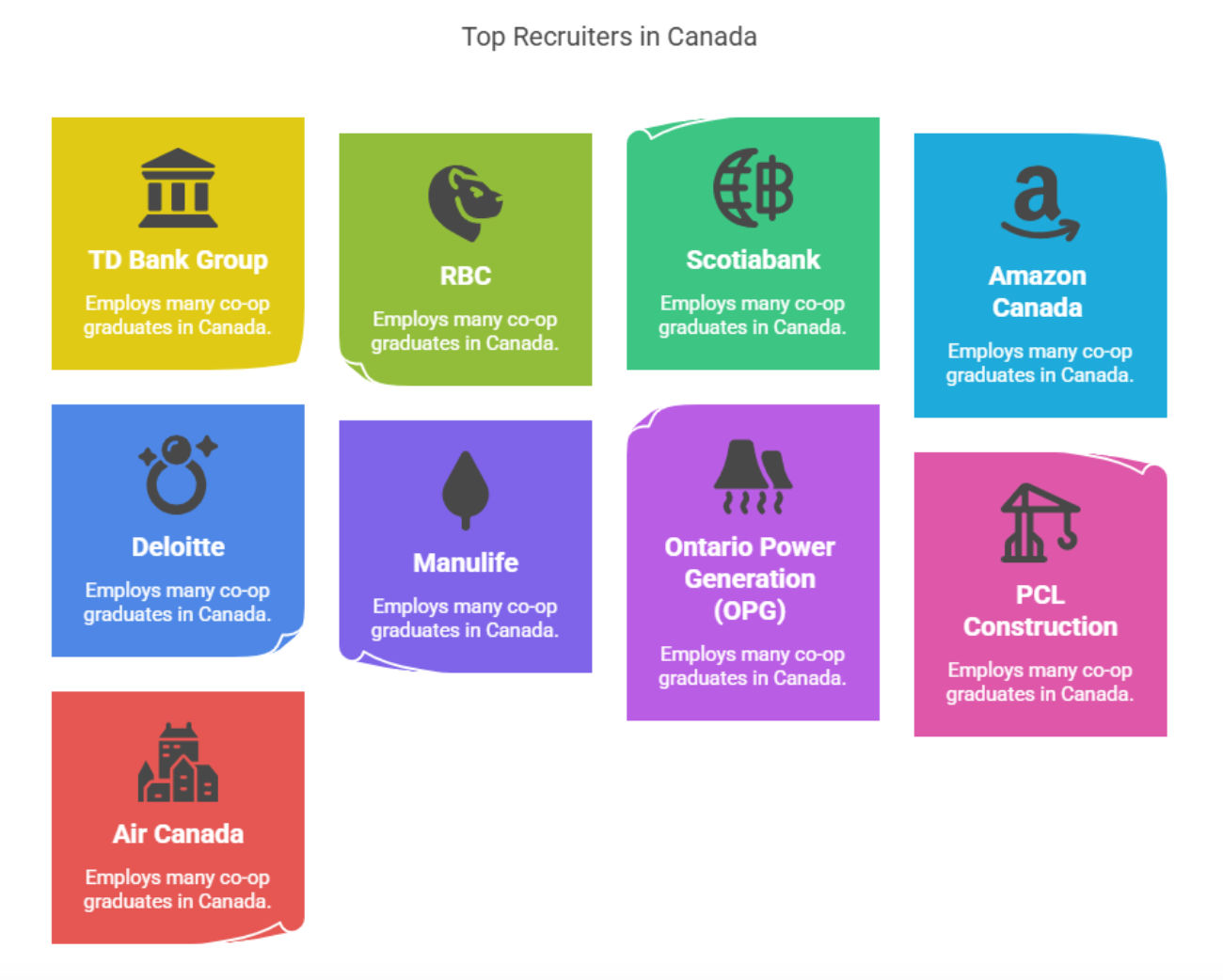
The table below highlights some of the leading companies and institutions known for hiring co-op students in Canada:
Employer
Industry
Co-op Opportunities
TD Bank Group
Banking & Finance
Provides co-op positions in various departments, including technology and operations.
RBC
Banking & Finance
Offers co-op and internship programs in technology, finance, and risk management.
Scotiabank
Banking & Finance
Provides co-op opportunities in technology, audit, and other departments.
Amazon Canada
E-commerce & Tech
Offers co-op positions in software development and other technical roles.
Deloitte
Consulting
Provides co-op and internship programs in the consulting and technology sectors.
Manulife
Financial Services
Offers co-op opportunities in actuarial science, finance, and technology.
Ontario Power Generation (OPG)
Energy & Utilities
Provides co-op positions in engineering, environmental science, and other fields.
PCL Construction
Construction
Offers co-op opportunities in project management, engineering, and other construction-related roles.
Air Canada
Aviation
Provides co-op positions in various departments, including operations and customer service.
Note: The information provided is based on publicly available sources as of 2025 and may be subject to change. For the most up-to-date information on co-op opportunities, it's advisable to visit the respective company's official website.
Now, let us explore how students get a job during the work term, courses with Co-Op in Canada: earn while you learn.
How do Students Get a Job during the Courses? Earn While You Learn
In 2025, co-op students in Canada can earn between CAD 9,600 (INR 5.8L) and CAD 22,500 (INR 13.7L) per four-month work term, depending on their field and experience level. This "earn while you learn" model helps offset tuition costs and provides invaluable industry experience.
Here’s how students typically secure co-op jobs during their work terms:
University Job Portals: Institutions like the University of Waterloo offer platforms like WaterlooWorks, where students can access exclusive job postings from over 7,000 employers.
Co-op Advisors: Dedicated advisors assist students throughout the co-op process, offering guidance during job searches and work terms.
Independent Job Search: Students are encouraged to seek positions outside university portals, provided the roles meet the co-op program requirements.
Professional Development Courses: Before their first work term, students often complete courses that prepare them for the co-op experience, covering topics like professionalism and work ethics.
Using these resources and supports, students can effectively secure co-op positions aligning with their academic and career goals.
Now, let us explore the Internship vs Co-Op Courses in Canada.
Internship vs Co-Op Courses in Canada
In 2025, over 60% of Canadian post-secondary students will participate in internships or co-op programs to gain practical experience. Both options provide valuable industry exposure but differ in structure, duration, and integration with academic studies.
Let’s explore the key differences between internships and co-op courses in Canada:
Aspect
Internship
Co-Op Course
Duration
Short-term (a few weeks to months)
Longer-term (typically 4-8 months)
Integration
Optional; may or may not be credited
Mandatory part of the academic program
Payment
Often unpaid or stipend-based
Usually paid work terms
Work Terms
Typically, one continuous work term
Alternating work and study terms over semesters
Academic Credit
Rarely offers academic credit
Credits earned count towards degree completion
Support Services
Limited university involvement; mainly student-driven
Dedicated career services with resume, interview prep, and placement assistance
Job Search Help
Mostly self-directed, occasional university job fairs
Structured job placement support, employer partnerships, and co-op coordinators
This comparison highlights why co-op courses are preferred for students seeking structured, paid work experience aligned closely with their academic curriculum.
Now, let us explore the reasons for studying Co-op courses in Canada.
Why Study Co-op Courses in Canada?
Canada hosts over 640,000 international students in 2025, making it one of the top global destinations for co-op education. Student life in Canada is unique and welcoming, with many extracurricular opportunities. Its world-class education and practical co-op experience attract students seeking academic and career growth.
In 2025, the government will continue to attract students worldwide due to its strong co-op programs and supportive policies.
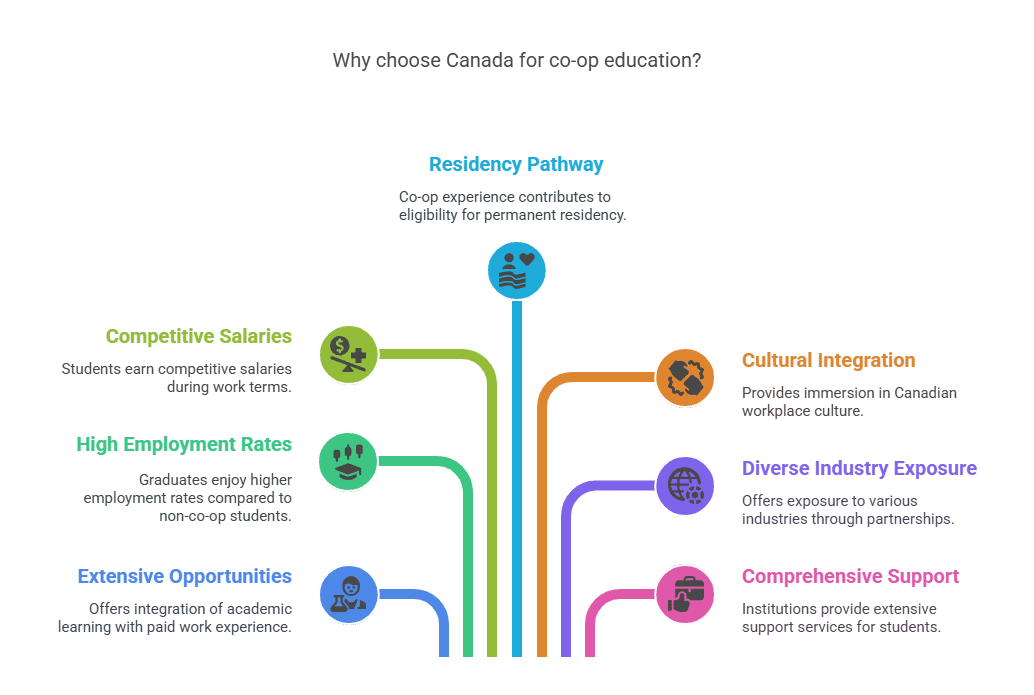
Key Reasons to Choose Canada for Co-op Education:
Extensive Co-op Opportunities: Canadian universities, such as the University of Waterloo, offer co-op programs that integrate academic learning with paid work experience, allowing students to earn while they learn.
High Employment Rates: Graduates from co-op programs often enjoy higher employment rates. For instance, the University of Alberta reported a 100% employment rate for co-op students, compared to 92% for non-co-op students.
Competitive Salaries: Co-op students in Canada can earn competitive salaries during their work terms. At the University of Victoria, undergraduate co-op students gain an average of CAD 3,553 (INR 2.17L) monthly.
Pathway to Permanent Residency: Co-op work experience can contribute to eligibility for Canada's Post-Graduation Work Permit (PGWP), providing a path to permanent residency.
Cultural Integration: Co-op programs offer international students the chance to immerse themselves in Canadian workplace culture, enhancing their adaptability and communication skills.
Diverse Industry Exposure: Students gain exposure to various industries, including technology, healthcare, and finance, through partnerships with over 7,000 employers globally, as seen at the University of Waterloo.
Comprehensive Support Services: Canadian institutions provide extensive support for co-op students, includingjob search assistance, resume writing workshops, and interview preparation, ensuring a smooth transition into the workforce.
Now, let us explore how upGrad can help you to stand out.
How Can upGrad Help You Study Co-op in Canada?
upGrad offers a comprehensive pathway for students aspiring to pursue co-op programs in Canada, combining online learning with on-campus experiences. Through strategic partnerships with Canadian universities, upGrad provides a seamless transition from virtual coursework to practical, in-country training.
Here’s an overview of the key support services provided by upGrad
University Partnerships: upGrad collaborates with institutions like the University of the Fraser Valley (UFV) and Yorkville University, offering programs such as Business Administration and Computer Information Systems Pathways.
Blended Learning Model: Students begin their studies online through upGrad's platform, completing the initial years remotely, and then transition to on-campus education in Canada for the final year.
Comprehensive Support Services: upGrad provides end-to-end assistance, including counseling, visa support, accommodation arrangements, and cultural assimilation training, facilitating a smooth transition to studying in Canada.
Career Development Opportunities: Through the upGrad Connect platform, students gain access to global internships, career counseling, and post-study placement information, enhancing their employability in the Canadian job market.
Post-Graduation Work Permit Eligibility: Upon successful completion of the on-campus program, students can apply for a Post-Graduate Work Permit, which allows them to stay and work in Canada for up to three years.
This guide explained to you about the Co-Op courses in Canada meaning, eligibility, and how to apply as an international student.
Ready to elevate your academic journey? Book Your FREE 1:1 Counselling Session today. upGrad experts will guide you in selecting the perfect program, streamline your application process, and help you map a clear path to success abroad.
FAQs
What types of industries offer co-op placements for students in Canada?
Co-op placements in Canada cover industries like tech, engineering, finance, healthcare, marketing, and environmental sciences. IT and engineering offer the most roles due to Canada's $30B tech ecosystem. These roles give students practical experience and valuable industry connections.
How do co-op programs enhance employability compared to traditional degrees?
Co-op programs combine academics with real work experience, enhancing employability by 40% over traditional degrees. Students gain practical skills, industry connections, and workplace readiness, making them job-ready upon graduation.
Are international students allowed to work off-campus during co-op terms in Canada?
International students with valid study permits can work off-campus if their program includes mandatory co-op or internship components. Canadian immigration policies updated in 2025 allow work permits tied to co-op placements without additional applications, facilitating smoother transitions between study and work terms.
What is the average duration of co-op terms during Canadian co-op programs?
Co-op terms in Canada typically last 4 to 8 months, depending on the program and institution. Students usually alternate between academic semesters and co-op placements, gaining practical experience over multiple cycles, which is a unique advantage compared to short-term internships offered elsewhere.
How does the co-op education model impact international student visa approval rates?
Programs with co-op placements have higher visa approval rates—around 90%, per IRCC data. They show clear job prospects and solid academic structure, reassuring visa officers of student intent and stability. This makes co-op programs a strong choice for international students seeking study permits.
What are the typical academic challenges co-op students face, and how can they overcome them?
Balancing work and studies requires good time management and adaptability to academic and workplace demands. Universities support co-op students with counseling, workshops, and flexible schedules to aid educational and professional success.
Can co-op credits be transferred between Canadian universities?
Co-op credit transfer depends on university agreements and program compatibility. Many Canadian schools use provincial transfer systems for some credit recognition. Students should check with advisors to ensure credits meet the new university’s requirements.
What is the role of career services in Canadian universities for co-op students?
Career services support co-op students with resumes, interviews, job searches, and networking events. In 2025, 85% of employers were satisfied with these services. They play a key role in connecting students to relevant placements.
How do co-op programs help international students adapt to the Canadian workplace culture?
Many Canadian institutions provide workshops and mentoring programs focusing on workplace culture, communication skills, and professional etiquette. These initiatives ease cultural transition, improve teamwork, and enhance confidence, ensuring international students thrive in diverse Canadian workplaces.
Are there specific insurance or health coverage requirements during co-op work terms?
Students must have valid health insurance during study and co-op work terms. Some provinces require extended coverage or proof of private/university plans. This protects against medical expenses during placements.
How does participation in a co-op program influence long-term career growth for graduates?
Graduates with co-op experience typically experience faster career progression and higher starting salaries. According to 2025 US News reports, co-op alums earn up to 20% more than non-co-op peers within five years of graduation, gaining early industry experience and valuable professional networks.
Akansha Semwal is a content marketer at upGrad and has also worked as a social media marketer & sub-editor. Experienced in creating impressive Statement of Purpose, Essays, and LOR, she knows how to c...
Refer Your Friend & Earn upto ₹15000
Help your friend upgrade to a Global Career and earn rewards together.