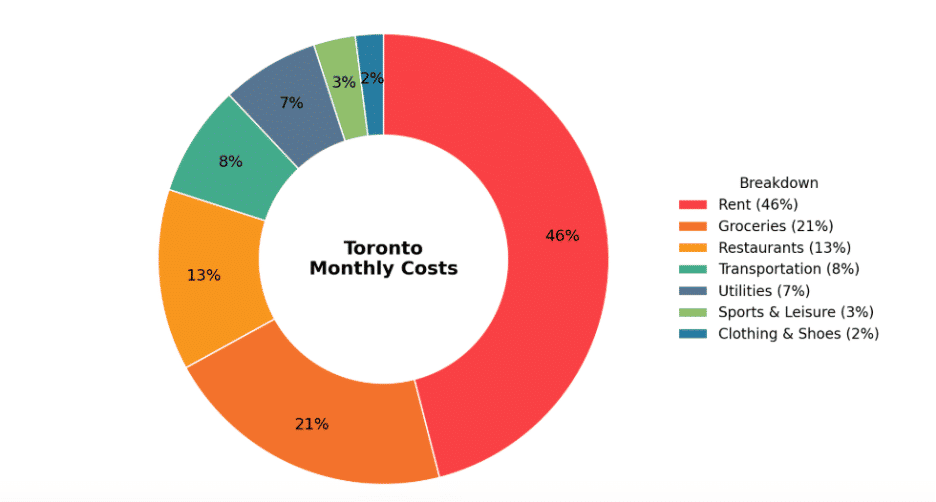
The cost of living in Toronto is among the highest in Canada, with a single person spending CAD 1,500–1,600 (INR 1.02L–1.09L) per month excluding rent, while a family of four needs CAD 5,600–5,700 (INR 3.81L–3.92L) for essentials.
Rent remains the biggest cost, with 1‑bedroom apartments priced between CAD 2,100–2,500 (INR 1.42L–1.69L) in central areas. Rising grocery and transport expenses further shape what is the cost of living in Toronto Canada for newcomers.
Below is a quick snapshot of Toronto’s major living costs:
Category
Approximate Cost Range (CAD / INR)
Accommodation
CAD 2,100–2,500 (INR 1.42L–1.70L)
Food & Groceries (Monthly)
CAD 350–550 (INR 23.7K–37.3K)
Transport (Monthly)
CAD 150–165 (INR 10.2K–11.2K)
Utilities (Basic Monthly Estimate)
CAD 130–350 (INR 8.8K–23.8K)
Leisure & Miscellaneous
CAD 50–125 (INR 3.4K–8.4K)
Education (Annual)
CAD 4,000–27,000 (INR 2.71L–18.36L)
The sections below break down each cost category in detail, helping you understand how every expense contributes to the overall cost of living in Toronto.
Cost of Living in Toronto by Profile
The cost of living in Toronto varies based on household size, lifestyle, and location, with rent, food, and transportation shaping overall expenses. Below is a breakdown of typical monthly living costs for different resident profiles in Toronto.
Monthly Living Cost by Profile in Toronto (CAD / INR)
Profile
Monthly Cost (CAD / INR)
Single Person
CAD 1,500–1,600 (INR 1.02L–1.09L)
Working Professional
CAD 2,800–3,200 (INR 1.90L–2.17L)
Family of Four
CAD 5,600–5,700 (INR 3.81L–3.92L)
International Student
CAD 1,200–1,600 (INR 81.5K–1.09L)
Notes:
Working professionals typically spend more due to commuting, eating out, and higher lifestyle consumption.
Families encounter larger grocery, utility, and transport costs even before rent.
Students' lower expenses by choosing shared accommodation and TTC passes.
Cost of Living in Major Areas of Toronto
The cost of living in Toronto varies significantly across different neighbourhoods, with downtown districts showing the highest rents, while midtown and suburban areas offer comparatively moderate living costs.
Below is an overview of monthly expense ranges across major residential areas.
Monthly Expense Range by Area in Toronto (CAD / INR)
Area
Monthly Expense Range (CAD / INR)
Downtown Toronto (City Centre)
CAD 2,300–2,900 (INR 1.56L–1.97L)
Midtown (Yonge–Eglinton / Forest Hill)
CAD 2,000–2,500 (INR 1.36L–1.70L)
North York / Etobicoke / Scarborough
CAD 1,800–2,200 (INR 1.22L–1.49L)
East Toronto (Beaches / Danforth)
CAD 1,900–2,300 (INR 1.29L–1.56L)
West Toronto (High Park / Junction / Roncesvalles)
CAD 2,000–2,400 (INR 1.36L–1.63L)
Toronto Suburbs (Mississauga / Brampton)
CAD 1,600–2,000 (INR 1.08L–1.36L)
Downtown Toronto remains the most expensive due to high rental demand, while North York, Etobicoke, and Scarborough offer more affordable options for students, families, and new immigrants.
Accommodation Costs in Toronto
Accommodation forms the largest share of the cost of living in Toronto, with rent varying sharply between downtown and suburban areas.
Monthly rent for a 1‑bedroom apartment typically ranges between CAD 2,100–2,500 (INR 1.42L–1.70L) in the city centre, while outside‑centre options offer slightly lower pricing.
Below is a breakdown of 1BHK rental prices across major Toronto areas:
1 BHK Rental Prices in Toronto (CAD/INR)
Area
1BHK (City Centre)
1BHK (Outside City Centre)
Downtown Toronto
CAD 2,100–2,500 (INR 1.42L–1.70L)
CAD 1,800–2,200 (INR 1.22L–1.49L)
Midtown (Yonge–Eglinton / Forest Hill)
CAD 2,000–2,400 (INR 1.36L–1.63L)
CAD 1,700–2,100 (INR 1.15L–1.42L)
North York
CAD 1,900–2,300 (INR 1.29L–1.56L)
CAD 1,600–1,900 (INR 1.08L–1.29L)
Etobicoke
CAD 1,900–2,300 (INR 1.29L–1.56L)
CAD 1,600–2,000 (INR 1.08L–1.36L)
Scarborough
CAD 1,800–2,200 (INR 1.22L–1.49L)
CAD 1,600–1,900 (INR 1.08L–1.29L)
Monthly Food & Grocery Expenses in Toronto
Food and grocery costs in Toronto are moderately high, with monthly spending shaped by dietary choices, supermarket preferences, and eating-out frequency.
On average, groceries range between CAD 350–550 (INR 23.7K–37.3K) per month, while dining out adds additional monthly expense depending on routine.
Meal at an inexpensive restaurant: CAD 15–40 (INR 1.15K–2.71K)
Meal for two at a mid‑range restaurant:CAD 75–175 (INR 5.09K–11.88K)
Fast‑food combo meal:CAD 13–20 (INR 880–1.36K)
Cappuccino:CAD 3.00–8.00 (INR 200–545)
Note: Students and young professionals often reduce monthly spending by cooking at home, a major factor when assessing the overall cost of living in Toronto Canada.
Transportation Costs in Toronto
Toronto has a well‑connected public transport network operated by the TTC, including buses, streetcars, and subways.
Monthly commuting costs range between CAD 150–165 (INR 10.2K–11.2K), making transport a significant but predictable part of the monthly budget.
Below is a breakdown of common transportation expenses in Toronto:
Transport Type
Cost (CAD / INR)
One‑way Public Transport Ticket
CAD 3.30–4.00 (INR 220–275)
Monthly Public Transport Pass (TTC)
CAD 150–165 (INR 10.2K–11.2K)
Taxi Start (Standard Tariff)
CAD 4.25–8.00 (INR 285–540)
Taxi (1 Mile)
CAD 2.82–5.18 (INR 190–355)
Taxi (1 Hour Waiting)
CAD 31.00–35.00 (INR 2.10K–2.38K)
Gasoline (1 Liter)
CAD 1.22–1.65 (INR 80–115)
Healthcare and Insurance Costs in Toronto
Healthcare costs in Toronto vary depending on whether residents rely on public OHIP coverage, private insurance, or out‑of‑pocket consultations.
Monthly medical spending generally ranges between CAD 40–150 (INR 2.7K–10.2K), depending on medication needs, doctor visits, and supplementary insurance.
Below is a breakdown of common healthcare expenses in Toronto:
Healthcare Service
Cost (CAD / INR)
Healthcare Service Costs in Toronto (CAD/INR)
General doctor consultation
CAD 50–100 (INR 3.3K–6.7K)
Cold medicine (1 week)
CAD 10–20 (INR 680–1.35K)
Antibiotics (prescription)
CAD 15–35 (INR 1.02K–2.37K)
Specialist visit (private)
CAD 80–180 (INR 5.4K–12.2K)
Monthly utilities for healthcare services (admin/coverage‑related)
CAD 130–350 (INR 8.8K–23.8K)
Leisure & Miscellaneous Costs in Toronto
Leisure and personal expenses in Toronto vary depending on lifestyle, fitness routines, and recreational choices. Central neighbourhoods tend to be more expensive, while outer districts offer more affordable options.
Overall, residents spend CAD 50–125 (INR 3.4K–8.4K) monthly on fitness, entertainment, and basic personal items.
Below is a breakdown of common leisure and miscellaneous expenses in Toronto:
Activity / Item
Cost (CAD / INR)
Fitness club membership (monthly)
CAD 50–125 (INR 3.4K–8.4K)
Cinema ticket (international release)
CAD 13–20 (INR 883–1.36K)
Tennis court rental (1 hour, weekend)
CAD 20–35 (INR 1.35K–2.38K)
Basic toiletries (monthly estimate)
CAD 10–25 (INR 680–1.70K)
Jeans (mid‑range brand)
CAD 40–90 (INR 2.7K–6.1K)
Running shoes (branded)
CAD 70–130 (INR 4.8K–8.8K)
Fitness clubs, sports facilities, and entertainment venues contribute to monthly spending patterns, playing a meaningful role in shaping the overall cost of living in Toronto Canada.
Education Costs for International Students in Toronto
Toronto offers a mix of public universities with regulated tuition and private or international institutions that charge higher annual fees.
Education costs vary significantly depending on program level and institution type, influencing overall budgeting for international students.
Annual Tuition Costs by Course Type in Toronto (CAD / INR)
Course Type
Public Universities (CAD / INR)
Private / International Schools (CAD / INR)
Bachelor’s Programs
CAD 7,000–25,000 (INR 4.75L–16.98L)
CAD 15,000–35,000 (INR 10.19L–23.78L)
Master’s Programs (Non‑STEM)
CAD 10,000–30,000 (INR 6.79L–20.38L)
CAD 20,000–40,000 (INR 13.59L–27.18L)
MBA Programs
CAD 20,000–45,000 (INR 13.59L–30.57L)
CAD 35,000–60,000 (INR 23.78L–40.77L)
Engineering / STEM Master’s
CAD 12,000–35,000 (INR 8.15L–23.78L)
CAD 25,000–50,000 (INR 16.98L–33.97L)
International / Private Schooling (K–12)
N/A
CAD 4,000–27,000 (INR 2.71L–18.36L)
Note: Books, materials, and student insurance may add CAD 800–1,500 (INR 54K–1.02L) per year depending on the program.
Cost of Living in Toronto vs Other Canadian Cities
The cost of living in Toronto is among the highest in the country, especially due to elevated rental prices and overall lifestyle costs.
Below is a city‑wise breakdown comparing Toronto to other major Canadian cities:
Cost of Living in Toronto vs Vancouver
Toronto’s city‑centre rent averages CAD 2,100–2,500 (INR 1.42L–1.70L), while Vancouver typically ranges CAD 2,200–2,800 (INR 1.49L–1.90L), making both cities similarly expensive. Monthly essentials excluding rent cost CAD 1,535 (INR 1.04L) in Toronto.
Cost of Living in Toronto vs Ottawa
Comparing the cost of living in Toronto vs Ottawa, Ottawa is noticeably more affordable. Ottawa’s central 1BHK costs CAD 1,600–2,000 (INR 1.08L–1.36L), while Toronto ranges CAD 2,100–2,500 (INR 1.42L–1.70L). Monthly essentials are also lower in Ottawa at CAD 1,200–1,350 (INR 81.5K–91.5K), compared to Toronto’s CAD 1,535 (INR 1.04L).
Cost of Living in Toronto vs Calgary
Calgary offers more affordability, with central 1BHK units averaging CAD 1,500–1,900 (INR 1.02L–1.29L). Utilities and groceries also cost less, helping reduce monthly living expenses compared to Toronto’s combined baseline of CAD 1,535 (INR 1.04L) excluding rent.
Cost of Living in Toronto vs Montreal
Montreal is one of Canada’s most budget‑friendly major cities. A single person typically spends CAD 1,000–1,200 (INR 67.9K–81.5K) monthly excluding rent. Toronto’s baseline is CAD 1,535 (INR 1.04L), and central rents exceed CAD 2,100 (INR 1.42L), making Toronto significantly more expensive.
Cost of Living in Brampton vs Toronto
The cost of living in Brampton vs Toronto shows clear differences in rent. Brampton’s 1BHK averages CAD 1,700–2,100 (INR 1.15L–1.42L), while Toronto’s city‑centre units cost CAD 2,100–2,500 (INR 1.42L–1.70L). Groceries and utilities in Brampton are also moderately cheaper, making it a popular alternative for commuters.
Budgeting Tips to Reduce Living Costs in Toronto
Managing expenses wisely can help students, newcomers, and families lower their monthly living costs in Toronto, especially with high rent and transportation prices.
The most practical tips include:
How to Save on Rent in Toronto?
Choose shared accommodation or rent outside the downtown core; rents in suburbs like North York or Etobicoke cost CAD 1,600–2,000 (INR 1.08L–1.36L) versus downtown’s CAD 2,100–2,500 (INR 1.42L–1.70L).
Look for older buildings or mid‑rise apartments, which often offer better value than new condo towers.
Consider Brampton or Mississauga for lower rent if commuting is feasible.
How to Save on Food in Toronto?
Shop at economical chains like No Frills, FreshCo, Food Basics, and buy produce during weekly markdowns.
Too Good To Go – offers discounted surplus food from local cafes and restaurants.
Conclusion
Toronto remains one of Canada’s most expensive cities, with monthly essentials averaging CAD 1,535 (INR 1.04L) for a single person and rent pushing overall budgets much higher.
Understanding neighbourhood‑wise costs, transport spending, groceries, and education fees helps students, newcomers, and families plan realistically for the overall cost of living in Toronto Canada.
What factors determine the overall cost of living in Toronto in 2026?
Toronto’s overall cost of living is shaped by monthly rent, groceries, transportation, utilities, and healthcare. Rent remains the biggest driver, with downtown 1BHK units costing CAD 2,100–2,500 (INR 1.42L–1.70L). Essentials excluding rent average CAD 1,535 (INR 1.04L) for a single person.
What is the cost of living in Toronto Canada for a new immigrant arriving without employment?
A new immigrant should budget CAD 3,500–4,500 (INR 2.38L–3.05L) monthly, covering rent, TTC pass, groceries, utilities, and phone/internet. Essentials excluding rent already average CAD 1,535 (INR 1.04L), while rent adds CAD 2,100–2,500 (INR 1.42L–1.70L), making savings essential during the first months.
How much monthly budget does a single person realistically need in Toronto including rent?
A single person requires CAD 3,600–4,000 (INR 2.44L–2.71L) monthly. Numbeo shows CAD 1,535 (INR 1.04L) for essentials excluding rent, while rent in the city centre averages CAD 2,100–2,500 (INR 1.42L–1.70L). Dining out, transit, and winter utilities further increase monthly spending.
How expensive is daily life in Toronto for international students compared to other Canadian cities?
Daily living for Toronto students ranges CAD 1,200–1,600 (INR 81.5K–1.09L) excluding rent, higher than cities like Ottawa or Calgary due to pricier transit and groceries. Rent significantly adds to expenses, with outside-centre options costing CAD 1,800–2,200 (INR 1.22L–1.49L).
What one-time settlement expenses should newcomers expect when moving to Toronto?
Initial settlement costs include first-month rent, security deposit, furniture, TTC card, groceries, mobile plan activation, and household essentials. For a 1BHK costing CAD 2,100–2,500 (INR 1.42L–1.70L), upfront expenses can reach CAD 4,000–6,000 (INR 2.71L–4.07L) depending on setup choices.
How much do groceries cost in Toronto on a monthly basis for different lifestyles?
Groceries cost around CAD 350–550 (INR 23.7K–37.3K) monthly. Key items such as milk CAD 1.75–6.00 (INR 119–407), eggs CAD 3.79–7.99 (INR 258–543), and chicken CAD 4.08–14.00 (INR 277–951) are available at moderate-high prices.
What are the common hidden or overlooked monthly expenses residents should plan for?
Residents often underestimate winter heating, garbage fees, internet, mobile plans, and extra TTC trips. Utilities range CAD 130–350 (INR 8.8K–23.8K), while internet adds CAD 50–120 (INR 3.4K–8.1K). Occasional dining, subscriptions, and personal care can raise overall spending.
How affordable is public transportation in Toronto compared to maintaining a personal vehicle?
Public transport is far cheaper, with a TTC monthly pass costing CAD 150–165 (INR 10.2K–11.2K). In contrast, car ownership adds fuel (CAD 1.22–1.65 per litre / INR 83–112), insurance, parking, and maintenance, making commuting significantly more expensive for most residents.
How do winter-specific costs such as heating and utilities impact monthly budgeting?
Winter sharply increases heating and electricity usage. Utility bills typically rise toward the upper range of CAD 130–350 (INR 8.8K–23.8K). Older buildings often require more heating, making winter one of the costliest months for energy consumption in Toronto.
How does the cost of living in Toronto vs Ottawa differ for students, professionals, and families?
Ottawa is more affordable, with central 1BHK rent at CAD 1,600–2,000 (INR 1.08L–1.36L) versus Toronto’s CAD 2,100–2,500 (INR 1.42L–1.70L). Toronto’s essentials excluding rent average CAD 1,535 (INR 1.04L), typically higher than Ottawa. Students particularly benefit from Ottawa’s lower rent.
What are the main spending differences between the cost of living in Brampton vs Toronto?
Brampton offers lower housing costs, with 1BHK rents CAD 1,700–2,100 (INR 1.15L–1.42L) versus Toronto’s CAD 2,100–2,500 (INR 1.42L–1.70L). Groceries and utilities are slightly cheaper in Brampton, making it popular for commuters seeking affordable living near Toronto.
How much should couples expect to spend monthly when living in central or suburban Toronto?
Couples typically spend CAD 4,800–5,500 (INR 3.26L–3.73L) in central Toronto, factoring rent, utilities, groceries, and TTC passes. Suburban costs average CAD 4,000–4,500 (INR 2.71L–3.05L) due to lower rent in areas like North York or Etobicoke.
What does a comfortable lifestyle cost for families with school-age children in Toronto?
Families of four spend CAD 5,600–5,700 (INR 3.81L–3.92L) monthly excluding rent. Rent adds CAD 2,500–3,500 (INR 1.70L–2.37L) depending on area. Tuition for private schools ranges CAD 4,000–27,000 (INR 2.71L–18.36L) annually, significantly affecting budgets.
How expensive is healthcare and insurance for international residents who are not covered by OHIP yet?
International residents pay CAD 40–150 (INR 2.7K–10.2K) monthly for basic private insurance until OHIP becomes available. Doctor consultations range CAD 50–100 (INR 3.3K–6.7K), while common medicines cost CAD 10–35 (INR 680–2.37K) based on pharmacy pricing.
How much do eating-out habits in Toronto influence an individual’s total monthly expenses?
Eating out significantly raises budgets, with restaurant meals costing CAD 17–40 (INR 1.15K–2.71K) each. Weekly dining can add CAD 200–350 (INR 13.5K–23.7K) per month. Mid-range dinners for two cost CAD 75–175 (INR 5.09K–11.88K), making cooking at home more economical.
What rental documents and deposits do landlords in Toronto require from tenants?
Tenants often provide ID, employment letter, pay stubs, credit report, references, and first-and-last-month’s rent. For a 1BHK costing CAD 2,100–2,500 (INR 1.42L–1.70L), upfront payments can be substantial. Some landlords may also request post-dated cheques or guarantors.
How much do broadband internet, mobile plans, and digital services add to the monthly budget in Toronto?
Broadband internet costs CAD 50–120 (INR 3.4K–8.1K) monthly, while mobile plans range CAD 32–100 (INR 2.17K–6.79K) depending on data. Combined digital expenses often reach CAD 120–180 (INR 8.1K–12.2K) per month in most households.
Is Toronto more expensive than other large Canadian metros such as Vancouver, Calgary, and Montreal?
Toronto and Vancouver are Canada’s most expensive cities. Toronto’s central rent averages CAD 2,100–2,500 (INR 1.42L–1.70L), while Vancouver is slightly higher. Calgary and Montreal remain more affordable, with lower rents and essentials. Toronto’s essentials excluding rent are CAD 1,535 (INR 1.04L).
What is the recommended salary range for living comfortably in Toronto without financial stress?
A comfortable lifestyle generally requires CAD 75,000–90,000 per year. Monthly expenses for individuals average CAD 3,600–4,000 (INR 2.44L–2.71L) including rent. With essentials excluding rent at CAD 1,535 (INR 1.04L), salaries below this range may lead to tight budgeting.
What is the cost of living in Toronto Canada for students seeking part-time jobs and affordable housing?
Students spend CAD 1,200–1,600 (INR 81.5K–1.09L) excluding rent. Shared housing options range CAD 700–1,200 (INR 47.5K–81.5K) in suburban areas. Monthly passes cost CAD 150–165 (INR 10.2K–11.2K), while groceries average CAD 350–550 (INR 23.7K–37.3K).
Ireland( study abroad expert) |50 articles published
Honey Gupta is a leading consultant with over 10 years of experience in helping students navigate the complexities of studying overseas, with a specialized focus on Ireland. Honey brings a wealth of a...
Refer Your Friend & Earn upto ₹15000
Help your friend upgrade to a Global Career and earn rewards together.