Social Media Marketing for Small Business: A Practical Guide
By upGrad
Updated on Jun 11, 2026 | 9 min read | 1.65K+ views
Share:

All courses
Certifications
More
By upGrad
Updated on Jun 11, 2026 | 9 min read | 1.65K+ views
Share:
Table of Contents
Running a small business means you don't have a dedicated marketing team or a big ad budget. Social media marketing for small business is no longer optional. Customers discover brands, compare products, read reviews, and make buying decisions on social platforms every day. If your business isn't active where your audience spends time, you're missing opportunities to build trust and generate sales. It's about being intentional, showing up where your customers already are, and building trust over time.
This blog covers how to do social media marketing for small businesses from scratch. You'll learn which platforms to focus on, what kind of content works, how to build a posting routine, and how to measure whether any of it is actually working.
Explore upGrad's Digital Marketing programs to build practical skills in SEO, SEM, keyword research, website analytics, performance marketing, content strategy, social media marketing, and data-driven campaign optimization.
Small businesses often compete against larger brands with bigger advertising budgets. Social media marketing helps level the playing field. It’s one of the few marketing channels where a small business can genuinely compete with larger ones. A local bakery with great photos and an engaged following can outperform a chain on Instagram. A freelance consultant who posts useful LinkedIn content regularly can win clients that an agency can't reach.
It takes consistency, though.
The real value isn't just visibility. It's the ability to have direct conversations with your customers, get feedback in real time, and build a community around your brand without spending a rupee on ads (at least not initially).
Benefit |
What It Means for Small Businesses |
| Low entry cost | Start with just a phone and a profile |
| Direct customer access | Comment, DM, and reply in real time |
| Brand credibility | An active profile builds trust fast |
| Organic reach | Consistent posting grows reach without paid ads |
| Competitor insight | See exactly what others in your space are doing |
Also read: How To Create Instagram Reels: 5 Actionable Steps in 2024
Free Courses
Don't try to be everywhere and use all types of social media to promote your business. It's the fastest way to burn out and produce low-quality content. Your social media strategy should be to pick one or two platforms where your target customers spend their time.
Define Your Goals before posting anything, and decide what success looks like.
Common goals include:
Ask yourself a few questions.
Platform |
Best For |
Key Advantage |
Limitation |
| Food, fashion, beauty, lifestyle, travel, and visually appealing products | Strong engagement through reels, stories, and product-focused content | Requires consistent visual content and video creation | |
| Local businesses, community-driven brands, and older audiences | Effective for local promotions, community groups, events, and targeted ads | Organic reach can be lower than some other platforms | |
| B2B companies, consultants, recruiters, and professional service providers | Strong organic reach and high-quality professional audience | Less effective for highly visual consumer products | |
| YouTube | Tutorials, educational content, product demonstrations, and thought leadership | Builds long-term authority and generates evergreen traffic | Requires more time and effort to create quality videos |
| WhatsApp Business | Small businesses focused on direct customer interaction | Ideal for customer support, broadcast messages, catalog sharing, and repeat sales | Limited discoverability compared to public social platforms |
| X (Twitter) | Technology, media, news, startups, and industry experts | Useful for real-time conversations, trends, and thought leadership | Less effective for businesses selling visual or physical products directly |
Must read: Social Media Algorithms: Everything You Need to Know
Digital Marketing Courses to upskill
Explore Digital Marketing Courses for Career Progression
MICA Executive Alumni Status
Posting random content without a clear content marketing strategy is a waste of time. What works is content that either solves a problem, sparks a conversation, or makes someone feel something.
Here's a simple framework that works for most small businesses:
A clothing boutique that only posts product photos will see flat engagement. The same boutique that also shows how to style outfits, shares customer reviews, and asks followers to vote on new arrivals will build an audience that actually buys.
Don't overthink the tools. A decent phone with natural light is enough.
Content Format |
Best Use Cases |
Example Ideas |
| Short-form Videos (Reels, YouTube Shorts) | Demonstrations, education, product showcases, quick engagement | Unboxing videos, before-and-after transformations, quick tips, product demonstrations |
| Carousels | Explaining concepts, educating audiences, increasing saves and shares | Step-by-step guides, listicles, comparisons, actionable checklists |
| Stories | Real-time engagement, community building, limited-time promotions | Polls, Q&A sessions, flash sales, day-in-the-life content |
| Static Posts | Brand awareness, announcements, showcasing products or services | Inspirational quotes, product photos, company announcements, customer testimonials |
Do read: How to Use Google Analytics: Comprehensive Guide For Beginners
Consistency beats frequency. Posting three times a week every week is more valuable than posting daily for two weeks and then going silent for a month.
Create a content calender you can realistically maintain.
Three posts a week is a manageable starting point. Batch your content creation. Set aside two to three hours on a Sunday to plan and create content for the coming week. Use free tools like Canva for design and Meta Business Suite for scheduling on Facebook and Instagram at no cost.
Day |
Content Type |
Platform |
| Monday | Educational post or tip | Instagram / LinkedIn |
| Wednesday | Engagement post or story | Instagram / Facebook |
| Friday | Product/service promotion | Instagram / Facebook |
Engagement after posting matters as much as the post itself. Reply to comments. Respond to DMs. Ask follow-up questions. The algorithm on every major platform favours accounts that drive conversations, not just impressions.
Do read: Best Ways to Use Instagram Marketing For Business
You don't need to obsess over analytics every day. But checking in once a week helps you understand what's working and what isn't.
Track these metrics for each platform:
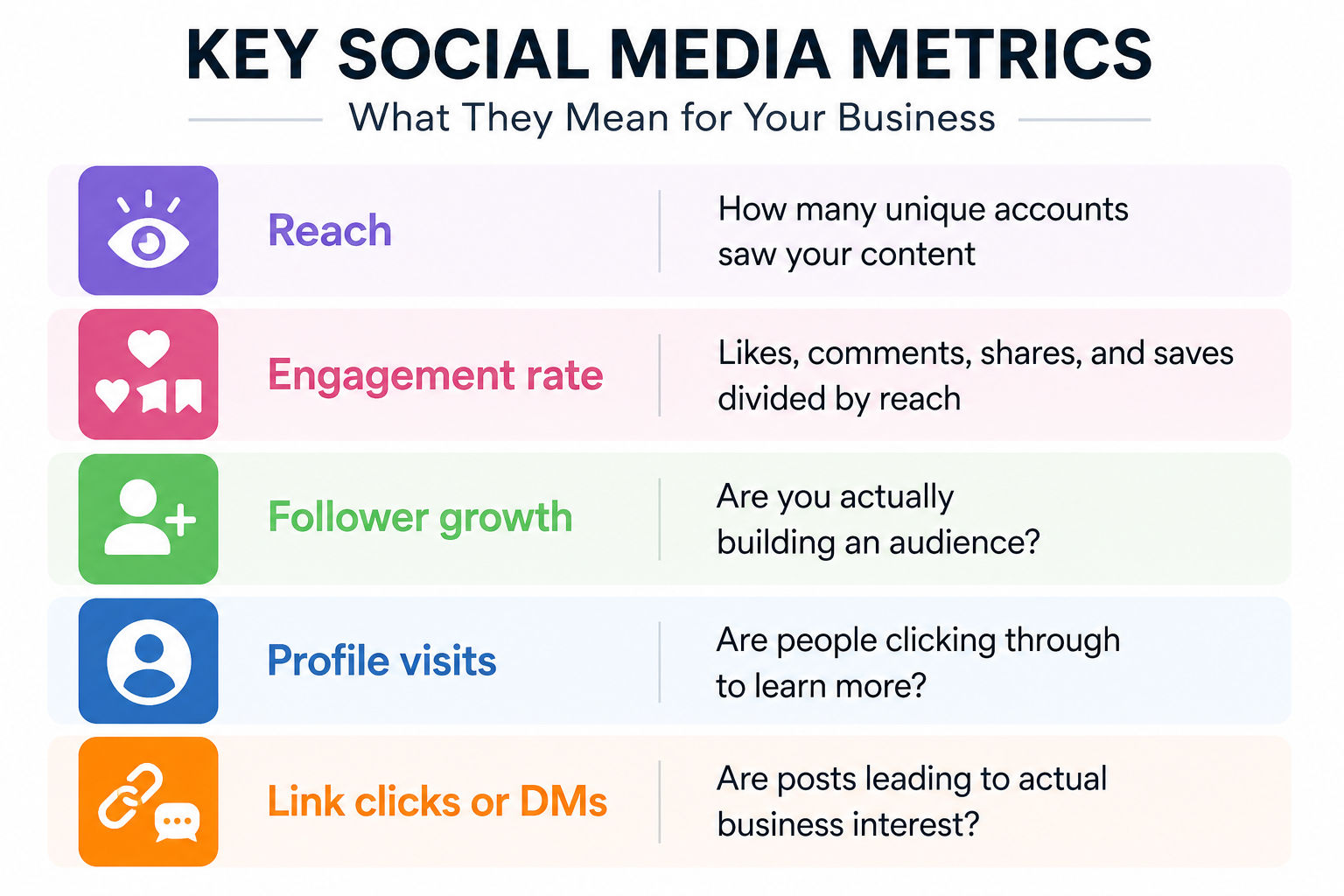
A post with 500 views and 40 saves is more valuable than one with 5,000 views and zero interaction. Saves and shares signal that your content is genuinely useful. That's what you're aiming for.
Set a simple monthly review. Look at your top three posts. Ask: what did they have in common? Create more of that.
Do read: Future of Social Media Marketing: Trends and Innovations in 2025
Organic content builds long-term trust. Paid ads accelerate results when you need faster visibility. You don't need a large budget to start. Even Rs. 200-300 per day on Meta ads can generate meaningful reach for a local business.
Before running any ad, you need:
Boosting a post isn't the same as running a proper campaign. It's a quick option, but it gives you less control over who sees it. For serious results, use Meta Ads Manager and build campaigns from scratch.
Start with a small test budget across two or three ad variations. Run them for 5-7 days and see which one performs best. Put the remaining budget behind the winner.
Social media marketing for small business doesn't require a large team or a complicated strategy. It requires clarity on who you're talking to, consistency in showing up, and content that's genuinely worth someone's time.
Start with one platform. Build a simple three-post weekly routine. Engage with your audience like they're real people, because they are. Track what works and do more of it.
The businesses that win on social media aren't always the ones with the best product. They're the ones that show up consistently and make their audience feel seen.
Ready to start your journey? Book a free consultation with upGrad today to find the best path for your career.
Most small businesses start seeing engagement within a few weeks, but customer inquiries and sales often take longer. Results depend on your industry, content quality, competition, and consistency. Businesses that post regularly and actively engage with followers usually see stronger results within three to six months.
Organic content should come first because it helps you understand what resonates with your audience. Once you know which posts generate engagement, you can support them with paid campaigns. Running ads without understanding your audience often leads to wasted budget and weak results.
Content that educates, entertains, or solves a specific problem typically performs best. Short videos, customer success stories, behind-the-scenes updates, and practical tips consistently attract engagement. People are more likely to interact with content that provides value than with constant promotional posts.
No. Consistency matters more than frequency. A small business posting three quality posts every week can outperform another posting daily without a clear strategy. A realistic schedule is easier to maintain and usually leads to better engagement over time.
Many successful small businesses create content using a smartphone, free design tools, and natural lighting. Simple product demonstrations, customer testimonials, quick tips, and behind-the-scenes videos often perform well because they feel authentic rather than overly polished.
One common mistake is treating social media like a digital billboard. Businesses often focus only on selling and forget to start conversations. Audiences engage more with brands that answer questions, share useful information, and participate in discussions rather than constantly promoting products.
Start by looking at where your customers spend their time. Visual brands often perform well on Instagram, while consultants and B2B businesses may see better results on LinkedIn. Research your audience before creating accounts on multiple platforms.
Focus on one platform and batch-create content. Spending a few hours each week planning posts is usually more effective than creating content daily. Scheduling tools can automate publishing, allowing you to spend more time engaging with customers and responding to messages.
Follower numbers matter less than engagement and business outcomes. An account with 1,000 engaged followers can generate more leads than one with 20,000 inactive followers. Track meaningful actions such as comments, inquiries, website visits, and direct messages instead.
Yes. Local businesses often use social media to increase visibility, showcase customer experiences, promote offers, and attract nearby customers. Many people check a business's social profiles before visiting, making an active presence valuable even without e-commerce capabilities.
A good rule is to keep promotional content to roughly 20-30% of your posts. The remaining content should educate, entertain, or engage your audience. This balance helps build trust and prevents followers from feeling like they're being sold to constantly.
1312 articles published
We are an online education platform providing industry-relevant programs for professionals, designed and delivered in collaboration with world-class faculty and businesses. Merging the latest technolo...
Get Free Consultation
By submitting, I accept the T&C and
Privacy Policy
Level Up Your Digital Marketing Career Today!
Top Resources
MICA
Advanced Certificate in AI-Powered Digital Marketing & Communication from MICAMICA Executive Alumni Status
Certification
5 Specialisation
Classroom
4 Months
Certification
2 Months