React vs Angular vs Vue: Complete Framework Comparison
By Sriram
Updated on Jul 03, 2026 | 7 min read | 2.31K+ views
Share:

All courses
Certifications
More
By Sriram
Updated on Jul 03, 2026 | 7 min read | 2.31K+ views
Share:
Table of Contents
In this blog, you'll learn how Vue vs React vs Angular, and are compared across frontend fundamentals. We'll also discuss the common mistakes developers make while choosing, and which option is best for different project types.
The demand for skilled data professionals continues to grow across industries. Compare our Data Science Courses online and choose a program that matches your career aspirations.
Popular Data Science Programs
When you study these technologies together, it is easier to decide which one to use. They all help developers build modern software and create user interfaces. But they have their unique ecosystem, flexibility and complexity of each technology.
Feature |
React |
Angular |
Vue |
| Type | UI Library | Full Framework | Progressive Framework |
| Maintained By | Meta | Vue Core Team | |
| Primary Language | JavaScript, TypeScript | TypeScript | JavaScript, TypeScript |
| Learning Curve | Moderate | Steep | Easy |
| Performance | Excellent | Excellent | Excellent |
| Bundle Size | Small | Larger | Small |
| TypeScript Support | Optional but strong | Built-in | Good |
| State Management | External libraries | Built-in services | Pinia or Vuex |
| Routing | React Router | Angular Router | Vue Router |
| SEO Support | Excellent with SSR frameworks | Good with Angular Universal | Excellent with Nuxt |
| Scalability | High | Very High | High |
| Enterprise Suitability | High | Excellent | Good |
| Community | Very large | Large | Large and active |
| Best For | Interactive web apps | Enterprise applications | Small to medium projects and rapid development |
Free Courses
Although people often put React, Angular and Vue in a group, they are actually very different. Understanding the idea behind each one will make it easier to compare them.
Instead of wondering which framework is the best, we should think about which framework works well with what our project needs, what our team is good at, and what we want to achieve in the long run with web development.
React is a free and open JavaScript tool that Meta developed for creating user interfaces. It deals with the view layer of a project. For features like routing, handling forms, managing data and rendering on servers' developers pick extra tools that fit their project's needs. Since React gives developers freedom to choose, they can develop apps using tools that work best for them.
This freedom is one of Reacts' advantages; it also means developers must decide on the architecture beforehand, allowing developers to customize their project. Developers have to make decisions about how to build their project. At times, it can be considered a challenge too.
Also Read: A Complete Guide to the React Component Lifecycle: Key Concepts, Methods, and Best Practices
Angular is a front-end framework that Google developed and maintained. It is different from React because Angular already has a lot of features that you need, like routing, dependency injection, forms, HTTP services, testing utilities, and state management patterns.
This approach does not let you decide, and it also helps consistency on a large team project.
You have to learn more about Angular at the beginning because you need to know the concepts such as modules, services, dependency injection, and RxJS. Once you understand these, Angular becomes the best choice for making big and complicated applications and it helps you keep everything organized.
Also Read: Angular Components: A Guide to Building Dynamic Web Applications
Vue is a free progressive JavaScript framework; it was created by Evan You. This framework is really good for making websites. Vue is easy to use because it works with the HTML templates that people are used to. People can start using Vue as it is efficient for both big and small projects.
Vue is a mix of React and Angular, flexible, React and structured like Angular. Vue has a lot of built-in features that make it easy to develop with. It also lets developers make their own choices as their projects get bigger. Vue is also easy to learn; this is also one of the reasons why a lot of developers and small teams prefer Vue.
Mastering Python concepts such as arrays and lists is essential for a successful data science career. The Executive Diploma in Data Science & Artificial Intelligence from IIITB helps you build strong programming, machine learning, and AI skills through hands-on projects and industry-relevant learning.
Data Science Courses to upskill
Explore Data Science Courses for Career Progression
IIIT Bangalore
Executive Post Graduate Certificate in Data Science & AIPlacement Assistance
Performance is one thing that developers usually look at first. When they ask, "Which framework is the fastest?" There's no simple answer. It depends on many things, and how complex the app is. Not just the framework.
For web apps, Vue, React, and Angular all work well in terms of performance. The differences only really matter in projects or ones that need lots of interaction.
There is no clear winner for every project.
Also Read: Angular Architecture: A Complete Guide for Beginners to Advanced Developers
Performance Area |
Vue |
React |
Angular |
| UI Rendering | Excellent | Excellent | Excellent |
| DOM Updates | Very Fast | Fast | Fast |
| Memory Efficiency | High | High | Moderate to High |
| Large App Performance | Very Good | Excellent | Excellent |
Also Read: React Router DOM
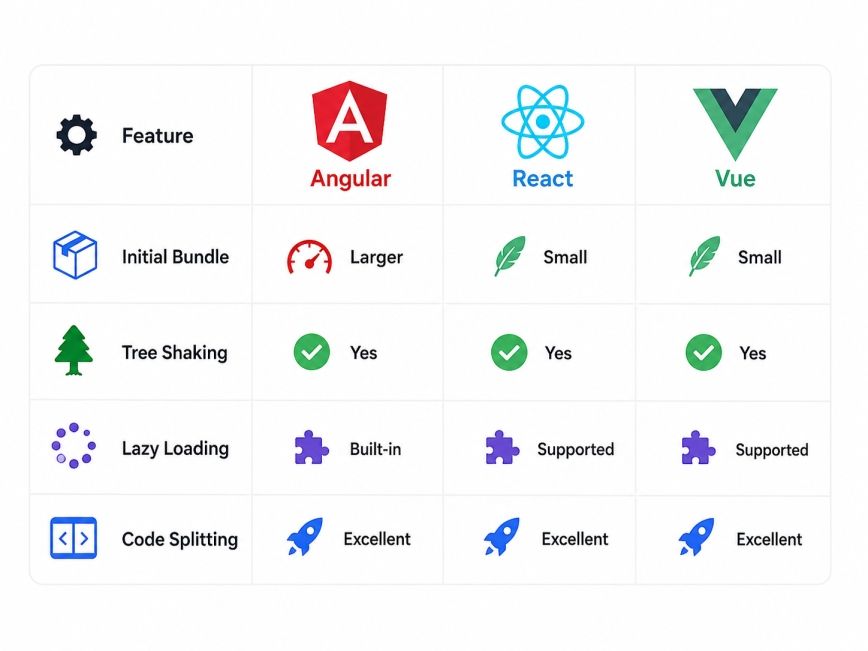
Bundle size affects how quickly a website loads, especially on slower networks and mobile devices. Smaller bundles generally improve the initial loading experience, although modern optimization techniques can significantly reduce the impact.
The default bundle sizes of React, Angular, and Vue differ because they include different levels of built-in functionality.
Feature |
Angular |
React |
Vue |
| Initial Bundle | Larger | Small | Small |
| Tree Shaking | Yes | Yes | Yes |
| Lazy Loading | Built-in | Supported | Supported |
| Code Splitting | Excellent | Excellent | Excellent |
Developing software is not only about writing code. It includes things like documentation, tooling, debugging, setting up projects, getting help from the community, and the overall ease of building and maintaining applications.
When a framework makes it easier for developers to do their job, it usually means they can release things faster and work together better.
Area |
Vue |
React |
Angular |
| Documentation | Excellent | Excellent | Excellent |
| Tooling | Excellent | Very Good | Excellent |
| Setup Complexity | Easy | Moderate | Higher |
| Ecosystem | Large | Largest | Large |
| Beginner Experience | Excellent | Good | Moderate |
Subscribe to upGrad's Newsletter
Join thousands of learners who receive useful tips
SEO is a deal for websites these days, especially for sites, with a lot of content, online stores, and products that need to be marketed. When you compare React, Angular and Vue for SEO, it really comes down to how each one handles server-side rendering (SSR) and static site generation.
All three can get great SEO results; the main difference is how hard it is to set them up and how well their ecosystems are developed.
Feature |
Angular |
React |
Vue |
| SSR Support | Angular Universal | Next.js | Nuxt |
| Static Generation | Good | Excellent | Excellent |
| SEO Friendliness | High | High (with setup) | High |
| Default SEO Setup | Partial | No | No |
Also Read: What is Technical SEO in 2025? Key Concepts & Best Strategies
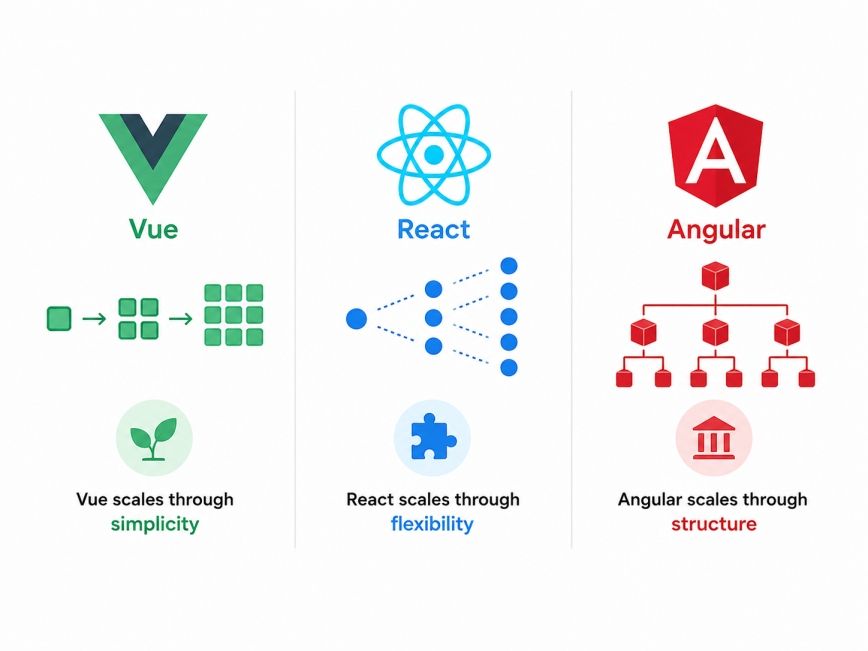
Scalability is about how a framework handles growth. This growth can be in the size of the codebase, the number of people on the team, or how complex the application is.
When we compare the scalability of Vue vs React vs Angular, it's not really about limits. It's more about how the team sets up the project and how disciplined they are:
The best framework for you depends on what your team wants. It is about finding the right balance between control and structure for your team's needs.
Factor |
Vue |
React |
Angular |
| Small Projects | Excellent | Excellent | Good |
| Medium Projects | Excellent | Excellent | Excellent |
| Large Enterprise Apps | Good to Very Good | Excellent (with structure) | Excellent |
| Architectural Control | Balanced | Developer-driven | Framework-driven |
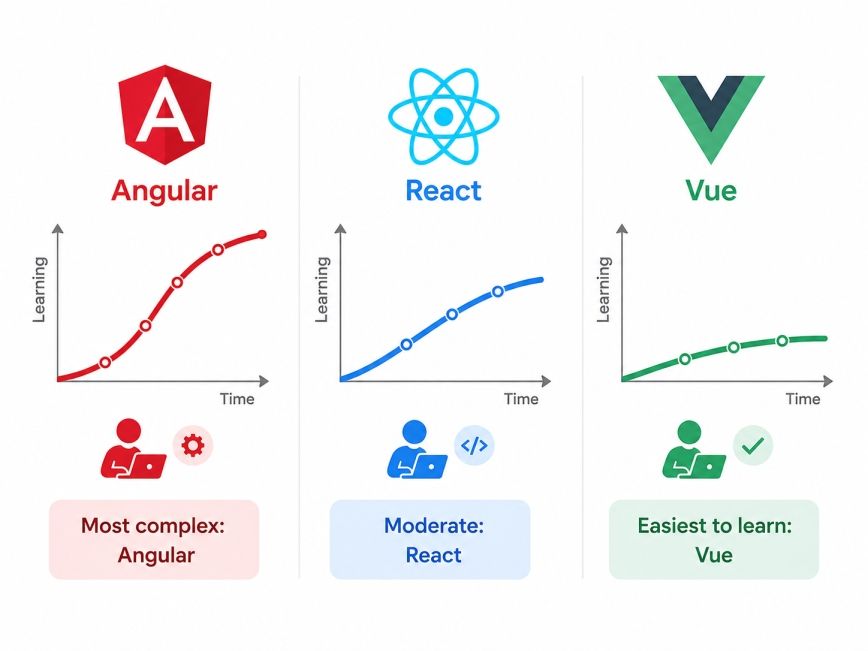
When trying to choose between React, Angular, and Vue, the React vs Angular vs Vue learning curve is important for beginners and teams that need to adopt a framework. The thing is, even though people use them to build applications all over the world, they are actually pretty different when it comes to how fast developers can become productive.
Angular is really tough to learn at first. It throws a lot of ideas at you all at once like modules, decorators, dependency injection, RxJS and TypeScript-first development.
This can be a lot to take in when you start. Once you get the hang of it, Angular is really powerful especially for big applications used by lots of people. Just because something is hard to learn does not mean it is not a choice in the long run. Angular is a choice of large-scale applications because it is complex.
Key learning challenges
Also Read: RxJava
React is not that hard to learn. The basic ideas like components, props, and state are pretty simple. But React only helps with the user interface (UI) layer, so beginners often have to learn additional too like routing, state management, and build systems.
This creates a “learning ecosystem” rather than a single framework journey.
What makes React easier or harder
It is simple to understand how Vue works; it is beginner friendly; it lets the developer build functional applications with minimal setup. This makes Vue a good choice for people who are new to the front-end framework. It is also considered the easiest to learn among the three.
Why Vue feels easier
The answer to this question depends on what you want to achieve, not what is trending now.
Related Article: Top 15 Front End Frameworks for 2026 & Tips to Pick the Right One
Many developers care more about what is popular than what is suitable for their project. This can cause a lot of problems when they have to maintain the project for a time.
Mistake 1: Choosing based on popularity
Just because a framework is used by a lot of people does not mean it is the best choice for your project. For example, React is very popular, but Angular might be a better choice for big companies with complicated systems.
Mistake 2: Ignoring team experience
You should choose a framework that your team is familiar with. If your team is mostly made up of developers using Angular can make development take a lot longer.
Mistake 3: Overestimating project complexity
Not every project needs to be very complicated. Some projects can be built quickly and easily with Vue or React.
Mistake 4: Ignoring long-term maintenance
It's great to get a project done quickly, but it is more important to think about how easy it will be to maintain the project framework, over time especially when it is being used by a lot of people.
Instead of asking which framework is the best, it makes more sense, when you ensure that matches with your project types.
1. Single Page Applications (SPAs)
2. Progressive Web Apps (PWAs)
3. E-commerce Applications
When you look at the architecture, performance, learning curve, SEO, scalability and real-world use cases of frameworks, you start to see things clearly. The framework that is best for you is not the same for everyone. It really depends on the project you are working on and the people in your team. So:
Choose React if
React works best for teams that want control and scalability without strict rules.
Choose Angular if
Angular is ideal when long-term maintainability and structure matter more than flexibility.
Choose Vue if
Vue is the most approachable option without sacrificing modern capabilities.
The React vs Angular vs Vue comparison is not about finding a universal winner. It is about understanding trade-offs. React offers flexibility, Angular provides structure, and Vue focuses on simplicity.
The best choice depends on your project goals, team experience, and long-term maintenance needs. Choosing wisely matters more than choosing quickly.
There is no single best framework because each serves different needs. React offers flexibility, Angular provides structure, and Vue focuses on simplicity. The right choice depends on project size, team expertise, and long-term maintenance goals rather than popularity or trends.
React is better for large, dynamic applications with complex ecosystems. Vue is better for beginners and smaller projects due to its simplicity. Both are powerful but React offers more flexibility while Vue provides a smoother learning experience.
React generally has wider industry adoption and more job opportunities compared to Vue. However, Vue is still used in many startups and mid-sized companies. Job demand depends more on region and industry than just framework choice.
No, AI will not replace React or other frontend frameworks. AI tools may assist developers in writing code faster, but frameworks like React will still be needed to structure applications and build user interfaces in production systems.
Yes, Vue is still worth learning in 2026, especially for beginners or developers working on small to medium projects. It remains relevant due to its simplicity, performance, and strong ecosystem with tools like Nuxt and Vite.
Yes, transitioning from React to Vue is generally easier than the reverse. Both use component-based architecture, but Vue has simpler syntax and a more structured approach, which reduces complexity for developers switching from React.
Vue is used by several global companies, including Alibaba, Xiaomi, and Grammarly. It is especially popular in Asian markets and among companies that prefer lightweight, fast development frameworks for scalable applications.
Vue is the easiest to learn due to its simple syntax and minimal setup. React comes next with moderate difficulty, while Angular is the most complex because it includes many built-in concepts like dependency injection and RxJS.
All three frameworks perform well in real-world applications. Performance depends more on implementation than the framework itself. React and Vue are lightweight, while Angular is optimized for large-scale structured applications.
If you are a beginner, Vue is often the easiest starting point. If you want job opportunities, React is widely adopted. If you aim for enterprise development, Angular is commonly used in large organizations.
Yes, Angular is still widely used in enterprise environments such as banking, healthcare, and government systems. It remains relevant due to its strong structure, TypeScript integration, and long-term support from Google.
730 articles published
Sriram K is a Senior SEO Executive with a B.Tech in Information Technology from Dr. M.G.R. Educational and Research Institute, Chennai. With over a decade of experience in digital marketing, he specia...
Speak with Data Science Expert
By submitting, I accept the T&C and
Privacy Policy
Start Your Career in Data Science Today
Top Resources
Master's Degree
18 Months
Executive Diploma
12 Months
Bootcamp
6 Months