Meta Learning: How AI Learns to Learn
By Sriram
Updated on Jun 02, 2026 | 8 min read | 1.97K+ views
Share:

All courses
Certifications
More
By Sriram
Updated on Jun 02, 2026 | 8 min read | 1.97K+ views
Share:
Table of Contents
Meta-learning, often referred to as “learning to learn,” is a branch of artificial intelligence and cognitive science focused on designing algorithms that can improve their own learning process. Unlike traditional machine learning models, which are trained to perform a single specific task, meta-learning models are exposed to a range of different tasks. This enables them to quickly adapt to new and unfamiliar problems, even when only a small amount of data is available.
In this blog, you'll learn what meta learning is, how it works, major approaches, benefits, challenges, and where meta learning AI systems are already being used today.
Explore upGrad’s AI, Machine Learning, and Agentic AI programs to build practical skills in intelligent systems, neural networks, model optimization, and adaptive AI techniques that power advanced applications like meta learning.
Popular AI Programs
When the system is learning, it sees problems that are different but also related. Over time, it figures out ways to solve these problems that work for tasks. When a new task comes up, the system does not have to start over again. It already knows a lot about learning. The system usually does things in two steps.
Regular computer models are good at doing one thing. When the task changes, they have a hard time. For example, a model that is trained to find fraud in banking can’t automatically find fraud in medical insurance claims. It usually needs to be retrained and get information. Meta-learning helps with this problem. Teaching a model to do one task teaches the model how to learn.
That is why people call it "learning to learn". By learning from tasks, the system can get used to new things much faster.
Meta-learning works in two steps, which are called the loop and the outer loop. In the loop, the model works on one task and learns from a few examples. It makes small changes to get better at the task. The outer loop looks at how the model learned. Then it updates the model so it can learn tasks faster and better. Meta-learning is about system learning and getting better at learning new things, like meta-learning.
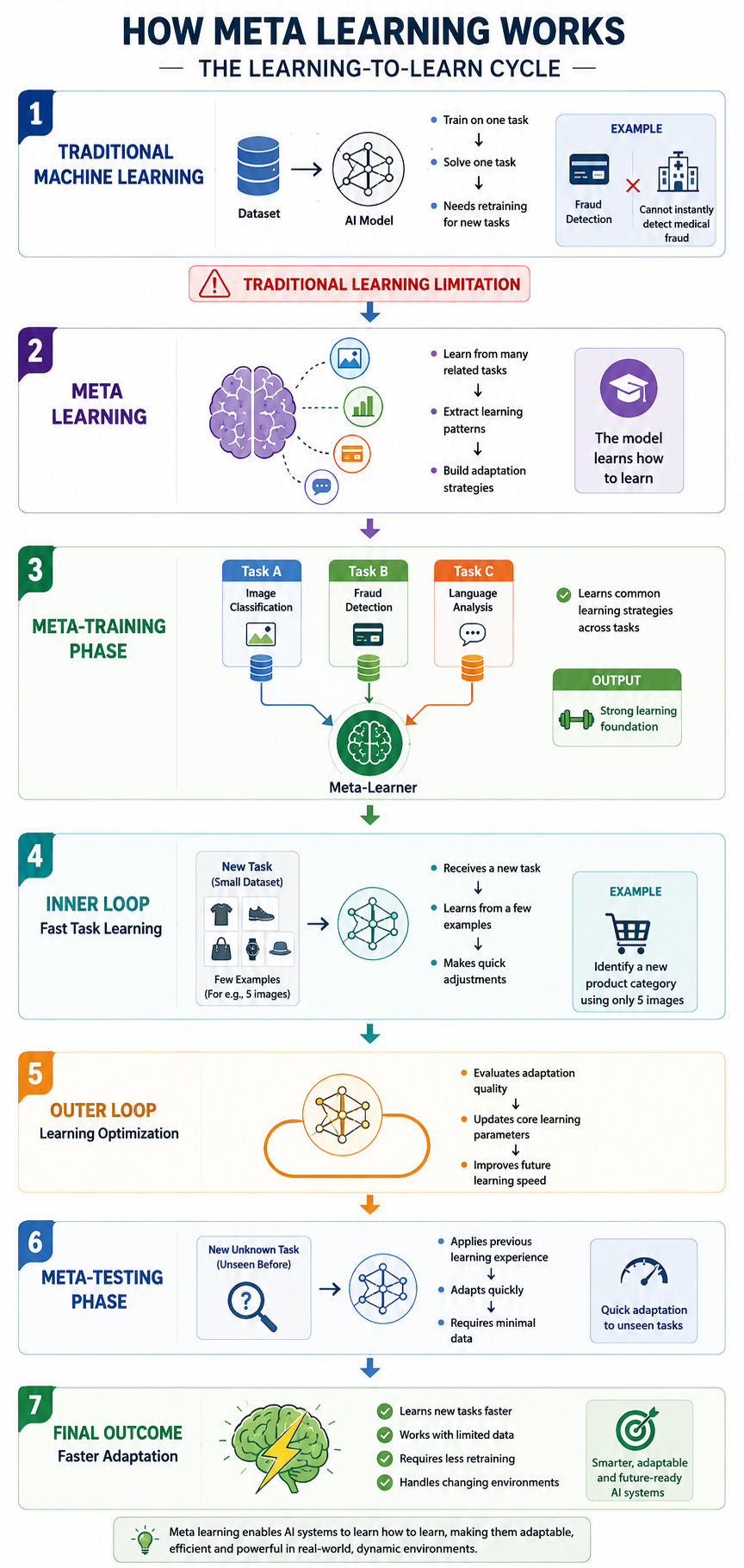
The result is a system that doesn't just memorize patterns. It learns better ways to learn, making adaptation quicker when new challenges appear.
| Element | Standard Machine Learning | Meta Learning in Machine Learning |
| Primary Goal | Minimize error on one specific task | Minimize adaptation time on new tasks |
| Data Required | Thousands of examples per category | A handful of examples per new task |
| Testing Focus | New data from the same distribution | Entirely unseen tasks and environments |
One of the biggest challenges in meta-learning is avoiding overfitting. A model might become very good at adapting to the tasks it was trained on, but struggle when faced with completely new problems. This happens when the training tasks aren't diverse enough. The goal is to strike a balance.
The model should learn useful learning strategies without becoming too dependent on familiar patterns. Otherwise, its performance can drop significantly in real-world situations.
Metric-based methods teach models to compare new examples with known ones. Instead of learning every feature from scratch, the model focuses on measuring similarity between data points.
This approach works particularly well in few-shot learning. Techniques such as Matching Networks and Prototypical Networks can classify new objects using only a few reference examples, making them useful when labeled data is limited.
Model-based approaches use specialized neural network architectures that can adapt quickly to new tasks.
These models maintain an internal memory that helps them learn from previous experiences.
As new data arrives, the system updates its internal state and adjusts its behavior accordingly. This allows fast adaptation, although the added complexity often increases computational requirements.
Optimization-based methods focus on finding model parameters that can be adapted quickly for new tasks. Rather than learning a single solution, the model learns a strong starting point for future learning.
A well-known example is Model-Agnostic Meta-Learning (MAML). With this approach, the model can achieve good performance on a new task after only a few training updates, making it one of the most widely used meta-learning techniques.
Also read: Exploring the Types of Machine Learning: A Complete Guide for 2025
Each approach solves a slightly different problem. The right choice depends on the application and available data.
Approach |
Main Focus |
Best For |
| Model-Based | Learning through architectural design | Fast adaptation |
| Optimization-Based | Learning better starting parameters | Few-shot learning |
| Metric-Based | Learning similarity relationships | Classification tasks |
Also read: Understanding Gradient Descent in Logistic Regression: A Guide for Beginners
Free Courses
The concept sounds academic until you see where it's being applied. Many advanced AI systems already use ideas inspired by meta-learning. The common thread is flexibility.
Whenever data is limited or change happens quickly, meta-learning becomes valuable.
Industry / Domain |
How Meta Learning Helps |
Common Applications |
| Healthcare | Learns from related medical conditions and performs well even with limited patient data. | Disease detection, medical image analysis, clinical decision support |
| Natural Language Processing (NLP) | Adapts quickly to changing language patterns, terminology, and user behavior without extensive retraining. | Chatbots, machine translation, sentiment analysis, content classification |
| Computer Vision | Identifies new objects or categories using only a small number of training examples. | Image recognition, product categorization, object detection |
| Robotics | Uses prior learning to adapt to unfamiliar environments and tasks in real time. | Warehouse automation, autonomous navigation, industrial robots |
| Recommendation Systems | Adjusts recommendations as user interests and behaviors change over time. | E-commerce recommendations, content suggestions, personalized marketing |
| Finance | Detects new fraud patterns and financial anomalies faster than traditional models. | Fraud detection, risk assessment, transaction monitoring |
| Retail | Improves personalization and product discovery with minimal retraining. | Product recommendations, customer segmentation, demand forecasting |
Here are the challenges and how meta-learning faces it:
Key Challenge |
How Meta Learning Addresses It |
| Limited training data | Learns from related tasks and adapts with fewer examples |
| Rapidly changing environments | Updates quickly without full model retraining |
| High training costs | Reduces the need for large datasets and repeated training cycles |
| New and unseen scenarios | Transfers previous learning to unfamiliar situations |
| Dynamic user behavior | Continuously adapts to changing preferences and patterns |
Must read: The Role and Application of Machine Learning in Healthcare
AI Courses to upskill
Explore Artificial Intelligence Courses for Career Progression
Meta-learning offers exciting possibilities, but it isn't a perfect solution. Understanding both sides creates realistic expectations. Meta-learning isn't replacing traditional machine learning. Instead, it expands what's possible when adaptability becomes a priority.
Benefits of Meta Learning |
Challenges of Meta Learning |
Faster learning and adaptation Models can learn new tasks with fewer examples and training iterations. |
High computational cost Meta-training requires significant processing power because the model must learn across multiple tasks. |
Better performance with limited data Useful in domains where collecting large datasets is difficult or expensive. |
Task similarity dependency Knowledge transfer works best when new tasks are related to previously learned tasks. |
Improved generalization Models learn broader learning strategies instead of memorizing task-specific patterns. |
Evaluation complexity Measuring how effectively a model can learn new tasks requires specialized benchmarks and testing methods. |
Reduced retraining effort Existing knowledge can be transferred to new tasks, reducing the need for extensive retraining. |
Complex implementation Designing and optimizing meta-learning systems requires advanced expertise in machine learning and optimization. |
Faster deployment of AI systems Models can adapt quickly when new scenarios arise. |
Longer initial development time Building and training a meta-learning framework often takes more time than traditional models. |
Greater flexibility in dynamic environments Handles changing conditions more effectively than many conventional approaches. |
Risk of meta-overfitting The model may perform well on training tasks but struggle with truly unseen problems. |
Do read: Difference Between Machine Learning and Deep Learning: Key Comparisons & Learning Path
As Artificial Intelligence systems work in changing situations, being able to adapt becomes more important than doing one thing well. Artificial Intelligence models that can learn fast from a bit of information might be used everywhere in healthcare, autonomous systems, cybersecurity, and enterprise Artificial Intelligence.
Researchers are also putting learning together with reinforcement learning, large language models, and agent-based systems. This means Artificial Intelligence can do tasks and also get better at learning over time.
That is a step forward.
The main goal, for the future is not just to make Artificial Intelligence models smarter. It is to make Artificial Intelligence systems that can keep getting better at learning, adapting, and solving problems without people helping them much.
Must read: What Is Machine Learning and Why It’s the Future of Technology
Meta-learning represents a shift in how artificial intelligence approaches learning. Rather than focusing only on solving individual tasks, it teaches systems how to acquire new skills faster and more efficiently. This makes meta-learning especially useful in environments where data is limited, conditions change rapidly, or rapid adaptation is essential.
As AI applications continue expanding across industries, the ability to learn from prior experience and transfer that knowledge effectively will become increasingly important. Organizations exploring advanced AI solutions should keep a close eye on meta-learning because it addresses one of the biggest challenges in machine learning: adapting quickly to something new.
Ready to start your journey? Book a free consultation with upGrad today to find the best path for your career.
No. While both approaches reuse previous knowledge, they work differently. Transfer learning adapts a model trained on one task to another related task. Meta learning goes a step further by teaching the model how to learn new tasks efficiently, making adaptation faster across many different scenarios.
AI applications increasingly operate in environments where data changes quickly or is limited. Meta-learning helps systems adapt without requiring complete retraining every time conditions shift. This makes it particularly useful for real-world applications where flexibility matters more than static performance.
Yes. One of the biggest advantages of meta learning is its ability to learn from limited examples. By drawing knowledge from previously encountered tasks, the model can perform effectively even when only a few training samples are available for a new problem.
Few-shot learning refers to training a model to recognize or perform a task using only a small number of examples. Meta learning often powers few-shot learning systems because it helps models develop learning strategies that transfer efficiently to unfamiliar tasks.
Researchers are increasingly combining meta learning concepts with large language models and generative AI systems. These techniques help models adapt to new instructions, domains, and user preferences more efficiently, reducing the need for extensive retraining across different applications.
A strong foundation in Python, machine learning, deep learning, and neural networks is helpful. Familiarity with frameworks such as TensorFlow or PyTorch can make implementation easier. Understanding optimization techniques and probability concepts also provides a significant advantage when studying advanced meta-learning methods.
It can reduce long-term costs by lowering the need for repeated model retraining and large-scale data collection. However, the initial meta-training process often requires substantial computational resources, so organizations must balance upfront investment against future efficiency gains.
Meta learning is being explored in personalized healthcare, adaptive recommendation systems, autonomous robotics, fraud detection, and intelligent virtual assistants. These environments constantly change, making rapid adaptation more valuable than relying on fixed models trained for a single task.
Researchers typically evaluate how quickly a model adapts to new tasks and how accurately it performs with limited training data. Benchmarks often focus on unseen tasks rather than familiar datasets, since the goal is to assess learning adaptability rather than memorization.
The main barriers include high computational requirements, implementation complexity, and the challenge of creating diverse training tasks. If the training tasks are too similar or poorly designed, the model may struggle to generalize effectively in real-world environments.
Meta learning is expected to play a growing role in autonomous systems, AI agents, robotics, healthcare, and enterprise AI. As organizations seek systems that can adapt continuously rather than remain static, meta learning is likely to become a core capability in next-generation AI development.
730 articles published
Sriram K is a Senior SEO Executive with a B.Tech in Information Technology from Dr. M.G.R. Educational and Research Institute, Chennai. With over a decade of experience in digital marketing, he specia...
Speak with AI & ML expert
By submitting, I accept the T&C and
Privacy Policy
Top Resources
Master's Degree
18 Months
Executive Diploma
12 Months
IIIT Bangalore
Executive Programme in Generative AI & Agentic AI for LeadersIndia’s #1 Tech University
Dual Certification
5 Months