Few-Shot Learning: How AI Learns from Just a Handful of Examples
By Sriram
Updated on Jun 03, 2026 | 7 min read | 1.67K+ views
Share:

All courses
Certifications
More
By Sriram
Updated on Jun 03, 2026 | 7 min read | 1.67K+ views
Share:
Table of Contents
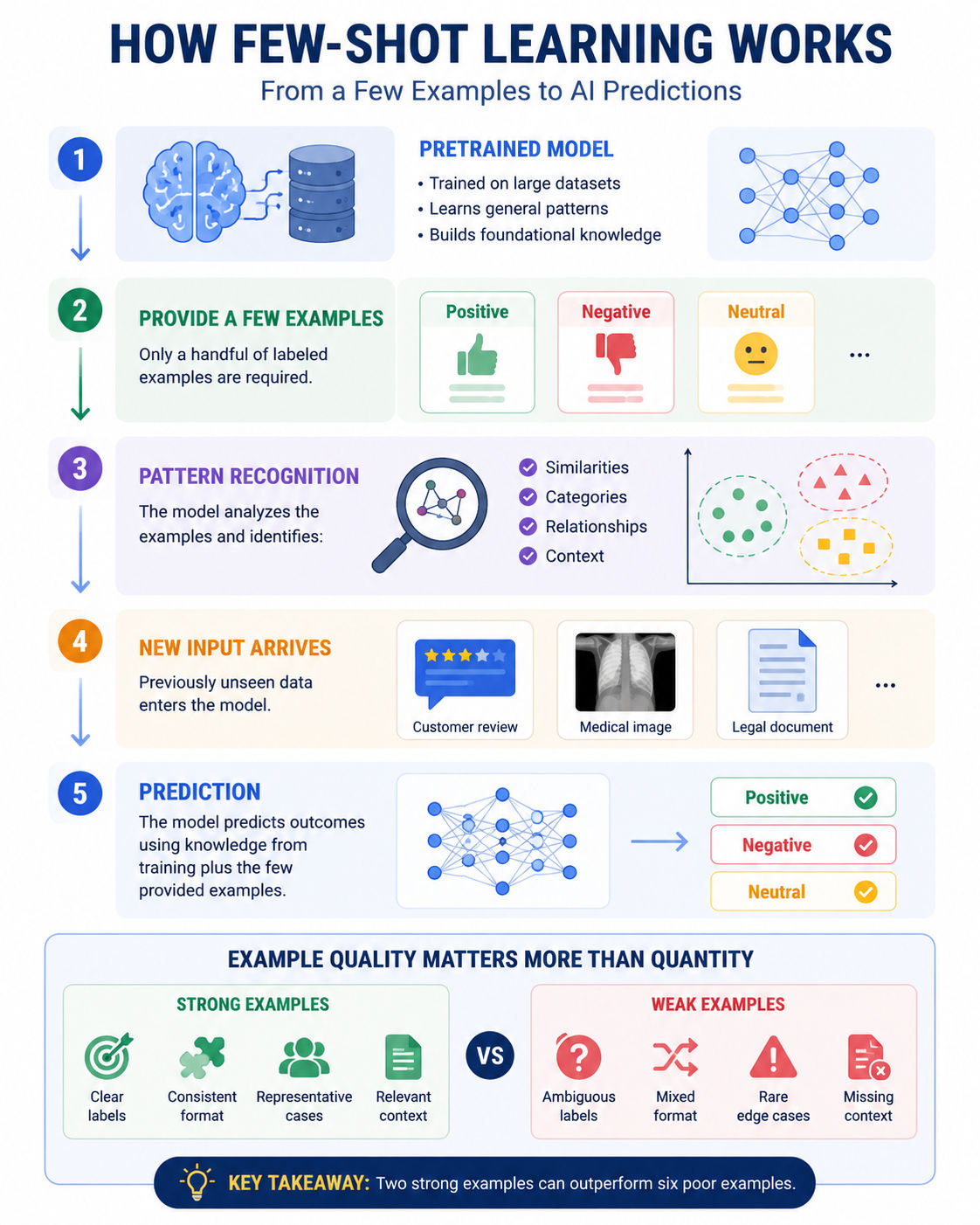
Few-shot learning is a machine learning approach where a model learns to perform a task using only a small number of labeled examples. Instead of requiring massive datasets, the model uses prior knowledge gained from previous training and applies it to new tasks.
This blog covers what few-shot learning actually is, how it works under the hood, where it's being used today, and what its real limitations look like. By the end, you'll have a clear picture of why this approach is gaining serious attention in the AI world.
Explore upGrad's Artificial Intelligence, Machine Learning, and Data Science programs to build practical skills in AI, machine learning, deep learning, and data-driven decision-making.
Popular AI Programs
Here's the core idea. You show a model two or three examples of something it hasn't been trained on before, and it figures out the pattern well enough to classify or generate correctly.
That sounds almost too simple. But it works because few-shot learning doesn't start from scratch. The model has already been pre-trained on a large, diverse dataset. That pre-training gives it a strong base of generalized knowledge. The few examples you provide at inference time just steer that knowledge toward a specific new task.
Think of it like this. You've spent years reading books, studying science, and having conversations. Someone shows you two photos of a fruit you've never seen and tells you what it is. You'd probably identify it correctly in a third photo. You're not learning from scratch. You're applying existing pattern recognition to something new.
That's the logic that few-shot learning operates on.
There are three related terms worth knowing:
Term |
Examples Given |
How Hard |
| Zero-shot learning | 0 | Hardest |
| One-shot learning | 1 | Hard |
| Few-shot learning | 2 to 10 | More practical |
Zero-shot is impressive but unreliable for complex tasks. Few-shot hits a practical sweet spot.
There's no strict definition. Most researchers treat 2 to 10 labeled examples as the range. Beyond that, you're getting into standard fine-tuning territory. The whole point is that performance stays solid even when data is scarce.
Free Courses
The mechanism depends on the type of model and how it's structured. There are two main approaches worth understanding.
Meta-learning is probably the most well-known approach. The model is trained across hundreds of different tasks during the pre-training phase. It doesn't just learn facts. It learns how to learn quickly from limited data. When you give it a new task with a few examples, it applies that meta-skill directly.
One popular framework here is the Prototypical Network. It works by creating a "prototype" representation for each class based on the few examples you give. New data points get classified based on how close they are to each prototype in the feature space.
This is where few-shot learning shows up most visibly today. When you use GPT-4 or Claude and provide a couple of examples in your prompt before asking a question, you're doing few-shot learning. No model weights are being updated. The model reads the examples as context and adjusts its output accordingly.
That's a very different mechanism from traditional training. It's faster, cheaper, and surprisingly effective.
AI Courses to upskill
Explore Artificial Intelligence Courses for Career Progression
This isn't a theoretical concept sitting in a research paper. It's running in production across real systems right now.
A short list of domains where it's actively in use:
Each of these shares the same constraint of not having enough labelled data. Few-shot learning doesn't make that problem disappear, but it makes working around it practical.
Do read: Neural Networks for Dummies: A Comprehensive Guide
Few-shot learning gets a lot of praise. But there are genuine limitations that don't get discussed enough.
Aspect |
Benefits of Few-Shot Learning |
Challenges and Limitations |
| Data Requirements | Learns effectively from a small number of labeled examples, reducing data collection efforts. | Still relies heavily on the quality and diversity of data used during pretraining. |
| Deployment Speed | Enables faster experimentation and model adaptation for new tasks. | Performance can vary significantly depending on the examples provided. |
| Cost Efficiency | Reduces annotation, storage, and training costs compared to traditional machine learning. | Advanced architectures and pretraining can still require substantial computational resources. |
| Specialized Applications | Works well in domains with limited data, such as rare diseases, fraud detection, and defect identification. | Highly specialized or complex tasks may still require larger datasets for acceptable accuracy. |
| Learning Capability | Can generalize from a few examples by leveraging prior knowledge. | Models may overfit to the limited examples instead of learning broader patterns. |
| Consistency | Adapts quickly without requiring extensive retraining. | Outputs can change when the order or wording of examples changes, creating reproducibility issues. |
| Example Quality | A small set of high-quality examples can produce strong results. | Poor, biased, or unrepresentative examples can significantly reduce performance. |
| Accuracy | Often achieves good results for straightforward classification and recognition tasks. | Multi-step reasoning tasks and domain-specific decision-making can expose accuracy limitations. |
| Evaluation | Allows rapid testing in low-data environments. | Measuring true performance is difficult because small validation sets can produce misleading results. |
| Scalability Across Tasks | Can be applied to various domains without collecting massive task-specific datasets. | Not a universal solution and should not be viewed as a replacement for traditional training in every scenario. |
Also Read: How to Implement Machine Learning Steps: A Complete Guide
Aspect |
Few-Shot Learning |
Transfer Learning |
Fine-Tuning |
| Definition | Uses a small number of examples to guide a pretrained model during inference without changing its weights. | A broad machine learning approach where knowledge from a pretrained model is reused for a new task. | A transfer learning technique where the pretrained model's weights are updated using task-specific data. |
| Model Weight Updates | No | Sometimes | Yes |
| Training Required | No additional training required | Depends on the approach used | Requires additional training |
| Number of Examples Needed | Typically 2–50 examples | Varies widely depending on the task | Usually hundreds to thousands of examples |
| Compute Requirements | Low | Moderate | High |
| Cost | Lower | Moderate | Higher due to training infrastructure and compute usage |
| Speed of Implementation | Very fast | Moderate | Slower because training and evaluation are required |
| Adaptation Method | Learns from examples provided in prompts or context windows | Reuses previously learned representations from another task | Permanently adapts the model to a specific use case |
| Performance Consistency | Can vary depending on prompt quality and example selection | Generally more stable than few shot learning | Usually delivers the most consistent results for a defined task |
| Data Dependency | Works well when labeled data is scarce | Requires some transferable knowledge from a source task | Performs best when sufficient task-specific data is available |
| Best Use Cases | Rapid prototyping, classification, content generation, customer support tasks | Domain adaptation, computer vision, NLP applications | Enterprise applications requiring high accuracy and repeatable performance |
| Maintenance Effort | Low | Moderate | Higher due to retraining and model management |
| Flexibility | Highly flexible and easy to change between tasks | Flexible but depends on model architecture | Less flexible once optimized for a specific task |
| Example Scenario | Providing 10 examples of customer feedback categories in a prompt and asking the model to classify new reviews | Usin |
Also Read: Top Image Processing Projects Ideas & Topics [For Beginners]
The right approach depends on your data, resources, and business goals. If you're working with a small team, have limited labeled data, or need results quickly, few-shot learning is often the most practical option because it requires minimal setup and no additional training. When you have access to a large proprietary dataset and need reliable, repeatable performance in production, fine-tuning is usually the better choice.
If your goal is to build on an existing pretrained model and adapt it to a related task, transfer learning provides a strong starting point.
Use case stability matters too. Few-shot learning works well when requirements change frequently since you can update prompts instead of retraining models. Organizations with limited compute budgets also benefit from this approach.
For highly specialized domains such as healthcare, legal services, or manufacturing, transfer learning and fine-tuning often deliver stronger results because they allow deeper adaptation to domain-specific data. If no labeled data is available at all, zero-shot learning or retrieval-augmented generation (RAG) can help by relying on pretrained knowledge or external information sources.
Rather than looking for a single "best" method, focus on choosing the approach that matches your data availability, performance requirements, budget, and operational constraints.
Also Read: Types of Regression Models in Machine Learning You Should Know About
Few-shot learning solves a real problem. Most of the world doesn't have millions of labeled examples sitting around. This technique lets AI systems work in those constrained environments without sacrificing usefulness.
It's not perfect. It depends heavily on the quality of the base model and the examples you choose. And it struggles with high-complexity tasks. But for practical, fast deployment in low-data scenarios, it's one of the most useful tools available to machine learning teams today.
Ready to start your journey? Book a free consultation with upGrad today to find the best path for your career.
There's no fixed number, but most few-shot learning tasks work with anywhere from 2 to 50 examples per class. The ideal number depends on task complexity, example quality, and the strength of the underlying model. More examples don't always improve performance if they introduce inconsistency or noise.
Yes. Large language models such as GPT, Claude, and Gemini are particularly effective at few-shot learning because they have already been trained on vast amounts of text. This extensive pretraining allows them to recognize patterns from a small number of examples and apply them to new tasks.
Few-shot learning can significantly lower costs associated with data labeling, dataset creation, and model retraining. Instead of collecting thousands of examples for every new task, organizations can often achieve useful results with a much smaller set of carefully selected samples.
Absolutely. Small businesses often lack the resources to build large machine learning datasets. Few-shot learning provides a practical way to experiment with AI-powered classification, content generation, customer support automation, and analytics without making large investments in data collection.
The examples act as instructions for the model. If they are unclear, inconsistent, or biased, the model may learn the wrong pattern. Well-structured examples help the system identify the desired behavior more accurately and produce more reliable outputs across different inputs.
Yes. Few-shot learning is increasingly used for translation, text classification, and language understanding tasks involving low-resource languages. It helps organizations build AI solutions even when large labeled datasets are unavailable for a particular language or regional market.
Enterprises often use few-shot learning to classify documents, analyze customer feedback, automate workflows, detect anomalies, and improve support systems. It is particularly valuable when business requirements change frequently and retraining a model for every new task isn't practical.
Data quality is often more important than data quantity. A small set of representative examples can outperform a larger set of poorly labeled data. Clear labels, consistent formatting, and realistic examples help the model learn the intended pattern more effectively.
Yes. Many modern AI systems combine few shot learning with retrieval-augmented generation. The examples guide the model's behavior, while the retrieval system supplies up-to-date information. This combination often improves accuracy, relevance, and domain-specific performance.
Few shot learning is widely used in computer vision, especially when collecting image data is difficult. Applications include medical image analysis, defect detection, facial recognition, wildlife monitoring, and object classification where only a limited number of labeled images are available.
Few shot learning is expected to become increasingly important as organizations seek faster and more flexible AI deployment. As foundation models improve, the ability to adapt systems using only a handful of examples will likely become a standard capability across many AI applications.
730 articles published
Sriram K is a Senior SEO Executive with a B.Tech in Information Technology from Dr. M.G.R. Educational and Research Institute, Chennai. With over a decade of experience in digital marketing, he specia...
Speak with AI & ML expert
By submitting, I accept the T&C and
Privacy Policy
Top Resources
Master's Degree
18 Months
Executive Diploma
12 Months
IIIT Bangalore
Executive Programme in Generative AI & Agentic AI for LeadersIndia’s #1 Tech University
Dual Certification
5 Months