Performance Marketing vs Digital Marketing: Key Differences, ROI, and When to Use Each
By upGrad
Updated on Jul 27, 2026 | 7 min read | 1.6K+ views
Share:

All courses
Certifications
More
By upGrad
Updated on Jul 27, 2026 | 7 min read | 1.6K+ views
Share:
Table of Contents
Key Takeaway
Explore upGrad's Digital Marketing Course Degree to build practical skills in SEO, SEM, keyword research, website analytics, performance marketing, content strategy, social media marketing, and data-driven campaign optimization.
Digital marketing is a broader discipline. It includes everything a business does to market itself online, from SEO and content marketing to email marketing, social media, and paid ads.
Performance marketing fits within this broader strategy and is just one tool in that box, but its focus is different. Every campaign is built around measurable outcomes like leads, sales, or app installs, making it easier to track exactly what's working.
Digital marketing is the long game you need to be in business. You publish a blog post today and it might rank and bring traffic for three years. Performance marketing doesn't work that way. You launch a campaign, you watch the numbers within hours, and you adjust or kill it fast.
Here's the takeaway. If you need something to work by next week, that's performance marketing territory. If you're playing for the next two years, you're in digital marketing's broader lane.
Factor |
Performance Marketing |
Digital Marketing |
| Definition | Results-driven marketing | All online marketing |
| Primary Goal | Conversions | Brand growth & sales |
| Scope | Campaign-focused | End-to-end marketing |
| Channels | Google Ads, Meta Ads, Affiliate | SEO, Content, Social, Email, PPC |
| Payment Model | Pay for results | Paid + Organic |
| Key KPIs | CPA, ROAS, CTR, CAC | Traffic, Reach, Engagement, Leads |
| ROI | Immediate | Short and long term |
| Timeframe | Days to weeks | Weeks to months |
| Budget | Performance-based | Multi-channel allocation |
| Best For | Leads, sales, launches | Awareness, trust, growth |
| Biggest Advantage | Easy to measure | Sustainable visibility |
| Main Limitation | Depends on ad spend | Slower to show results |
Every successful marketing strategy starts with a clear objective, but the way you achieve that objective differs. Performance marketing focuses on driving immediate, measurable conversions, while digital marketing builds long-term visibility and customer relationships. The table below highlights how the two strategies differ across key areas.
Aspect |
Performance Marketing Strategy |
Digital Marketing Strategy |
| Primary Focus | Drives conversions like leads or sales | Builds brand awareness and trust |
| Approach | Starts with a clear conversion goal | Focuses on the complete customer journey |
| Execution | Launches and optimizes paid campaigns using real-time data | Uses channels like SEO, content, social media, and email over time |
| Measurement | Easy to track clicks, leads, and sales | Attribution is spread across multiple touchpoints |
| Budgeting | Reviewed and optimized frequently | Planned for long-term growth and consistency |
| Results Timeline | Delivers quick, measurable results | Produces gradual, long-term results |
| Best For | Short-term campaigns and immediate ROI | Sustainable growth and customer relationships |
| Overall Goal | Maximize conversions | Build lasting brand value and loyalty |
Also read: A Complete Guide to Crafting an Impactful Digital Marketing Strategy
You can't measure both approaches with the same yardstick. Trying to judge a brand awareness campaign by its cost per lead will make it look like a failure, even when it's working exactly as intended.
Performance Marketing Metrics |
Digital Marketing Metrics |
| Cost Per Acquisition (CPA) | Organic traffic |
| Return on Ad Spend (ROAS) | Engagement rate |
| Click-Through Rate (CTR) | Brand reach |
| Conversion Rate | Keyword rankings |
| Customer Acquisition Cost (CAC) | Customer lifetime value |
CPA and ROAS matter when you're spending money to get an immediate return. If your CPA is higher than your customer's value, you're losing money. CTR and conversion rate tell you if your ad creative and landing page are actually doing their job.
On the digital marketing side, organic traffic and keyword rankings tell you if your content strategy is gaining ground. Engagement and reach matter when you're trying to build recognition, not close a sale today. Customer lifetime value ties both worlds together because it shows whether your marketing, paid or organic, is bringing in customers who stick around.
Pick your metrics based on what you're actually trying to achieve.
Do read: A Beginner’s Guide to Developing a Digital Marketing Strategy
Digital marketing ROI is harder to measure. A blog published today may take months to rank on search engines, but it can continue driving free traffic and leads long after it's live. While attribution tools help, it's rarely possible to credit a single piece of content for every sale.
Consider an ecommerce brand during a festive sale. A performance marketing campaign delivers quick results within days, while SEO content created months earlier continues bringing in organic sales without additional ad spend. One delivers immediate wins, while the other creates lasting value.
The two strategies work best together. Lifetime customer value is where the two approaches actually meet. A customer might first click on a performance ad but return later through emails or helpful content to make repeat purchases. That's where performance marketing and digital marketing complement each other.
Also read: What is Paid Media? 5 Simple Ways to Create Paid Media Strategy
Free Courses
Digital marketing is the practice of promoting products, services, or brands through online channels to reach and engage customers. It includes both organic methods, such as SEO and content marketing, and paid strategies like search and social media marketing. The goal isn't just to drive sales but also to build brand awareness, attract qualified traffic, nurture leads, and retain customers over time.
Unlike performance marketing, which focuses on measurable actions such as clicks or conversions, digital marketing takes a broader approach. It combines multiple channels to guide potential customers through every stage of the buying journey, from discovering a brand to becoming loyal customers.
Common digital marketing channels include:
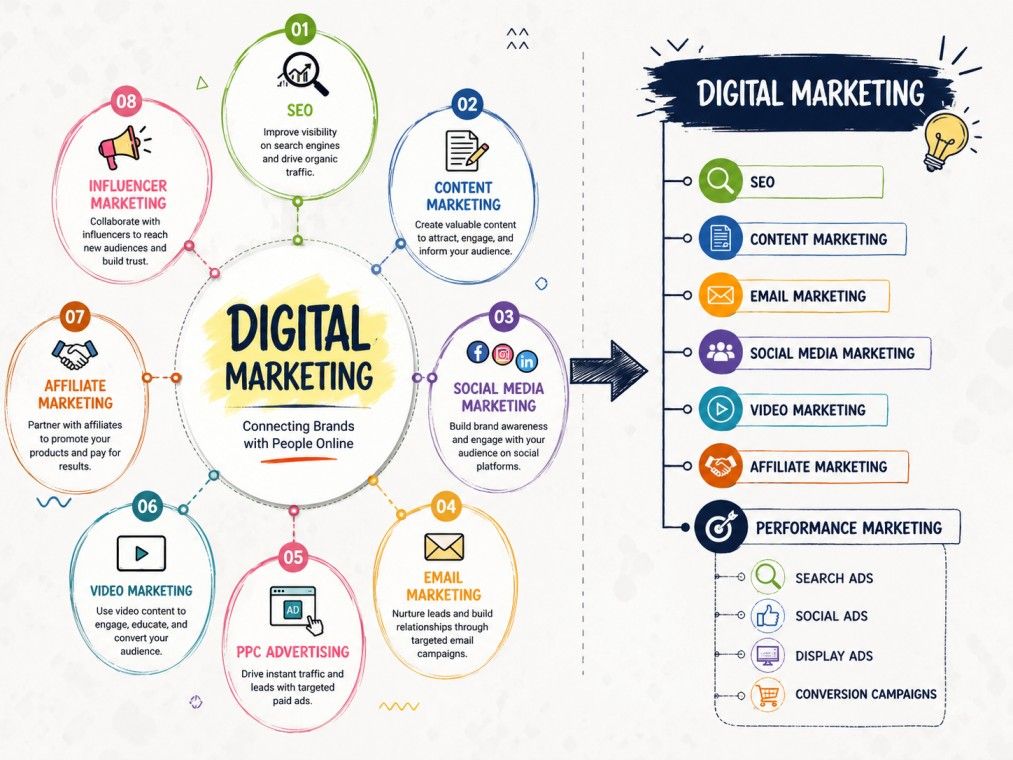
A successful digital marketing strategy doesn't rely on just one channel. Instead, it brings these channels together to create a consistent customer experience and support both short-term business goals and long-term growth.
Explore upGrad's Chief Data and AI Officer Program with IIIT Bangalore and IIM Udaipur, which equips experienced professionals to lead enterprise data strategy, AI governance, monetization, and C-suite decision-making through live learning, hands-on decision labs, and a board-ready strategic portfolio.
Digital Marketing Courses to upskill
Explore Digital Marketing Courses for Career Progression
MICA Executive Alumni Status
Is performance marketing part of digital marketing? Performance marketing is a subset of digital marketing and is a results-driven approach to online advertising where businesses pay only when a specific action is completed. These actions can include clicks, leads, app installs, sign-ups, or sales, making every campaign measurable and easier to optimize for return on investment (ROI).
Unlike broader digital marketing efforts that focus on long-term brand building, performance marketing is designed to achieve immediate, trackable outcomes. Marketers continuously monitor campaign data and adjust budgets, audiences, ad creatives, and bidding strategies to improve performance and reduce acquisition costs.
Common performance marketing channels include:
The typical performance marketing process looks like this:
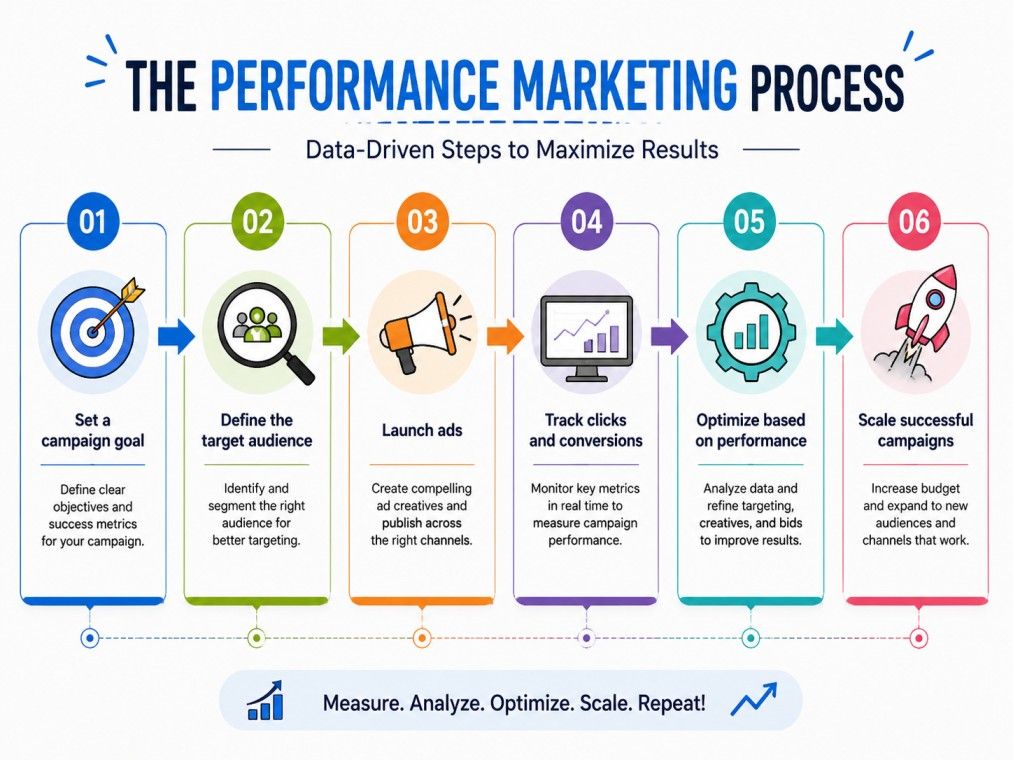
Because every action is measurable, performance marketing is widely used by ecommerce brands, SaaS companies, startups, and businesses that want to generate leads or sales while keeping a close eye on advertising spend.
No, performance marketing alone can generate leads, but it can't build the trust that makes people choose you over a competitor with a similar offer.
Think about it this way. Would you buy from a brand you've never heard of just because you saw one ad? Most prople won't, not without checking reviews, visiting the website, or seeing the brand mentioned somewhere else first. That whole missing field and groundwork is digital marketing's job.
Performance marketing also has a scaling problem. Ad costs rise as you compete for the same audience, and without organic traffic or brand recognition backing it up, your cost per lead keeps climbing with no ceiling in sight.
Businesses that rely only on performance marketing often see diminishing returns within a year or two. Businesses that combine both usually see performance campaigns get cheaper over time, because brand recognition built through digital marketing lowers the cost of convincing someone to click.
Must Read: How to Create Social Media Content Strategy? Everything You Need to Know
Seeing real examples side by side makes the distinction click faster than any definition.
Performance Marketing Examples |
Digital Marketing Examples |
| Google Search Ads for a product launch | SEO-optimized blog content |
| Meta Lead Ads for course enrollments | Email nurture sequences |
| Affiliate marketing campaigns | Organic social media posts |
| App install campaigns | Brand awareness video campaigns |
Performance marketing examples all have a clear, trackable action attached to them, a click, an install, a lead form.
Digital marketing examples build relationships and visibility over time, without demanding an immediate transaction.
A SaaS company launching a new feature might run Google Search Ads (performance marketing) while simultaneously publishing tutorial content and case studies (digital marketing) to support the launch from both angles.
Must read: 25+ Proven SEO Strategies to Master On and Off Page SEO Techniques
Subscribe to upGrad's Newsletter
Join thousands of learners who receive useful tips
Although performance marketing vs digital marketing differ in how campaigns are measured and optimised, they share several core objectives and practices. Since performance marketing is a subset of digital marketing, both approaches work together to help businesses build brand awareness, generate leads, and increase revenue.
Here are the key similarities between performance marketing and digital marketing:
Similarity |
Explanation |
| Digital Channels | Use search, social, email, websites, and apps |
| Customer Focus | Target the right audience with personalized campaigns |
| Data-Driven | Rely on analytics to improve performance |
| Business Goals | Drive traffic, leads, conversions, and sales |
| Content | Use content to attract and engage customers |
| Audience Targeting | Segment users by behavior, interests, and demographics |
| Automation | Use CRM, email workflows, and AI tools |
| Optimization | Test and improve campaigns regularly |
| Analytics Tools | Track results with GA4, Search Console, and ad platforms |
| Business Growth | Increase visibility, customers, and revenue |
They work best together, not against each other. Digital marketing builds long-term brand visibility through SEO, content, social media, and email, while performance marketing drives fast, measurable results through paid campaigns. Together, digital marketing vs performance marketing help businesses grow both now and over time.
Must read: How to Use Google Analytics: Comprehensive Guide For Beginners
Sometimes you genuinely don't need the long game. Here's when performance marketing makes more sense on its own.
Business Need |
Choose Performance Marketing |
Choose Digital Marketing |
| Timeline | Need leads or sales within days | Building growth over months or years |
| Business Goal | Launch a product or limited-time offer | Build long-term brand authority |
| Market Testing | Validate a new market with quick feedback | Strengthen market presence over time |
| Budget Focus | Need measurable returns quickly | Invest in sustainable organic growth |
| Customer Strategy | Prioritize immediate conversions | Focus on trust, education, and relationships |
| Traffic Source | Rely on paid campaigns for instant visibility | Grow through SEO, content, and organic channels |
| Best Fit | Short-term campaigns and fast results | Long-term business growth and brand recognition |
Why Do Businesses Use Both Performance Marketing and Digital Marketing? Most growing businesses eventually need both. Startups often lean performance-first to validate demand, then shift budget toward digital marketing once they've got product-market fit and want to lower acquisition costs over time.
There's no one-size-fits-all answer. A startup testing a new idea needs a very different marketing strategy than an established brand protecting its market share. The key is to choose the approach that fits your business goals and growth stage, not whatever trend is making headlines.
Business Type |
Recommended Approach |
| Startup | Performance marketing first, then expand into broader digital marketing |
| Small business | Balanced mix of local SEO, content, and paid ads |
| Ecommerce | Performance marketing supported by SEO and email marketing |
| SaaS | Content marketing combined with paid acquisition |
| Enterprise | Full-funnel digital marketing with performance campaigns woven in |
Do read: How to Choose the Right Digital Marketing Channels For Your Business?
A few mistakes to avoid when choosing between performance marketing and digital marketing, across industries and budget sizes:
Avoiding these mistakes usually comes down to one thing: matching your metrics and expectations to the actual goal of the campaign.
Performance marketing vs digital marketing isn't really a rivalry. Performance marketing is the fast, measurable slice of a much bigger picture called digital marketing. One gets you sales this week. The other builds the reputation that makes those sales cheaper and more consistent over time.
The businesses that win long-term rarely pick one over the other. They use performance marketing to capture demand that already exists, and digital marketing to create demand that doesn't exist yet. Get that balance right, and both approaches end up working harder for less.
Ready to start your journey? Book a free consultation with upGrad today to find the best path for your career.
No. Performance marketing is a subset of digital marketing that focuses on measurable outcomes such as clicks, leads, app installs, or sales.
A business can generate leads and sales using only performance marketing, but long-term growth usually requires broader digital marketing efforts. SEO, content, and email marketing help build trust, improve organic visibility, and reduce reliance on paid advertising over time.
A common example is a Google Search Ads campaign where an advertiser pays only when someone clicks the ad or completes a purchase. Meta lead generation ads, affiliate marketing, and app install campaigns also fall under performance marketing because payment is tied to measurable results.
For immediate lead generation, performance marketing is usually the better choice because campaigns can be launched and optimized quickly. However, combining it with SEO and content marketing creates a stronger pipeline by attracting both ready-to-buy customers and future prospects through organic search.
There isn't a universal ratio. Businesses launching new products often invest more in paid campaigns initially, then gradually increase spending on SEO, content, and email marketing. A balanced mix helps generate short-term revenue while building sustainable traffic and brand authority.
Yes. High-quality content improves landing page relevance, builds trust, and educates potential customers before they convert. Businesses that combine content marketing with paid campaigns often see better engagement, improved conversion rates, and stronger long-term customer acquisition than relying on ads alone.
Industries with clear online conversion goals benefit the most. Ecommerce, SaaS, education, healthcare, finance, travel, and real estate frequently use performance marketing to acquire customers because campaign results can be tracked and optimized using conversion data.
Performance marketing campaigns are often reviewed daily or weekly because advertising data changes quickly. Digital marketing strategies, including SEO and content marketing, are usually evaluated monthly or quarterly to measure long-term improvements in traffic, rankings, and audience engagement.
Yes. AI helps both approaches by automating audience segmentation, predicting campaign performance, generating content ideas, improving bid strategies, and identifying optimization opportunities.
Most experts recommend learning digital marketing fundamentals first. Understanding SEO, content marketing, customer journeys, analytics, and social media creates a solid foundation before moving into paid advertising and performance marketing, making campaign decisions more informed and effective.
Performance marketing primarily focuses on acquiring customers through measurable campaigns, while digital marketing supports retention through content, email marketing, social media engagement, and loyalty initiatives. Using both together helps businesses attract new customers and encourage repeat purchases, increasing lifetime customer value.
972 articles published
We are an online education platform providing industry-relevant programs for professionals, designed and delivered in collaboration with world-class faculty and businesses. Merging the latest technolo...
Get Free Consultation
By submitting, I accept the T&C and
Privacy Policy
Level Up Your Digital Marketing Career Today!
Top Resources
MICA
Advanced Certificate in AI-Powered Digital Marketing & Communication from MICAMICA Executive Alumni Status
Certification
5 Specialisation
Classroom
4 Months
Certification
2 Months