Evolution of Machine Learning: From Simple Rules to Self-Learning Systems
By Sriram
Updated on Jun 25, 2026 | 8 min read | 1.74K+ views
Share:

All courses
Certifications
More
By Sriram
Updated on Jun 25, 2026 | 8 min read | 1.74K+ views
Share:
Table of Contents
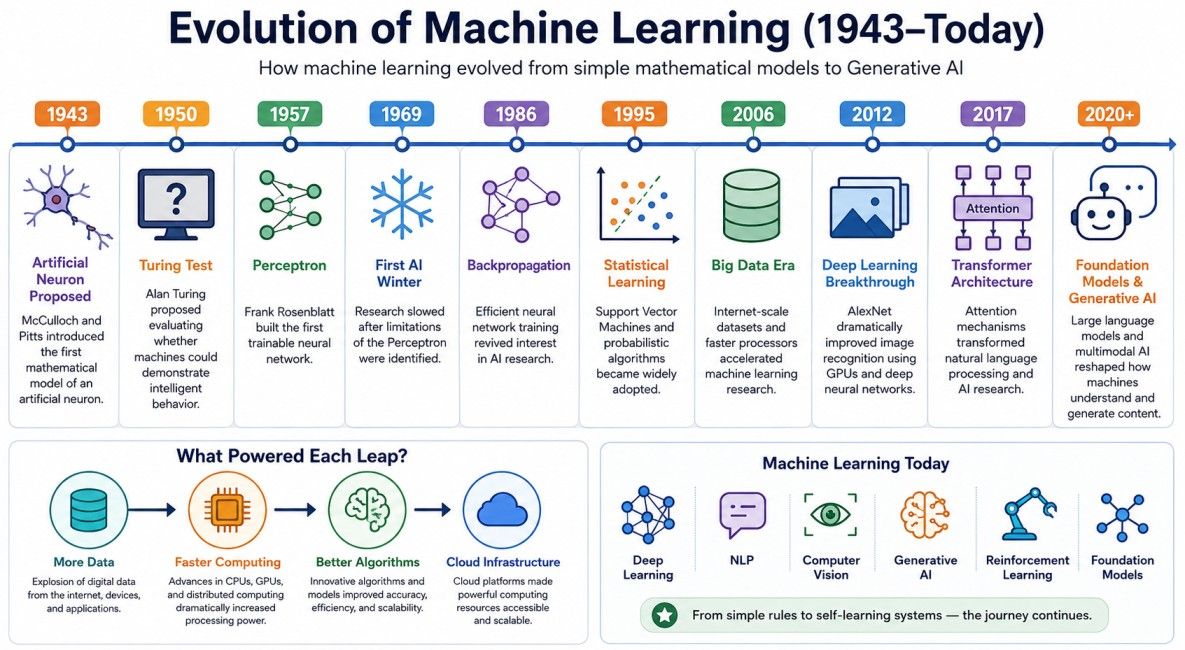
The evolution of machine learning took decades of research, advances in computing power, and access to larger datasets before machines could learn patterns efficiently. It started with simple mathematical models. Today, machine learning can recognize speech, generate text, predict diseases, and create images.
Machine learning has changed from a small research field into one of the most influential branches of artificial intelligence. Today, it powers recommendation systems, fraud detection, self-driving cars, language models, medical diagnosis, and countless business applications. Understanding the evolution of machine learning helps explain why today's AI systems perform so well and what challenges still remain.
This blog walks you through every major phase of that journey. You'll understand what changed, why it changed, and what each shift meant for how machines actually learn.
Explore upGrad's Machine Learning programs to build practical skills in machine learning algorithms, deep learning, neural networks, generative AI, model evaluation, NLP, and real-world AI applications.
Popular AI Programs
Most people assume machine learning is a recent thing. It's not.
The ideas go back to the 1940s and 1950s, when researchers started asking a genuinely strange question: can a machine learn from experience the way a human does? Alan Turing raised this in 1950 with his famous test, which asked whether a machine could behave intelligently enough to be mistaken for a human. That question set the whole field in motion.
The first concrete step came in 1957 when Frank Rosenblatt built the Perceptron. It was a single-layer neural network that could classify inputs into two categories. Basic by today's standards, but it was real. A machine was adjusting its own behavior based on data.
Then came the first hard stop.
In 1969, Marvin Minsky and Seymour Papert published a book that mathematically proved the Perceptron couldn't solve problems that weren't linearly separable. Funding dried up. Interest collapsed. This period is called the first AI Winter, and it lasted through much of the 1970s.
The gap between what ML promised and what it could actually deliver was wide. That gap drove the next phase.
Do read: Introduction to Machine Learning for Beginners: What is, History, Function & Classification
Free Courses
The 1980s brought a different approach. Instead of trying to mimic the brain, researchers leaned into statistics.
Expert systems became popular. These were rule-based programs that encoded human knowledge as if-then logic. A medical expert system, for example, would have thousands of rules written by actual doctors. The machine didn't learn anything. It followed instructions.
It worked, sort of. IBM's Deep Blue used rule-based logic to beat Garry Kasparov at chess in 1997. That was a headline moment. But the limitation was obvious: you had to write every rule by hand. If the domain changed, someone had to rewrite the rules.
Meanwhile, something quieter was happening in statistics. Researchers were developing algorithms that could find patterns in data without being told what patterns to look for.
Algorithm |
Year Introduced |
What It Did |
| Decision Trees | 1980s | Split data into categories using rules |
| Naive Bayes | Applied widely in 1990s | Classified text and emails using probability |
| Support Vector Machines | 1995 | Found optimal boundaries between classes |
| Backpropagation | Rediscovered mid-1980s | Trained multi-layer neural networks |
Backpropagation was the real shift. It meant you could train deeper networks by sending error signals backward through the layers. The math had existed earlier, but it took Rumelhart, Hinton, and Williams in 1986 to make it practical.
Still, neural networks weren't mainstream yet. Training them took too long, and the data wasn't there to make them shine.
Explore upGrad's Executive Diploma in Machine Learning and AI from IIIT Bangalore to master hands-on expertise in machine learning, deep learning, NLP, reinforcement learning, Generative AI, MLOps, and LLM-powered applications through real-world case studies, capstone projects, and industry-aligned learning designed for career growth.
AI Courses to upskill
Explore Artificial Intelligence Courses for Career Progression
The late 1990s and 2000s changed everything. Not because of a new algorithm, but because of the internet.
Suddenly there was data everywhere. Text, images, clicks, purchases, search queries. Billions of data points are generated every day by millions of people who didn't even know they were contributing to a training dataset.
Algorithms that had been theoretically sound but practically weak now had enough fuel to actually work.
This is when machine learning became a real engineering discipline. Companies started hiring ML engineers. Competitions like the Netflix Prize in 2006 showed that recommendation algorithms could be improved dramatically with the right approach.
Random forests, gradient boosting, and ensemble methods became go-to tools. They're still heavily used today in structured data tasks like fraud detection, credit scoring, and demand forecasting.
Don't underestimate this era. It's where ML moved from research labs into production systems that handled real money and real decisions.
Must read: Foundations of Machine Learning: What You Actually Need to Know
2012 is a hard line in the evolution of machine learning.
That year, a team led by Geoffrey Hinton entered the ImageNet competition, a large-scale image recognition contest. Their model, AlexNet, didn't just win. It won by a margin that made everyone in the field sit up.
AlexNet used deep convolutional neural networks and ran on GPUs. It cut the error rate in half compared to the previous best. Researchers who'd been skeptical about neural networks couldn't ignore the results.
Deep learning had arrived.
Why deep learning worked when earlier neural networks didn't:
The next few years saw deep learning spread into every domain. Speech recognition improved enough that voice assistants became usable. Translation quality jumped. Image classification reached near-human accuracy on benchmark tests.
It wasn't perfect. Deep learning models are hungry for data, slow to train on small datasets, and notoriously hard to interpret. If you ask a deep learning model why it made a decision, it often can't tell you. That's still a real problem in healthcare, finance, and legal applications where explainability matters.
Do read: How to Learn Machine Learning – Step by Step
If deep learning was a step change, transformers were a leap.
Introduced in the 2017 paper "Attention Is All You Need" by researchers at Google, the transformer architecture changed how models process sequences. Before transformers, recurrent neural networks processed text word by word, which made it hard to capture long-range relationships and slow to parallelize.
Transformers solved that. They look at an entire sequence at once and use attention mechanisms to figure out which parts of the input matter most for each output.
The results were striking. BERT in 2018 set new benchmarks across almost every natural language processing task. GPT-2 in 2019 generated text that genuinely fooled readers. GPT-3 in 2020 showed that scaling model size produced qualitative jumps in capability.
What's different about this era isn't just the performance. It's the paradigm. Instead of training a model for a specific task from scratch, you now start with a large pretrained model and fine-tune it. That's faster, cheaper, and often produces better results than building from zero.
Model |
Year |
What It Proved |
| BERT | 2018 | Context matters in both directions |
| GPT-2 | 2019 | Large models generate coherent long-form text |
| GPT-3 | 2020 | Few-shot learning at scale works |
| DALL-E | 2021 | Transformers can generate images from text |
| GPT-4 | 2023 | Multimodal reasoning across text and image |
Foundation models like GPT-4, Claude, Gemini, and LLaMA aren't task-specific tools. They're general-purpose systems that adapt to new tasks with minimal additional training. That's a structural shift in how machine learning gets deployed.
Must read: 9 Important Machine Learning Benefits You Should Know
Most of the evolution of machine learning has focused on prediction. Reinforcement learning is about decisions.
The idea is simple: an agent takes actions in an environment, gets rewards or penalties, and learns a policy that maximizes long-term reward. It sounds clean, but training RL agents is notoriously difficult.
Early RL work goes back to the 1990s. Q-learning and temporal difference learning were developed during this period. But the results were limited to toy problems.
The breakthrough came in 2013 when DeepMind trained an agent to play Atari games directly from raw pixels. The agent didn't know the rules. It learned them through trial and error. Then in 2016, AlphaGo beat the world champion at Go, a game where the number of possible positions exceeds the number of atoms in the observable universe.
That got attention.
Reinforcement learning is now central to training large language models too. RLHF (Reinforcement Learning from Human Feedback) is what makes models like ChatGPT align better with what humans actually want. Human raters compare outputs, and the model learns to prefer outputs that humans prefer.
It's still harder to implement than supervised learning. The reward signal has to be designed carefully, or the agent finds unintended shortcuts. That's a known failure mode, and researchers take it seriously.
Do read: Image Recognition Machine Learning: Brief Introduction
The field is still evolving. A few directions are driving current research and deployment. Multimodal models can process text, image, audio, and video together. That's a significant expansion from models that handled one modality at a time. Agentic AI systems don't just respond to prompts; they plan, use tools, and complete multi-step tasks with minimal human input.
Efficiency is a growing focus. Models like Mistral and LLaMA show that smaller, well-trained models can match or beat much larger ones on specific tasks. Not every application needs a trillion-parameter model. That's good news for teams with limited compute budgets.
There's also renewed interest in explainability. Regulatory frameworks in the EU and elsewhere are starting to require that AI decisions be explainable in certain high-stakes contexts. That's pushing researchers to develop interpretability tools that can open up what happens inside these models.
The evolution of machine learning is far from over. What's clear is that each phase built on the last, and the pace of change has accelerated rather than slowed.
Also read: Exploring the Types of Machine Learning: A Complete Guide
The path from the Perceptron to GPT-4 took about seven decades and ran through two AI winters, dozens of abandoned approaches, and a few moments of genuine surprise.
What made the difference each time wasn't just smarter algorithms. It was more data, faster hardware, and researchers willing to revisit ideas that had been written off. That pattern is worth keeping in mind as the next wave of developments unfolds.
If you want to work in this field, you don't need to master everything at once. Start with the fundamentals. Understand how the core algorithms work before jumping to the latest model. The evolution of machine learning makes a lot more sense when you see how each idea led to the next.
Ready to start your journey? Book a free consultation with upGrad today to find the best path for your career.
The evolution of machine learning refers to how learning algorithms have progressed from simple rule-based models to advanced AI systems that improve through data. It covers major developments such as neural networks, statistical learning, deep learning, transformers, and foundation models that power modern AI applications.
The seven commonly recognized stages include data collection, data preparation, feature engineering, model selection, model training, model evaluation, and deployment with continuous monitoring. Together, these stages create a complete machine learning lifecycle that helps build accurate, reliable, and production-ready models.
The evolution of machine learning in ML describes how algorithms, computing power, and data availability have improved over time. The field progressed from early mathematical models to statistical learning, deep learning, reinforcement learning, and today's large language models capable of solving complex real-world problems.
The four primary types of machine learning are supervised learning, unsupervised learning, semi-supervised learning, and reinforcement learning. Each approach learns differently depending on the available data and is used for tasks such as prediction, clustering, recommendation systems, and autonomous decision-making.
Early machine learning algorithms existed long before modern AI, but computers lacked sufficient processing power and large datasets. Once cloud computing, GPUs, and internet-scale data became widely available, researchers could train more sophisticated models that delivered practical business and consumer applications.
Big data gave machine learning models access to millions of real-world examples for training. Instead of learning from small datasets, algorithms could recognize more complex patterns, improve prediction accuracy, and support applications such as recommendation engines, fraud detection, language translation, and medical diagnosis.
Transformer architecture changed how machines process information by using attention mechanisms instead of sequential processing. This made training faster while improving performance on language understanding, text generation, image creation, and multimodal AI. Today's generative AI systems are largely built on transformer-based models.
Traditional machine learning usually requires manual feature engineering before training begins. Deep learning automatically learns features from raw data using multiple neural network layers. While deep learning often delivers better performance, it also requires larger datasets, greater computing power, and longer training times.
Many everyday digital services rely on machine learning without users noticing it. Search engines, streaming recommendations, online shopping, navigation apps, spam filters, virtual assistants, and digital payment security all use machine learning models to improve accuracy, personalization, and user experience.
Start with Python programming, basic statistics, linear algebra, and probability. Once those foundations are clear, learn common machine learning algorithms, model evaluation techniques, and deep learning concepts. Understanding the historical evolution makes it much easier to grasp why modern AI models work the way they do.
The next phase focuses on AI systems that are more efficient, explainable, and capable of handling multiple data types together. Researchers are also improving agentic AI, smaller language models, privacy-preserving learning, and human-AI collaboration so intelligent systems become more practical and trustworthy.
724 articles published
Sriram K is a Senior SEO Executive with a B.Tech in Information Technology from Dr. M.G.R. Educational and Research Institute, Chennai. With over a decade of experience in digital marketing, he specia...
Speak with AI & ML expert
By submitting, I accept the T&C and
Privacy Policy
Top Resources
Master's Degree
18 Months
Executive Diploma
12 Months
IIIT Bangalore
Executive Programme in Generative AI & Agentic AI for LeadersIndia’s #1 Tech University
Dual Certification
5 Months