Blue Ocean Strategy: Meaning, Examples, Framework, and How It Works
By upGrad
Updated on Aug 11, 2026 | 145 views
Share:

All courses
Certifications
More
By upGrad
Updated on Aug 11, 2026 | 145 views
Share:
Table of Contents
Key Highlights
Ready to lead with greater strategic impact? A DBA degree can help you develop advanced business expertise and leadership skills.
Blue Ocean Strategy is a business approach that focuses on creating new market space instead of competing directly in an overcrowded market.
The word "blue" represents an open market space with fewer direct competitors. In contrast, a crowded market is described as a "red ocean" because businesses are constantly competing for the same customers.
Example to understand blue ocean strategy better:
Think about a market where ten companies offer almost the same product. Each company tries to attract customers from the others. They may lower prices, add features, increase advertising, or offer discounts.
Now imagine one company changes the way the product is offered. It attracts people who were not buying from that market before. It also removes features that customers do not really need and adds something that makes the experience more useful.
The company is no longer simply trying to beat the other nine businesses. It is creating a different value proposition.
That is the basic idea behind a blue ocean.
The approach is built around a few important ideas and these are as follows:
1. Create new demand: Instead of fighting only for existing customers, businesses look for people who are not currently using the product or service.
2. Create uncontested market space: A company tries to change the basis of competition. It may combine features from different industries or remove unnecessary industry standards.
3. Make competition less relevant: A blue ocean does not mean competitors disappear forever. It means the business creates enough differentiation that customers are evaluating the offering differently.
4. Focus on value innovation: The strategy combines differentiation with cost considerations. A company should not simply add expensive features. It should find ways to increase buyer value while avoiding costs that do not contribute enough value.
This last principle is particularly important.
Also read: Business Model Canvas Explained with Real Examples!
To understand the concept properly, it helps us to look at blue and red ocean strategy together.
| Factor | Red Ocean | Blue Ocean |
| Market space | Existing market | New or reshaped market space |
| Competition | Direct and intense | Reduced or less direct |
| Demand | Existing demand | New demand is created |
| Customers | Existing customers | Existing customers and noncustomers |
| Value creation | Often based on industry standards | Based on new buyer value |
| Cost | Compete within existing cost structures | Look for opportunities to reduce unnecessary costs |
| Differentiation | Improve existing offerings | Change the value proposition |
| Strategic focus | Beat competitors | Make competition less relevant |
Also read: 10 Best Business Management Tools to use
DBA Courses to upskill
Explore DBA Courses for Career Progression
IIIT-B & IIM, Udaipur
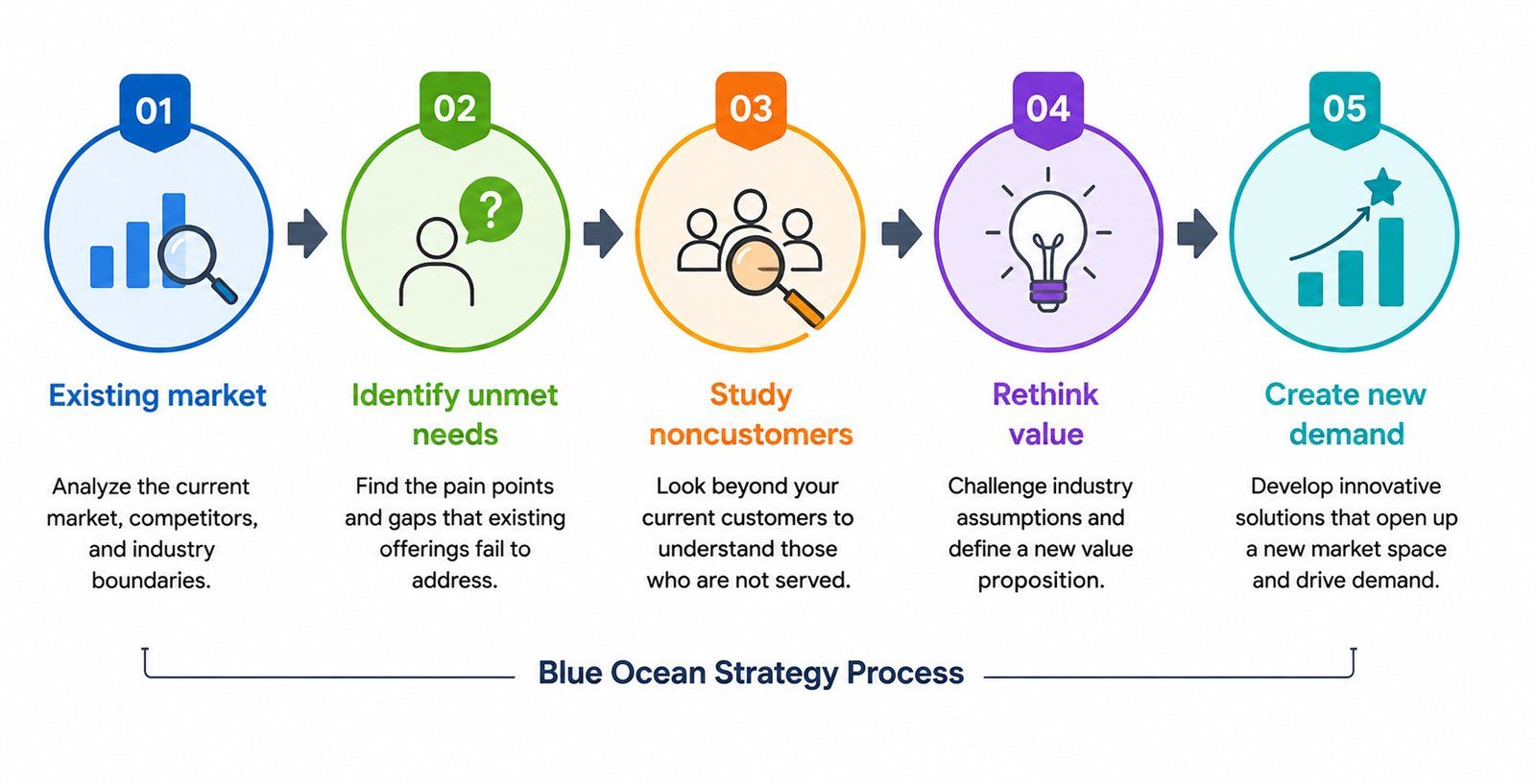
Chief Technology Officer & AI Leadership ProgrammeBlue Ocean Strategy works by changing how a business creates value. Instead of competing on the same factors as existing companies, it looks for unmet needs, overlooked customers, and unnecessary industry standards.
Three ideas form the foundation of the approach.
Value innovation means increasing customer lifetime value while controlling unnecessary costs.
Being different is not enough. A company can add many features and still fail if customers do not value them. Instead, businesses identify what customers truly care about, improve those areas, and remove elements that add cost without enough value.
The aim is to achieve both differentiation and cost efficiency.
Blue Ocean Strategy looks beyond existing customers. Businesses study noncustomers, or people who do not currently use products in the market.
They may avoid an offering because it is expensive, complicated, inconvenient, or poorly suited to their needs.
By solving these barriers, a business can attract new customers instead of competing only for existing ones.
In crowded markets, companies often compete on the same factors, such as price, features, quality, or speed.
Blue Ocean Strategy challenges these assumptions.
A business can remove factors customers do not value, improve the benefits they care about, or introduce something entirely new. This changes what customers compare when making a purchase.
Also read: Customer Retention Strategies: A Complete Guide for 2026
The blue ocean strategy framework gives businesses practical tools to identify opportunities outside traditional competition. Instead of relying only on brainstorming, these tools help companies examine what customers value, what competitors offer, and where the market has gaps.
Four important tools are the Four Actions Framework, Strategy Canvas, ERRC Grid, and Noncustomer Analysis.
Four Actions Framework
The Four Actions Framework helps a business rethink the factors it competes on. It uses four questions:
| Action | Key question |
| Eliminate | Which factors should be removed completely? |
| Reduce | Which factors should be reduced below industry standards? |
| Raise | Which factors should be improved above industry standards? |
| Create | Which new factors should be introduced? |
This framework prevents businesses from simply adding more features to an existing product.
For example, a company entering the fitness industry could eliminate complicated membership conditions, reduce unnecessary facilities, raise the focus on personalised guidance, and create flexible digital workout support.
The result could be a different customer experience rather than another traditional gym.
The blue ocean strategy canvas is a visual tool used to compare the value offered by businesses in an industry. It maps the factors on which companies compete and shows how much importance each business gives to those factors.
Suppose several airlines compete on:
If most airlines have similar profiles, the market may be crowded around the same value factors.
A company can use the strategy canvas to identify areas where customers are underserved or where businesses are spending resources without creating enough value. The goal is to create a different value curve.
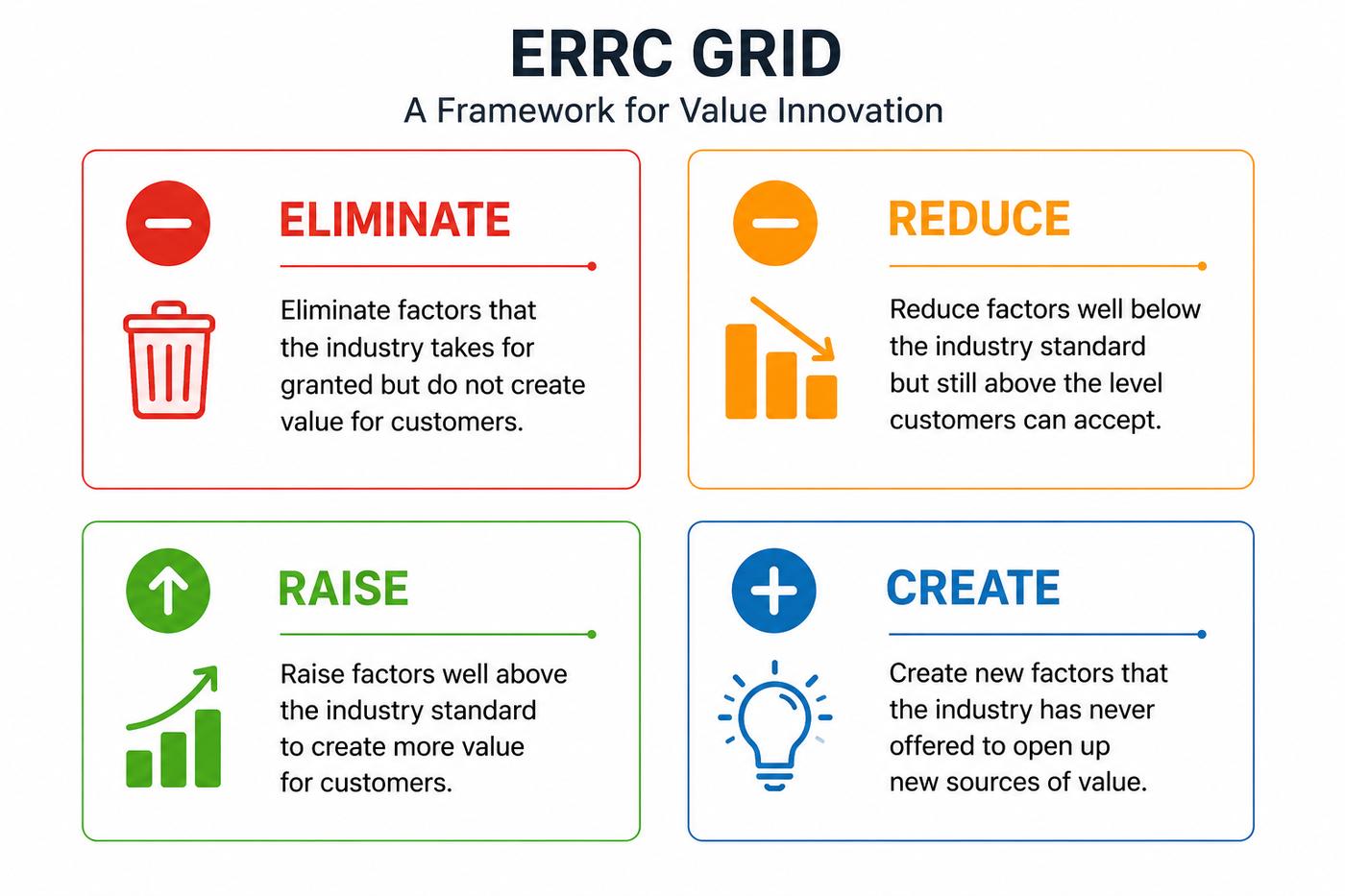
The ERRC Grid turns the Four Actions Framework into a practical decision-making tool.
ERRC stands for:
Eliminate → Reduce → Raise → Create
A business can create a simple grid and list the changes it wants to make under each category.
For example, a budget-focused travel service could:
The blue ocean strategy template can be built around this same structure, making it useful for workshops, business planning, and strategy discussions.
Blue Ocean Strategy divides noncustomers into three groups.
Studying these groups can reveal why people stay outside the market.
For example, a business may discover that potential customers are not rejecting its product because of quality. They may simply find it too expensive or difficult to use.
That insight can lead to a completely different offering.
Also read: Customer Relationship Management: The Key to More Sales
Understanding the blue ocean strategy concepts is useful, but businesses also need a practical process for applying them.
The following steps can help turn the idea into a business strategy.
Identify the major competitors, customer groups, pricing models, features, services, and factors businesses commonly compete on.
Do not stop at listing competitors. Look for patterns.
Talk to customers who are dissatisfied, people who have stopped using the product, and people who have never considered buying it. Find out what prevents them from participating in the market.
Their frustrations can point towards new opportunities.
List the main factors customers use when comparing products. For example, in a food delivery market, customers might care about:
Then ask whether every factor is equally important. Some may be industry habits rather than genuine customer priorities.
Use the Eliminate, Reduce, Raise, and Create questions. Remove factors that provide little value. Reduce costly elements that customers do not consider essential. Raise the factors that matter most. Create new elements that can attract overlooked customers.
This is where the blue ocean strategy canvas can be particularly useful because it helps teams visualise how their proposed value curve differs from existing competitors.
Now combine the insights into a clear offering.
The value proposition should answer:
Why would customers choose this offering instead of the existing alternatives?
It should also explain why noncustomers would consider entering the market. A strong value proposition should be easy to understand. If customers need a long explanation to understand the benefit, the idea may need further refinement.
Estimate the cost of delivering the new offering. At the same time, assess whether customers are likely to see enough value to pay for it. The goal is not simply to create something cheaper or more premium.
The goal is to find a combination of higher buyer value and sensible cost.
Do not assume that a new idea will automatically succeed. Test it with potential customers, do proper market research.
Use prototypes, pilot programs, landing pages, surveys, or small market launches to understand how people respond. Look for evidence of real interest rather than relying only on opinions.
Once the opportunity is validated, the business can begin implementation. However, creating a blue ocean is not a one-time activity.
Customer expectations change. Competitors respond. New technologies emerge. Businesses must continue measuring results and refining the offering.
The strongest strategy is therefore not simply about finding an uncontested space. It is about continuing to create meaningful value as the market changes.
Build future-ready business leadership skills with a DBA in Emerging Technologies in Gen AI and Agentic AI from GGU, and lead innovation in the AI-driven business landscape.
The best way to understand blue ocean strategy examples is to look at companies that changed the way customers experienced an existing market.
These businesses did not simply try to beat competitors on the same factors. They changed the value proposition, attracted new customer groups, or removed barriers that kept people away from the market.
Cirque du Soleil removed costly elements such as animal performances and focused more on theatre, storytelling, music, choreography, and sophisticated production. This created a more premium entertainment experience.
It also attracted adults and audiences who may not have been interested in traditional circuses.
What changed?
Nintendo Wii’s motion-based controls made gaming more physical and easier for casual users to understand. This helped Nintendo reach people who were not typical gaming customers.
Families, older users, and casual players could participate without needing extensive gaming experience.
What changed?
Nintendo did not simply compete for experienced gamers. It expanded the audience for gaming.
Before digital music became mainstream, consumers often purchased physical albums or used complicated digital downloading methods.
Apple iTunes simplified the process.
Users could purchase individual songs digitally instead of having to buy an entire album. The platform also connected naturally with Apple's devices and software ecosystem.
This changed how people discovered, purchased, organised, and consumed music.
What changed?
The opportunity was not just about selling music online. It was about creating a more convenient way to access and manage music.
Southwest Airlines built its model around simplicity and affordability. It focused on low fares, efficient operations, and convenient short-distance travel. Some traditional airline services were reduced or removed to support this model.
This also allowed the company to attract people who might otherwise travel by car.
What changed?
Southwest therefore competed not only with other airlines but also with alternative forms of transportation.
Hotels and resorts traditionally dominated the accommodation industry. Airbnb introduced a platform that allowed individuals to offer rooms, apartments, and homes to travellers.
This created a new source of accommodation supply while giving travellers more options.
Customers could find properties suited to different budgets, locations, group sizes, and travel needs. At the same time, property owners could participate in the accommodation market without operating a traditional hotel.
What changed?
Airbnb changed both the supply side and customer side of the traditional accommodation model.
Professional graphic design traditionally required specialised software and technical skills. This created a barrier for people who needed simple designs but did not have professional design training.
Canva simplified the process through templates, drag-and-drop functionality, and an easy-to-use interface. This opened graphic design to a much wider audience.
What changed?
These examples show an important point about blue ocean strategy examples: creating a blue ocean does not always require inventing an entirely new product.
Sometimes, the opportunity comes from changing who the product serves, what customers value, how the product is delivered, or which industry factors can be removed or reduced.
Also read: What is Supply Chain Management? Learn Its Impact on Business
These are the key advantages businesses can gain by creating new market space.
These are the main challenges businesses may face when trying to create a blue ocean.
Also read: 15 Ways to Improve Your Time Management Skills [With Actionable Tips]
Blue Ocean Strategy offers businesses a different way to think about growth. Instead of competing harder in an overcrowded market, it focuses on finding new opportunities by changing what customers value.
However, creating a new market does not guarantee success. Businesses still need to validate demand, manage costs, execute effectively, and respond when competitors enter space. The goal is not simply to avoid competition. It is to create an offering valuable enough to attract new customers and open a different path to growth.
Want to explore your next step in business leadership? Book a consultation call with upGrad to learn how the right program can support your career goals.
Yes. A blue ocean strategy can fail if the new offering does not solve a meaningful customer problem, attract enough demand, or support a sustainable business model. Poor execution, incorrect market assumptions, and changing customer preferences can also reduce its chances of success.
There is no fixed timeframe. A blue ocean can remain attractive for years or become competitive quickly. Its duration depends on how easily competitors can imitate the offering, how quickly the market evolves, and whether the original company continues improving its value proposition.
Yes. Small businesses can use the approach without creating an entirely new industry. They can identify underserved customer groups, simplify existing services, combine offerings differently, or solve a specific problem that larger competitors overlook.
No. Some industries may have limited opportunities for creating new market space because of strict regulations, established customer expectations, or high entry barriers. Businesses should evaluate their market conditions before deciding whether this approach is appropriate.
A company can study customer complaints, underserved groups, noncustomers, changing behaviours, and gaps in existing products. Looking at why people avoid a particular market can also reveal opportunities that competitors have not addressed.
Businesses can examine factors such as customer interest, market size, willingness to pay, acquisition potential, expected costs, and revenue opportunities. Early testing through prototypes or pilot launches can provide stronger evidence than assumptions alone.
Yes. A successful market opportunity can attract competitors once its potential becomes visible. Businesses can protect their advantage by continuing to innovate, strengthening customer relationships, improving operations, and creating capabilities that are difficult to replicate.
Customer research helps businesses understand unmet needs and barriers that prevent people from buying. It can reveal why existing customers are dissatisfied and why noncustomers remain outside the market, providing useful insights for developing a stronger offering.
There is no standard cost. Expenses depend on the type of offering, industry, technology, research, marketing, and operational changes required. A business can begin with smaller experiments before committing significant resources to a new market opportunity.
Yes. A company can create multiple new market opportunities over time. However, each opportunity requires its own customer research, value proposition, testing, and execution. Businesses should avoid pursuing too many opportunities without enough resources to develop them properly.
Businesses can maintain their advantage by continuing to understand changing customer needs and improving their offering. They should also monitor competitors, test new ideas, remove outdated features, and keep looking for ways to create additional customer value.
994 articles published
We are an online education platform providing industry-relevant programs for professionals, designed and delivered in collaboration with world-class faculty and businesses. Merging the latest technolo...
Speak with DBA expert
By submitting, I accept the T&C and
Privacy Policy