Customer Retention Strategies: A Complete Guide for 2026
By upGrad
Updated on May 07, 2026 | 386 views
Share:

All courses
Certifications
More
By upGrad
Updated on May 07, 2026 | 386 views
Share:
Table of Contents
Customer retention strategies are the actions and plans a business uses to keep existing customers coming back and prevent them from switching to competitors. Retaining customers is more cost-effective than acquiring new ones.
Research shows that acquiring a new customer can cost five to seven times more than keeping an existing one.
This guide covers everything you need to know about retaining customers effectively. You will learn what customer retention actually means, which strategies deliver real results, how to connect retention with acquisition, and how to measure whether your efforts are working.
If you want to build expertise in customer retention and broader business strategy, upGrad's management programs offer industry-relevant curriculum designed to equip you with practical, applicable skills.
Retention is not a single tactic, but it is a system. It touches every stage of the customer journey, from the moment of first purchase through to long-term loyalty. When businesses approach customer retention management strategically, they treat it as an ongoing process rather than a one-time campaign.
This means consistently delivering value, anticipating customer needs, and creating experiences that make switching feel unnecessary.
Customer retention and customer acquisition are both important for business growth, but they serve different purposes.
The table below highlights the key differences between acquisition and retention strategies.
| Factor | Customer Acquisition | Customer Retention |
| Focus | Bringing in new customers | Keeping existing customers |
| Cost | Higher (5–7x more expensive) | Lower (existing trust exists) |
| Revenue Impact | One-time or uncertain | Recurring and predictable |
| Timeline | Short-term boost | Long-term compounding growth |
| Effort Required | High marketing spends | Relationship and experience focus |
Also read: Management Free Online Course with Certificates to Upskill
Free Courses
Not every tactic will suit every business. The best customer retention strategies are the ones that match your product, your audience, and your capacity to execute consistently. Here are the proven approaches that deliver results across industries.
First impressions define long-term relationships. A poor onboarding experience is one of the top reasons customers leave after their first purchase. A strong onboarding flow:
Loyalty programs are one of the most effective customer loyalty and retention strategy tools available. They reward repeat customer purchase behavior and give customers a reason to choose you over a competitor.
Effective programs go beyond simple points. They offer:
Generic communication feels impersonal and drives customers away. Personalization makes customers feel seen and valued. This is central to any strong customer retention marketing strategy. Effective personalization strategies include:
Reactive support fixes problems after they happen. Proactive support prevents them. Reach out before a customer complains. Use usage data to find at-risk accounts and check in. Offer help before it is asked for. This approach transforms support from a cost center into a retention engine.
Customers who feel heard stay longer. Regular feedback loops like NPS surveys, exit surveys, and in-app prompts give you data you can act on. More importantly, closing the loop by telling customers how their feedback was used builds remarkable trust.
Also read: What is Customer Relationship Management? A Beginner's Guide
Digital Marketing Courses to upskill
Explore Digital Marketing Courses for Career Progression
MICA Executive Alumni Status
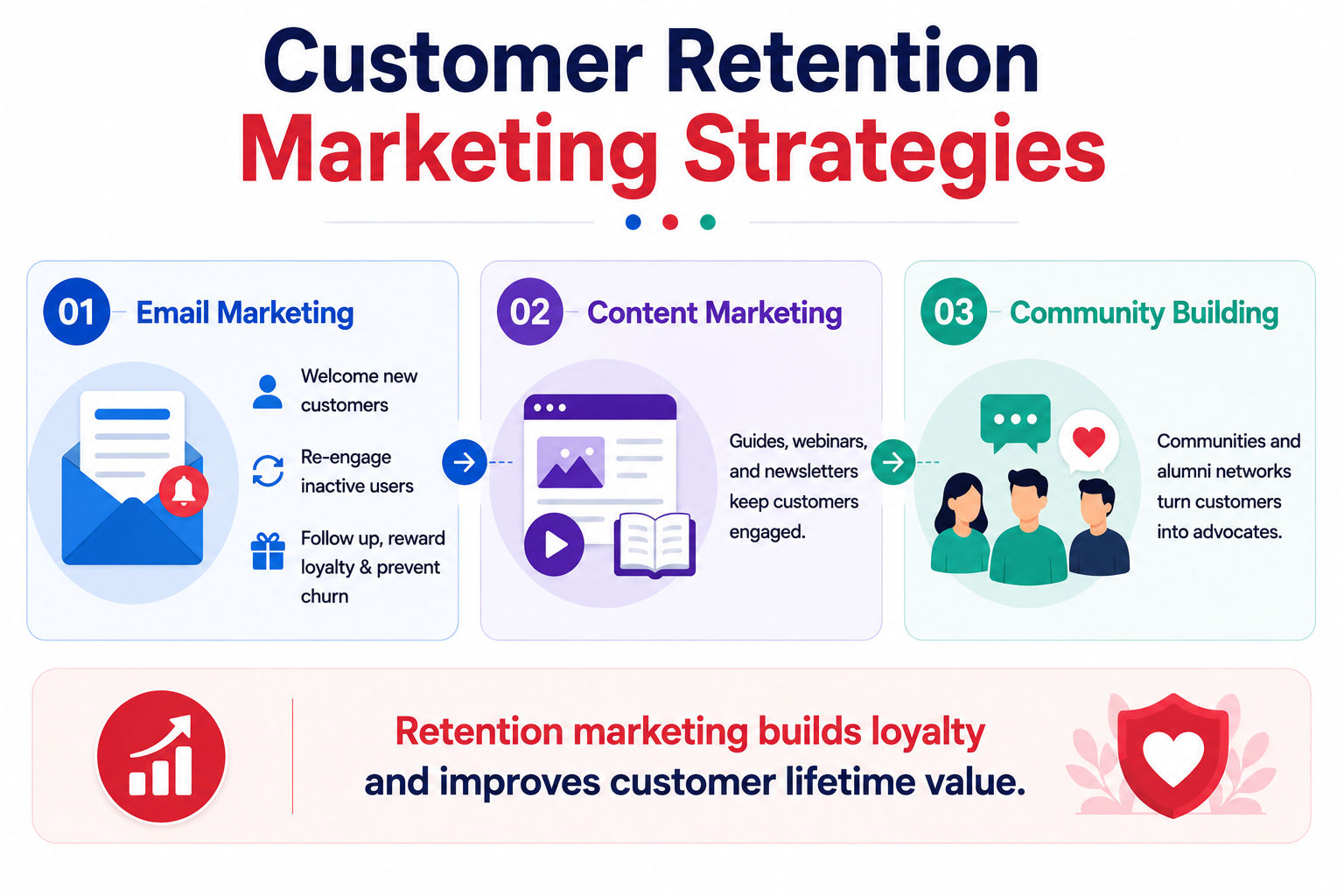
Marketing is not just for acquisition. Some of the most impactful customer retention marketing strategies happen after the sale is made. Here is how to keep customers engaged through smart, targeted marketing.
The key to email marketing is relevance and timing. The table below highlights the important retention emails, their purpose, and the ideal time to send them for maximum engagement.
| Email Type | Purpose | When to Send |
| Welcome Series | Orient new customers | Day 1, 3, and 7 after signup |
| Re-engagement | Win back dormant users | After 30–60 days of inactivity |
| Post-purchase Follow-up | Build trust after buying | 2–3 days after order |
| Milestone Emails | Celebrate loyalty | 1-year anniversary, 10th purchase |
| Win-back Campaign | Prevent churn | Before subscription renewal |
Customers who keep learning from your brand stay longer. Content marketing includes how-to guides, webinars, newsletters, and case studies adds continuous value beyond the initial product. This is especially powerful in the B2B and EdTech space, where knowledge is part of the experience itself.
A strong brand community turns customers into advocates. Online communities, user forums, social groups, and alumni networks give customers a sense of belonging that goes beyond the product. This is one of the most underutilized customer engagement and retention strategies in competitive markets.
Also read: Digital Marketing KPIs: Complete Guide to Track Growth
A solid customer retention management strategy is not just a set of tactics. It is a structure that ensures retention is measured, owned, and improved continuously.
Step 1: Define Your Retention Metrics
You cannot manage what you do not measure. Start by finding which metrics matter most for your business. These are some important metrics to calculate retention rate:
| Metric | What It Measures | Why It Matters |
| Churn Rate | % of customers lost in a period | Core health indicator |
| Customer Lifetime Value (CLV) | Total revenue from one customer | Guides acquisition spend |
| Repeat Purchase Rate | % of customers who buy again | Loyalty signal |
| Net Promoter Score (NPS) | Likelihood of recommendation | Predicts long-term retention |
| Customer Effort Score (CES) | Ease of doing business with you | Friction indicator |
Step 2: Segment Your Customer Base
Not all customers need the same attention. Segment your customers based on following points:
This segmentation allows you to direct retention efforts where they have the most impact and makes your customer retention management strategies far more efficient.
Step 3: Map the Customer Journey for Drop-Off Points
Find exactly where customers disengage. Is it after the first purchase? After a failed support interaction? At renewal time? Each drop-off point is an opportunity to intervene with the right message or offer.
Step 4: Assign Ownership
Retention works best when someone owns it. Assign a team or individual to monitor retention metrics weekly. Set quarterly goals. Review what is working and what is not. Without ownership, retention remains a good intention rather than a business outcome.
Also read: Segmentation in Marketing: Get Started with Effective Strategies
Running retention programs without measurement is guesswork. Tracking the right data tells you what is driving loyalty and what is causing churn. Here is how to measure your customer engagement and retention strategies effectively.
CRR = ((Customers at End − New Customers) / Customers at Start) × 100
This formula measures the percentage of customers retained over a specific period.
Churn Rate = (Customers Lost During Period / Total Customers at Start of Period) × 100
This formula measures the percentage of customers who stopped doing business with you during a specific period.
CLV = Average Purchase Value × Average Purchase Frequency × Customer Lifespan
This formula estimates the total revenue a business can expect from a customer over the entire relationship.
Tracking retention manually becomes difficult as your customer base grows. The right tools help businesses check customer behavior, find churn risks early, and more.
Also read: Key Data Science Skills for Landing Your Dream Job
Customer retention strategies are the foundation of sustainable business growth. When you invest in keeping the customers you already have, every other part of your growth engine becomes more efficient.
Start with the basics: nail your onboarding, personalize your communication, build a loyalty program, and measure what matters. Then layer in more advanced customer engagement and retention strategies as your business scales. Align your customer acquisition and retention strategies so they connect with each other instead of pulling in opposite directions.
To learn more about building stronger business and marketing skills, book a free consultation call with upGrad to find the right learning path.
For small businesses, personalized communication and excellent customer service tend to deliver the highest impact. When you know your customers by name, understand their preferences, and respond quickly to issues, you build trust that competitors with bigger budgets cannot easily replicate. Focus on consistency before complexity.
A good retention rate varies by industry. In SaaS, anything above 90% is considered healthy. In e-commerce, 40–45% or higher is strong. The most important benchmark is improvement over time. If your retention rate is rising quarter on quarter, your customer retention strategies are working.
Acquisition marketing targets people who have never bought from you. Retention marketing focuses on people who already have. Retention marketing uses personalized emails, loyalty offers, re-engagement campaigns, and value-added content to keep existing customers active.
Customer feedback is one of the most powerful inputs for any customer engagement and retention strategy. It tells you what is working, what is frustrating for customers, and where you are losing people before they churn. More importantly, asking for feedback and visibly acting on it shows customers they matter.
Customer retention means a customer continues to buy from you. Customer loyalty means they prefer you and actively advocate for you. A retained customer might stay out of habit or convenience. A loyal customer stays because they genuinely value what you offer.
The most common reasons include poor customer support, a lack of perceived value, a better offer from a competitor, and a confusing or frustrating user experience. In subscription-based businesses, price sensitivity at renewal is a leading driver. Finding which reason applies most to your business should be the starting point for any customer retention management strategy.
EdTech platforms can boost learner retention by focusing on early engagement, progress milestones, and real-world outcomes. Personalized learning paths, community features, career support, and regular communication keep learners motivated.
Churn rate and retention rate are opposites. If your churn rate is 10%, your retention rate is 90%. Churn measures the percentage of customers you lost in each period. Retention measures the percentage you kept. Both are useful, but retention rate is often more motivating as a goal because it frames success rather than loss. Use both your customer retention management strategies.
Acquisition brings customers in. Retention keeps them. When aligned, they create a compounding growth loop. Data from kept customers. Strong acquisition of the right customers reduces the pressure on retention teams. Treating customer acquisition and retention strategies as one integrated system is far more effective than managing them in silos.
Yes. AI and machine learning tools are increasingly central to modern customer engagement and retention strategies. They can predict which customers are at risk of churning, personalize content, and automate proactive outreach at the right moment. Tools like predictive CLV models and churn propensity scores.
Retention metrics should be reviewed monthly, with a deeper strategic review every quarter. Markets shift, customer expectations evolve, and what worked six months ago may be less effective today. Building a regular review of cadence into your customer retention management strategy ensures you stay responsive.
987 articles published
We are an online education platform providing industry-relevant programs for professionals, designed and delivered in collaboration with world-class faculty and businesses. Merging the latest technolo...
Get Free Consultation
By submitting, I accept the T&C and
Privacy Policy
Level Up Your Digital Marketing Career Today!
Top Resources
MICA
Advanced Certificate in AI-Powered Digital Marketing & Communication from MICAMICA Executive Alumni Status
Certification
5 Specialisation
Classroom
4 Months
Certification
2 Months