Customer Journey Mapping: Meaning, Process, Examples & Complete Guide (2026)
By Faheem Ahmad
Updated on May 06, 2026 | 9 min read | 2.37K+ views
Share:

All courses
Certifications
More
By Faheem Ahmad
Updated on May 06, 2026 | 9 min read | 2.37K+ views
Share:
Table of Contents
A customer journey map is a visual way to show the steps, interactions, and emotions a customer goes through when engaging with a brand, from first discovering it to post-purchase support.
It helps businesses understand customer needs, spot pain points, and improve the overall experience to build loyalty. It allows businesses see things from the customer’s point of view and improve their overall experience.
In this guide, you’ll learn what is a customer journey map, how to create one, examples, tools, and practical tips, all explained in a simple and clear way.
Looking to apply workplace efficiency concepts like customer journey map in real business settings? Explore upGrad’s management programs to build practical leadership, operations, and process improvement skills.
Popular Management Programs
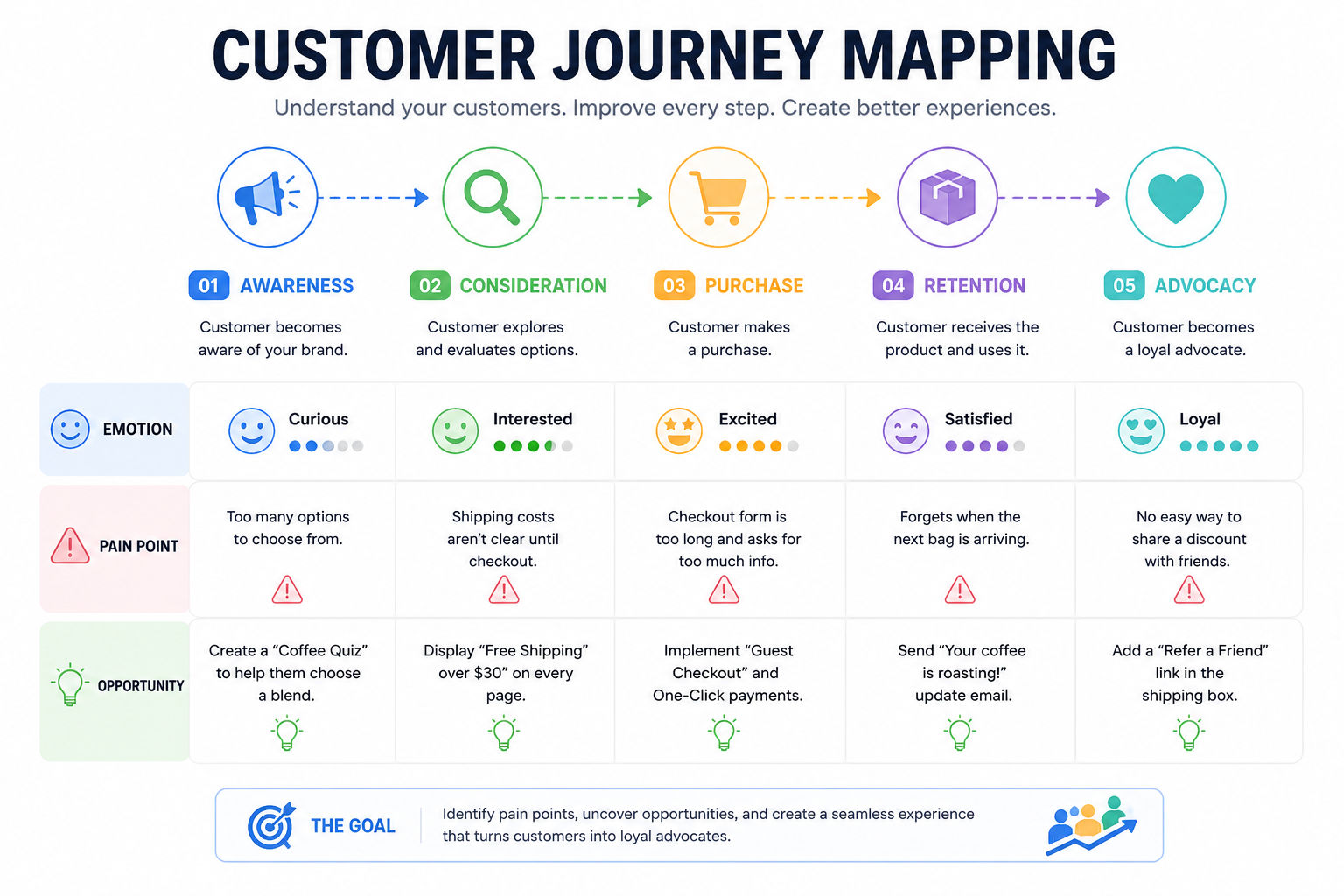
Customer journey mapping is the process of creating a visual representation of how a customer interacts with your brand across different stages. It helps you understand their actions, thoughts, and emotions at each step.
So, if someone asks “what is a customer journey map?”, the simple answer is:
A customer journey map is a tool that highlights every touchpoint, like visiting your website, talking to support, or making a purchase. It’s a way to see your business from the customer’s point of view.
Many businesses focus only on sales, but customers care about the entire experience. That’s where customer journey mapping makes a difference.
Also Read: Techniques of Decision-Making: 15+ Tools & Methods for Success in 2026
Free Courses
A customer journey map usually includes different stages that a customer moves through. Let’s understand each stage a bit more clearly:
Management Courses to upskill
Explore Management Courses for Career Progression
IIIT-B & IIM, Udaipur
Chief Technology Officer & AI Leadership ProgrammeThe customer journey mapping process is structured enough to bring clarity, yet flexible enough to adapt to different business models and customer types. Below is a step‑by‑step approach to building an effective journey map.
1. Define Your Goals
Start by clearly identifying why you are creating a customer journey map. The goal could be to improve conversions, enhance user experience, reduce drop‑offs, or strengthen customer support. Clear objectives keep the mapping focused and meaningful.
2. Understand Your Audience
Build customer personas using real data such as surveys, interviews, analytics, or support feedback. Understanding customer needs, behaviors, and motivations allows you to map realistic journeys instead of making assumptions.
3. Identify Touchpoints
List all touchpoints where customers interact with your brand. This includes websites, mobile apps, emails, ads, social media, customer support, and even offline interactions. Every touchpoint plays a role in shaping the overall experience.
4. Map the Customer Experience
Now connect everything into a single journey. For each stage, map what customers do, what they are thinking, and how they feel. This step brings clarity to the emotional and practical side of the customer experience.
5. Identify Pain Points
Analyze the journey to find moments where customers feel confused, frustrated, or delayed. These pain points highlight gaps in the experience and explain why customers may drop off or feel dissatisfied.
6. Improve and Optimize
Use insights from the customer journey mapping process to improve problem areas. This may involve simplifying steps, improving communication, or redesigning touchpoints. A journey map should guide actionable improvements, not just visualization.
Also Read: Top 10 Management Skills Required to Become a Successful Manager
There are many tools available that make customer journey mapping easier, more visual, and more accurate. Instead of creating everything manually, these tools help you organize data, collaborate with your team, and clearly map out the customer experience.
Here’s a better look at the different types of customer journey mapping tools and how they help:
Tool Type |
Purpose |
| Diagram & Flowchart Tools | Visualize the customer journey step-by-step using flowcharts |
| UX Design Platforms | Map user interactions, design flows, and improve experience |
| Analytics Tools | Track real user behavior like visits, drop-offs, and time spent |
| Collaboration Tools | Enable teams to share input and build journey maps together |
Also Read: An Introduction to Principles of Management
A customer journey map example helps bring the concept to life by showing how a real customer moves through different stages when interacting with a brand.
Take the example of an online shopper. The journey usually flows through the following steps:
Mapping this journey clearly shows where trust is built, where doubts appear, and where friction can be reduced. These insights help businesses improve experiences at the moments that matter most in customer decision‑making.
Also Read: An Introduction to Principles of Management
Using a customer journey map template is the best way to stop guessing and start visualizing. To help you get started, here is a customer journey map example for a fictional brand, "Daily Grind Coffee."
Stage |
Action |
Experience (Emotion + Pain Point) |
Opportunity |
| Awareness | Sees “Top 10 Coffee Brands” blog | Curious, too many options | Add a quick “Coffee Quiz” |
| Consideration | Browses site, reads reviews | Interested, shipping unclear | Show “Free Shipping over $30” |
| Purchase | Selects product, enters details | Excited, long checkout form | Enable guest + one-click checkout |
| Retention | Receives and tries coffee | Satisfied, delivery timing unclear | Send “Your coffee is roasting” email |
| Advocacy | Shares on Instagram | Loyal, no referral option | Add “Refer a Friend” link |
Do Read: Best Business Management Courses in India [2026]
Customer journey map is a simple yet powerful way to truly understand your customers. It shows where customers feel confused, where they face problems, and where their experience works well.
With the right customer journey map template, tools, and approach, businesses can improve interactions, build stronger customer relationships, and make smarter decisions. When done well, journey mapping helps create experiences that customers enjoy and remember.
Ready to start your journey? Book a free consultation with upGrad today to find the best path for your career.
The main purpose of customer journey mapping is to understand how customers interact with a brand at different stages. It helps businesses see the full experience from the customer’s perspective and identify areas where improvements can be made to enhance satisfaction and engagement.
Creating a journey map usually involves teams like marketing, sales, product, UX, and customer support. Each team brings unique insights based on customer interactions, which helps build a more accurate and complete picture of the overall customer experience across all touchpoints.
The 7 steps include defining goals, identifying customer personas, collecting data, listing touchpoints, mapping actions and emotions, identifying pain points, and refining the map. These steps help businesses build a structured view of customer behavior and improve experience effectively.
The five stages are awareness, consideration, decision, retention, and advocacy. These stages represent how a customer first discovers a brand, evaluates options, makes a purchase, stays engaged after buying, and finally recommends the brand to others.
The 5 A’s include awareness, appeal, ask, act, and advocate. This framework explains how customers notice a brand, develop interest, seek information, take action by purchasing, and eventually become loyal supporters who recommend it to others.
A customer journey map should be updated regularly because customer behavior changes over time. Many businesses review it quarterly or during major updates in products, services, or marketing strategies to ensure it stays relevant and useful for decision-making.
Yes, small businesses can benefit greatly from customer journey mapping. It helps them understand customer needs better, improve service quality, and identify gaps in the buying experience, which can lead to stronger customer relationships and better growth opportunities.
No, customer journey mapping is useful for both digital and offline businesses. Whether customers interact online, in-store, or through support channels, mapping their journey helps improve overall experience and ensures consistency across all touchpoints.
Creating a journey map requires customer feedback, analytics data, purchase history, surveys, and interaction records. Using real data ensures the map reflects actual customer behavior rather than assumptions, making it more accurate and actionable for improvements.
Common mistakes include relying on assumptions instead of data, overcomplicating the map, ignoring customer feedback, and treating it as a one-time activity. Avoiding these helps ensure the map remains practical, updated, and useful for real business decisions.
Journey mapping improves business decisions by providing a clear view of customer behavior and pain points. This helps businesses make informed choices in marketing, product development, and customer service, ultimately leading to better customer satisfaction and stronger results.
79 articles published
Faheem Ahmad is an Associate Content Writer with a specialized background in MBA (Marketing & Operations). With a professional journey spanning around a year, Faheem has quickly carved a niche in the ...
Get Free Consultation
By submitting, I accept the T&C and
Privacy Policy
Top Resources
Certification
3 Months
Certification
6 Months
O.P. Jindal Global University
Masters in International Accounting and Finance (Accredited by ACCA, UK)Master's Degree
12 Months