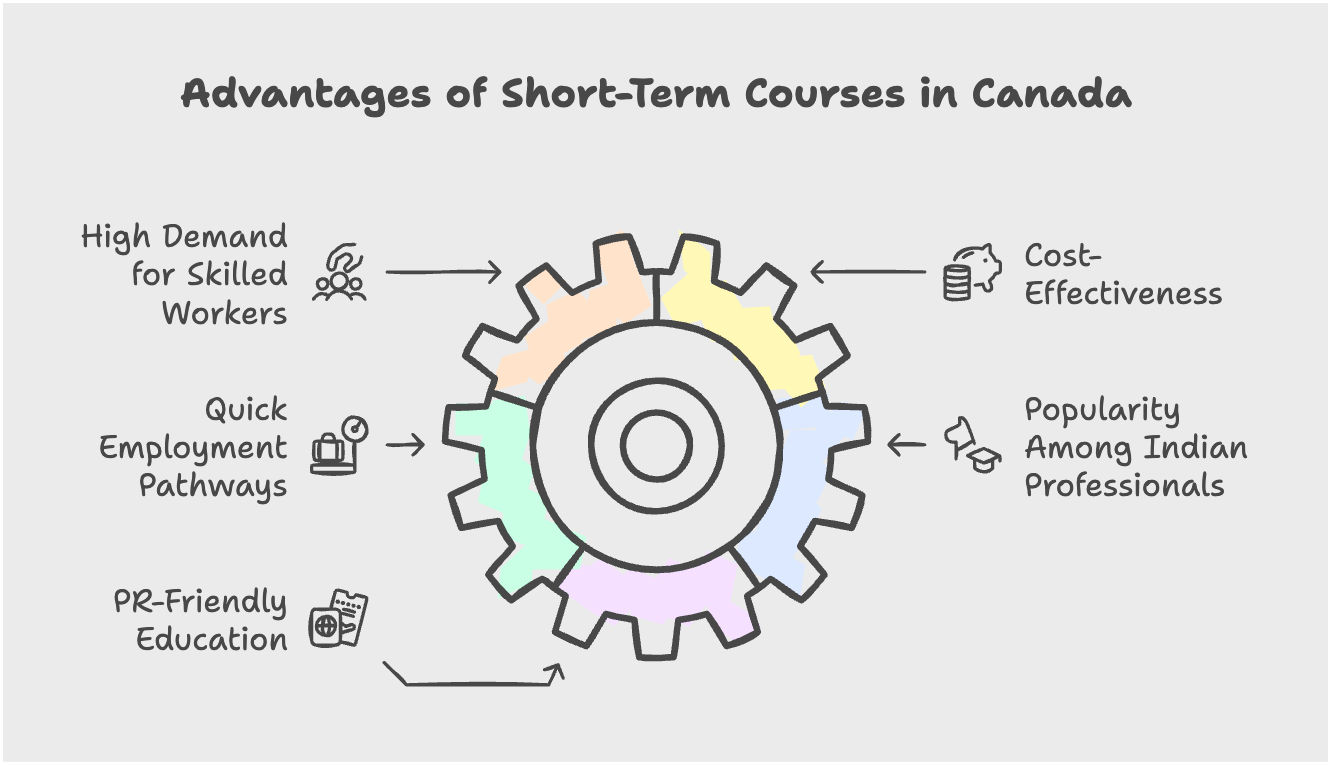
Short term courses in Canada include certificate programs, micro credentials, and post graduate diplomas, spanning business management, IT, and healthcare. Most run 6 months to 1 year, with fees between CAD 5,000 and 25,000 (₹3.43L to ₹17.13L).
Canada has become one of the fastest ways to build a career abroad, since these programs cost far less than a full degree and get you job ready quickly. Over 1 million international students study in Canada today, and a large share pick short programs for exactly this reason. Nearly 91% of graduates find a job within six months, per Colleges and Institutes Canada.
This article covers the best short term courses in Canada by field, actual costs, top colleges, eligibility, and visa and work permit rules.
Why Choose a Short-Term Course in Canada
Before getting into the course list, it helps to understand why short term courses in Canada for international students have become such a popular choice, especially compared to a full degree.
They're fast. Most programs run 6 months to 2 years, so you're job ready far sooner than you would be with a two year master's.
They're genuinely more affordable. Expect to pay CAD 8,000 to 25,000 for a short term program, compared to CAD 30,000 or more for a full degree.
Co-op placements are common. A lot of these programs build in paid work terms, so you're gaining real Canadian work experience while you study, not just after.
They can support your PR plans. Courses in IT, healthcare, and skilled trades line up well with Express Entry and Provincial Nominee Program (PNP) categories, though a short course alone won't hand you PR. We'll explain exactly why a bit further down.
Short term courses in Canada cover a wide range of industries, from business and IT to healthcare, engineering, and skilled trades, and each field comes with its own fee range, duration, and set of colleges known for it. Some programs run as short as 6 months, while others stretch closer to 2 years depending on the specialisation you choose. The right field for you really comes down to where you eventually want your career to go, so here's a closer look at what each one offers.
Business, Management & Finance Courses
These programs suit anyone aiming for a management, finance, or entrepreneurship focused career, and they're consistently among the most popular short term courses in Canada for Indian students.
One quick note: Exact course to college pairings shift with every intake, so treat the "offered at" column as a starting reference rather than a guarantee. Always cross check the college's current program list before you apply.
Healthcare & Medical Courses
Canada's healthcare sector is short staffed in nearly every province, which is exactly why these programs tend to place graduates so quickly.
Engineering diplomas in Canada are a solid pick if you already have a technical background and want hands on, industry ready skills rather than another theory heavy degree. These programs tend to run 6 months to 1 year and lean heavily on lab work and applied projects.
Online Short-Term Courses, If Relocating Isn't an Option
Not every student can pack up and move right away, and Canadian institutions have adapted to that. A growing number of colleges and universities now offer these same programs online or as hybrid formats, so you can start building your Canadian credentials before you even land there.
Popular Online Programs
If relocating to Canada right away isn't an option, several colleges and universities let you start with an online certificate or diploma instead. These run anywhere from 3 months to a year and cover much of the same ground as their in person versions, at a noticeably lower fee.
Not directly, but it isn't a wasted effort either. Here's how it actually helps in practice:
CRS points. Certain online credentials can add to your Express Entry education score.
Better job odds. Canadian recruiters still value a recognised certificate, whether it was earned online or on campus.
A low risk entry point. Many students use an online course to test out Canadian education before committing to a full study permit and relocation.
If PR is part of your long term plan, IT, healthcare, and business or project management remain the strongest fields to prioritise, since they face the most consistent hiring gaps.
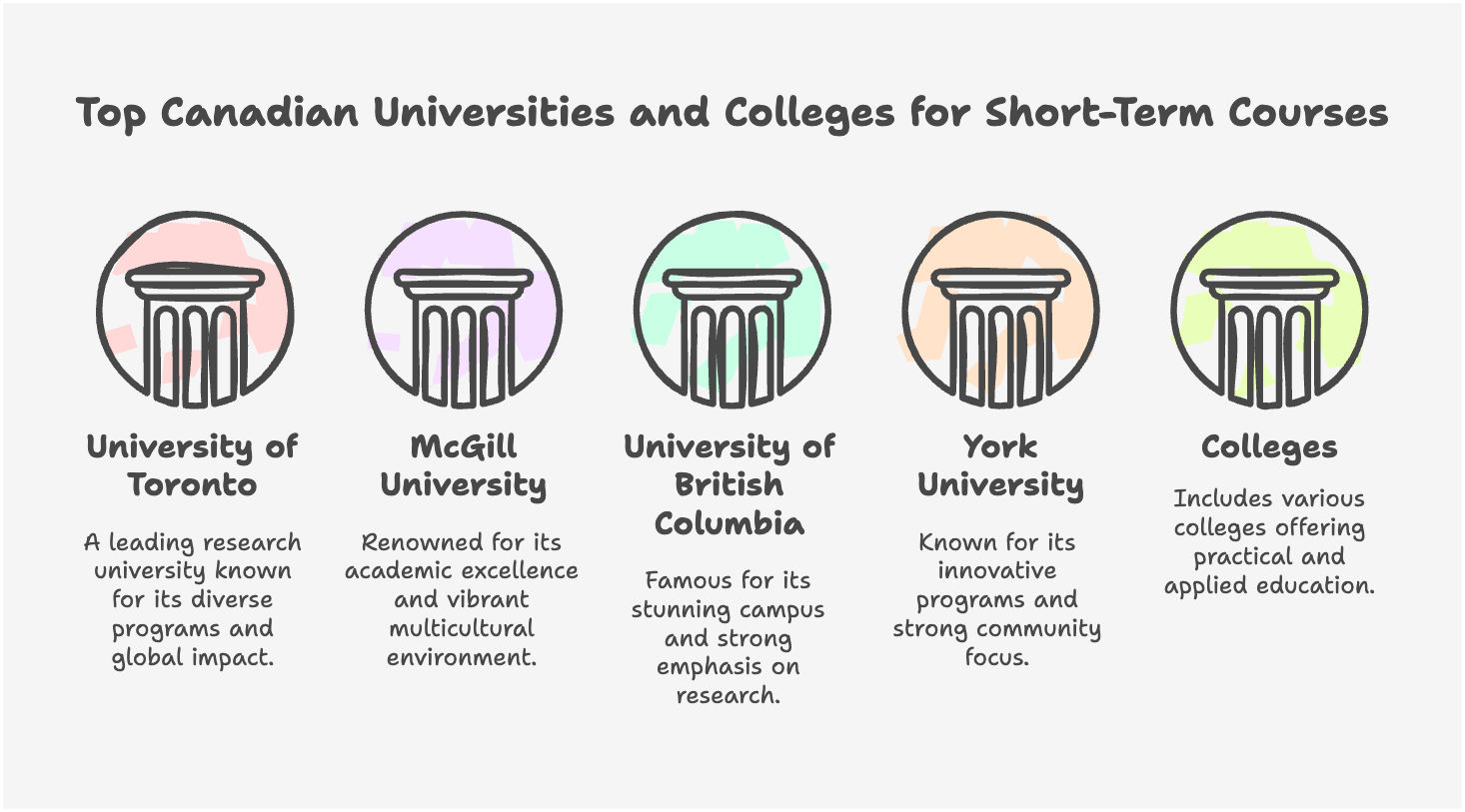
Top Colleges & Universities Offering Canada Short-Term Courses
If you're spending anywhere between ₹3L and ₹17L on a short term program, it needs to actually deliver. That could mean a real job, a valid work permit route, or a genuine shot at PR down the line. That makes the institution you pick just as important as the course itself.
University
Known For (Short-Term Programs)
QS World Rank 2027
McGill University
Project Management, AI, Healthcare Administration
#30
University of Toronto
Data Science, AI, Business Analytics
#32
University of British Columbia
Cybersecurity, Digital Marketing, Business Management
=45
York University
Supply Chain, IT & Networking, HR Management
=322
McGill and Toronto both score strongly on academic reputation, sitting at 98.2 and 100 respectively on that metric, while UBC posts the highest citations per faculty score of the three at 69.6.
A number of Canada's top short term programs also run out of applied colleges and polytechnics rather than universities, and these institutions don't feature on the QS list since that ranking only covers research universities.
College
Known For (Short-Term Programs)
Seneca Polytechnic
Business Analytics, Healthcare Administration, UX/UI
Humber College
Hospitality Management, Digital Marketing, Media Studies
George Brown College
Culinary Arts, Graphic Design, Business Admin
Centennial College
Software Development, Mobile Apps, AI
Conestoga College
Mechanical Engineering, IT Infrastructure, Logistics
Algonquin College
Game Development, UX/UI Design, Entrepreneurship
For a short, job focused program, these colleges often matter just as much as, if not more than, a university with a QS ranking, since their co-op pipelines and direct employer partnerships are built specifically around fast job placement.
Eligibility Criteria & Admission Process
Getting into a short term program in Canada is genuinely more flexible than applying for a full degree, but there are still a few boxes you need to tick.
Basic Eligibility Requirements
Entry requirements for short term courses are far more flexible than for a full degree, but a few basics still apply across almost every college.
Education: 12th grade pass for diplomas, and a bachelor's degree for PG diplomas.
English Proficiency: IELTS 6.0 to 6.5, with no band under 5.5, or TOEFL 80+.
Work Experience: Some PG diplomas in business, IT, or management ask for 1 to 2 years of prior experience.
Study Permit: Required only for programs longer than 6 months.
Proof of Funds: Around CAD 22,895 (₹15.69L) for living costs, on top of first year tuition. This figure is revised periodically by IRCC, so confirm the current number before finalising your budget.
Age: No hard limit, though most successful applicants fall between 18 and 35.
Note: A lot of students specifically search forshort term courses in Canada without IELTS. The honest answer is that most reputable colleges still ask for some form of English proficiency proof, but a handful of institutions do offer conditional admission or accept alternatives likeTOEFL, PTE, or an internal English test in place of IELTS.
Step-by-Step Admission Process
Applying to a short term program in Canada is a fairly linear process, and most colleges follow the same broad sequence from application to arrival.
1. Pick the course and college Go for a field with genuine hiring demand, like IT, healthcare, or business analytics, rather than simply the cheapest option available.
2. Check your eligibility Confirm yourIELTS score, academic background, and any work experience the specific program is asking for.
3. Apply online Submit your application along with the required documents. Some colleges charge an application fee of CAD 75 to 150 (₹5.14K to ₹10.28K).
4. Receive your offer letter This is your Letter of Acceptance (LOA), and it usually takes 3 to 6 weeks to arrive if you're selected.
5. Pay your tuition Pay either the first semester or the full tuition amount. Some colleges will ask for a GIC deposit as proof of funds.
6. Apply for your study permit Only necessary if your course runs longer than 6 months. The full process is covered in the next section.
7. Sort your accommodation and travel Do this once your permit has been approved, ideally 1 to 2 months ahead of your start date.
Keep these documents ready before you even begin the application process:
10th and 12th mark sheets
Bachelor's degree, if you're applying for a PG diploma
IELTS or TOEFL scorecard
Work experience letter, if the program requires one
Passport copy
Statement of Purpose (SOP)
Letter of Recommendation (LOR), for select PG programs
As a general rule, apply 4 to 6 months before your course starts. That buffer matters more now than it used to, and the next section explains exactly why.
This is the section where a lot of other guides on short term courses in Canada for international students fall behind, because they haven't been updated since late 2024.
Do You Actually Need a Study Permit?
Whether you need a study permit at all comes down to how long your program runs.
Under 6 months. A visitor visa is enough, but you won't be allowed to work.
6 months or more. You'll need a study permit from a Designated Learning Institution (DLI).
Co-op or internship programs. You'll need both a study permit and a co-op work permit.
How to Apply for Your Study Permit
Once you know a permit applies to you, the process itself follows a fixed sequence through IRCC.
1. Get your Letter of Acceptance: From a Designated Learning Institution.
2. Gather your documents: Passport, SOP, academic transcripts, and proof of funds.
3. Take your English test: RCC doesn't set one fixed minimum for the permit itself, but your college will, usually around 6.0+ IELTS.
4. Apply online through IRCC
5. Pay the required fees: CAD 150 (₹10.28K) for the study permit application, plus CAD 85 (₹5.82K) for biometrics, bringing the total to roughly CAD 235 (₹16.10K).
6. Complete biometrics: And attend a visa interview if IRCC requests one.
7. Wait for a decision: Budget for 8 to 12 weeks under standard processing timelines.
Since there's no fast track option left anymore, applying early isn't just good advice, it's genuinely your only real strategy for avoiding delays.
Can You Work While Studying?
If your program runs 6 months or longer at a DLI, yes, up to 20 hours a week during term, and full time during scheduled breaks. Here's how eligibility breaks down by course length.
Course Duration
Work Eligibility
Hours Allowed
Under 6 months
Not eligible
0
6 months or more at a DLI
Eligible
20 hours/week
Co-op/internship programs
Eligible
Based on co-op terms
Here's a quick look at where most students end up finding part-time work.
Job Type
Hourly Pay (CAD/INR)
Retail (Walmart, Best Buy, Superstore)
CAD 15-18 (₹1,028-₹1,233)
Food Service (Tim Hortons, McDonald's, Subway)
CAD 14-16 (₹959-₹1,096)
Call Centre & Customer Service
CAD 16-20 (₹1,096-₹1,370)
Teaching Assistant / Tutoring
CAD 18-25 (₹1,233-₹1,713)
Warehouse & Delivery (Amazon, DoorDash)
CAD 17-22 (₹1,165-₹1,507)
Your institution has to be a DLI for any of this to be legal, and the 20 hour weekly cap during term isn't a soft guideline. IRCC actively enforces it.
Careers, PGWP Eligibility & Scholarships
Finishing a short term course is only half the equation, since what happens after matters just as much. This section covers what these courses actually pay, the work permit rules that decide whether you can stay back and work, and the scholarships genuinely worth your time.
Job Outcomes by Field
Salary ranges below are directional average salary figures rather than guarantees, since actual pay depends heavily on city, employer, and experience level.
Field
Roles
Average Salary (CAD/INR per year)
Data Analytics
Data Analyst, BI Specialist
CAD 60,000-85,000 (₹41.11L-₹58.24L)
Cybersecurity
Security Analyst, IT Risk Consultant
CAD 70,000-95,000 (₹47.96L-₹65.09L)
Digital Marketing
SEO Specialist, Social Media Manager
CAD 50,000-75,000 (₹34.26L-₹51.39L)
Healthcare Administration
Medical Office Manager
CAD 55,000-80,000 (₹37.69L-₹54.82L)
Construction Management
Site Supervisor, Project Manager
CAD 65,000-90,000 (₹44.54L-₹61.67L)
UX/UI Design
UX Designer, Visual Designer
CAD 55,000-85,000 (₹37.69L-₹58.24L)
Getting hired after finishing your course usually comes down to a handful of things done consistently, rather than any single trick:
Build your resume around your Canadian certification, not just your Indian academic background.
Apply for co-op or internship placements wherever your program offers them.
Network on LinkedIn with recruiters specifically in your field, not generic HR contacts.
Use Indeed, Glassdoor, and Job Bank Canada together, not just one platform.
Check Provincial Nominee Programs, since several provinces actively prioritise specific skilled roles.
Get licensed where the job requires it, which comes up often in IT and healthcare.
Toronto, Vancouver, and Montreal have the highest number of openings, but they also come with the most competition. Smaller cities are frequently the easier way in, especially for your first Canadian job.
PGWP Eligibility: Read This Before You Pick a Course
A short term course does not automatically make you eligible for a Post-Graduation Work Permit (PGWP), and this is genuinely one of the most misunderstood parts of planning a Canada short term course.
8 month minimum. Your program has to be full time, in person, and at least 8 months long. Anything shorter, and PGWP simply isn't on the table.
Field of study now matters. Since November 1, 2024, if you're completing a college diploma or certificate rather than a degree, your program also needs to align with an IRCC approved field tied to long term labour shortages. IT, healthcare, and skilled trades generally qualify, while general arts diplomas often don't. Degree holders are exempt from this particular requirement.
Language requirement. CLB 5 across all four skills for diploma or certificate holders, and CLB 7 for degree holders.
PGWP length. Programs under 2 years typically get a matching length PGWP, while 2 year plus programs can get up to 3 years. Master's graduates get a special exception, a 3 year PGWP even from an 8 month program, though this doesn't extend to diplomas or certificates.
The real takeaway here is simple. Don't just check whether a program is 8 months long and assume you're covered. Confirm that its specific field of study is still on IRCC's current eligible list before you enrol, since this is now treated as a hard filter rather than a formality.
Scholarships Worth Actually Applying For
Scholarship options for short term courses are more limited compared to full degrees, but a few genuinely apply and are worth the extra effort.
Scholarship
Eligibility
Coverage
Global Affairs Canada Scholarships
Indian students in 6+ month programs
CAD 7,200 (₹4.93L)
Ontario Graduate Scholarships (OGS)
PG diploma/certificate students
CAD 5,000-15,000 (₹3.43L-₹10.28L)
Humber International Entrance Scholarship
Strong academics, diploma/certificate students
CAD 2,000-4,000 (₹1.37L-₹2.74L)
Seneca International Student Scholarship
Business, IT, healthcare diploma students
CAD 500-2,500 (₹34.3K-₹1.71L)
Conestoga International Entrance Scholarship
Engineering, business, IT diploma students
CAD 1,500-3,000 (₹1.03L-₹2.06L)
Mitacs Globalink Research Award
Short term research track students
CAD 6,000 (₹4.11L)
One scholarship we've deliberately left off this list is the Vanier Canada Graduate Scholarship. It's a doctoral only research award worth CAD 50,000 a year, and it has no real relevance to short term diploma or certificate students, so including it here would just be misleading rather than genuinely useful.
A few things that actually move the needle when applying:
Check each college's website to see whether scholarships are auto applied or need a separate application.
Put real effort into your SOP and LORs, not just formal correctness.
Apply 4 to 6 months ahead of your intake, since most scholarships have limited slots.
Keep your GPA at 3.0+ or 70%+ wherever that's a stated requirement.
Short term courses in Canada work best for a specific kind of student, and it's worth being honest about who that is. Here's the gist, and a bit of a personal take on where you actually fit:
If you want to work fast and don't need a master's on your resume, a diploma or certificate in IT, healthcare, or business is probably your quickest, cheapest route into the Canadian job market. Don't overthink this one.
If PR is your real end goal, not just studying abroad, be deliberate about it. Pick a program that's at least 8 months long, sits on IRCC's current eligible field of study list, and meets the CLB 5 or CLB 7 language bar for PGWP. Skip this check, and you could finish a perfectly good course that leads nowhere on the immigration side.
If you're choosing between a big city school and a smaller college, don't assume the flashier name wins. Seneca, Centennial, and similar polytechnics often place students faster than a university with a shinier QS ranking, simply because their co-op networks are stronger for this kind of program.
If budget is tight, skilled trades and healthcare support programs tend to be the most affordable route in, and they're also facing some of the strongest hiring demand in the country right now.
If you're still deciding between online and on campus, online is a genuinely reasonable way to test things out first, just don't expect it to move your PR timeline on its own.
Apply early, get your documents in order well ahead of time, and treat that as non negotiable rather than a nice to have.
The best options right now are in IT, healthcare, and skilled trades, since these fields have the strongest hiring demand and the clearest path to a work permit. Data science, cybersecurity, PSW, and HVAC consistently show up as top picks for Indian students because they combine reasonable fees with genuinely good job outcomes.
What are some short term courses in Canada?
Popular choices include Global Business Management, Project Management, Cybersecurity, Data Science, Personal Support Worker, and Electrical Engineering Technology, among others. Most of these fall under business, IT, healthcare, engineering, or skilled trades, and run anywhere from 6 months to 2 years depending on the college.
Which 3 month course is best?
Genuine 3 month diploma or certificate programs are fairly rare in Canada, since most colleges structure their short term programs around 6 month to 1 year timelines. If you do find one this short, keep in mind it won't require a study permit, but you also won't be allowed to work while studying it.
Are there any 6 month courses in Canada?
Yes, 6 months is actually the most common minimum length for short term diplomas and certificates in fields like business, digital marketing, and healthcare administration. A 6 month program is also the shortest duration that still lets you apply for a study permit and work part time while studying.
Which course gets easily PR in Canada?
Skilled trades, healthcare, and IT programs tend to have the smoothest path toward PR, mainly because they align with IRCC's approved field of study list for PGWP and with Provincial Nominee Program priorities. That said, no course guarantees PR on its own, since it still depends on gaining Canadian work experience afterward.
Can I do a short term course in Canada without IELTS?
Some colleges do accept alternatives like TOEFL, PTE, or an internal English test instead of IELTS, especially for certain diploma programs. It's still uncommon to skip English proficiency proof entirely, so it's worth confirming this directly with your shortlisted college before assuming you're exempt.
Do short term courses in Canada come with a certificate?
Yes, most short term programs end with a recognised diploma or certificate from the college, which you can use for job applications or further studies. Some programs also offer a post graduate certificate if you already hold a bachelor's degree.
How much does a short term course in Canada cost for Indian students?
Fees generally range from CAD 5,000 to 25,000, depending on the field and college, which works out to roughly ₹3.43L to ₹17.13L. Business and healthcare programs tend to sit at the lower end, while specialised IT and engineering diplomas can run higher.
Is there a free 6 month short term course in Canada for international students?
Genuinely free 6 month programs for international students aren't common, since Canadian colleges charge tuition regardless of program length. What you can look for instead are partial scholarships or bursaries that offset part of the cost, which is a more realistic option than expecting a fully free course.
Are Canada short term courses good for Indian students specifically?
Yes, they've become a popular route for Indian students who want international exposure without committing to the time or cost of a full degree. The mix of shorter duration, lower fees, and strong job placement in fields like IT and healthcare makes them a practical fit for a lot of profiles.
Is a study permit compulsory for every short term course in Canada?
No, only for courses running 6 months or longer. Anything shorter can be done on a visitor visa, though you won't be permitted to work during that time.