Python vs PHP: Key Differences, Use Cases, and Which One to Pick
By Sriram
Updated on Jun 18, 2026 | 4 min read | 1.63K+ views
Share:

All courses
Certifications
More
By Sriram
Updated on Jun 18, 2026 | 4 min read | 1.63K+ views
Share:
Table of Contents
Python vs PHP is one of the most common comparisons for aspiring developers, web programmers, and students entering software development. Both languages have been around for decades, power millions of applications worldwide, and continue to evolve. Yet they serve different purposes and attract different types of developers.
PHP was built specifically for web development. It runs on servers, generates HTML, and handles backend logic for websites. Python, on the other hand, is a general-purpose language. You can build websites with it, but you can also do machine learning, data analysis, automation, scripting, and a lot more.
This blog breaks down the core differences between Python and PHP across web development, data science, job demand, performance, and learning curve.
Explore upGrad's Data Science, AI, and Machine Learning programs to build strong Python and PHP programming skills.
Popular Data Science Programs
Python and PHP don't actually compete on the same turf.
Python is a versatile, general-purpose programming language used across fields like AI, data science, and web development. In contrast, PHP is a server-side scripting language specifically designed for building dynamic websites.
While PHP still powers nearly 80% of websites, largely due to platforms like WordPress, Python consistently ranks higher in developer popularity thanks to its flexibility, readability, and broad range of applications.
Parameter |
Python |
PHP |
| Primary Purpose | General-purpose programming language | Server-side web development language |
| Main Focus | Supports multiple domains including AI, data science, automation, and web development | Primarily designed for building dynamic websites and web applications |
| Learning Curve | Easy to learn with clean and readable syntax | Easy to learn but includes web-specific syntax and conventions |
| Web Development | Uses frameworks like Django and Flask | Built specifically for web development and integrates easily with HTML |
| AI & Machine Learning | Industry standard for AI and machine learning projects | Limited support and rarely used for AI development |
| Data Science & Analytics | Widely used for data analysis, visualization, and predictive modeling | Not commonly used for data science tasks |
| Automation & Scripting | Strong support for automation, scripting, and workflow management | Mainly used for web-related automation tasks |
| Popular Frameworks | Django, Flask, FastAPI | Laravel, Symfony, CodeIgniter |
| Content Management Systems | Rarely used for CMS platforms | Powers WordPress, Drupal, and many CMS solutions |
| E-commerce Development | Suitable through frameworks and custom applications | Commonly used in Magento, WooCommerce, and other e-commerce platforms |
| Career Opportunities | AI Engineer, Data Scientist, Backend Developer, Automation Engineer | PHP Developer, WordPress Developer, Laravel Developer, Full-Stack Developer |
| Best For | AI, data science, automation, research, and modern application development | Website development, CMS projects, and PHP-based backend systems |
Free Courses
Python is a high-level, general-purpose programming language known for its simple syntax and readability. Created by Guido van Rossum in 1991, Python has grown into one of the most popular programming languages in the world. Its straightforward structure allows beginners to learn programming concepts quickly while giving experienced developers the flexibility to build complex applications.
One reason for Python's popularity is its versatility. Unlike languages designed for a specific purpose, Python works across multiple domains. Developers can use the same language to build websites, automate repetitive tasks, analyze large datasets, or create artificial intelligence models.
Python's extensive library ecosystem also contributes to its widespread adoption. Instead of building everything from scratch, developers can use pre-built libraries to speed up development and solve complex problems efficiently.
Python is widely used in several industries and technology domains.
Area |
Common Uses |
Popular Tools |
| Artificial Intelligence & Machine Learning | Predictive models, chatbots, generative AI | TensorFlow, PyTorch, Scikit-learn |
| Data Science & Analytics | Data analysis, visualization, statistical modeling | Pandas, NumPy, Matplotlib |
| Web Development | Websites, web apps, APIs | Django, Flask, FastAPI |
| Automation & Scripting | Task automation, web scraping, report generation | Selenium, Requests |
| Scientific Computing & Research | Simulations, mathematical modeling, research | SciPy, SymPy |
| Cybersecurity | Penetration testing, network monitoring, security automation | Scapy, Paramiko |
Advantage |
Impact |
| Simple Syntax | Makes learning and development faster |
| Large Library Ecosystem | Reduces development time for complex projects |
| Cross-Platform Support | Works on Windows, macOS, and Linux |
| Strong Community Support | Provides extensive documentation and resources |
| Versatility | Supports web development, AI, automation, and data science using a single language |
Its ability to support multiple career paths makes Python one of the most valuable programming languages to learn today.
Do read: Top 6 Python IDEs of 2025 That Will Change Your Workflow!
Data Science Courses to upskill
Explore Data Science Courses for Career Progression
IIIT Bangalore
Executive Post Graduate Certificate in Data Science & AIPlacement Assistance
PHP is an open-source server-side scripting language designed specifically for web development. Introduced in 1995 by Rasmus Lerdorf, PHP became one of the foundational technologies behind the modern internet. Today, millions of websites still rely on PHP for delivering dynamic content and handling server-side operations.
Unlike Python, PHP was built with web development as its primary focus. It integrates easily with HTML and databases, making it a practical choice for creating websites, web portals, and content management systems.
Over the years, PHP has evolved significantly. Modern frameworks such as Laravel and Symfony have improved code organization, security, and development speed, helping PHP remain relevant in modern web development.
PHP continues to power a large share of web applications worldwide.
Area |
Common Uses |
Popular Platforms/Tools |
| Content Management Systems (CMS) | Website creation and content management | WordPress, Drupal, Joomla |
| Website Development | Dynamic and database-driven websites | PHP, MySQL |
| E-commerce Platforms | Online stores and payment processing | Magento, WooCommerce |
| Backend Development | Server-side logic, APIs, authentication | Laravel, Symfony |
| Enterprise Web Applications | Internal portals and business applications | Laravel, CodeIgniter |
| Shared Hosting Environments | Low-cost website hosting and deployment | cPanel Hosting, Apache |
For developers focused primarily on web development, PHP continues to offer strong career opportunities and a mature ecosystem.
Must read: How to Become a PHP Developer in 2025: A Complete Beginner's Guide
Despite their differences, Python and PHP share several core features that make them popular among developers. Both are open-source languages with large communities, extensive documentation, and strong ecosystem support. They can be used to build dynamic applications, connect with databases, and support modern development practices.
For beginners, the similarities are often more important than the differences. Both languages support object-oriented programming, offer a wide range of frameworks, and provide plenty of learning resources. Whether you're building a web application, working with APIs, or managing database-driven projects, both Python and PHP provide the tools needed to get the job done.
The table below highlights the key similarities between Python and PHP.
Parameter |
Python |
PHP |
| Open Source | Yes | Yes |
| Beginner Friendly | Yes | Yes |
| Object-Oriented Programming | Supported | Supported |
| Cross-Platform Support | Yes | Yes |
| Database Connectivity | Supported | Supported |
| Web Development | Supported | Supported |
| Large Community | Strong community support | Strong community support |
| Extensive Libraries | Thousands of libraries | Thousands of packages |
| Framework Availability | Django, Flask, FastAPI | Laravel, Symfony, CodeIgniter |
| API Development | Supported | Supported |
| Regular Updates | Actively maintained | Actively maintained |
| Job Opportunities | High demand | Consistent demand |
Also read: Top 12 PHP Developer Skills: Key Technologies & Frameworks
This is the real question most people are asking.
Let's look at job demand. Python consistently ranks as one of the most in-demand programming languages globally. The explosion of AI, machine learning, and data science has pushed Python demand even higher. PHP jobs exist, but the growth curve is flatter.
Experience Level |
PHP Developer Salary |
Python Developer Salary |
| Entry-Level (0–3 Years) | ₹2.6–2.9 LPA | ₹4.4– 4.8LPA |
| Mid-Level (3–6 Years) | ₹4.4–4.8 LPA | ₹7.6–8.5 LPA |
| Senior-Level (6-9 Years) | ₹6.3 –6.9 LPA | ₹15–30 LPA |
Source: ambitionbox
Python developers earn more on average. The primary reason is that Python skills translate into data science and AI roles, which pay significantly better than web development.
That said, PHP developers with strong Laravel skills are still hired. Many companies have existing PHP infrastructure and need people to maintain and extend it. It's not a dead-end.
But if you're starting fresh and thinking long-term? Python opens more doors.
PHP is the easiest to get started with for web work. Python balances ease of learning with wide applicability. Java is more verbose but powers some of the world's most complex systems.
If you're a beginner, both Python and PHP are more accessible than Java. Python has better learning resources and a larger beginner community today.
Also read: How Long It Will Take to Learn Python in 2025: Your Step-by-Step Guide
You don't have to pick forever. Some developers know both. But if you're learning your first language, you need to commit to one. Python has the broader career ceiling right now.
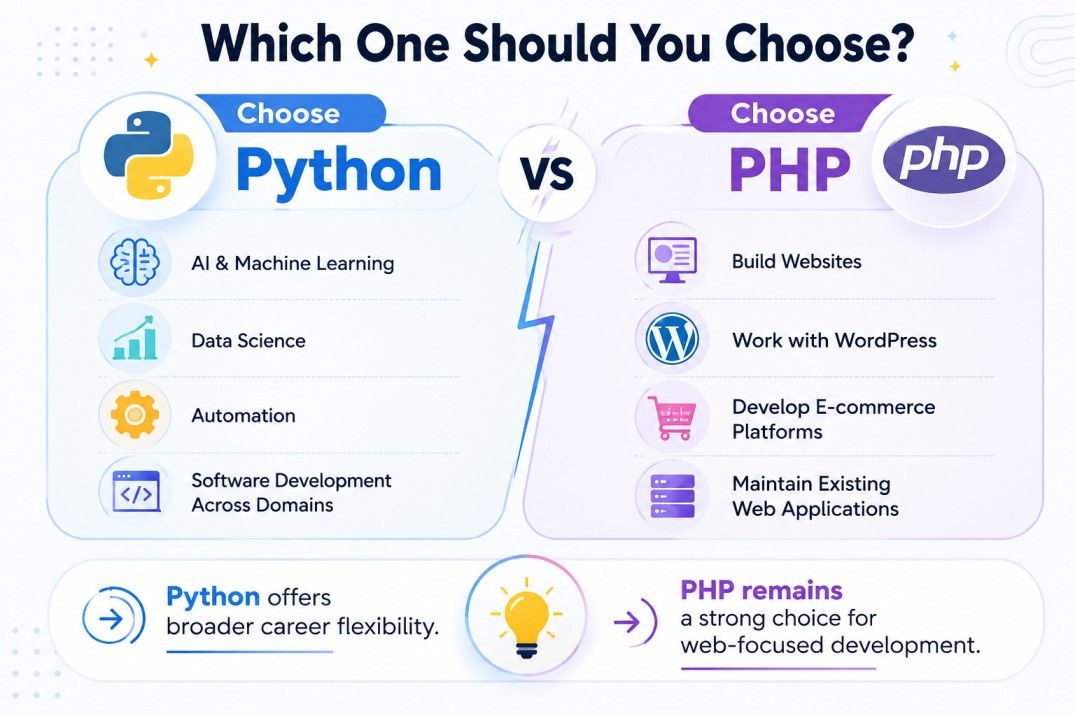
Here's the straightforward version.
Learn PHP If... |
Learn Python If... |
| You want to build WordPress websites and themes | You want to work in AI, machine learning, or data science |
| You're targeting web agencies and digital studios | You want flexibility across multiple tech domains |
| You want to enter web development quickly | You're interested in automation and analytics |
| You prefer working on websites and CMS platforms | You're targeting product companies and startups |
| You want a web-focused development career | You want broader career opportunities |
| You enjoy backend web development | You want higher long-term salary potential |
upGrad offers structured courses in Python for beginners and working professionals. If you're looking to build practical skills with real projects and career support, that's a solid place to start.
The Python vs PHP debate doesn't have a single winner because both languages solve different problems. Python offers broader opportunities across AI, machine learning, automation, data science, and backend development. PHP continues to dominate website development, CMS platforms, and many large-scale web applications.
For most beginners in 2026, Python provides a wider range of career paths and learning opportunities. PHP remains a strong choice for web-focused development and businesses that rely on established web ecosystems. The best decision comes down to your goals, interests, and the type of projects you'd like to build over the next few years.
Ready to start your journey? Book a free consultation with upGrad today to find the best path for your career.
Neither language is universally better because they serve different purposes. Python is often preferred for AI, machine learning, data science, and automation, while PHP remains a strong choice for web development, WordPress projects, and content management systems. The better option depends on your career goals and the type of applications you want to build.
Python has gained popularity in modern software development, but it isn't replacing PHP. Millions of websites still run on PHP, including WordPress-powered platforms. Python is growing rapidly in areas such as AI and data science, while PHP continues to maintain a strong presence in web development and website management.
Python can handle most tasks that PHP performs, including backend development, database management, API creation, and web applications. However, PHP still has an advantage in ecosystems built specifically around web development, particularly WordPress and many legacy website infrastructures that continue to power a significant portion of the internet.
Python has experienced faster growth due to demand in artificial intelligence, machine learning, automation, and data science. PHP remains widely used for websites, content management systems, and enterprise web applications. While Python attracts more new learners, PHP continues to support millions of active websites and business applications.
Python currently offers broader remote opportunities because companies hire Python developers across software engineering, AI, analytics, automation, and cloud computing roles. PHP remote positions are largely concentrated in web development, WordPress projects, e-commerce platforms, and backend application maintenance.
There is no requirement to learn PHP first. Most beginners start directly with Python because its syntax is easier to understand and learning resources are widely available. If your primary goal is WordPress development or website creation, starting with PHP may make more sense.
The answer depends on the type of projects you want. PHP freelancers often work on websites, WordPress customization, and e-commerce stores. Python freelancers frequently take on automation projects, AI prototypes, data analysis work, and backend development for startups and technology companies.
Many startups prefer Python because one language can support web development, analytics, automation, and AI-related features as the business grows. PHP remains a practical option for startups focused solely on building web applications and launching content-driven platforms quickly.
PHP is often easier to deploy on traditional hosting environments because most shared hosting providers support it by default. Python applications usually require additional server configuration. For beginners launching simple websites, PHP deployment can feel more straightforward and cost-effective.
Yes. Many developers transition from PHP to Python after gaining experience in web development. Concepts such as variables, loops, functions, classes, and database interactions remain similar. Learning Python after PHP is generally easier because the programming fundamentals already transfer well.
Both languages have large global communities, but Python has seen stronger growth in recent years. Its adoption across education, AI, data science, research, and software development has expanded its community significantly. PHP still maintains a large ecosystem due to its long-standing role in web development.
730 articles published
Sriram K is a Senior SEO Executive with a B.Tech in Information Technology from Dr. M.G.R. Educational and Research Institute, Chennai. With over a decade of experience in digital marketing, he specia...
Speak with Data Science Expert
By submitting, I accept the T&C and
Privacy Policy
Start Your Career in Data Science Today
Top Resources
Executive Diploma
12 Months
Master's Degree
18 Months
Bootcamp
6 Months