MCP vs API: Understanding the Key Differences and Use Cases
By Sriram
Updated on Jun 22, 2026 | 5 min read | 7.18K+ views
Share:

All courses
Certifications
More
By Sriram
Updated on Jun 22, 2026 | 5 min read | 7.18K+ views
Share:
Table of Contents
Traditional APIs are designed for developers to manually connect software systems through predefined code and endpoints. MCP (Model Context Protocol) is built specifically for AI models and agents, enabling them to discover, access, and use tools dynamically. Rather than replacing APIs, MCP works as an orchestration layer that standardizes and simplifies how AI systems interact with existing APIs and services.
In this blog, you'll learn the differences between MCP and APIs, how each works, their advantages and limitations, and when to use one over the other. Understanding
Build hands-on AI skills with upGrad’s Artificial Intelligence courses and Generative AI, and learn AI and programming technologies through real-world projects.
Agentic AI Courses to upskill
Explore Agentic AI Courses for Career Progression
IIIT Bangalore
Executive Diploma in Machine Learning and AI360° Career Support
Both MCP and APIs enable communication between systems, but they differ significantly in design, purpose, flexibility, and implementation.
Understanding MCP vs API helps organizations choose the right integration approach for traditional software systems and AI-driven applications.
The following table summarizes the major differences:
Feature |
MCP (Model Context Protocol) |
API (Application Programming Interface) |
| Purpose | Standardized protocol for connecting AI models with tools and data sources | Interface for enabling communication between software applications |
| Communication Style | Context-aware and dynamic | Request-response based |
| AI Integration | Specifically designed for AI and LLM ecosystems | General-purpose integration mechanism |
| Standardization | Uses a common protocol across multiple tools | Each API may have unique structures and specifications |
| Context Handling | Maintains context across interactions | Typically stateless unless explicitly designed otherwise |
| Scalability | Simplifies AI tool integration at scale | Requires separate integrations for different services |
| Flexibility | Allows AI models to discover and use tools dynamically | Functions are predefined by developers |
| Development Effort | Reduces repetitive integration work | Requires custom development for each API connection |
| Interoperability | High interoperability across MCP-compliant systems | Varies depending on API design |
| Primary Use Case | AI agents, LLM applications, intelligent assistants | Web applications, mobile apps, enterprise systems |
Also Read: Engineering Applications of Artificial Intelligence
Model Context Protocol (MCP) is an open standard that allows AI models to securely connect with external tools, databases, applications, and services through a unified interface.
Instead of creating custom integrations for every tool, developers can use MCP to provide AI systems with standardized access to resources.
MCP acts as a bridge between AI models and external systems.
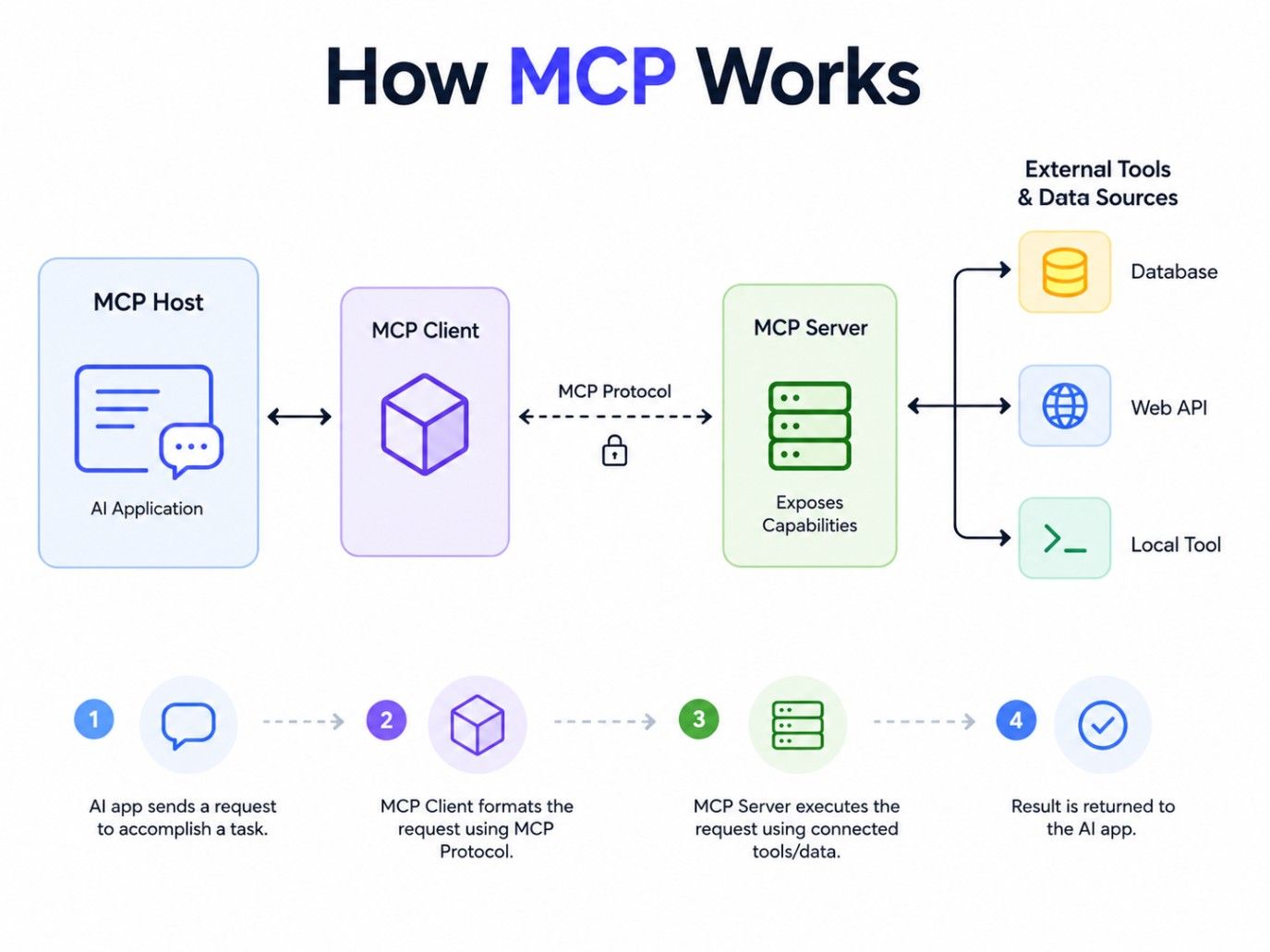
The typical workflow includes:
Imagine an AI assistant helping a project manager.
Using MCP, the assistant can:
All these actions happen through a standardized protocol without requiring separate custom integrations for every tool.
This is one reason why discussions around MCP vs API have become increasingly important in modern AI development.
Do Read : Agentic AI Learning Path: A Complete Guide for Developers and AI Professionals
An Application Programming Interface (API) is a set of rules and protocols that enables different software applications to communicate with each other.
APIs define how requests should be made, what data can be exchanged, and how responses are returned.APIs have been the backbone of software integration for decades and power everything from payment gateways to social media platforms.
APIs follow a request-response model.
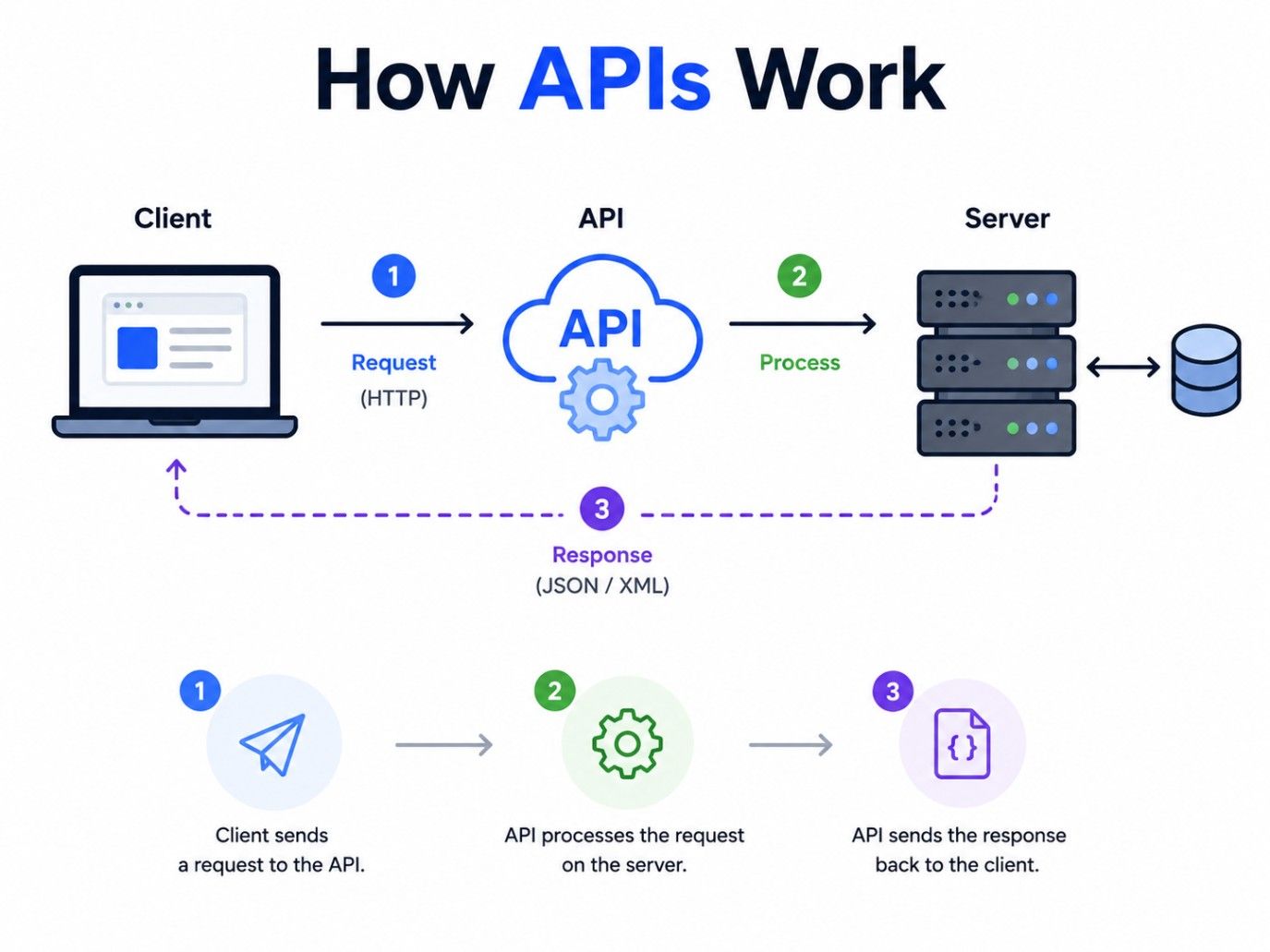
The typical workflow includes:
Consider a weather application.The application sends a request to a weather API containing a city name.
The API processes the request and returns:
The application then displays this data to the user.
Unlike MCP, each API requires developers to build and manage individual integrations.
Also Read: API Development and Integration Fundamentals
Must Read : Agentic AI Design Patterns: Building Smarter AI Sysems
Choosing between MCP and APIs depends on the nature of your application and integration requirements.
Use MCP When:
Use APIs When:
Many modern AI systems actually combine both approaches, where MCP uses APIs behind the scenes to access external services.
Also Read : AI Skills in Demand: 25 Essential Skills Required for a Career in AI Engineering
The table below highlights the key benefits and challenges of each approach.
Approach |
Advantages |
Limitations |
| MCP | Standardized integrations, context awareness, AI-friendly architecture, improved interoperability | Newer technology, evolving ecosystem, limited adoption compared to APIs |
| API | Mature technology, widely adopted, flexible, extensive documentation and support | Requires multiple custom integrations, can become complex at scale, often stateless |
Must Read: 5 Significant Benefits of Artificial Intelligence
MCP and APIs both play critical roles in modern software development, but they solve different challenges. APIs enable communication between applications through predefined endpoints, while MCP provides a standardized framework that helps AI models interact with tools and external systems more effectively.
Rather than replacing APIs, MCP builds upon them to create more intelligent and context-aware AI experiences. Understanding the differences between MCP vs API allows businesses and developers to choose the right architecture for their applications and future AI initiatives.
Want personalized guidance on AI and upskilling? Speak with an expert for a free 1:1 counselling session today.
Yes. MCP is designed to work alongside existing APIs rather than replace them. Organizations can expose their current APIs through an MCP server, allowing AI agents to access services in a standardized way. This reduces the need to build separate integrations for every model or AI application while preserving existing infrastructure investments.
AI systems often need access to multiple tools, databases, and applications. Managing individual API integrations for each service can become difficult as systems scale. MCP provides a consistent framework that helps AI agents discover and use tools dynamically, making development and maintenance more efficient across different environments.
MCP helps AI agents access relevant tools and context more efficiently. Instead of relying only on preconfigured integrations, agents can identify available resources through the protocol. This enables better decision-making, smoother workflows, and more accurate responses when interacting with external systems, documents, and business applications.
Yes. Many enterprises are exploring MCP because it offers a standardized approach to connecting AI systems with internal tools and data sources. It can simplify governance, improve interoperability, and reduce integration overhead. However, organizations should still evaluate security, compliance, and scalability requirements before deployment.
No. MCP is unlikely to replace APIs because APIs remain the foundation of software communication. Instead, MCP complements APIs by providing a layer that helps AI models interact with tools more effectively. In most real-world implementations, MCP relies on underlying APIs to access services, databases, and applications.
A traditional API exposes predefined endpoints that developers manually integrate into applications. An MCP server provides AI models with structured access to tools, resources, and capabilities through a standardized protocol. While APIs focus on application-to-application communication, MCP focuses on enabling AI systems to discover and use available tools dynamically.
No. MCP may use JSON for data exchange, but it is much more than a data format. It defines a complete protocol for communication between AI models and external systems. The protocol includes rules for tool discovery, context sharing, capability descriptions, and interaction workflows beyond simple JSON messaging.
MCP can use APIs underneath, but its purpose is different. APIs expose functions for developers, while MCP provides a standardized way for AI agents to understand, discover, and interact with tools. It addresses challenges that traditional APIs were not specifically designed to solve.
Industries using AI assistants, automation platforms, and knowledge systems may see the greatest benefits. Examples include healthcare, finance, customer support, software development, and education. Any organization that needs AI models to access multiple tools and data sources can potentially simplify integrations through MCP-based architectures.
MCP does not automatically make systems more secure, but it can support structured access management. Organizations can define permissions, authentication methods, and tool access policies within their MCP implementations. This helps ensure AI agents only access approved resources while maintaining visibility into system interactions.
The choice depends on your project's goals. If you're building a traditional web or mobile application, APIs may be sufficient. If you're creating AI agents that need access to multiple tools and services, MCP can reduce integration complexity. Understanding MCP vs API helps teams choose an architecture that supports both current needs and future AI capabilities.
730 articles published
Sriram K is a Senior SEO Executive with a B.Tech in Information Technology from Dr. M.G.R. Educational and Research Institute, Chennai. With over a decade of experience in digital marketing, he specia...
Speak with AI & ML expert
By submitting, I accept the T&C and
Privacy Policy