ETL vs ELT: Key Differences, Use Cases, and How to Choose
By Sriram
Updated on Jun 19, 2026 | 7 min read | 2.31K+ views
Share:

All courses
Certifications
More
By Sriram
Updated on Jun 19, 2026 | 7 min read | 2.31K+ views
Share:
Table of Contents
ETL vs ELT is one of the most common conversations that people talk about a lot when it comes to working with data. If you are someone who deals with data pipelines, analytics or cloud platforms, then you need to know what sets ETL and ELT apart. Both ETL and ELT are used to move and prepare data. The way ETL and ELT handle transformation is important when it comes to speed, cost, and scalability.
In this blog, you’ll find out what ETL and ELT really mean, how they differ, when to use each approach, and how to choose according to your needs.
From raw data to real insights - explore Data Science Courses from upGrad and learn ETL, ELT, and beyond today.
Popular Data Science Programs
The core difference between ETL vs ELT lies in when and where data transformation occurs. Both the methods involve moving data from a source system to a target system, system to another, but the sequence of steps differs.
Feature |
ETL |
ELT |
| Transformation Timing | Before loading | After loading |
| Data Storage | Structured only | Raw + structured |
| Speed | Slower for large data | Faster for big data |
| Flexibility | Limited | High |
| Infrastructure | Traditional systems | Cloud-native systems |
Also Read: Data Warehouse Architecture: Discover Layers That Enhance Your Data!
ETL stands for Extract, Transform, Load. In ETL, the transformation of the data happens before it is stored. So, the data that actually gets stored is clean and structured. This means that only the clean ETL data and the structured ETL data enters the target system.
ELT stands for Extract, Load, Transform. In ELT, raw data is loaded first, and transformation happens later using the power of modern data platforms.
The ETL vs ELT difference becomes important when dealing with:
For example, a traditional bank might use ETL to make sure their data quality is good before storing it. A modern SaaS company might use ELT to process large amounts of data faster and in a flexible way.
Free Courses
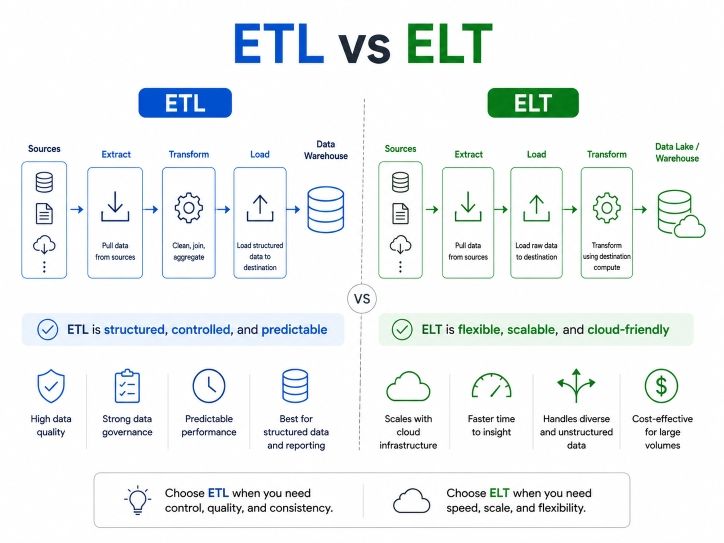
Knowing the difference between ETL vs ELT in depth helps you make better architectural decisions. While the basic difference is clear, there are several practical factors that separate the two.
In summary:
The choice depends on your use case, not just trends.
ETL processes data before storage. This ensures that only high-quality data enters the system.
ELT processes data after storage. This gives space for multiple transformations on the same raw data
Key takeaway:
Also Read: 5 Must-Know Steps in Data Preprocessing for Beginners!
ELT is generally faster for large datasets because:
ETL can slow down when dealing with big data because transformation happens upfront.
Aspect |
ETL |
ELT |
| Storage Usage | Lower | Higher |
| Raw Data Storage | Not stored | Stored |
| Historical Data | Limited | Easily available |
ELT requires more storage but provides more flexibility for future analysis.
ELT is more scalable because:
ETL struggles when scaling due to transformation bottlenecks.
In ETL:
In ELT
This is a major advantage in analytics-driven organizations.
The ETL vs ELT difference also shows up in cost:
However, ELT may increase storage costs due to raw data retention.
Read: What Is Big Data Analytics? Key Concepts, Benefits, and Industry Applications
Data Science Courses to upskill
Explore Data Science Courses for Career Progression
IIIT Bangalore
Executive Post Graduate Certificate in Data Science & AIPlacement Assistance
Choosing between ETL vs ELT is not about which is better. It really depends on your data requirements, business goals, and system architecture.
ETL is a good fit when:
Example use cases:
ELT works best when:
Example use cases:
The hybrid model balances control and flexibility; thus, many companies today prefer using a mix of both.
Use this quick guide:
The cloud computing boom has really changed how we talk about ETL and ELT. ELT is becoming more popular nowadays. But ETL is still super important and plays a key role.
In modern pipelines:
Check this out: Building a Data Pipeline for Big Data Analytics: 7 Key Steps, Tools and More
Platforms like Snowflake, BigQuery and Redshift support ELT because it makes ELT more practical now than it was ten years ago.
ELT can:
Also Read: Data Security in Cloud Computing: Top 6 Factors To Consider
ELT supports near real-time analytics:
ETL struggles with real-time use cases due to preprocessing delays.
Data lakes store raw data in large volumes. This approach is often called schema-on-read.
ELT works naturally with them because:
Despite ELT’s growth, ETL is not obsolete.
ETL is still useful for:
Also Read: What is Data Architecture? A Comprehensive Guide to Its Benefits, Types, Components, and More
The ETL vs ELT difference reflects a broader shift in data engineering, but when you understand both approaches, it will help you design better data systems.
ETL vs ELT is noticeable:
ETL vs ELT is not about who is the winner. It is about choosing the right tool for your data requirements. ETL offers control and data quality, while ELT provides speed and flexibility. Most modern organizations use a mix of both.
If you are dealing with traditional systems or strict compliance, ETL is a strong choice, but if you operate in a cloud-first, data-driven environment, ELT is often the better fit. The key is to understand the e ETL vs ELT difference clearly and apply it based on your use case.
Want to explore more about ETL vs ELT? Book your free 1:1 personal consultation with our expert today.
The main etl vs elt difference is the order of transformation. ETL transforms data before loading it into storage, while ELT loads raw data first and transforms it later. This impacts performance, flexibility, and scalability in data pipelines.
There is no universal winner in etl vs elt. ETL is better for structured, compliance-heavy environments. ELT is better for large-scale, cloud-based analytics. The right choice depends on your data volume, infrastructure, and business needs.
ETL is slower because data must be transformed before loading. This adds processing time upfront. In contrast, ELT loads data quickly and uses powerful cloud systems to transform it later, making it faster for large datasets.
No, ELT is not fully replacing ETL. While ELT is growing in popularity, ETL is still widely used in industries that require strict data validation, governance, and structured workflows.
Yes, many organizations use a hybrid approach. ETL is used for critical pipelines, while ELT is used for analytics and exploration. This combination helps balance control and flexibility.
ETL tools include Informatica and Talend, while ELT tools often rely on cloud platforms like Snowflake and BigQuery. The choice depends on your system architecture and data needs.
ELT can increase storage costs because it stores raw data. However, it reduces infrastructure complexity and improves scalability. Overall cost depends on how efficiently you manage storage and compute resources.
ELT works well in the cloud because modern data warehouses can handle large-scale transformations efficiently. This allows faster data ingestion and more flexible analytics compared to traditional ETL systems.
ETL works best with structured data that requires strict validation before storage. It is commonly used in finance, healthcare, and legacy enterprise systems where data accuracy is critical.
ELT is ideal for large volumes of raw and semi-structured data. It supports flexible analysis and is commonly used in big data environments and modern analytics platforms.
To choose between etl vs elt, consider your data size, infrastructure, and use case. If you need control and clean data upfront, go with ETL. If you need speed, scalability, and flexibility, ELT is the better option.
730 articles published
Sriram K is a Senior SEO Executive with a B.Tech in Information Technology from Dr. M.G.R. Educational and Research Institute, Chennai. With over a decade of experience in digital marketing, he specia...
Speak with Data Science Expert
By submitting, I accept the T&C and
Privacy Policy
Start Your Career in Data Science Today
Top Resources
Executive Diploma
12 Months
Master's Degree
18 Months
Bootcamp
6 Months