Off page SEO : Techniques, Types, Examples, Tools and Checklist
By Sriram
Updated on Sep 01, 2026 | 10 min read | 4.25K+ views
Share:

All courses
Certifications
More
By Sriram
Updated on Sep 01, 2026 | 10 min read | 4.25K+ views
Share:
Table of Contents
Key Highlights
Ready to build your SEO expertise? Explore the Digital Marketing Postgraduate program and develop practical skills in SEO, content, analytics, and digital strategy.
Off page SEO covers the work done outside your website to improve its visibility, reputation, and search presence. Unlike on page SEO, it relies on how other websites, customers, publishers, and online communities interact with your brand.
Common SEO off-page activities include earning relevant backlinks, gaining brand mentions, promoting content, collecting genuine reviews, maintaining local listings, digital PR, and building industry relationships.
For example, if a marketing publication references your original research, you may gain referral traffic, wider exposure, and a valuable external reference.
The goal is not to collect as many links as possible. It is to build genuine credibility around your website through useful content and trusted connections.
Free Courses
Think of off page SEO as building your website's reputation beyond its own pages.
Suppose you run a cybersecurity website. You publish a detailed guide explaining common phishing attacks. A technology publication discovers the guide, references it in one of its articles, and links to your page.
Now, something useful has happened on several levels. Readers of the publication can discover your website; the link can bring referral traffic, and your brand gets recognition from a source operating within the same subject area.
This is broadly how off page SEO works.
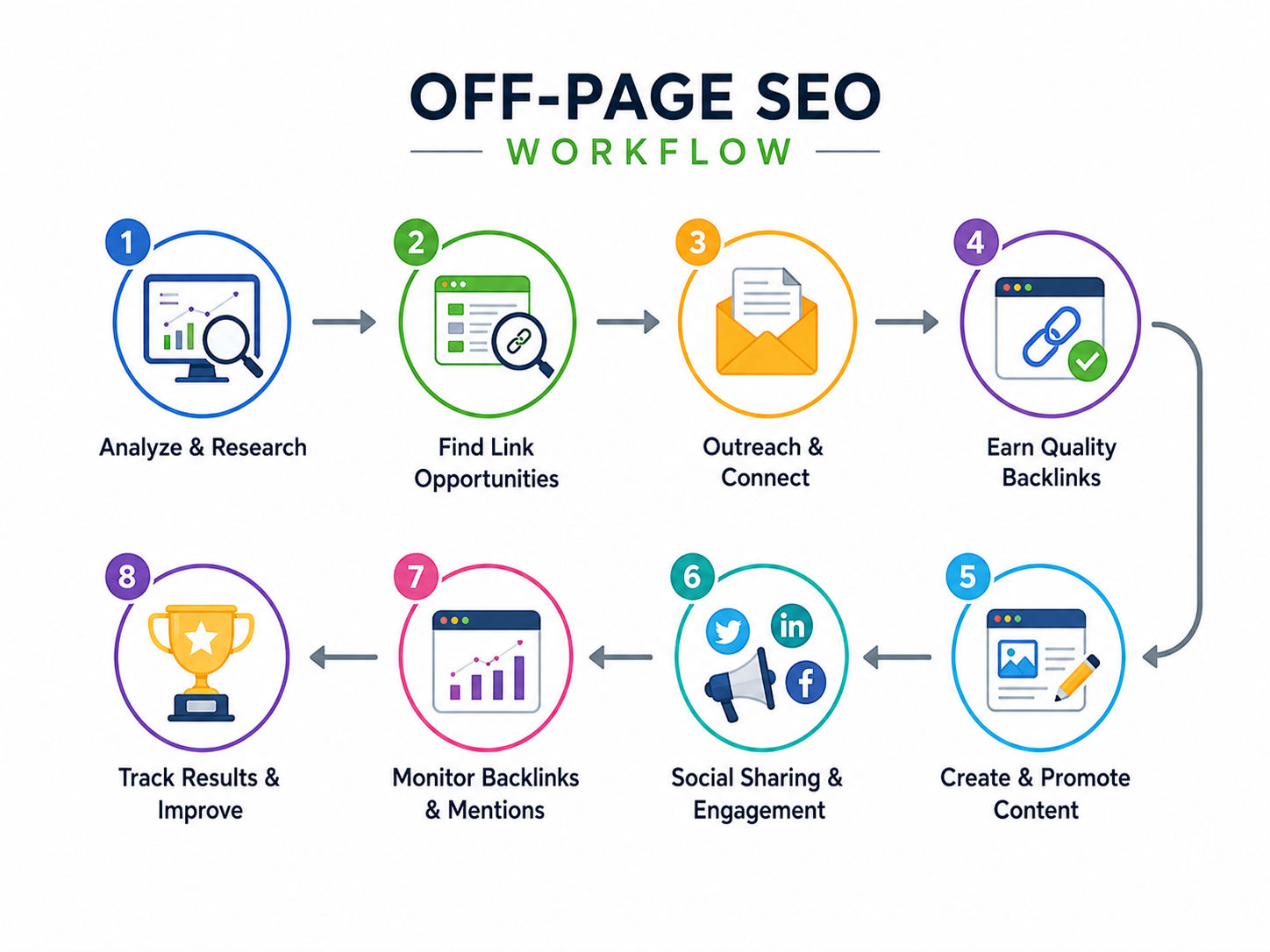
The quality of these SEO off page activities matters. Ten links from unrelated or questionable websites are unlikely to be as useful as a few meaningful references from websites that are genuinely relevant to your subject.
Search engines need more than the content on your website to understand its reputation. External references can provide additional context about how your business, content, or brand is viewed across the web.
A strong off-page strategy can contribute to several areas:
It is worth remembering that off page SEO is not a quick campaign you complete once and forget. Websites gain new competitors, links disappear, businesses change, and online reputations evolve. Regular attention is usually more useful than a short burst of activity.
Digital Marketing Courses to upskill
Explore Digital Marketing Courses for Career Progression
MICA Executive Alumni Status
Off page SEO covers several activities, and not all of them are focused on backlinks. The right mix depends on your business model, audience, location, and industry.
Type of Off page SEO |
What It Involves |
Example |
| Link Building | Earning relevant links from external websites | An industry website linking to your research |
| Social Media Promotion | Sharing and distributing content | Promoting a blog post on LinkedIn |
| Online Reviews | Encouraging genuine customer feedback | Customers reviewing a local business |
| Brand Mentions | Getting referenced by external sources | A publication mentioning your company |
| Local Citations | Maintaining business information on external platforms | A business directory listing |
| Digital PR | Earning media coverage and editorial attention | A company being featured in an industry publication |
| Influencer Outreach | Building relationships with relevant creators | An industry expert discussing your product |
Link building involves earning links from other websites. These links can help people discover your content and may contribute to how search engines assess your website.
The important word here is relevant. A link from a website that covers your industry or a closely related subject is generally more meaningful than a random link from an unrelated site.
Social platforms give businesses another way to distribute their content. A useful article, research report, video, or guide can reach people who may later mention or link to it elsewhere.
Social media should not be treated as a replacement for link building. Its greater value is content discovery, audience engagement, and brand exposure.
Reviews matter particularly for businesses that sell products or services directly to customers. Genuine customer feedback can influence how potential customers perceive a company before they decide to buy.
Responding to reviews also gives businesses an opportunity to demonstrate that they pay attention to customer experiences.
A brand mention happens when another website, publication, creator, or online source refers to your company, product, service, or content.
Some mentions contain links, while others do not. Both can increase awareness. Monitoring these references can also reveal opportunities to connect with websites that are already familiar with your brand.
Must read: What is Digital Marketing Funnel? How to Create One?
Local citations usually contain information such as a business name, address, phone number, website, or category.
For local businesses, keeping this information accurate across important platforms can make it easier for customers to find and recognise the business online.
Digital PR combines public relations with online content and media outreach. Businesses may create original research, surveys, reports, expert commentary, or data-led stories that publishers find worth covering.
A strong digital PR campaign can result in brand mentions, referral traffic, media exposure, and potentially valuable links.
Influencer outreach involves connecting with creators or experts whose audience overlaps with your own.
The emphasis should be on relevance. Working with someone simply because they have a large following may not produce meaningful results if their audience has little connection with your product or industry.
Also Read: Crucial PR Skills: What Makes PR Effective?
The best off page SEO techniques help people discover, trust, mention, and recommend your website. The right approach depends on your business. For example, a local restaurant may focus on reviews and citations, while a B2B company may benefit more from digital PR and industry links.
1. Build High-Quality Backlinks
Focus on earning links from relevant and trustworthy websites rather than chasing large numbers.
Consider:
A relevant link from a respected technology publication is generally more useful than multiple links from unrelated websites.
Write useful, original articles for relevant websites and include a link only when it adds value.
Good guest posting focuses on:
Avoid publishing the same article across many sites just to gain backlinks.
Also Read: How to do Competitor Analysis? Step by Step Guide
Find broken links on relevant websites and suggest a suitable resource from your site as a replacement.
The basic process is:
The goal is to solve a problem, not simply ask for a link.
Link reclamation means recovering backlinks or mentions that have been lost.
Look for:
Regular backlink checks can help you find these opportunities.
Digital PR works best when you have something genuinely worth sharing, such as:
For example, a recruitment company could publish hiring data that journalists later reference in their articles.
A website, podcast, publication, or online community may mention your brand without linking to it. These references can increase awareness and create future link opportunities.
Monitor:
If a link would help readers, consider contacting the publisher.
Social media can help your content reach journalists, professionals, creators, and potential customers.
For example, sharing an original research report on LinkedIn may bring it to the attention of an industry expert who later references it in an article.
Must Read: Digital Marketing Objectives: Full Guide with Types and Examples [2026]
Genuine reviews can strengthen trust, especially for customer-facing and local businesses.
Encourage customers to:
Respond professionally and avoid fake or misleading reviews.
Keep your business details accurate across relevant directories and platforms.
Check your:
Focus on useful, industry-relevant directories instead of submitting your business everywhere.
Industry forums, professional groups, Q&A sites, and specialist communities can help you connect with your audience and demonstrate expertise.
Answer questions properly, share useful resources when relevant, and avoid repeated promotional posts or unnecessary links.
Also Read: How to Make Social Media Marketing Strategy in Just 8 Steps
Practical examples show how off page SEO works in real situations. From earning backlinks through useful content to gaining reviews and media mentions, these activities can help businesses build visibility, trust, and authority online.
Activity |
Example |
Benefit |
| Guest Post | Write an article for a relevant industry website with a useful link. | Traffic and backlinks |
| Digital PR | Publish original research that gets covered by industry media. | Media exposure and mentions |
| Brand Mention | A publication references your brand in relevant content. | Brand awareness |
| Customer Reviews | Customers share genuine feedback about your business. | Trust and reputation |
| Local Citation | Keep business details consistent across local directories. | Better local visibility |
| Broken Link Building | Suggest your resource as a replacement for a broken link. | Relevant backlink opportunity |
Ready to build AI-powered software solutions? Explore the Executive Post Graduate Certificate in AI-Native Software Engineering and develop practical skills to stay ahead in modern software development.
On-page and off page SEO address different parts of search optimisation. One focuses mainly on what happens on your website, while the other deals with external recognition and relationships.
Factor |
On-Page SEO |
Off page SEO |
| Meaning | Optimising elements on a website | Activities performed outside the website |
| Main focus | Content, structure, and user experience | External authority, mentions, and relationships |
| Control | Mostly direct control | Often depends on external websites and audiences |
| Examples | Keywords, headings, content, internal links | Backlinks, reviews, brand mentions, PR |
| Main objective | Improve relevance, accessibility, and usability | Build credibility and external visibility |
| Common tools | Search Console and content tools | Backlink, monitoring, and outreach tools |
Do read: Top Digital Marketing Channels for Maximum Reach and ROI
The right tools depend on what you are trying to investigate. Some are designed primarily for backlink analysis, while others are more useful for local visibility or search performance.
Tool |
Primary Use |
Off page SEO Application |
| Ahrefs | Backlink analysis | Research backlinks, referring domains, and competitors |
| Semrush | SEO research | Analyse backlinks and discover link-building opportunities |
| Moz Link Explorer | Link analysis | Explore backlinks and link-related metrics |
| Google Search Console | Search performance | Monitor website performance and available link data |
| Google Business Profile | Local presence | Manage business information and customer reviews |
Start with the task you need to complete rather than choosing a tool simply because it has a long list of features.
Consider whether you need:
For example, someone researching competitor backlinks may need a different toolset from a local business mainly concerned with reviews and business listings.
Tools are most useful when they help you make better decisions. A report can show you hundreds of potential backlinks, but you still need to judge whether those websites are relevant, credible, and worth pursuing.
Also read: What is SEO Content Writing? A Beginner’s Guide to Writing for Search Engines
An off page SEO checklist gives marketers a simple way to keep track of external optimisation work. Instead of concentrating only on link acquisition, it encourages you to look at backlinks, brand visibility, reviews, local information, and ongoing monitoring.
1. Backlink Review
2. Content Outreach
3. Brand & Reputation
4. Reviews & Customer Trust
5. Local SEO
6. Performance Monitoring
Using an off page SEO checklist makes it easier to organise these tasks and spot gaps in your strategy.
Must Read: Branding: When’s the Right Time to Start
Off page SEO services are professional services that focus on improving a website's external visibility, reputation, and authority.
The exact work varies between providers, but services may include:
Off page SEO services help businesses improve their online visibility and build credibility beyond their own websites. These services cover activities such as link building, digital PR, brand monitoring, local citations, and reputation management.
Backlink Building: Finding and pursuing relevant opportunities to earn quality backlinks.
Link Outreach: Connecting with publishers, editors, website owners, and industry professionals about useful resources.
Digital PR: Developing research, data, expert commentary, and stories that can attract media attention.
Local Citation Building: Creating and maintaining accurate business information on relevant local platforms.
Reputation Management: Monitoring reviews and external references to understand how people perceive a brand.
Competitor Backlink Analysis: Studying competitor backlink profiles to identify potential opportunities.
Professional support can make sense when a business does not have enough internal SEO resources or operates in a highly competitive market.
It may also be useful when a company needs specialised outreach, digital PR, competitor research, or ongoing backlink monitoring.
However, outsourcing does not remove the need for oversight. Businesses should understand what work is being performed and how success is being measured.
Before hiring a provider, look beyond the number of links they promise.
Check:
A reliable provider should be comfortable explaining the strategy, the type of websites being targeted, and the reason those opportunities are relevant.
Be cautious about services that promise thousands of backlinks in a very short period or refuse to explain how the links will be acquired.
Off page SEO helps build your website’s reputation outside its own pages. Backlinks matter, but they are not the only factor. Brand mentions, reviews, digital PR, local citations, and content promotion can also improve visibility and trust.
A practical off page SEO checklist keeps these activities on track, while SEO tools make backlink research and monitoring easier. When paired with strong content and on-page optimisation, off page SEO can strengthen credibility, attract relevant audiences, and support better search visibility.
Ready to start your journey? Book a free consultation with upGrad today to find the best path for your career
The two commonly discussed types are on-page SEO and off page SEO . On-page SEO deals with elements you control on your website, while off page SEO focuses on external signals and activities. In practice, SEO also includes areas such as technical and local SEO, depending on the strategy.
On-page SEO improves elements within your website, such as content, headings, and page structure. Off page SEO works beyond the site through external signals and relationships. Both serve different purposes, so treating them as competing strategies is less useful than building them together.
Yes, off page SEO remains relevant, although the focus has shifted from collecting large numbers of links to earning credible, relevant signals. Search visibility increasingly depends on trust and authority, making genuine mentions, quality references, and strong brand reputation more valuable than manufactured link volume.
The three C's are commonly described as Content, Code, and Credibility. Content covers useful and relevant information, Code refers to technical website foundations, and Credibility reflects external trust signals. Together, they provide a simple way to understand how different parts of an SEO strategy work together.
The 80/20 rule suggests that roughly 20% of SEO efforts can generate around 80% of the results. It is not a fixed Google ranking formula. For off-page work, this means prioritising activities with strong potential rather than spreading resources across every available opportunity.
Off page SEO can strengthen brand authority by increasing the number of credible places where a business is referenced, discussed, or recommended. Consistent recognition across relevant publications, communities, reviews, and industry sources can help establish the brand as a trusted entity within its subject area.
Yes. A new website can begin by creating resources worth referencing, building relationships with relevant publishers, participating in industry discussions, and developing genuine brand visibility. Early efforts should focus on relevance and credibility rather than trying to match the backlink volume of established competitors.
Look beyond the number of backlinks. Useful indicators include referring domains, quality of earned links, referral traffic, brand mentions, media coverage, review trends, and changes in organic visibility. Comparing these signals over time gives a clearer picture of whether external SEO efforts are gaining traction.
Yes, particularly for businesses serving specific locations. Consistent business information, customer reviews, relevant local references, and mentions across trusted platforms can strengthen local visibility. The quality and relevance of those external references matter more than simply appearing on a large number of directories.
AI-powered search makes brand credibility and external recognition increasingly important because answer systems need reliable sources to identify trustworthy information. Strong content still matters, but consistent mentions, authoritative references, and recognised expertise can help strengthen a brand's visibility across both traditional and AI-driven search experiences.
AEO, or Answer Engine Optimisation, is not necessarily better than SEO. The two address overlapping but different search experiences. SEO focuses broadly on organic visibility, while AEO aims to make information easier for answer engines to understand and surface. A modern strategy can incorporate both approaches rather than choosing one.
724 articles published
Sriram K is a Senior SEO Executive with a B.Tech in Information Technology from Dr. M.G.R. Educational and Research Institute, Chennai. With over a decade of experience in digital marketing, he specia...
Get Free Consultation
By submitting, I accept the T&C and
Privacy Policy
Level Up Your Digital Marketing Career Today!
Top Resources
MICA
Advanced Certificate in AI-Powered Digital Marketing & Communication from MICAMICA Executive Alumni Status
Certification
5 Specialisation
Classroom
4 Months
Certification
2 Months