The dMAT (Digital Master Assessment Test) Core Module is a 90-minute digital test that checks general cognitive and academic reasoning skills for students applying to Master's programmes in Germany. It looks at how well you can understand information, work with numbers, and solve different types of problems.
The Core Module syllabus covers three areas: verbal reasoning, numerical reasoning, and logical reasoning. The questions are designed to test how you work with written information, numbers, and patterns rather than your knowledge of a specific academic subject.
In the sections below, we cover the dMAT Core Module syllabus, exam pattern, scoring system, and official preparation material to give you a clear idea of what to expect and how you can prepare.
dMAT Core Module Syllabus
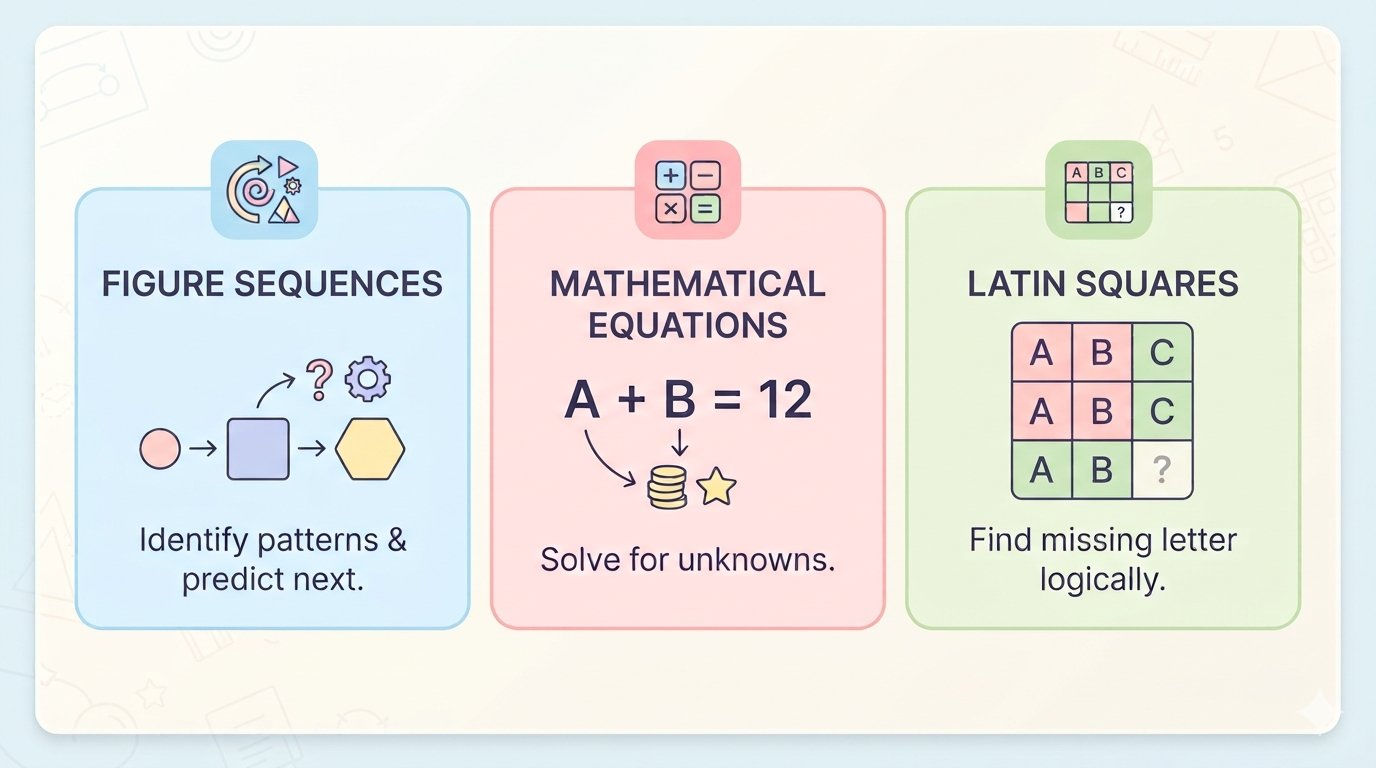
The Core Module contains three types of tasks: Figure Sequences, Mathematical Equations, and Latin Squares.
The questions in each task differ significantly from each other, but they all share the common feature that requires understanding the provided information and applying logic to obtain the correct answer.
Below are the examples of tasks, along with explanations of what needs to be done:
Task
What you work with
What you need to do
Figure Sequences
Figures and patterns
Find the rule and predict what comes next
Mathematical Equations
Equations and numbers
Work out the values represented by the letters
Latin Squares
A 5×5 letter grid
Find the missing letter using the row and column rules
Let's look at each task in a little more detail.
Figure Sequences
You are shown a series of figures or matrices that change according to a particular rule. Your job is to spot the pattern and use it to identify the next figure.
The changes may involve the position, colour, direction, or arrangement of the figures.
Keep an eye on:
What changes from one figure to the next
What stays the same
Whether the pattern repeats
Mathematical Equations
These questions use equations where letters represent numbers. You need to use the information provided to work out the unknown values and find the correct answer.
The focus is on understanding the equations and working through them carefully rather than using complicated mathematics.
You may need to:
Work out what a letter represents
Use one equation to help solve another
Find the value that satisfies the given equations
Latin Squares
Latin Squares are 5×5 logic grids containing the letters A to E. A letter cannot appear more than once in the same row or column.
Some cells are already filled, and you need to work out which letter belongs in the empty cell.
The Core Module tests your reasoning and problem-solving skills through three subtests: Figure Sequences, Mathematical Equations, and Latin Squares. Each section has 20 tasks and 25 minutes, giving you 75 minutes of active testing time overall.
Here is a clear breakdown:
Subtest
Tasks
Time
Figure Sequences
20
25 minutes
Mathematical Equations
20
25 minutes
Latin Squares
20
25 minutes
Core Module Total
60
75 minutes
The time limit applies separately to each subtest. This means any time left after finishing one section cannot be added to the next section. You therefore need to manage your time within each 25-minute block.
The Core Module score in dMAT is given on a scale of 0 to 200. The average score is 100. Along with your score, you also get a percentile rank, which tells you how your result compares with other students who took the dMAT.
Here are the main things to know:
The average dMAT Score is 100.
You get a separate score for the Core Module and Subject Module.
You also get a percentile rank for each module.
The two module scores are added to give your overall dMAT score.
There is no negative marking in the Core Module.
For example: If you score 105 in the Core Module and 115 in the Subject Module, your overall dMAT score will be 220.
Understanding Your Percentile Rank
Your percentile is not the same as your percentage. It tells you how your score stands compared with other dMAT test takers.
For example, a percentile rank of 70 means that you scored as well as or better than 70% of the test takers. The other 30% scored higher than you.
The official dMAT website provides preparation videos and sample questions for the Core Module. These materials can help you understand the tasks and get familiar with the question format before the test.
Official dMAT Core Module Preparation Material
You can watch the official introduction video for each Core Module task:
These videos explain how each task works and what you need to do.
dMAT Core Module Sample Questions
The official dMAT Preparatory Materials PDF also includes sample questions. You can use them to get a better idea of the type of tasks you may see in the Core Module and practise solving them before the test.
dMAT can be an important step towards studying in Germany. Ready to take the next step? Plan your Masters in Germanywith upGradstudy abroad today!
How to Prepare for the dMAT Core Module?
The Core Module is more about getting used to the questions than memorising anything. Start with the official videos, try the sample questions, and then practise with a timer. After a few rounds, you will have a better idea of which questions take you longer.
Know the Question Type First
Before you start timed practice, make sure you know what each task is asking. The official dMAT videos are a good place to start.
For example, in Figure Sequences, you may need to spot how a figure changes from one step to the next. In Latin Squares, you need to look at the letters already placed in the rows and columns. Knowing this beforehand saves you from spending your test time just working out the rules.
Start With the Official Questions
Use the sample questions in the official dMAT preparation material. Try a few questions without a timer first.
When you get one wrong, do not just note the right answer. Go back to the question and see what you missed. Maybe you overlooked a change in a figure or missed a letter that was already given in a row.
A simple practice routine: Try the question → Check your answer → Find your mistake → Try a similar one again
Bring the Timer In Slowly
Each Core Module section has 25 minutes, so speed does matter. But there is no point rushing from the first day of practice.
Start by getting comfortable with the questions. Then set a timer and see how many you can solve without losing accuracy. If one question is taking much longer than the others, move on and come back to it if time allows.
Note: There is no negative marking in the Core Module. If you are left with very little time, do not leave a question unanswered.
The dMAT consists of two modules: Core Module and Subject Module. The former assesses your level of general reasoning and cognitive aptitude through three types of tasks, whereas the latter evaluates your academic or subject-specific aptitude.
To get an idea about the contents of the exam, take a look at the following comparison of the two modules in terms of the focus, content, time, format, and preparation:
Aspect
dMAT Core Module
dMAT Subject Module
Focus
General reasoning and cognitive skills
Subject-specific aptitude
Content
3 task types
Varies by academic field
Duration
~75 minutes
~90 minutes
Format
Single-choice tasks
Subject-related questions
Preparation
Reasoning and pattern practice
Subject concepts and application
The Core Module is common to candidates, while the Subject Module depends on the academic field and programme requirements.
Conclusion
Understanding how to perform a given task for the dMAT Core Module is essential during its study period. Sequential Figures, Mathematical Formulas, and Latin Square need separate methods; therefore, spend some time learning about them before practicing on your own using their textbooks.
While practicing, pay attention to both precision and efficiency. Analyzing how to answer questions will allow for improvement of weak areas while improving familiarity with this module’s formatting requirements.
The dMAT Core Module applies to students applying for a Master's degree at universities in Germany. Whether you need to take it depends on your degree programme, university, and the applicable eligibility criteria.
Is there a requirement of dMAT Core Module for all Master's applicants in Germany?
No. Not all Master's applicants in Germany are required to take the dMAT Core Module. This depends on the applicant's programme and the applicable admission or APS criteria. Check your requirements before registering.
Is it possible to take the dMAT Core Module from India?
Yes, eligible candidates can take the dMAT Core Module at an approved testing centre in India. Check the available test centres and dates before booking so you can choose an option that fits your application timeline.
Where can I register for the dMAT Core Module?
You can register for the dMAT Core Module through the official dMAT website. Enter your details accurately during the registration process and make sure the information matches your passport and other application documents.
Is there a fixed date for testing for the dMAT Core Module?
Test availability may vary depending on the dates and slots offered through the official dMAT booking system. Check the available slots while booking and select a date that fits your university application timeline.
How long is a dMAT Core Module score valid?
The dMAT score is valid for 1 year from the date of the test. However, validity requirements may vary depending on your application. Check the latest information from dMAT and your university before taking the test.
Can I retake the dMAT Core Module if I don't pass it?
Yes, you can take the dMAT Core Module again if you need to improve your result or your previous score is no longer suitable for your application. However, retake conditions, including the waiting period, registration process, and applicable fee, may vary. Check the latest rules on the official dMAT website before booking another test.
What happens after completing my dMAT Core Module?
Once you complete the dMAT Core Module, your test is evaluated through the dMAT assessment process. You can then use the result as required for your application and follow any further instructions from the relevant admissions authorities.
Do universities in Germany receive my dMAT Core Module scores directly?
Your dMAT result may need to be submitted or shared as part of your university application. Requirements can vary by programme, so check the latest dMAT and university guidelines to confirm how and where you need to submit your score.
Is there an English version of the dMAT Core Module?
The dMAT Core Module is available for international applicants and can be taken in English. However, applicants should check the latest official test information before registration, particularly where their university has specific language requirements.
Is it possible to take the dMAT Core Module without enrolling in a higher education institute?
Yes, you can prepare for the dMAT Core Module independently using official dMAT materials and a regular study plan. Practising relevant questions and understanding the test format can help you organise your preparation effectively.
upGrad Abroad Editorial Team |5005 articles published
We are a dedicated team of study-abroad experts, ensuring intensive research and comprehensive information in each of our blogs. With every piece written, we aim at simplifying the overseas education ...
Refer Your Friend & Earn upto ₹15000
Help your friend upgrade to a Global Career and earn rewards together.