The January intake in Ireland gives students another chance to start their studies without waiting until September. It is smaller than the main September intake, so fewer universities and courses are available. Most January options are at the postgraduate level, although some undergraduate courses may also be available.
Here are the main highlights of the January intake in Ireland:
Start month: January or February (depending on course)
Courses options: Selected undergraduate and postgraduate courses
Application period: September to December (generally)
Demand for Study Areas: Business-Computing Finance & Data Analytics
English prerequisite: Depends on the university and course
Student visa: for students from visa-required countries
In the sections below, you will find details about January intake universities, courses, application deadlines, eligibility, documents, visa steps and other important points.
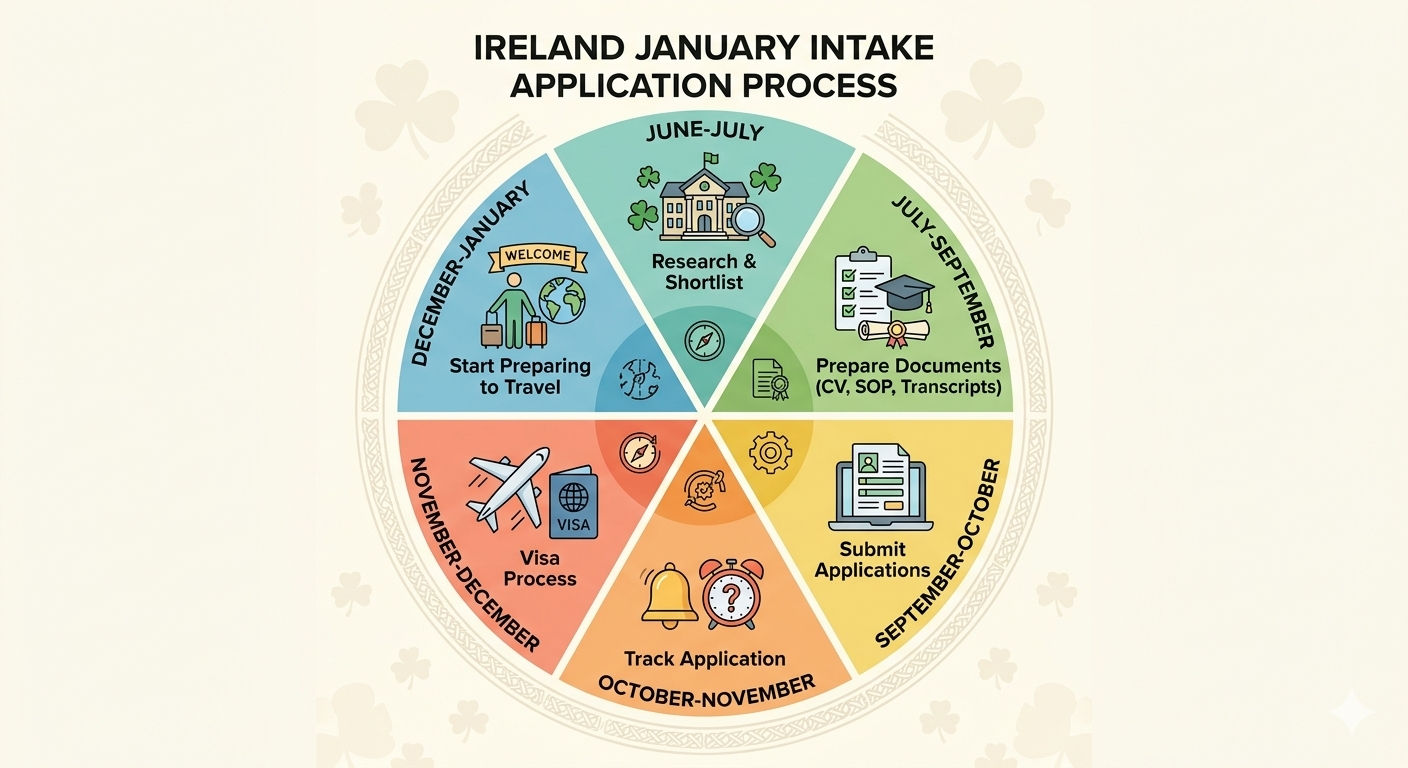
Ireland January Intake Application Process
The September intake has a wider choice of courses than the January intake, so make sure to check availability for January before you apply. Since universities have different deadlines, your application, document preparation and visa steps may fall in different months.
For your reference, here’s a month-wise timeline for the Ireland January intake:
If your course requires an English language test, take the test during this period.
September–October: Submit Your Applications
Once your documents are ready, you can start submitting your applications.
Complete the university application form.
Upload the required documents.
Pay the application fee, if applicable.
Check the deadline before submitting your application.
October–November: Track Your Application
After applying, keep checking your application status and email regularly.
Check your university application portal and email.
Provide any additional documents requested by the university.
Attend an interview if required.
Keep your offer letter and other admission documents safe.
November–December: Get Your Visa Ready
Once you receive your offer, you can start working on your visa process.
Accept your offer.
Arrange your finances and accommodation.
Collect the documents you need for your Irish Student Visa.
December–January: Start Preparing
The last few weeks are for sorting out your travel and university arrangements.
Check your travel plans and accommodation.
Keep your important documents ready.
Complete university registration once you reach Ireland.
Attend orientation and get ready to begin your classes.
Starting your preparation 6–8 months before the January intake gives you enough time to complete each step without having to rush at the end.
Ireland Application Deadlines for January Intake
The deadline for the January intake in Ireland usually falls between September to December, depending on the course and university.
Some courses close applications earlier, so it’s important to check the deadline before you apply.
Here are the main deadline periods for your reference:
Period
Status of the application
September-October 2026
Some courses have early due dates
Oct – Nov 2026
Primary application time frame
November-December 2026
Application late for selected courses
When applying, always check the exact deadline of your course on the official university website.
Top Universities for January Intake in Ireland
Most of the options for a January intake in Ireland are for postgraduate study and include courses with topics like business, computing, data analytics and finance.
There are about 10 universities and colleges offering selected courses for January intake, giving students choice in a range of study areas and locations.
Here are some universities to look for courses and deadlines for January intake:
University
Courses
January Intake Application Deadline (January 2027)
Business, Computing and designated postgraduate programs
30 November 2026
Please check the university website before applying as deadlines vary by course and applicant type.
Eligibility for January Intake in Ireland
For January intake, Ireland has both undergraduate and postgraduate options but there are fewer courses available compared to September.
Your eligibility is largely dependent on your previous qualification, academic marks, English language score and the specific requirements of the course you choose.
Here are the main eligibility requirements to check before applying:
Eligibility for Undergraduates
Eligibility Requirement
Standard Requirement
Academic Credentials
Class 12 or equivalent pass from recognized board
School grades
Usually 60+ depending on the university and course
Subject requirements
Certain courses need specific subjects in Class 12
Interview/ Entrance Test
May be required for some courses
Postgraduate Eligibility
Qualification Criteria
Requirement
Educational qualification
Bachelor’s degree in a relevant field (recognized)
Academic Achievement
Usually about 55%-60% or more depending on the university and course
Education that relates to the position
Some courses require a relevant bachelor’s degree or particular subjects
Experience
Required for certain MBA, management and professional courses
Entrance exam / interview
May be required for certain courses
Porfolio
May be needed for design, art and other practical courses
Requirements differ from university to university and from course to course, so check the eligibility criteria for each course before applying.
How to apply for January Intake in Ireland?
The process of applying for January intake in Ireland starts with finding the right course and verifying that it is open for January. Next you need to check the entry requirements, submit your application and wait for the university’s decision. If you get an offer, you can proceed with your student visa.
Here are the procedures you need to follow to apply for January intake in Ireland:
Narrow Down the Universities and Courses
Start by looking at universities that offer your chosen course in January. Compare a few options to create your shortlist.
Can you confirm that the course is available in January?
Compare course length & tuition fees.
Check the university’s location.
Note: application deadline is.
If the course is offered in September, don’t expect it to be available in January. Always consult the official course page.
Review Application Requirements
Check what the university asks for your chosen course before applying. Courses will have different requirements.
See:
Academic scores
English language proficiency score
Subject or degree requirements
Work experience as needed
Portfolio or interview requirement(s) if applicable
Get Your Documents Ready
Once you know the requirements, prepare your documents before you begin the application. This may help make the process a lot easier, especially if you’re applying to more than one university.
Go through the below section for the complete list of documents required for Ireland January intake.
Apply to the University
Application via the university’s official website or through the application system specified by the university. Please complete your details, upload the relevant documents and pay any application fee if applicable.
Check your course name, personal details, uploaded documents and deadline once before submitting.
Monitor Your Application
After you submit your application, keep an eye on your email and application portal. The university will contact you if they require further information or wish to invite you to attend an interview.
The university will update you on your application once a decision has been made.
Student Visa Application for Ireland
If you need a student visa, start the visa process after you have accepted your university offer. Have your papers and financials ready and be sure of the current visa requirements.
Start early on this step so you have enough time before your January course starts.
Documents Required for January Intake in Ireland
For the January intake, you will need documents to support your university application and, later, your student visa.
Your academic records and English test score are usually needed for admission, while the visa stage also requires proof of your offer, fee payment and finances.
Portfolio, if any Work experience documents, if any
Student’s Visa Purpose
Letter of Offer / Acceptance
Proof of tuition fee payment
Financial papers
Details Of AVATS Application Form
Application Letter
Health insurance (private)
Documentation of any gaps in education or employment, where applicable
The documents required may vary, so check the requirements of your university and the Irish Immigration Service before you apply.
The Irish Immigration Service might require additional documents based on your circumstances. For example, its official checklist includes passport photographs, details of any previous visa refusal where applicable and other supporting documents.
If your course fees are more than €6,000 (approx. 7 L) then you normally also need to show that at least €6,000 has been paid before applying for the visa. If the total fees are less than €6,000 the total sum must be paid.
Please ensure you check the latest university and Irish Immigration requirements before you submit your application as the documents can vary by course and individual case.
January Intake vs September Intake in Ireland
Ireland has two main intake periods: January and September. September is the main intake, so you will usually find more universities and courses during this period.
January has fewer options, but it can work well if you have missed September and do not want to wait another year.
Here’s a simple comparison of both intakes:
Factor
January Intake
September Intake
Start month
January/February
September
University and course options
Fewer courses at selected universities
More UG and PG courses across universities
Application period
Usually September–November
Usually October–May or June
Course availability
Some courses may have limited places
More courses and places are usually available
Scholarships
Fewer scholarship options may be available
More scholarship options are usually available
Graduation and jobs
You may graduate at a different time from the main September batch
Graduation may line up with more September hiring activity
What intake should you choose?
It mainly depends on your course, budget and when you are ready to apply. If you want more course options or are looking for scholarships, September gives you more choices. If you have missed September and do not want to wait another year, January is another option.
Finding student accommodation in Ireland can be difficult, so it is better to start looking once you receive your offer.
Tips to Prepare for January Intake in Ireland
January intake in Ireland is a little different because fewer courses are open compared with September. Some courses may also close early.
For example, if you are planning for January 2027, you can start checking your options around June or July 2026. This gives you time to finish your English test, arrange your documents and submit your applications without doing everything at the last minute.
Here are some tips to help you prepare for your January intake:
Check the Courses Available
Start by checking which courses are actually open for January. A course offered in September may not have a January start.
Make a shortlist and check the start date, entry requirements, fees and application deadline on the university website.
Finish Your English Test Early
If your course requires IELTS, PTE, TOEFL or another English test, try to take it early.
You will then have some time to retake the test if needed. In some cases, you can also apply while waiting for your score, depending on the university.
Keep Your Documents Together
You may need your marksheets, degree certificates, passport, SOP, CV and other documents for your application.
Keep the final copies and scanned documents in one folder on your laptop or Google Drive. It will save you time when you start applying to different universities.
Keep Track of Deadlines
If you are applying to more than one university, make a simple list of all your deadlines.
You can keep four columns: University, Course, Deadline and Application Status. Update the list whenever you submit an application or receive a decision.
Don't Wait Until the Last Day
If your application is ready, there is no real benefit in waiting until the deadline.
Some January courses have limited places, and some universities may close applications early. So, if your documents are ready in October and the deadline is in November, you can submit your application instead of waiting for the last week.
Start Your Visa Work After Your Offer
Once you accept your offer, check the Irish student visa requirements and start collecting the documents you need.
Depending on your situation, this may include your offer letter, proof of fee payment, financial documents and medical insurance.
Start Looking for Accommodation Early
Don't wait until you are about to fly to start looking for a room.
Once you receive your offer, you can start checking your accommodation options. For example, if you receive your offer in October, start looking in October or November rather than waiting until December.
Keep a Backup Course in Mind
January has fewer course options, so it is useful to have one or two alternatives.
Your first choice may close, have limited places or not match your final eligibility. Having another option ready means you can move on without starting your course search from scratch.
Conclusion
For students who missed the September intake and do not want to wait another year, the January intake in Ireland can be good. Big thing to remember is January has less course options so start checking your choices and deadlines early. Once you have found the right course, you will be able to complete the application, documents, visa, and accommodation step by step.
1. Is there a January intake for all courses in Ireland?
No. January has fewer course options than September, and many courses are available only in September. Check your preferred university’s course page to see whether the course has a January start.
2. Can Indian students apply for the January intake in Ireland?
Yes. Indian students can apply for January courses if they meet the university’s entry requirements. If you need a student visa, you will also need to meet the Irish visa requirements.
3. What courses are available for the January intake in Ireland?
Some January options are available in business, computing, finance, data analytics and management. The list is different at each university, so check the courses available for your chosen intake before applying.
4. Can I apply for a master’s in Ireland in January?
Yes. Some universities offer Master’s Courses with a January Intake in Ireland, particularly in areas such as computing, finance and data-related fields. Course options and entry requirements vary by university.
5. Can I apply for two courses at the same university?
It depends on the university. Some allow students to apply for more than one course, while others have their own application rules. Check the university’s application process before submitting applications for two courses.
6. Do January intake students need a different visa from September intake students?
No separate visa is based only on the intake month. The requirements depend on factors such as your course, nationality and immigration status. Check the latest Irish visa requirements before applying.
7. Can I retake my English test if I get a low score?
Yes, you can retake the test if you have enough time before your university deadline. Taking the test early gives you more time for another attempt. Also, check which English tests your university accepts.
8. Are scholarships available for January courses in Ireland?
Some scholarships may be open to students starting in January, but not all scholarships cover this intake. Check the scholarship eligibility rules and deadline separately before applying.
9. Can I take my spouse or children to Ireland for a January course?
This depends on your course, immigration permission and your family member’s circumstances. The rules can vary, so check the latest Irish immigration guidelines before making any plans.
10. When should I book my flight for the January intake?
It is better to wait until your visa is approved before booking your flight. You should also have your accommodation arranged before travelling, especially if you are going to a popular student city.
11. What if my preferred course is not available in January?
Check whether the same course is available for the September intake. You can also look at similar courses at other universities. This is fairly common because there are fewer January intake courses in Ireland than September options.
upGrad Abroad Editorial Team |5019 articles published
We are a dedicated team of study-abroad experts, ensuring intensive research and comprehensive information in each of our blogs. With every piece written, we aim at simplifying the overseas education ...
Refer Your Friend & Earn upto ₹15000
Help your friend upgrade to a Global Career and earn rewards together.