The January intake in France, also known as the Spring intake, gives international students another option to start their studies without waiting until September. It is mainly available at selected private business schools, management institutes and some specialised postgraduate programmes.
Here are some of the key highlights you need to know:
Intake: January or Spring
Course options: Selected courses and programmes
Popular fields: Business, Management, Finance, Marketing and specialised postgraduate programmes
Application period: Usually a few months before the January start
Visa: France student visa required for eligible international students
In the sections below, we will cover January intake universities, courses, deadlines, eligibility, application process, required documents, visa process and more.
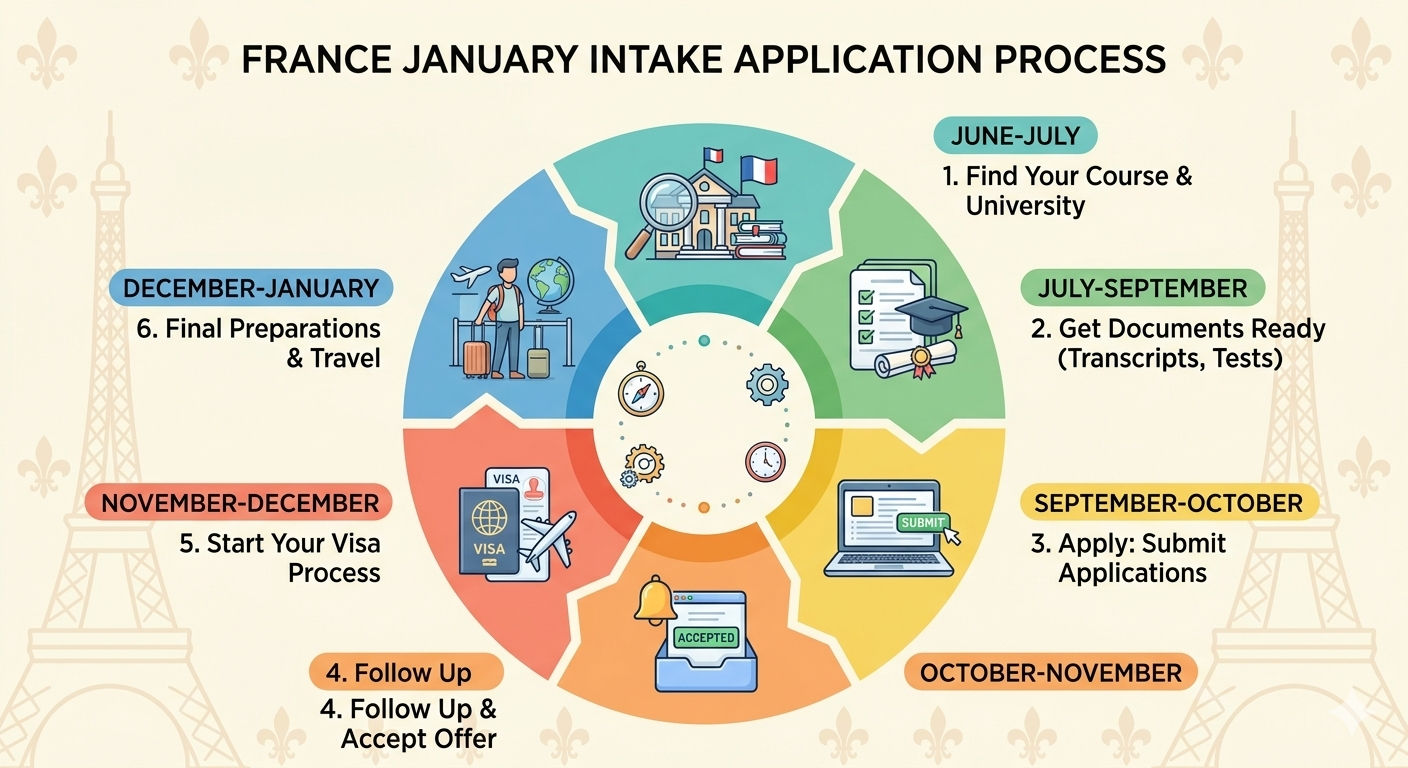
Application Timeline for January Intake in France
If you are planning to start your studies in France in January, it is better to start your preparation a few months early. The exact dates can be different for each university and course, so keep checking the course page while you prepare your application.
A recommended timeline for the January intake in France is:
June–July: Find Your Course
Check which universities offer a January start.
Shortlist the courses you want to apply for.
Check the entry requirements and tuition fees.
Note down the application deadlines.
July–September: Get Your Documents Ready
Collect your academic certificates and transcripts.
Take your English or French language test, if required.
Check everything once before submitting your application.
October–November: Follow Up
Check your email and application portal regularly.
Send any extra documents if the university asks for them.
Attend an interview if required.
Keep your offer letter and other admission documents safely.
November–December: Start Your Visa Process
Once you receive and accept your offer, start working on your student visa.
Check the latest visa requirements.
Prepare your financial and other visa documents.
Complete the required visa or Campus France steps.
Start looking for accommodation.
December–January: Get Ready to Travel
Finalise your accommodation.
Make your travel plans.
Keep your passport, offer letter and other important documents with you.
Complete any remaining university formalities before your course starts.
January Intake in France Application Deadlines
The application deadline for the January intake in France is different for each university and course. Some business schools and selected master's programmes accept students for a January start, while others only have a September intake.
For many January programmes, applications may close between October and December. Some courses may close earlier if all available places are filled.
University Application Deadlines
Early applications: Around October
Regular applications: October to November
Late applications: December, only where the university allows them
Always check the official course page for the final date before applying.
Campus France and Visa Deadlines
If you are an Indian student, check whether your course comes under the Études en France (EEF) process. India is one of the countries covered by this procedure.
After receiving your admission, you also need to complete the required visa steps through France-Visas. For students applying from India, France-Visas advises submitting a long-stay visa application one month before the planned departure.
So, it is better not to wait until December to start your visa work. Check the university, Campus France and visa deadlines together before planning your January intake.
The January intake in France is mainly available for selected programmes rather than every course at a university. Business schools and some public institutions have programmes with different application rounds, so the deadline can also vary.
Here are some Grandes Écoles and universities in France to consider when checking January options:
Management, Finance, Marketing, Business Analytics
Early Round: October 15; Final Submission: November 15
École Polytechnique
Data Science, AI, Engineering, Technology
Final Cutoff: November 1
SKEMA Business School
Business, Marketing, Finance, Management
Rolling rounds until November 30
NEOMA Business School
Management, Digital Transformation, Finance, Marketing
Rolling rounds until November 30
KEDGE Business School
Supply Chain, Management, Marketing, Finance
Rolling rounds until November 30
Sorbonne University
Business, Economics, Science, Social Sciences
Final window: November 30
University of Lyon
Engineering, Technology, Business, Social Sciences
Final window: December 1
What to Check Before Applying?
The programme, intake and deadline can be different even within the same university. Before applying, check:
Whether the course starts in January
The exact application deadline
Course-specific eligibility requirements
English or French language requirements
Tuition fees and other charges
Whether the application is made directly or through another application system
It is better to check the official university website for the course you want, as deadlines and available programmes can change from one intake to another.
Eligibility for January Intake in France
Before applying for a January course in France, check two things first: whether you meet the academic requirements and whether you meet the language requirements.
The marks, degree, subjects and other conditions can change from one course to another, so there is no single eligibility rule for every January programme.
For Bachelor's Courses
If you are applying after Class 12, most universities will look at your school qualification and the subjects you studied. Some courses may also ask for a particular subject background or additional selection steps.
Requirement
What to Check
Class 12 qualification
A recognised Class 12 or equivalent qualification
Academic marks
Minimum marks set by the university
Subject requirements
Specific subjects may be needed for some courses
Language skills
English or French proficiency, based on the course
Selection process
Interview, entrance test or other assessment, if required
For Master's Courses
For a master's programme, your bachelor's degree is the main academic requirement. Some courses also expect your previous degree to be related to the subject you want to study.
Requirement
What to Check
Bachelor's degree
A recognised degree from a relevant field
Academic performance
Minimum marks or grade required by the university
Previous subjects
Some programmes ask for specific academic subjects
Language skills
English or French language proof, depending on the course
Work experience
May be needed for some MBA and professional courses
Portfolio
May be required for design, art or similar courses
English or French Language Requirements
The language test depends on the programme. An English-taught course may ask for IELTS, TOEFL or another accepted test, while a French-taught course may require proof of French language ability.
The exact score is decided by the university and course. So, before booking a test, check the language requirement on the official course page.
How to Apply for France January Intake?
The first step to apply for January intake in France is to select your course and university. Then you have to look at the requirements of the university, gather your documents, apply in time and then work on your student visa.
Here is the step-by-step process to apply for a January intake in France:
Select Universities and Courses
First, find the universities that have your course available in January. Look at the course details before you add a university to your list.
See:
Start date of the course
Tuition costs
Entry requirements
Language score required
Deadline for applications
Where is the campus located?
It is also a good idea to have a few course options lined up, rather than just applying for one course.
Review the Application Requirements
Each course can have its own entry rules. Check what you need on the university website before you apply.
You might need:
A particular level of marks
A relevant degree for master’s courses
Results of an English or French language test
Work experience for some courses
Entrance examination if required
An interview if needed
Organize Your Documents
Know what the university needs and start collecting your documents.
Keep all your documents in one folder as clear digital copies.
Apply to the University
Apply at the application portal given by the university. Please review your form and documents before submitting.
Ensure that:
All particulars are filled in correctly.
Your name is the same as your passport.
I have uploaded all the documents required.
Application fee, if any, is paid.
You save the confirmation of the application.
Follow Your Application
When applying, be sure to check your email and university portal. The university may get in touch with you if they need another document or want to schedule an interview.
Once you receive your offer letter, review the next steps and the offer acceptance deadline.
France Student Visa Application Process
Get admission, then start your student visa process. Indian students may also have to complete the Campus France steps required depending on the course and the application route.
Have your main visa documents ready, including:
Letter of Admission
Passport
Proof of finances
Accommodation Information
Other documents required by visa authorities
Before applying, please check the France-Visas website for the most up-to-date student visa requirements.
Documents Required for January Intake in France
Having your documents ready can make the application process easier. The exact documents can be different for each course and university. You will also need some extra documents for your student visa.
Here are the main documents you may need:
Document
What It Shows
Academic certificates and transcripts
Your education and marks
Valid passport
Your identity and travel details
CV or Resume
Your education, skills and work details
SOP or Motivation Letter
Why you want to study the course
English or French language test score
Your language skills
Letters of Recommendation
Your academic or work background
Work Experience Documents
Your previous work, if needed
Portfolio
Your work for art or design courses, if needed
Admission Letter
That you have been accepted by the university
Proof of Funds
That you can pay for your stay and studies
Accommodation Proof
Where you will stay in France
Visa Documents
Documents needed for your student visa
Check the university website and France-Visas website for the latest list before you apply
January Intake vs September Intake in France
France has two common intakes: January and September. September is the main intake, so more courses and universities are available at this time. January has fewer options, but it can be useful for students who are ready to start their studies earlier.
Here is a comparison of both intakes:
Factor
January Intake
September Intake
Classes start
January
September
Courses available
Selected courses
Most courses
Universities
Selected universities and business schools
More universities and schools
Application deadlines
Mostly before the January start
Usually before the September start
Course choices
Fewer choices
More choices
Scholarships
Some scholarships may be available
More scholarships are usually available
Preparation time
Less time if applying close to the deadline
More time to prepare
Good for
Students who find a suitable January course
Students who want more choices
Which Intake Should You Choose?
Your course should be the first thing you check.
January may be better for you if:
Your course starts in January.
You are ready with your documents.
You want to start your studies without waiting until September.
September may be better if:
You want more courses to choose from.
Your preferred course starts in September.
You need more time to prepare.
Always check the course start date and deadline before applying.
Tips for January Intake in France
There is a smaller range of courses in January than the main September intake, so it is best to start checking your options early. If you are planning for January, allow yourself enough time to find a course, take your language test, prepare your documents and complete the visa process.
Here are a few simple tips to help you get ready:
1. Know about the Courses
First, find out what courses are on offer for January. A course may have a September start but not January.
List your favorite universities and check the course pages for the latest dates.
2. Take Your Language Test In Advance
If your course requires IELTS, TOEFL, PTE or a French language test, try to do it early.
It also gives you time to retake the test if you do not score what you need.
3. Have Your Papers Ready
Don’t wait until the application deadline to gather your documents.
Hold your:
School certificates
Passport
CV
SOP or Letter of Motivation
Language Test Outcome
Letters of recommendation (if needed)
in one folder so you can easily find them.
4. Make a Note of Deadlines
If applying to more than one university, make a simple list of:
University → Course → Application Deadline → Application Status
This makes it easier for you to see what you have already applied for and what still needs to be done.
5. Begin Your Visa Work Early
Once you receive your acceptance letter, look into the student visa process. If you have Campus France steps to complete, plan for those as well.
Don't leave your visa work till the last couple of weeks.
6. Start Looking for Accommodation Early
Once you have been accepted, start looking for accommodation. Check location, rent, travel time to your university before you book.
7. Possess a Backup Alternative Course
January offers fewer course choices. Therefore, have one or two other courses or universities in mind in case your first choice is not available.
Conclusion
The January intake in France can be a good option if your preferred course is available for the January start. Since fewer courses are offered compared with September, it is better to check the course options, deadlines and eligibility requirements early.
Once you shortlist your course, focus on preparing your documents, submitting the application on time and completing the required visa steps. Starting early gives you enough time to handle each part of the process properly.
1. Can you work while studying in France in January intake?
Yes, there are rules for international students which permit them to work part-time while studying in France. "But your studies shouldn't suffer because of work."
2. Can I apply for master's courses with a January intake in France?
Yes, some universities and business schools offer master's courses with a January intake in France. However, the options are more limited than the September intake, so check the course start date before applying.
3. Is it a good time to move to France for a student?
In France, January is winter, so students should anticipate cooler weather for the majority of the country. You also need to plan your travel, accommodation, and winter clothes before coming.
4. Am I allowed to stay in France after my studies?
Depending on your qualification, employment situation and type of residence permit, there are different things you can do after you graduate. Before you make your post-study plans, check the latest French immigration rules.
5. Can I take my family with me to France to study?
Depending on their relationship, visa or residence status and other conditions, family members may be able to join an international student in France. You might want to check the rules as per your own situation.
6. What is the cost of living in France for a student?
The average student cost of living in France ranges from €700 to €1,800 (₹66,000 to ₹1,70,000) per month. Regional cities like Toulouse cost less, while living in Paris sits at the highest end of the budget.
7. Which are the popular cities in France for international students?
International students can study in cities such as Paris, Lyon, Toulouse, Lille, Bordeaux and Montpellier. The right city for you will depend upon your university, course, budget and lifestyle preference.
8. Can I study in France without French?
Yes, you can study in France without knowing French if you choose to study a program that is taught in English. However, knowing a little basic French can be useful for everyday communication and life outside the university.
9. What if I get my admission close to the January intake?
If you get admission late, check the time you have left for the other university and visa formalities. If you are unsure that you can finish everything before the course begins, please contact the university.
10. Is it possible to defer my January admission to a later intake?
Each university and program has different deferral rules. Some institutions may allow students to defer admission to a later intake while others may require a new application.
11. What should I do after I reach France for my intake in January?
On arrival complete all university joining/registration formalities, move into your accommodation and meet any residence or administration requirements. Have your admission and travel papers handy for the first few days.
upGrad Abroad Editorial Team |5023 articles published
We are a dedicated team of study-abroad experts, ensuring intensive research and comprehensive information in each of our blogs. With every piece written, we aim at simplifying the overseas education ...
Refer Your Friend & Earn upto ₹15000
Help your friend upgrade to a Global Career and earn rewards together.