What Is Model Context Protocol? Meaning, How It Works, and Benefits
By upGrad
Updated on Oct 30, 2026 | 5 min read | 5.91K+ views
Share:

All courses
Certifications
More
By upGrad
Updated on Oct 30, 2026 | 5 min read | 5.91K+ views
Share:
Table of Contents
Quick Insights:
Ready to build your AI skills? Explore upGrad’s Generative AI and Agentic AI Programs to understand how AI models work, build intelligent applications, and learn how agentic AI systems handle complex tasks.
Agentic AI Courses to upskill
Explore Agentic AI Courses for Career Progression
IIIT Bangalore
EPGP in Applied AI and Agentic AIIIIT Bangalore
Executive Diploma in Machine Learning and AI360° Career Support
MCP acts as a bridge between AI applications and external systems. It allows them to exchange information and access features like file retrieval, database queries, and tool-based actions using a shared set of rules.
Think of MCP as a USB-C port for AI applications. It provides a standard connection between AI applications and different other external systems.
MCP can help AI applications to:
For example, an AI assistant can use MCP to access a company's documents or retrieve information from a connected database. This helps the AI assistant provide answers based on available information.
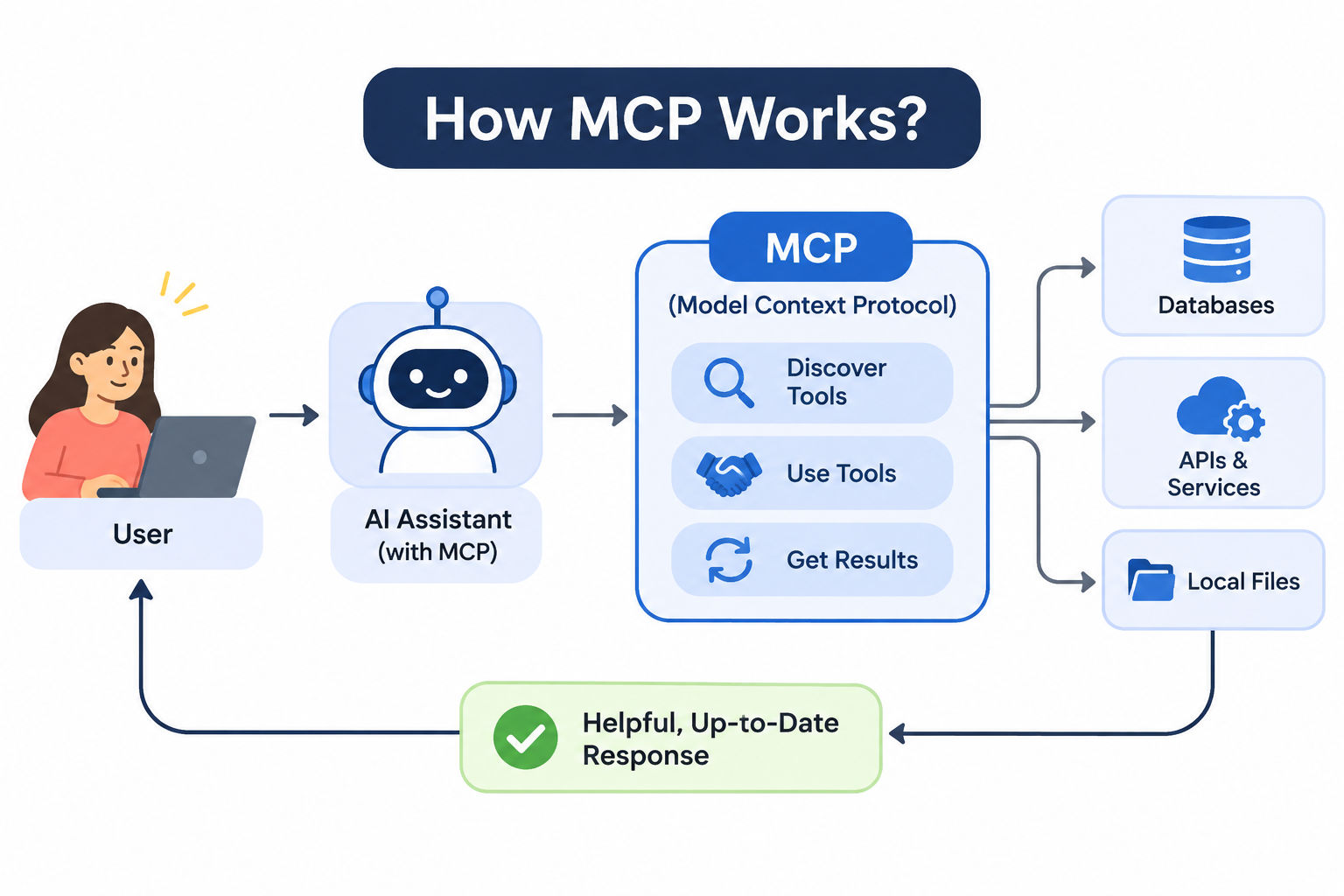
To communicate with external tools and data sources MCP helps AI applications using a standard set of rules. It uses three main components: the host, the client, and the server.
| Component | What It Does |
| MCP Host | The AI application that the user interacts with, Ex. AI assistant. |
| MCP Client | Manages the connection between the host and MCP server. |
| MCP Server | Makes tools, data, or other features available for the AI application. |
MCP connects an AI application with external tools in a few simple steps.
Example: Suppose you ask an AI assistant to find the main points in a company report. The assistant uses MCP to access the report, retrieve its contents, and summarise the main points.
Ready to strengthen your AI and data science skills? Explore the Data Science and Generative AI Certification from IIIT Bangalore to learn data-driven techniques, understand generative AI applications, and apply these skills to real-world problems.
MCP helps AI applications connect with external tools and data. It provides a common way to connect different systems, so developers do not need to build a separate connection for every tool.
| Use Case | How MCP Helps |
| Accessing files and databases | Helps AI assistants get information from connected files, documents, and databases. |
| Automating tasks | Lets AI applications use tools to create tasks or retrieve records. |
| Connecting business systems | Connects AI applications with business tools like customer management systems. |
| Software development | Helps AI coding assistants access project files and development tools. |
| Research and data analysis | Helps AI applications collect information from connected sources for research and analysis. |
Dive Deeper: How to Learn Artificial Intelligence and Machine Learning
Model Context Protocol (MCP) and Retrieval-Augmented Generation (RAG) have different purposes. MCP connects AI applications with external tools and data sources. RAG helps AI models answer questions using information retrieved from external sources.
| Basis | Model Context Protocol (MCP) | Retrieval Augmented Generation (RAG) |
| Purpose | Connects AI applications with external tools, data, and services. | Helps AI models answer questions using relevant external information. |
| How It Works | Uses a standard protocol to connect AI applications with tools and data sources. | Finds relevant information and gives it to the AI model to generate an answer. |
| Main Focus | Connecting AI applications with tools and resources. | Finding useful information to improve AI answers. |
| Common Use Cases | Accessing files, connecting databases, and using business tools. | Answering questions from documents, searching knowledge bases, and using company data. |
| Example | An AI assistant connects to a calendar to check events or create a meeting. | An AI assistant searches company documents to answer questions about leave policies. |
Understand the difference in Detail: MCP vs RAG
Yes. MCP and RAG can work together in the same AI application. MCP connects the application to a document store or search tool. RAG finds relevant information from that source and gives it to the AI model.
Example: A company assistant can use MCP to connect to internal documents and RAG to find the right policy information before answering an employee's question.
Must Read: Difference Between LangGraph and LangChain
Conclusion:
Understanding MCP helps developers connect AI applications with external tools and data. It makes these connections easier to build and manage. The choice between MCP, RAG, or both depends on what the AI application needs to do.
Ready to start your journey? Book a free consultation with upGrad today to find the best path for your career.
Also Read:
Model Context Protocol (MCP) is an open standard that connects AI applications with external tools, data sources, and services. It helps applications access information and use connected tools.
Model Context Protocol is a set of rules that helps AI applications communicate with external systems. It lets them access data and tools without needing a separate connection method for every service.
Anthropic introduced Model Context Protocol in November 2024. It developed MCP to make it easier for AI applications to connect with external tools and data sources.
MCP connects AI applications with external tools, files, databases, and services. For example, an AI assistant can use MCP to retrieve information from documents or interact with a connected application.
MCP uses a client-server structure to connect AI applications with external tools and data.
MCP has three main components:
An MCP server makes tools and information available to AI applications using the MCP standard. For example, it can help an AI assistant access files or retrieve information from a database.
Yes. MCP is an open standard that lets developers build compatible AI applications and integrations without relying on a single AI provider.
An API lets software applications communicate with each other. MCP provides a standard way for AI applications to discover and use external tools and data. MCP servers can also use APIs to provide these features.
MCP connects AI applications with external tools and data sources. Retrieval-Augmented Generation (RAG) finds relevant information to help an AI model generate better answers. MCP handles connections, while RAG uses retrieved information to answer questions.
1328 articles published
We are an online education platform providing industry-relevant programs for professionals, designed and delivered in collaboration with world-class faculty and businesses. Merging the latest technolo...
Speak with AI & ML expert
By submitting, I accept the T&C and
Privacy Policy