RAG Vs Fine Tuning: Key Differences, Benefits, Use Cases & Which to Choose
By upGrad
Updated on Sep 18, 2026 | 9 min read | 3.25K+ views
Share:

All courses
Certifications
More
By upGrad
Updated on Sep 18, 2026 | 9 min read | 3.25K+ views
Share:
Table of Contents
Key Highlights
Want to go beyond theory and actually build RAG pipelines or fine-tune models yourself? Explore our Generative AI courses in India and turn these concepts into real, hands-on skills.
Popular AI Programs
To create an AI application that goes beyond its default knowledge, two approaches are useful - RAG and fine-tuning. Both the approaches focus on making large language models more accurate, but their way of working is fundamentally different.
Here is a quick side-by-side RAG vs fine-tuning comparison:
Aspect |
RAG (Retrieval-Augmented Generation) |
Fine-Tuning |
| Core idea | Retrieves external info at query time and adds it as context | Retrains model weights on custom data to learn new knowledge or behavior |
| Knowledge storage | Outside the model, in a database or vector store | Inside the model, as adjusted parameters |
| Updating knowledge | Fast, just update the data source | Slow, requires retraining |
| Setup requirements | Retrieval pipeline: embeddings, vector DB, search | Labeled data, compute (GPUs), ML expertise |
| Cost | Lower upfront cost | Higher, due to compute and data prep |
| Time to implement | Faster to set up | Longer, due to data curation and training |
| Accuracy on facts | Strong, pulls from current sources | Can go outdated after training |
| Behavior/tone control | Limited, controls content not style | Strong, shapes tone, style, and structure |
| Transparency | High, can cite exact sources | Low, hard to trace responses |
| Hallucination risk | Reduced, grounded in retrieved data | Possible, especially on unseen cases |
| Best suited for | Dynamic or large volumes of information | Stable tasks needing consistent tone or expertise |
| Maintenance | Lightweight, refresh data source | Resource heavy, periodic retraining |
| Model dependency | Works with most LLMs, no modification needed | Needs access to model weights |
Also read: Difference Between RAG and LLM
Free Courses
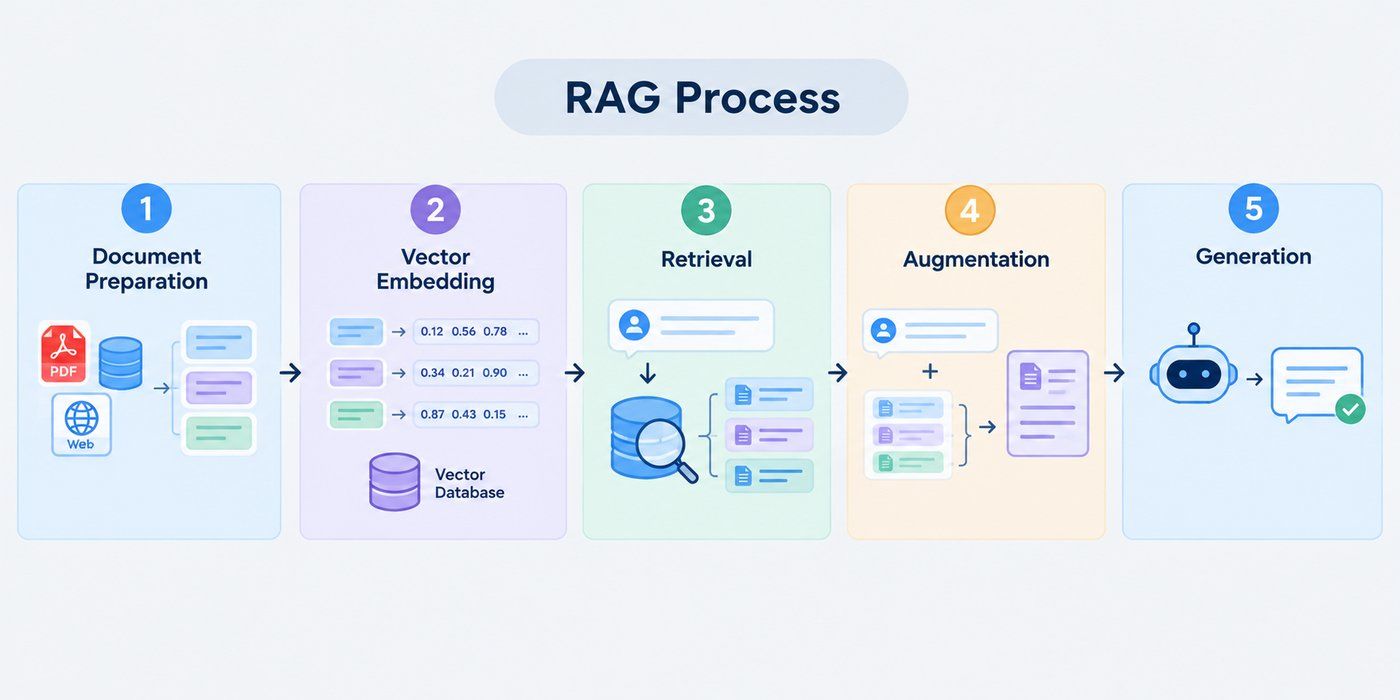
The Retrieval-Augmented Generation, or RAG in generative AI is an approach that combines a language model with an external knowledge source. Instead of relying only on what the model learned during training. RAG allows the model to fetch relevant, up to date information from documents, databases, or the web, and use that information to generate a response.
This means the model is not stuck on its training knowledge only. When a user asks a query, the RAG looks for the most relevant information and passes it to the model along with original questions. And, the model uses this information to produce answers that are accurate and relevant.
RAG is especially useful when:
RAG improves AI models better by searching external data sources for relevant facts before answering a question. Instead of relying only on the data that they memorized during training. This helps in generating better and relevant answers.
How the RAG Pipeline Works
The following are the use cases of RAG:
Also read: Generative AI for Beginners: A Practical Guide to Understanding Modern AI
AI Courses to upskill
Explore Artificial Intelligence Courses for Career Progression
Fine-tuning takes a pre-trained language model and trains it further on a smaller, specific dataset. So, the model’s internal weights adjust and the new knowledge or behavior becomes a part of the model rather than the information it looks up.
This is useful for businesses who need a model that consistently follows a certain tone, format, or vocabulary. For example, a support team is fine-tuning a model on past tickets so it can understand brand voice, and product terms and respond accordingly
Fine-tuning works best when:
Fine-tuning takes a model which is already trained on a huge amount of data and then trains it on a smaller and specific dataset. Instead of training the model from scratch, this step adjusts what the model already knows.
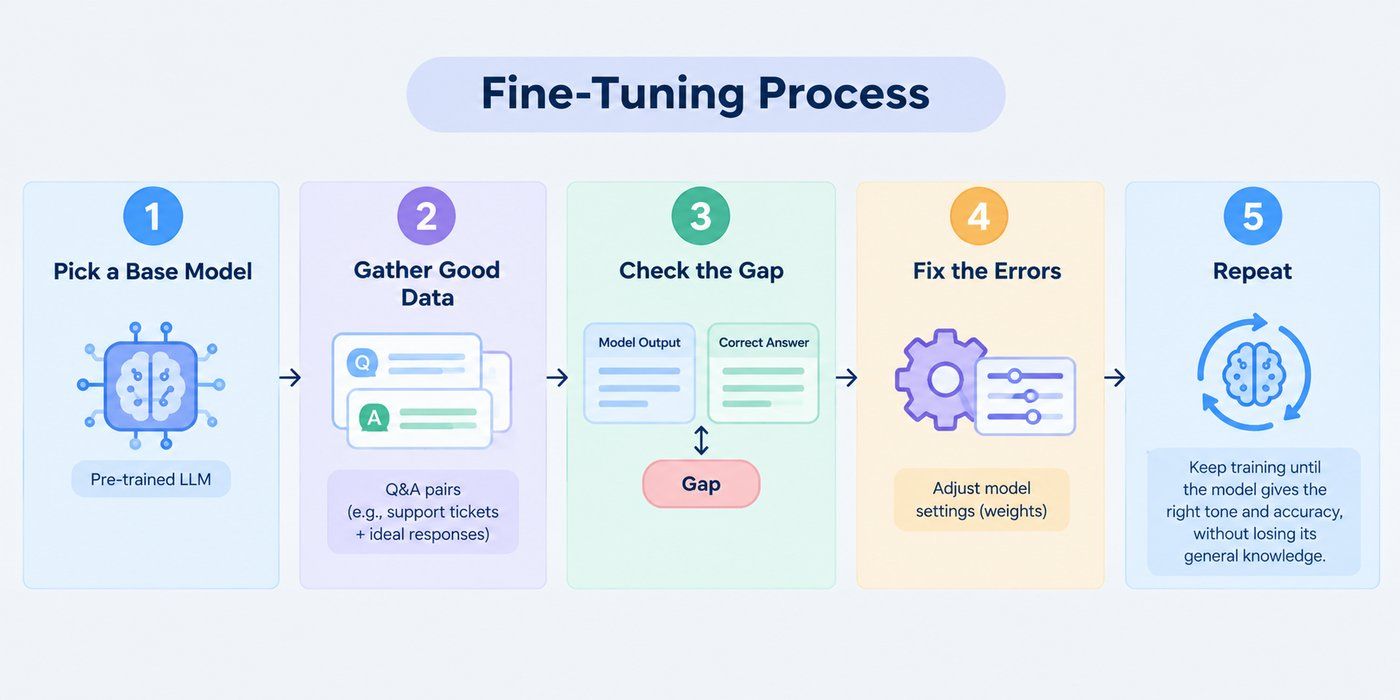
The Fine-Tuning Process, Step by Step
Fine-tuning common use cases are:
Learn to lead with AI, not just adapt to it. Enroll in IIM Kozhikode's Strategic AI for Business Professionals program and future-proof your leadership skills.
To choose RAG vs fine-tuning - the answer depends on where your model is actually failing.
If your model gives wrong or outdated answers because it does not have the latest facts. Choose RAG, it fixes the problem by fetching current information every time someone asks a question.
If your model has the right facts but responds in the wrong tone, ignores your formatting rules, or does not understand terms specific to your industry. This is a behavior problem, and choose fine-tuning. It fixes this by training the model to consistently respond the right way.
A quick gut check:
Ask yourself |
If yes, lean toward |
| Does my data change weekly or monthly? | RAG |
| Do I need to cite sources for answers? | RAG |
| Does the model need a fixed tone or format every time? | Fine-Tuning |
| Is my domain full of specialized terms a general model misses? | Fine-Tuning |
| Do I need this live quickly with a smaller budget? | RAG |
For most teams, RAG is the starting point, since it is faster and cheaper to implement. Fine-tuning becomes worth the investment once tone, structure, or domain expertise need to be baked in permanently.
Also read: Difference Between LLM and Generative AI
Yes both can be used together and in many production systems, it is the most effective approach as well.
The fine-tuning trains a model to handle tone, formatting, or domain-specific reasoning, while RAG trains it with the latest facts and context. This way, the model already speaks like a specialist and knows how to structure its answers, but it is not limited to only what it learned during training.
This combined method works well when:
For example, a healthcare assistant could be fine-tuned to communicate in a clear, empathetic tone and follow strict clinical response formats. On the other hand, RAG feeds it the most recent treatment guidelines or drug information pulled from a live database. Neither approach on its own would cover both needs as efficiently.
Also read: The Ultimate Guide to Gen AI Tools for Businesses and Creators
Choosing RAG vs fine-tuning is not really about finding the "better" option, it is about matching the solution to your problem. A model that struggles because it does not have the right information needs a different solution than one that struggles because it does not respond the way you want.
As AI applications grow more advanced, this choice is becoming less either-or. More teams are combining both, using fine-tuning to shape how a model communicates and RAG to keep it grounded in accurate, up-to-date information. The point is not to master just one technique, it is to understand what each one actually fixes, so you can build an AI system that is both knowledgeable and reliable.
Curious which Generative AI course fits your career goals? Book a personalized consultation with our team today.
RAG works with almost any LLM since it just feeds retrieved context into the prompt, no model access needed. Fine-tuning is more restrictive; it requires either an open-weight model you can train yourself or a provider (like OpenAI or Google) that offers a fine-tuning API for their closed models.
RAG typically adds latency because the system has to search a vector database and retrieve chunks before generating a response. Fine-tuning doesn't add runtime latency since the knowledge is baked into the weights; the model responds just as fast as the base model would.
Fine-tuning usually needs to be repeated periodically, especially if your domain data, product terms, or desired behavior evolve. Each round requires fresh labeled data and another training cycle, unlike RAG where you just swap or add documents.
Yes, this is a real risk since RAG surfaces raw content from your data source at query time. Proper access controls, document-level permissions, and filtering are needed to prevent the model from retrieving and exposing restricted information.
Yes, if a model is fine-tuned too aggressively on a narrow dataset, it can lose some of its general reasoning or broader knowledge. This is why fine-tuning data quality and volume need careful balancing, along with techniques like low-rank adaptation (LoRA) to limit how much the base model changes.
LoRA (Low-Rank Adaptation) is a lightweight fine-tuning technique that updates only a small set of additional parameters instead of the entire model. It's popular because it's cheaper, faster, and less prone to catastrophic forgetting than full fine-tuning.
This varies by task, but even a few hundred high-quality, well-labeled examples can produce noticeable improvements for narrow tasks. For broader behavior changes or complex domains, datasets in the thousands are usually more reliable.
Yes, RAG has become more accessible with managed vector database services and frameworks that handle much of the pipeline setup. A small team can get a basic RAG system running without deep ML expertise, unlike fine-tuning which typically needs more specialized skills.
Common approaches include tracking answer accuracy against a labeled test set, monitoring hallucination rates, and running human evaluations on tone or relevance. For RAG, retrieval quality metrics (like how often the right document chunk is found) are also important to track separately from generation quality.
RAG's ongoing costs come from hosting the vector database, embedding new documents, and the extra compute for retrieval on every query. Fine-tuning's ongoing costs come mainly from periodic retraining runs, though inference itself doesn't cost more than using the base model.
Fine-tuning embeds your data into the model weights, which can make it harder to fully "remove" specific information later if needed. RAG keeps data external, so removing or updating a document is straightforward and doesn't require touching the model itself.
975 articles published
We are an online education platform providing industry-relevant programs for professionals, designed and delivered in collaboration with world-class faculty and businesses. Merging the latest technolo...
Speak with AI & ML expert
By submitting, I accept the T&C and
Privacy Policy
Top Resources
Master's Degree
18 Months
Executive Diploma
12 Months
IIIT Bangalore
Executive Programme in Generative AI & Agentic AI for LeadersIndia’s #1 Tech University
Dual Certification
5 Months