SQL Query Optimization: Guide to Faster Database Performance
By Sriram
Updated on Jul 01, 2026 | 7 min read | 2.24K+ views
Share:

All courses
Certifications
More
By Sriram
Updated on Jul 01, 2026 | 7 min read | 2.24K+ views
Share:
Table of Contents
SQL query optimization is the process of improving SQL queries; it makes them run faster and use less of the database. When databases get really big, even simple queries can be slow if they are not written in a way. Optimizing queries helps them run faster uses less of the server and makes the application work better. When we create websites or big applications, how well the database works affects the people using it. So, it is really important to know about optimizing SQL queries.
In this blog you will learn what SQL query optimization is, why it matters, slow SQL queries causes, techniques to optimize SQL queries like indexing strategies and execution plans, for SQL queries and tools that can help you optimize your SQL queries online.
Master SQL query optimization today and give your data career the edge it deserves. Explore Data Science Courses and discover programs designed to build real-world skills.
Popular Data Science Programs
SQL query optimization is really about making database queries run faster. The main goal of SQL query optimization is to get the data you need. You want to use time, memory, CPU power, and disk space in a way. When you give the database a query, it does not just follow it step by step.
The database picks what it thinks is the best way to get the data from the database. SQL query optimization is important for the database to work well. The query optimizer handles this. As databases get big with millions of rows, bad queries can slow everything down.
Also Read: SQL for Data Science: Functions, Queries, and Best Practices
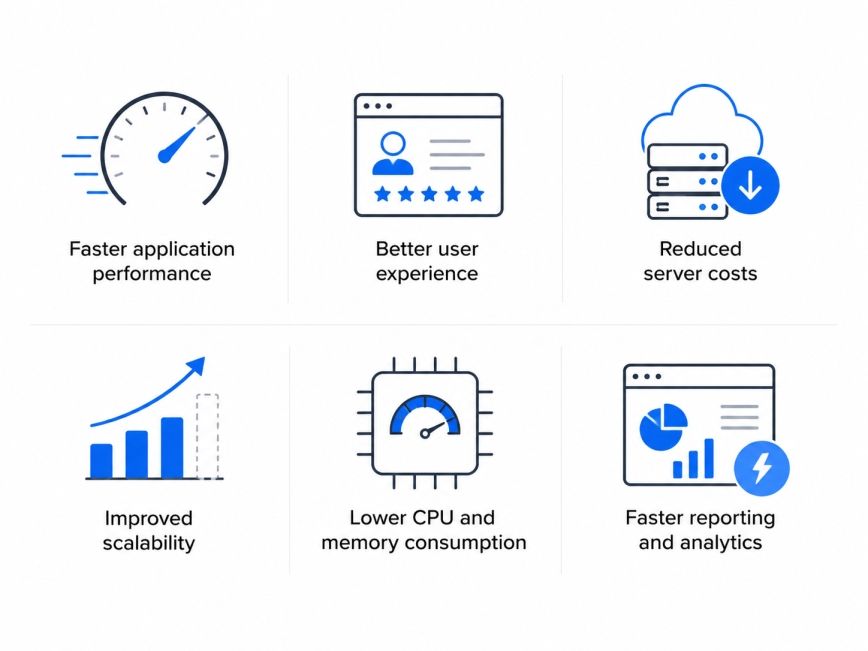
Benefits include:
Database experts often find that slow queries happen because of missing indexes, statistics using SELECT * and putting functions inside WHERE clauses. These are common issues they see behind slow queries.
Many performance issues come from a few recurring mistakes:
Problem |
Impact |
| Missing indexes | Full table scans |
| SELECT * usage | Unnecessary data retrieval |
| Complex joins | Increased processing time |
| Outdated statistics | Poor execution plans |
| Functions in WHERE clauses | Indexes become unusable |
| Large result sets | Higher memory usage |
The optimizer checks out ways to do things and selects the one that it thinks will cost the least. We need to have numbers because they help the optimizer figure out how many rows it is dealing with and pick the best plan to get things done. The optimizer uses these numbers to make choices so the optimizer can do its job well.
This is why SQL query optimization is not only about rewriting SQL statements. It also involves understanding how the database engine thinks.
It uses information such as:
Also Read: Scalar Functions in SQL: Simplify, Reuse, and Optimize Your Code
Free Courses
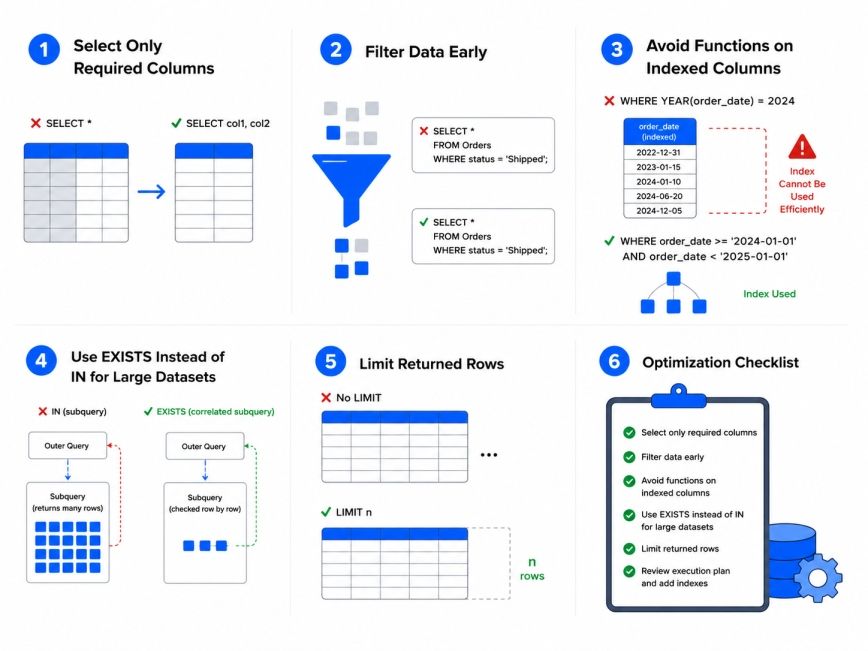
A lot of people who write code want to know how to make their SQL queries work better without having to become super knowledgeable about databases. The good thing is that there are some things you can do that really make a big difference to your SQL query performance.
One of the simplest optimizations is avoiding:
SELECT * FROM Customers;Instead:
SELECT Customer ID, Name
FROM Customers;
Benefits:
Always reduce the number of rows as soon as possible.
Example:
SELECT *
FROM Orders
WHERE Order Date >= '2025-01-01';
Filtering early minimizes processing during joins and sorting operations.
Bad example:
WHERE YEAR(Order Date)=2025
Better example:
WHERE Order Date >= '2025-01-01'
AND Order Date < '2026-01-01'
Functions can prevent indexes from being used effectively.
In some scenarios: EXISTS can outperform: IN. Especially when working with large tables.
If you only need a small sample:
SELECT TOP 100 *
FROM Orders;
or
LIMIT 100;depending on your database system.
Technique |
Benefit |
| Avoid SELECT * | Less data retrieval |
| Use WHERE clauses | Faster filtering |
| Remove unnecessary joins | Lower execution cost |
| Use indexes | Faster lookups |
| Limit result sets | Reduced resource usage |
| Review execution plans | Identify bottlenecks |
Also Read: Scalar Functions in SQL: Simplify, Reuse, and Optimize Your Code
Data Science Courses to upskill
Explore Data Science Courses for Career Progression
IIIT Bangalore
Executive Post Graduate Certificate in Data Science & AIPlacement Assistance
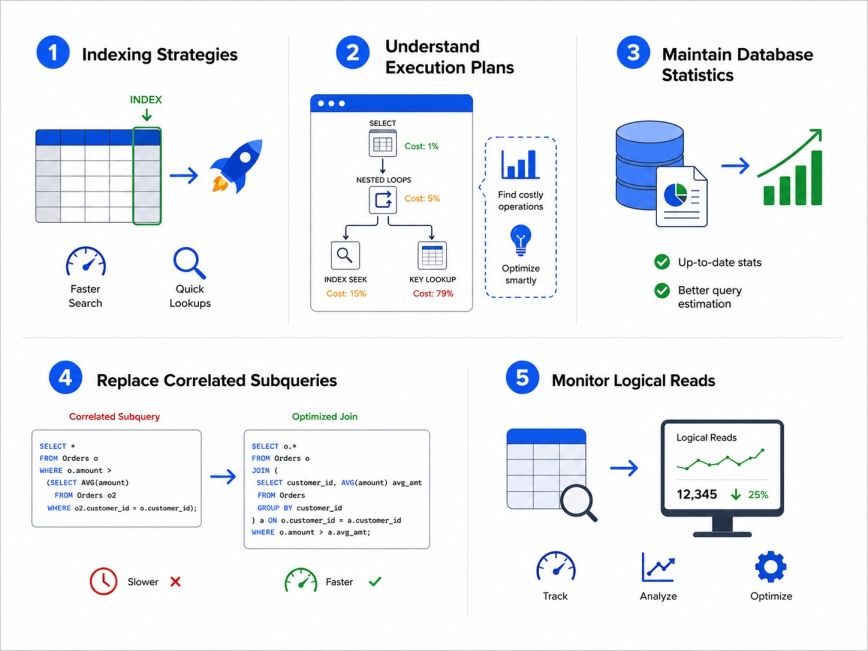
Once basic improvements are covered, it's time to explore advanced SQL query optimization techniques.
Indexes are really good at making things work faster. So, an index is like a list of things you find at the beginning of a book. It is really helpful because it saves you time. You do not have to look through every page to find what you are looking for.
When people do research and work on producing things, they always see that indexes that are missing or not done well are a reason why queries are slow. Indexes are important because they help you find things quickly. Slow queries can be frustrating. That is why good indexes are necessary. Indexes help make things run smoothly.
Common index types:
Index Type |
Use Case |
| Single Column Index | Frequent filtering |
| Composite Index | Multiple search columns |
| Unique Index | Unique values |
| Covering Index | Reduce table lookups |
Execution plans show exactly how a query runs. Execution plans are often the fastest way to identify performance problems.
Look for:
Common indicators:
Indicator |
Meaning |
| Table Scan | Potential optimization needed |
| Index Seek | Usually efficient |
| High-Cost Operator | Investigate further |
| Large Row Estimates | Review statistics |
Several database engines automatically update statistics, but manual maintenance may still be necessary for rapidly changing data. Statistics help the optimizer estimate how many rows a query will return.
When statistics become outdated:
Correlated subqueries can be executed repeatedly. Window functions often perform better because they process data in fewer passes.
Instead of: SELECT ...
consider:
Many experts focus on logical reads rather than execution time alone because timing can vary across environments. Logical reads often provide a more stable measure of query efficiency.
Applying these SQL query optimization techniques consistently can dramatically improve database performance.
Also Read: SQL Window Functions: How They Work and When to Use Them
If you're ready to build end-to-end skills from data engineering and analytics to building intelligent, autonomous AI systems Enroll in Professional Certificate Programme in Data Science & Agentic AI, designed for exactly that.
Modern developers have access to several tools that simplify query analysis and tuning. Whether you're troubleshooting a slow query or learning SQL performance concepts, these tools can help you optimize SQL query online more effectively.
Tool Type |
Purpose |
Examples |
| Query Analyzers | Review execution plans | SQL Server Management Studio (SSMS), MySQL Workbench, pgAdmin |
| Performance Monitors | Track resource usage | SQL Server Profiler, Performance Monitor, MySQL Enterprise Monitor |
| Database Profilers | Identify bottlenecks | SQL Server Profiler, pgBadger, Oracle SQL Trace |
| AI SQL Assistants | Suggest improvements | ChatGPT, GitHub Copilot, Amazon Q Developer |
| Online SQL Editors | Test query performance | DB Fiddle, SQL Fiddle, OneCompiler SQL |
A good optimizer should help you:
Also Read: Top 20 SQL Query Interview Questions & Answers You Must Know!
SQL query optimization is one of the most valuable database skills a developer can learn. Faster queries lead to better application performance, happier users, and lower infrastructure costs. Start with the basics: avoid unnecessary columns, filter data early, use indexes wisely, and review execution plans.
Then move toward advanced SQL query optimization techniques such as indexing strategies, statistics maintenance, and execution plan analysis. The key lesson is simple. Don't guess. Measure. Review execution plans, monitor performance metrics, and make data-driven improvements. Small changes often produce surprisingly large gains.
Want to explore more about SQL query optimization? Book your free 1:1 personal consultation with our expert today.
Start by reviewing the execution plan, identifying table scans, and checking index usage. Remove unnecessary columns, filter records early, and simplify joins where possible. Also monitor query statistics and logical reads. These metrics often reveal inefficiencies that are not obvious from execution time alone.
Use indexed columns in join conditions and ensure related tables have proper primary and foreign key relationships. Avoid joining large datasets before filtering records. Review execution plans to understand join methods such as nested loop, hash join, or merge join. The right indexing strategy can significantly improve join performance.
There is no single best SQL optimizer because optimization capabilities depend on the database system. SQL Server, PostgreSQL, MySQL, and Oracle all have built-in query optimizers. The best approach is to understand how your database optimizer works and use execution plans to guide tuning decisions.
ChatGPT can help identify inefficient patterns, suggest indexing opportunities, rewrite queries, and explain execution plans. It is useful for learning and troubleshooting. However, recommendations should always be validated against actual database performance metrics and production workloads.
Growing datasets, outdated statistics, missing indexes, and changing access patterns are common reasons. A query that performed well initially may struggle as data volume increases. Regular monitoring and maintenance help prevent unexpected performance degradation.
Not always. While indexes often improve performance, excessive indexing can increase storage requirements and slow insert or update operations. The best solution depends on workload patterns and query behavior.
The frequency depends on how often data changes. Databases with heavy transactional activity may require more frequent updates than relatively static systems. Accurate statistics help the optimizer choose better execution plans.
An execution plan is a roadmap showing how a database retrieves data for a query. It includes operations such as scans, seeks, joins, and sorting steps. Execution plans help developers identify performance bottlenecks and optimization opportunities.
Some of the most effective techniques include indexing, filtering data early, avoiding SELECT *, maintaining statistics, and reviewing execution plans. These practices consistently improve performance across most database platforms.
Yes. Many online tools can analyze query structure, suggest improvements, and identify potential inefficiencies. They are useful for learning and preliminary reviews. However, full optimization usually requires access to execution plans and database statistics.
SQL query optimization is the broader process of improving query performance. Query tuning refers to the practical actions taken to improve a specific query. Both concepts work together to deliver faster and more efficient database operations.
730 articles published
Sriram K is a Senior SEO Executive with a B.Tech in Information Technology from Dr. M.G.R. Educational and Research Institute, Chennai. With over a decade of experience in digital marketing, he specia...
Speak with Data Science Expert
By submitting, I accept the T&C and
Privacy Policy
Start Your Career in Data Science Today
Top Resources
Master's Degree
18 Months
Executive Diploma
12 Months
Bootcamp
6 Months