Best SQL Free Online Course with Certification [2026 Guide]
By Rohan Vats
Updated on Sep 18, 2026 | 7 min read | 36.72K+ views
Share:

All courses
Certifications
More
By Rohan Vats
Updated on Sep 18, 2026 | 7 min read | 36.72K+ views
Share:
Table of Contents
Quick Overview:
Take your SQL skills further with upGrad’s Data Science Online Courses. Learn SQL, data analysis, Python, statistics, and other essential skills to prepare for data-focused roles.
Popular Data Science Programs
Finding a quality SQL course can feel challenging, but excellent options are available. These courses are designed for self-paced learning and provide a certificate upon completion. Below are some of the best choices to get you started, beginning with a few comprehensive options from upGrad.
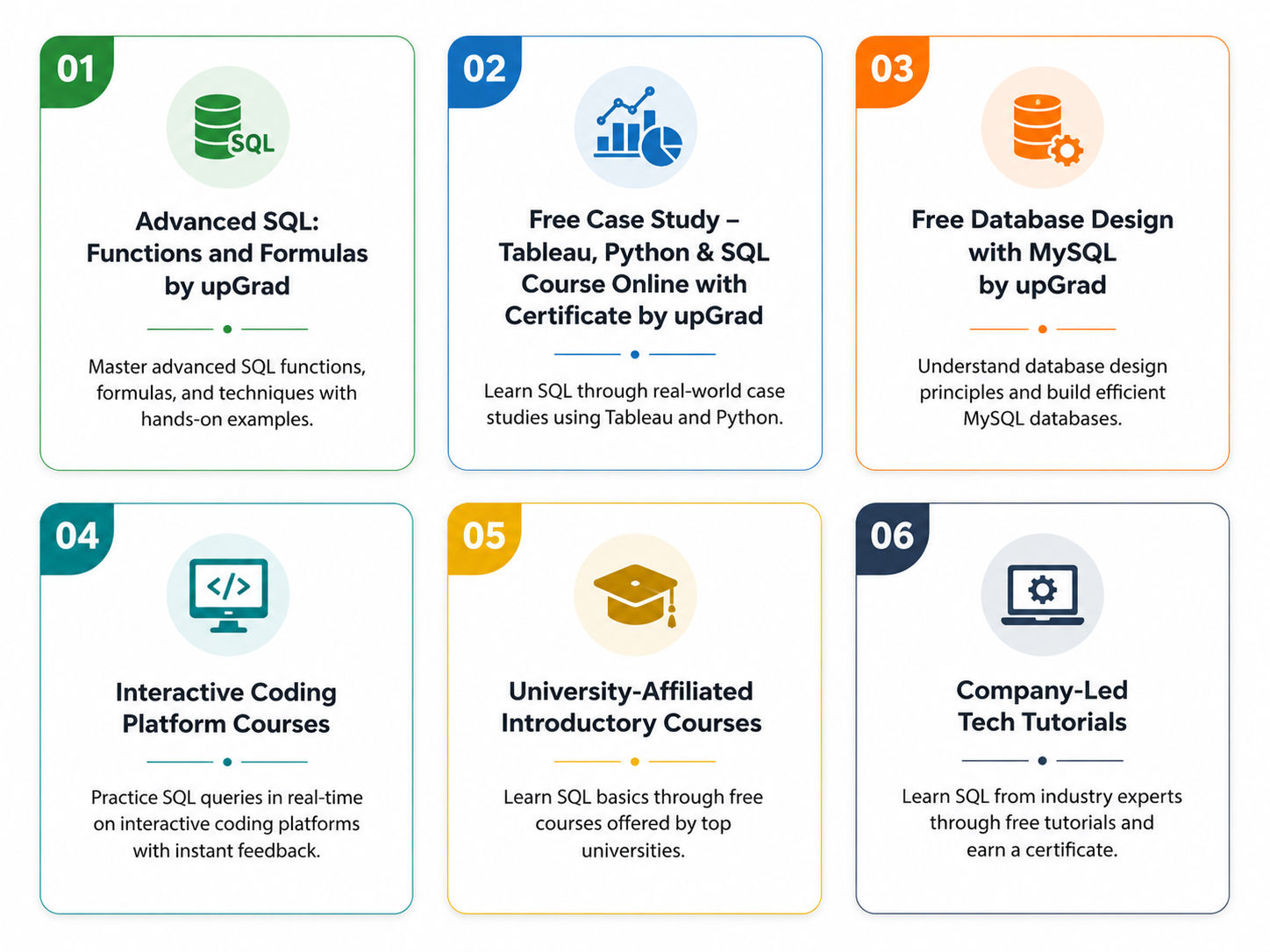
The Advanced SQL: Functions and Formulas course by upGrad is designed for learners who want to go beyond basics and strengthen their SQL expertise. This SQL Free Online Course covers complex functions, optimization, and indexing with practical examples.
Prepare for emerging technology roles with the IIT Delhi - Certificate Programme in Cybersecurity & AI. Develop skills in cybersecurity, AI, threat detection, and data-driven security practices.
This Free Case study-based course by upGrad helps you apply SQL, Python, and Tableau to solve a real-world business churn problem. It’s a practical SQL Free Online Course that combines database querying, analytics, and visualization in one program.
This Free Database Design with MySQL course focuses on building strong foundations in database design and SQL with MySQL. It’s one of the best free online SQL courses for learners who want to understand data modeling and management.
Also Read: Top 20 SQL Query Interview Questions & Answers You Must Know!
Other Free SQL Course Options
Beyond upGrad, many other platforms provide high-quality SQL education. Here are the types of courses you can find.
Several popular learn-to-code websites offer interactive SQL courses. These platforms are known for their hands-on approach. You write real code in a browser-based window and get immediate feedback. They break down learning into small, manageable lessons, making the process engaging. Most offer a certificate after you complete all the modules in a learning path.
Also Read: MySQL Database: What It Is, Features & How It Works
You can often find introductory computer science and data management courses from top universities available for free on large online learning platforms. These courses provide an academic structure, with video lectures, readings, and quizzes. They offer a great theoretical foundation and often end with a certificate of completion.
Major technology companies that develop database systems (like Microsoft, Oracle, or Amazon) often provide free training materials for their specific products. While these courses might focus on a particular SQL dialect, like T-SQL for SQL Server, the fundamental skills you learn are transferable to other systems. Completing these can earn you a badge or certificate directly from the tech giant.
If you’re interested in broader data skills, consider exploring Best Free Data Analysis Courses Online with Certificates to further enhance your data management capabilities.
Free Courses
With several options available, selecting the right course depends on your personal goals and learning style. Finding the best free online SQL course is about finding the one that fits you perfectly. Consider these factors before you enroll.
Why do you want to learn SQL? Your objective is the most important factor.
Also Read: Difference between Data Analysis and Data Analytics
Always review the course curriculum before committing. A comprehensive beginner SQL free online course should cover these core topics:
Also Read: Mastering SQL Aggregate Functions: A Comprehensive Guide
If a course covers these, you can be sure you are building a solid foundation.
You cannot learn SQL by just watching videos. You must write queries. The best courses integrate hands-on learning directly into the curriculum. Look for features like:
For those aiming to strengthen their programming fundamentals, consider upGrad’s Data Structures and Algorithms Course to complement your database expertise and build well-rounded technical skills.
A certificate from a free course is a testament to your initiative and willingness to learn. It shows employers you have taken concrete steps to acquire a new skill. When evaluating a certificate, consider:
You may also read: Is SQL Hard to Learn? Breaking Down the Challenges and Solutions
Data Science Courses to upskill
Explore Data Science Courses for Career Progression
IIIT Bangalore
Executive Post Graduate Certificate in Data Science & AIPlacement Assistance
A well-structured beginner SQL course will take you from knowing nothing about databases to being able to write useful queries that extract valuable information. Here is a breakdown of the key skills you can expect to acquire.
Before writing queries, you need to understand how data is organized.
Want a structured tutorial? Here it is: DBMS Tutorial For Beginners: Everything You Need To Know
This is the heart of SQL. You will spend most of your time learning how to retrieve data.
Also Read: Top 27 SQL Projects With Source Code
Rarely is all the information you need in a single table. JOINs are essential for combining data from multiple tables.
Also Read: Top 50 SQL Interview Questions With Answers: Ace Your Next Data Job!
SQL is powerful for creating summaries and reports directly from the raw data.
Also Read: A Guide to Relationships in SQL: One-to-One, One-to-Many, and Many-to-Many
A free online SQL certification course teaches you the basics of SQL, including writing queries, working with databases, filtering data, and retrieving records. Some courses also offer a certificate after completion.
A free SQL course with certificate can help you build practical database skills through topics such as:
SQL courses online certification free programs usually provide learning materials, exercises, and assessments at no cost. The certificate may be provided after you complete the required lessons or pass an assessment.
You may also read: PL SQL Developer Salary in India: For Freshers & Experienced
Are Free SQL Certificates Recognized?
Free SQL certificates can show that you completed a course and learned specific SQL concepts. Their value depends on the course provider, curriculum, assessment method, and how well you can demonstrate your SQL skills.
SQL is useful for anyone who works with structured data or databases. A PL SQL free online course can also be useful if you want to learn Oracle's procedural extension of SQL.
Follow this SQL learning roadmap to move from database basics to advanced querying and practical data work.
| Stage | What to Learn | Key Topics |
|---|---|---|
| 1. Database Fundamentals | Understand how databases work | Tables, rows, columns, primary keys, foreign keys |
| 2. SQL Basics | Learn essential SQL commands | SELECT, INSERT, UPDATE, DELETE, CREATE, ALTER |
| 3. Filtering & Sorting | Learn to retrieve specific data | WHERE, ORDER BY, DISTINCT, GROUP BY, HAVING |
| 4. SQL Functions | Perform calculations and data manipulation | COUNT(), SUM(), AVG(), string functions, date functions |
| 5. SQL Joins | Work with data across multiple tables | INNER JOIN, LEFT JOIN, RIGHT JOIN, FULL JOIN, Self Join |
| 6. Advanced SQL | Handle complex queries | Subqueries, CTEs, Views, Window Functions, Stored Procedures |
| 7. Practice With Datasets | Apply SQL to practical problems | Sales analysis, customer data, employee data, interview questions |
| 8. Learn PL/SQL | Explore Oracle database programming | Procedures, functions, loops, exception handling |
| 9. Build SQL Projects | Apply your skills to complete projects | Banking database, e-commerce database, employee management system, sales analysis |
Conclusion
Learning SQL through a free online SQL certification course can help you build skills in querying, databases, joins, functions, and data analysis. Choose a course that includes practical exercises and a certificate.
Use the SQL learning roadmap to progress from database basics to advanced queries and projects. A free SQL course with certificate can be a useful starting point for your data career.
No. Most SQL Courses are designed for beginners and don’t require prior coding knowledge. They introduce basic SQL syntax, database concepts, and query building from scratch. Whether you are a student or working professional, you can easily learn SQL and gradually progress toward advanced queries and database management.
MySQL is often recommended as the best SQL for beginners due to its ease of use, wide adoption, and strong community support. PostgreSQL is another solid choice if you want to explore advanced features early. Most SQL Courses start with MySQL, making it the preferred option for beginners.
Yes, SQL is one of the easiest programming languages to self-learn. With an SQL Free Online Course, you can quickly pick up the basics of writing queries, joining tables, and analyzing data. Interactive platforms and hands-on exercises make it possible to learn SQL independently while building real-world projects for practice.
SQL is a language for managing relational databases, while MySQL is a database management system that uses SQL. An SQL Free Online Course usually teaches you SQL syntax first and then applies it using MySQL or PostgreSQL. This way, you gain both theoretical knowledge and practical database management experience.
Yes. After completing an SQL Free Online Course, you can integrate SQL queries with Excel using tools like Microsoft Query or Power Query. This allows you to directly fetch, filter, and join data from databases inside Excel. It enhances your ability to analyze large datasets and generate interactive reports easily.
Yes, employers value SQL certifications from recognized platforms. Completing the Best Free Online SQL Course not only validates your skills but also enhances your resume. While certifications matter, employers also expect you to demonstrate real SQL query writing skills, so combining the certificate with practice projects gives you a strong advantage.
INNER JOIN is generally faster because it only returns matching rows, reducing data load. In SQL Free Online Courses, you’ll often start with INNER JOIN before exploring LEFT JOIN, RIGHT JOIN, and FULL JOIN. Performance depends on proper indexing, database design, and query optimization, all of which are introduced in advanced modules.
Some SQL Free Online Courses cover advanced concepts like indexing, stored procedures, triggers, and query optimization. However, many free beginner-level courses focus on core SQL queries first. If you want in-depth knowledge, you can enroll in the Best Free Online SQL Course that includes both beginner and advanced modules for career growth.
After completing an SQL Course, you’ll receive a certificate that can be added to LinkedIn under the "Licenses & Certifications" section. Many platforms provide a shareable link or digital badge. Highlighting certifications along with SQL projects on GitHub or resumes boosts credibility with recruiters and hiring managers.
Yes, SQL is easier to learn than Python for beginners focusing on databases. SQL syntax is close to plain English, making query writing intuitive. Python, while more versatile, requires deeper programming logic. Many SQL Courses recommend learning SQL first and then using Python for advanced data analysis and automation tasks.
Most free SQL courses don’t provide one-on-one mentorship, but they often include community forums, Q&A sections, or peer discussions. Some platforms like upGrad offer mentorship in premium programs. If you’re using a Best Free Online SQL Course, supplement your learning with forums like Stack Overflow for real-time guidance.
SQL Courses typically use MySQL, PostgreSQL, or SQLite because they are free, open-source, and widely adopted. These databases help learners practice writing SQL queries, building schemas, and managing relational data. Some advanced courses may also introduce Oracle or Microsoft SQL Server for enterprise-level applications.
Yes. The Best Free Online SQL Course often includes hands-on projects like building a student database, employee records system, or sales data dashboard. These practical exercises allow you to apply concepts like joins, subqueries, and indexing while preparing you for real-world database management and data analytics tasks.
Most beginner-level SQL Courses take 2–4 weeks if you study consistently for a few hours per day. Intermediate and advanced courses can take longer, depending on project work. The Free SQL Course with certification might also include assessments, extending the learning duration for skill mastery.
Yes. Many SQL Courses use cloud-based platforms or interactive editors that let you run queries directly in your browser. This eliminates the need for local setup. As you progress, installing MySQL or PostgreSQL locally is recommended for deeper practice and building offline projects.
Completing an SQL Course can open careers in database administration, data analysis, data engineering, and business intelligence. SQL is also essential for backend development and ETL processes. Employers across industries expect candidates to know SQL, making it a foundational skill for multiple data and technology roles.
Indexing is crucial for improving query performance, especially on large datasets. Some SQL Courses briefly introduce indexing, but advanced courses explain concepts like clustered and non-clustered indexes. The Best Free Online SQL Course usually covers indexing in detail, ensuring you understand when and how to use it effectively.
Yes. After completing an SQL Course, you can connect SQL databases to visualization tools like Tableau, Power BI, or Excel. SQL queries allow you to filter and structure data before visualizing trends. Many free SQL courses demonstrate how to integrate SQL with BI tools for interactive reporting.
Some SQL Courses include stored procedures, triggers, and functions in intermediate or advanced sections. These features automate repetitive tasks and improve efficiency in database management. If you want deeper expertise, select the Free SQL Course that provides in-depth training on database programming techniques.
You can continue practicing SQL after an SQL Course by solving queries on platforms like HackerRank, LeetCode, or SQLZoo. Building personal projects, analyzing open datasets, or replicating business scenarios will keep your skills sharp. Consistent practice ensures you apply concepts from the Free Online SQL Course effectively.
418 articles published
Rohan Vats is a Senior Engineering Manager with over a decade of experience in building scalable frontend architectures and leading high-performing engineering teams. Holding a B.Tech in Computer Scie...
Speak with Data Science Expert
By submitting, I accept the T&C and
Privacy Policy
Start Your Career in Data Science Today
Top Resources
Master's Degree
18 Months
Executive Diploma
12 Months
Bootcamp
6 Months