ROAS in Digital Marketing: Formula, Calculation, Examples and Best Practices
By Sriram
Updated on Aug 06, 2026 | 10 min read | 4.37K+ views
Share:

All courses
Certifications
More
By Sriram
Updated on Aug 06, 2026 | 10 min read | 4.37K+ views
Share:
Table of Contents
Key Highlights:
Build your digital marketing skills with a Digital Marketing Course Degree and learn how to use analytics, advertising strategies, and performance metrics like ROAS to create effective campaigns.
ROAS in digital marketing measures how much revenue a business earns from its advertising spend. The ROAS full form in digital marketing is Return on Ad Spend. It helps marketers evaluate whether their paid campaigns are generating valuable returns.
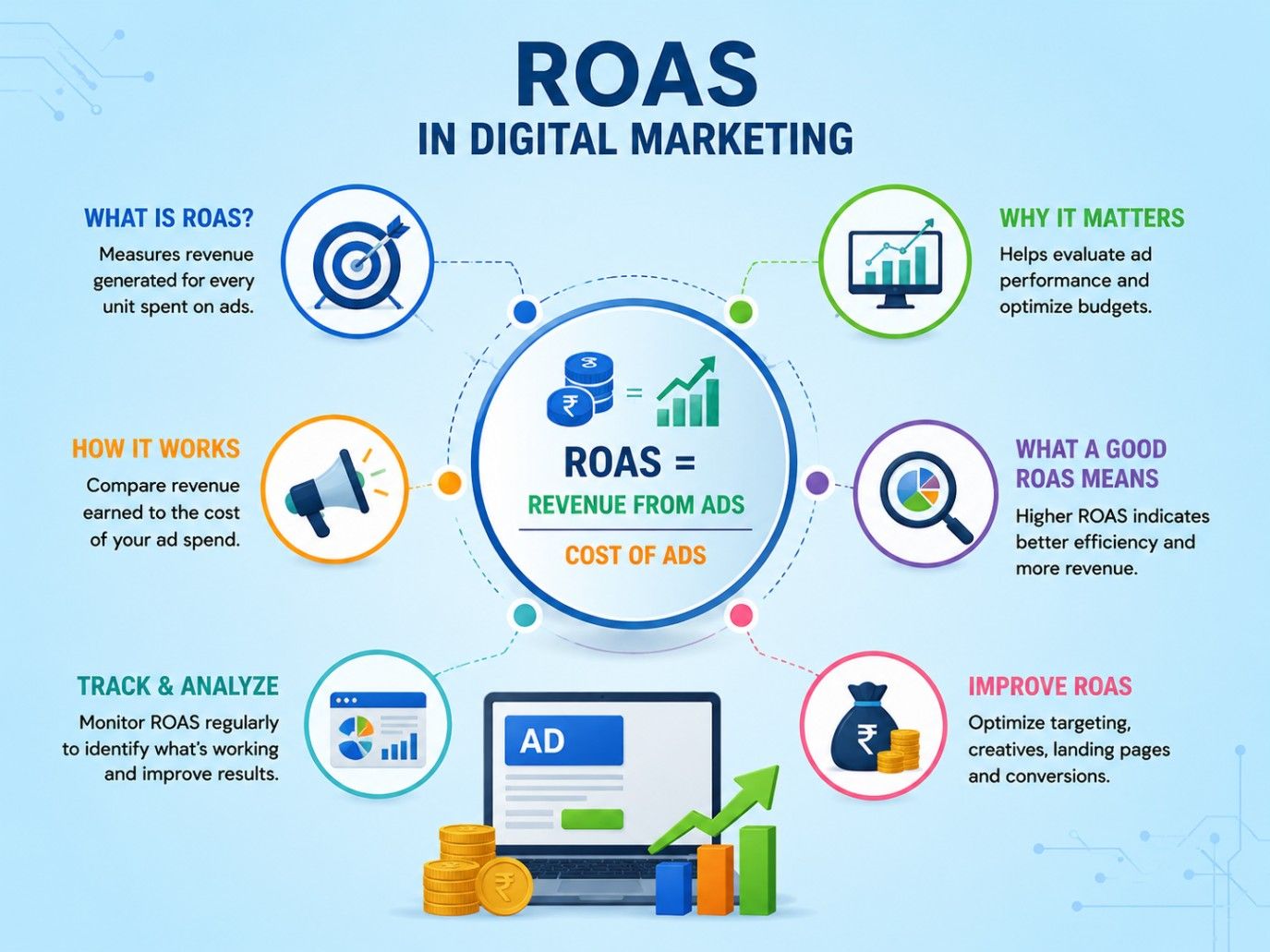
The ROAS full form in digital marketing stands for Return on Ad Spend.
It measures the relationship between:
Unlike general profitability metrics, ROAS focuses only on advertising investment. This allows marketers to evaluate individual campaigns, channels, or ad groups without mixing advertising performance with other business expenses.
Here's a quick overview
Metric |
Meaning |
| Full Form | Return on Ad Spend |
| Purpose | Measures advertising efficiency |
| Formula | Revenue Generated from Advertising ÷ Advertising Cost |
| Used By | Digital marketers, ecommerce businesses, advertisers, agencies |
| Primary Goal | Evaluate campaign performance |
ROAS helps marketers understand which campaigns deserve more investment and which ones need improvement. Without it, advertising decisions often rely on guesswork rather than measurable results.
Businesses commonly use ROAS to:
Imagine running two advertising campaigns with the same budget. One campaign generates twice the revenue of the other. ROAS quickly highlights the better-performing campaign, allowing marketers to shift budgets toward higher returns instead of continuing to spend equally on both.
That's one reason ROAS in digital marketing remains a key performance metric across industries.
The formula is simple.
ROAS = Revenue Generated from Advertising ÷ Advertising Cost
Suppose an online store spends ₹50,000 on paid advertising and earns ₹2,50,000 in sales directly from those campaigns.
ROAS = ₹2,50,000 ÷ ₹50,000 = 5
The campaign generated five times the advertising investment.
Many marketers express this as 5:1, meaning every ₹1 spent on ads produced ₹5 in revenue.
Although the formula is straightforward, the accuracy of ROAS depends on reliable tracking. Missing conversions, incorrect attribution, or incomplete revenue data can produce misleading results.
Understanding a ROAS value helps marketers decide whether their advertising campaigns are performing well. The number becomes meaningful only when compared with campaign goals, profit margins, and overall business objectives.
For example,
ROAS |
Interpretation |
Less than 1 |
Advertising spends more than it earns. |
2 |
Every ₹1 spent generates ₹2 in revenue. |
4 |
Often considered a healthy benchmark for many businesses, though it varies by industry. |
8 or higher |
Indicates strong advertising efficiency if profit margins remain healthy. |
A higher ROAS usually signals better advertising performance. Still, it doesn't automatically mean the business is making a profit.
Let's look at a simple scenario. A fashion retailer launches an advertising campaign before a seasonal sale.
Using the formula:
ROAS = ₹1,50,000 ÷ ₹30,000 = 5
This means every ₹1 invested in advertising generated ₹5 in revenue.
Now consider another campaign.
The ROAS is 2.
Although both campaigns generated sales, the first campaign delivered a much stronger return. This simple comparison helps marketers decide which campaign deserves additional investment and which one needs optimization.
By understanding what is ROAS in digital marketing and applying the calculation consistently, businesses can make more informed advertising decisions instead of relying on assumptions.
Want to make smarter marketing decisions backed by data? The Certificate Programme in General Management for Young Leaders (YLP) from IIMB helps you build strong business, marketing, and analytical skills to evaluate campaign performance and drive better business outcomes.
Free Courses
Calculating ROAS is simple when you have two numbers: your advertising cost and the revenue generated from your ads. Understanding what ROAS in digital marketing is also means knowing how to measure it accurately so you can evaluate campaign performance and make better marketing decisions.
The ROAS formula is:
ROAS = Revenue Generated from Advertising ÷ Advertising Cost
Here are the components considered while calculating ROAS
| Component | Description |
| Revenue Generated | Sales attributed to advertising |
| Advertising Cost | Total amount spent on ads |
| Formula | Revenue ÷ Advertising Cost |
Step-by-Step Calculation
Follow these simple steps:
ROAS Calculation Example
Suppose an online store spends ₹50,000 on advertising and generates ₹2,50,000 in sales.
ROAS = ₹2,50,000 ÷ ₹50,000 = 5
This means the campaign generated ₹5 in revenue for every ₹1 spent on advertising.
Avoid these common mistakes when calculating ROAS:
A correct calculation gives you a reliable ROAS value. The next step is understanding whether that ROAS is good enough for your business.
Also read : Starting A Career In Digital Marketing: All You Need To Know
Digital Marketing Courses to upskill
Explore Digital Marketing Courses for Career Progression
MICA Executive Alumni Status
A good ROAS depends on your business goals, profit margins, industry, and advertising strategy. There isn't one fixed number that works for every company. A campaign generating a ROAS of 3 might be successful for one business, while another business may need a higher ROAS to remain profitable.
When evaluating ROAS in digital marketing, businesses should look beyond revenue alone. The cost of products, operating expenses, customer retention, and campaign objectives all influence whether a ROAS result is considered effective.
Many marketers consider a ROAS between 3:1 and 5:1 to be a strong benchmark. This means the campaign generates ₹3 to ₹5 in revenue for every ₹1 spent on advertising.
However, these numbers are not universal. New brands may accept a lower ROAS while building awareness and acquiring customers. Established businesses with higher margins may aim for a much stronger return.
| ROAS Value | Meaning |
| Below 1:1 | Campaign generates less revenue than ad spend |
| 2:1 | Generates ₹2 for every ₹1 spent |
| 3:1 to 5:1 | Often considered a healthy range |
| Above 5:1 | Indicates strong campaign efficiency |
Different industries have different ROAS goals because their pricing, margins, and customer behavior vary.
| Industry | Expected ROAS Consideration |
| Ecommerce | Often focuses on product margins and repeat purchases |
| SaaS | May accept lower short-term ROAS due to recurring revenue |
| Lead Generation | Measures lead quality along with conversion value |
| Retail | Often targets consistent revenue growth |
Several factors determine whether your ROAS is strong or needs improvement.
Key factors include:
A company spending ₹1 lakh on ads and earning ₹5 lakh in revenue has a ROAS of 5. But if the cost of goods and operations consumes most of that revenue, the actual profit may be limited.
That is why marketers don't look at ROAS alone. They compare it with other metrics like ROI, CPA, and customer lifetime value to understand the complete picture.
Understanding what is ROAS in digital marketing means knowing that a good ROAS is not just a high number. It is a return that supports your business objectives and advertising goals.
Also read: ROI in Digital Marketing: What It Means and How to Actually Calculate It
Advertising decisions need clear measurement. Without tracking results, businesses may continue spending money on campaigns that don't generate enough value.
ROAS in digital marketing helps marketers understand whether their advertising investment is producing the expected revenue. It connects ad spending with actual business outcomes, making it easier to identify successful campaigns and areas that need improvement.
ROAS gives a quick view of how efficiently an advertising campaign generates revenue.
A campaign with strong ROAS shows that the money spent on ads is creating valuable returns. A low ROAS may indicate issues with targeting, messaging, conversion rates, or customer experience.
For example, if two campaigns have the same budget but different ROAS values, marketers can identify which campaign is delivering better results and adjust their strategy accordingly.
Marketing budgets are limited. Businesses need to decide where their money should go.
ROAS helps marketers compare campaigns and allocate more budget to ads that generate better returns.
It helps answer questions like:
Instead of spreading budgets equally, businesses can focus spending on campaigns with stronger performance.
ROAS provides insights that help improve campaigns over time.
Marketers can analyze performance data and make changes to:
Small improvements in these areas can increase revenue without increasing advertising costs.
Also read: Digital Growth Marketing: A Complete Guide to Scaling Businesses in the Digital Age
Marketing decisions become more reliable when they are based on measurable results.
ROAS helps businesses move away from assumptions and understand what is actually working. By monitoring performance regularly, marketers can make informed decisions about scaling campaigns, testing new approaches, or reducing spending on underperforming ads.
A business may run campaigns on search engines, social media platforms, and display networks. ROAS helps compare these channels and identify which ones generate better returns.
For example, if search ads generate a ROAS of 6 while display ads generate a ROAS of 2, the business can review whether increasing investment in search advertising makes sense.
ROAS does not replace every marketing metric, but it gives marketers a clear view of advertising efficiency. When combined with other performance indicators, it becomes a useful tool for improving campaign decisions.
Read: Best Digital Marketing Ads: Top Campaigns That Nailed Online Engagement
Subscribe to upGrad's Newsletter
Join thousands of learners who receive useful tips
ROAS and ROI are both important metrics used to measure business performance, but they answer different questions.
ROAS in digital marketing focuses specifically on advertising performance. It tells marketers how much revenue they generate from their ad spend. ROI looks at the bigger picture by measuring the overall profitability of an investment after considering all related costs.
Understanding the difference helps businesses choose the right metric for different decisions.
Feature |
ROAS |
ROI |
| Meaning | Return on Ad Spend | Return on Investment |
| Focus | Advertising performance | Overall investment profitability |
| Formula | Revenue from Ads ÷ Advertising Cost | (Profit ÷ Investment Cost) × 100 |
| Measures | Revenue generated from ads | Profit after expenses |
| Used For | Evaluating campaigns and ad channels | Evaluating overall business investments |
ROAS measures how effectively advertising money generates revenue. It only considers advertising costs and the revenue directly linked to those ads.
ROI measures the overall return from an investment after accounting for expenses. It includes costs beyond advertising, such as production, operations, and other business expenses.
The ROAS formula is:
ROAS = Revenue Generated from Advertising ÷ Advertising Cost
ROI formula:
ROI = (Net Profit ÷ Investment Cost) × 100
Both formulas are useful, but they provide different insights.
ROAS has a narrower focus. It helps marketers understand which campaigns are performing well.
ROI has a broader scope. It helps business owners evaluate whether an entire investment is financially worthwhile.
For example, a campaign may generate a high ROAS but still have a low ROI if product costs and operational expenses reduce overall profit.
Businesses use ROAS when they want to improve advertising performance, compare campaigns, or decide where to increase ad spending.
ROI is useful for larger financial decisions, such as evaluating new products, business expansions, or long-term investments.
Suppose a company spends ₹50,000 on ads and generates ₹2,50,000 in sales.
ROAS: ₹2,50,000 ÷ ₹50,000 = 5
The campaign generated ₹5 in revenue for every ₹1 spent on advertising.
However, after considering product costs, salaries, and other expenses, the actual profit may be much lower. ROI provides that broader profitability view.
Must read: How Much Should I Budget For Digital Marketing?
Several factors influence ROAS beyond advertising spend. Understanding these elements helps marketers identify what is working and where campaigns need improvement.
Factor |
How It Affects ROAS |
| Audience Targeting | Reaching the right audience increases the chances of conversions. Poor targeting can waste ad spend on users who are unlikely to purchase. |
| Ad Creative Quality | Clear messaging, attractive visuals, and strong calls-to-action can improve engagement and conversions. |
| Landing Page Experience | A slow or confusing landing page can reduce conversions even when ads generate clicks. |
| Conversion Rate | More conversions from the same number of visitors can increase revenue and improve ROAS. |
| Customer Lifetime Value | Repeat purchases increase customer value and can make a lower initial ROAS more profitable. |
| Bidding Strategy | The right bidding approach helps control advertising costs while reaching valuable customers. |
| Attribution Model | Accurate attribution helps identify which campaigns and channels are actually driving revenue. |
Improving these areas can help businesses get better returns from their advertising investment. When measuring ROAS in digital marketing, it's important to analyze these factors instead of looking only at the final number.
Improving ROAS means getting more revenue from your advertising spend. Businesses can improve campaign performance by optimizing different parts of the customer journey, from targeting to conversions.
Strategy |
How It Improves ROAS |
| Refine Audience Targeting | Reaches users who are more likely to convert and reduces wasted ad spend. |
| Optimize Ad Creatives | Better headlines, visuals, and offers improve engagement and conversions. |
| Improve Landing Pages | Faster pages and simple checkout processes help convert more visitors. |
| Increase Conversion Rates | More conversions from the same traffic can improve revenue returns. |
| Test Ad Formats | Comparing search, video, display, and social ads helps find better-performing options. |
| Use A/B Testing | Identifies which ads, messages, or pages deliver better results. |
| Optimize Bidding | Helps control costs while reaching valuable customers. |
| Reduce CPA | Lower acquisition costs can improve overall campaign efficiency. |
Consistent testing and optimization help businesses achieve better ROAS in digital marketing without simply increasing their advertising budget.
Also read: High Converting Landing Pages to Ace the Marketing Game
ROAS can be measured across different advertising channels to understand which platforms generate better returns. Each channel has different audiences, costs, and conversion patterns, so businesses should compare results based on their campaign goals.
Google Ads is commonly used to measure ROAS because users often search with strong purchase intent.
For example:
ROAS = ₹2,50,000 ÷ ₹50,000 = 5
This means the campaign generated ₹5 for every ₹1 spent on Google Ads.
Meta Ads help businesses reach users based on interests, behavior, and demographics.
ROAS tracking helps marketers understand whether campaigns on Facebook and Instagram are generating sales, leads, or other valuable actions.
Example:
ROAS = ₹90,000 ÷ ₹30,000 = 3
The campaign generated ₹3 for every ₹1 spent.
LinkedIn Ads are often used for B2B marketing, where conversions may include demo requests, registrations, or qualified leads.
Businesses usually evaluate ROAS along with lead quality and customer value because B2B sales cycles are often longer.
YouTube Ads can support both brand awareness and direct conversions.
ROAS tracking helps businesses understand whether video campaigns are generating measurable revenue after users interact with the ads.
Amazon Ads are widely used by ecommerce sellers to increase product visibility and sales.
ROAS helps sellers identify which products and campaigns generate the highest returns and where advertising budgets should be adjusted.
Different platforms may produce different ROAS results because audience intent, competition, and advertising costs vary. Businesses should compare ROAS based on campaign objectives rather than expecting every channel to deliver the same return.
Do read: Everything You Need to Know About Performance Marketing
ROAS calculation is simple, but incorrect tracking can create inaccurate results. Avoid these common mistakes to measure campaign performance correctly.
Accurate ROAS tracking helps businesses make better advertising decisions and improve campaign performance.
Do read: Digital Marketing Objectives: Full Guide with Types and Examples [2026]
Tracking ROAS accurately helps businesses understand campaign performance and make better advertising decisions.
Also read: High Converting Landing Pages to Ace the Marketing Game
Different tools help marketers track advertising spend, conversions, and revenue generated from campaigns. Choosing the right tool depends on the advertising platform and business requirements.
Tool |
How It Helps Measure ROAS |
| Google Ads | Tracks conversion value, ad spend, and campaign performance for search, display, and shopping ads. |
| Google Analytics 4 | Measures website conversions, revenue sources, customer journeys, and campaign performance after ad clicks. |
| Meta Ads Manager | Tracks Facebook and Instagram ad spend, purchases, conversion value, and audience performance. |
| Microsoft Advertising | Measures conversions, revenue, and campaign results from ads running on Microsoft networks. |
| HubSpot | Connects marketing campaigns with customer data to track leads, revenue impact, and acquisition costs. |
| Shopify Analytics | Helps ecommerce businesses monitor orders, sales revenue, product performance, and marketing channel results. |
Using these tools helps businesses measure ROAS in digital marketing more accurately and identify campaigns that generate better returns.
ROAS in digital marketing helps businesses measure how effectively their advertising spend generates revenue. Understanding the ROAS full form in digital marketing, calculation method, and factors affecting performance allows marketers to optimize campaigns and make smarter budget decisions.
However, ROAS should not be analyzed alone. Combining it with metrics like ROI, CPA, and conversion rate gives a clearer view of profitability. Accurate tracking and continuous optimization help businesses improve advertising performance over time.
Ready to start your journey? Book a free consultation with upGrad today to find the best path for your career.
ROAS in digital marketing measures how much revenue an advertising campaign generates compared to the amount spent on ads. Marketers track it to understand campaign efficiency, compare advertising channels, and decide where budget should be invested for better returns.
ROAS is calculated by dividing the revenue generated from advertising by the total advertising cost. The formula is Revenue Generated from Ads ÷ Advertising Cost. For example, if an ad campaign generates ₹1,00,000 revenue from ₹20,000 spend, the ROAS is 5.
A 2.5 ROAS means that a campaign generated ₹2.50 in revenue for every ₹1 spent on advertising. Whether this result is good depends on factors like profit margins, product costs, industry standards, and the overall business objective behind the campaign.
Businesses set a target ROAS based on profit margins, advertising costs, industry benchmarks, and campaign goals. A target that works for one company may not work for another. Marketers usually analyze past campaign data and business profitability before setting a realistic ROAS goal.
A ROAS of 20 indicates very high revenue compared to advertising spend, but it does not always mean maximum profitability. Extremely high ROAS can sometimes happen with small campaigns, repeat customers, or limited spending, so businesses should analyze the overall impact before scaling.
The 3-3-3 rule in marketing is a framework that suggests marketers should focus on reaching the right audience, delivering the right message, and creating consistent engagement. While it is not a direct ROAS formula, it can support better campaign performance through improved targeting and communication.
ROAS measures revenue generated from advertising spend, while profit margin shows how much money remains after covering costs. A campaign can have a high ROAS but lower profit if product costs, operations, or discounts reduce the final earnings.
Yes, a campaign with lower ROAS can still support business goals. New customer acquisition, brand building, entering a new market, or increasing future purchases may justify a lower short-term return when the long-term customer value is high.
Businesses should monitor ROAS regularly based on campaign activity, budget size, and advertising goals. Daily checks may help identify sudden changes, while weekly or monthly analysis can provide better insights for optimization and long-term decision-making.
ROAS should be reviewed with other metrics such as conversion rate, CPA, ROI, customer lifetime value, and average order value. These metrics help marketers understand whether advertising revenue is translating into sustainable business growth rather than only measuring short-term sales.
No, the ROAS full form in digital marketing remains Return on Ad Spend across platforms like Google Ads, Meta Ads, Amazon Ads, and other advertising channels. The calculation stays the same, but reporting methods and attribution models may differ between platforms.
727 articles published
Sriram K is a Senior SEO Executive with a B.Tech in Information Technology from Dr. M.G.R. Educational and Research Institute, Chennai. With over a decade of experience in digital marketing, he specia...
Get Free Consultation
By submitting, I accept the T&C and
Privacy Policy
Level Up Your Digital Marketing Career Today!
Top Resources
MICA
Advanced Certificate in AI-Powered Digital Marketing & Communication from MICAMICA Executive Alumni Status
Certification
5 Specialisation
Classroom
4 Months
Certification
2 Months