Quality Score in Google Ads: Guide for Beginners
By upGrad
Updated on Jun 18, 2026 | 7 min read | 2.37K+ views
Share:

All courses
Certifications
More
By upGrad
Updated on Jun 18, 2026 | 7 min read | 2.37K+ views
Share:
Table of Contents
This is important because it shows how relevant Google thinks your ads are. It also helps you find ways to make your campaigns better. Many advertisers only think about how they are paying for ads and their budget. Quality scores can tell you why some keywords work better than others.
In this guide, you’ll learn what quality score is in Google Ads, how Google figures it out, and why it is important. You will also learn how to check your quality score and ways to improve it.
Want to make every ad dollar work harder? Explore upGrad's Online Digital Marketing Courses and master the strategies behind metrics like Quality Score, CTR, and campaign optimization.
Understanding Quality Score is the first step to improving your campaigns. Google assigns this 1-10 grade per keyword to show how your ads, keywords, and landing pages compare to competitors targeting similar audiences.
How Google Calculates Quality Score
Factor |
What It Measures |
| Expected Click-Through Rate (CTR) | How likely people are to click your ad when it's shown |
| Ad Relevance | How closely your ad matches the intent behind the search |
| Landing Page Experience | How relevant and useful your landing page is to users who click |
A higher score signals that your ads are seen as more useful and relevant than competing ads targeting the same keywords.
Read: The Ultimate Digital Marketing Statistics You Need to Know for 2025
A keyword that scores 8 or 9 is more likely to meet user experience than one that scores 3 or 4.
Score |
Meaning |
| 1-3 | Poor |
| 4-6 | Average |
| 7-8 | Good |
| 9-10 | Excellent |
Google wants people to find the answers they need. If the ads that show up are always relevant to what people are looking for and they land to websites that are actually helpful, then people will consider Google Search.
Google uses the Quality Score to help advertisers understand if their ads are meeting the expectations of users and if their ads are leading to landing pages on Google.
Google evaluates three factors:
Component |
What It Measures |
| Expected CTR | Likelihood users will click your ad |
| Ad Relevance | Match between keyword and ad copy |
| Landing Page Experience | Relevance and usability of the landing page |
Each factor receives a status:
These ratings help identify which area needs improvement.
Imagine someone searching for an "online digital marketing course."
Ad A
Ad B
Ad A will probably get a Quality Score. This is because it matches what people are searching for closely.
Some people think that Quality Score decides where your ad will show up. That's not entirely true. Google says the score you see which ranges from 1 to 10 is mostly, for helping you understand what's going on. It's not exactly what Google uses to figure out where to show your ad during an auction.
Also Read: A 7-Step Guide to Google Advertising
Free Courses
Many advertisers wonder if they need to worry about Quality Score in Google Ads when they are already getting conversions.
The truth is you should care about Quality Score. This is because it often affects how efficient your Google Ads campaigns are, helps you get more out from your ad spend. And impact ad positioning.
Also Read: Marketing Vs Advertising – Which is More Effective?
The Quality Score is important because it helps us make our campaign work well for our business, even though it is not a KPI by itself.
A strong score can help:
A higher-quality ad experience often allows advertisers to compete more effectively without simply increasing bids.
Consider two advertisers targeting the same keyword.
Advertiser |
Quality Score |
CPC Efficiency |
| Advertiser A | 9/10 | More efficient |
| Advertiser B | 4/10 | Less efficient |
One overlooked benefit is user satisfaction.
When ads closely match search intent:
Also Read: Best Digital Marketing Ads: Top Campaigns That Nailed Online Engagement
Digital Marketing Courses to upskill
Explore Digital Marketing Courses for Career Progression
MICA Executive Alumni Status
Many accounts struggle because of avoidable issues:
An important nuance often missed by beginners: A campaign can do well with conversions even if its Quality Score is just moderate.
Experienced pay per click, managers believe that the performance of conversions is what they should focus on, and Quality Score is just a tool to help them understand their campaign.
The best approach is balancing:
Also Read: What is PPC in Digital Marketing & How to use it?
A lot of marketers know what quality scores are in Google Ads. They have a hard time figuring out how to see the quality score in Google Ads when they are using the platform.
Luckily, Google has made it really easy to do this.
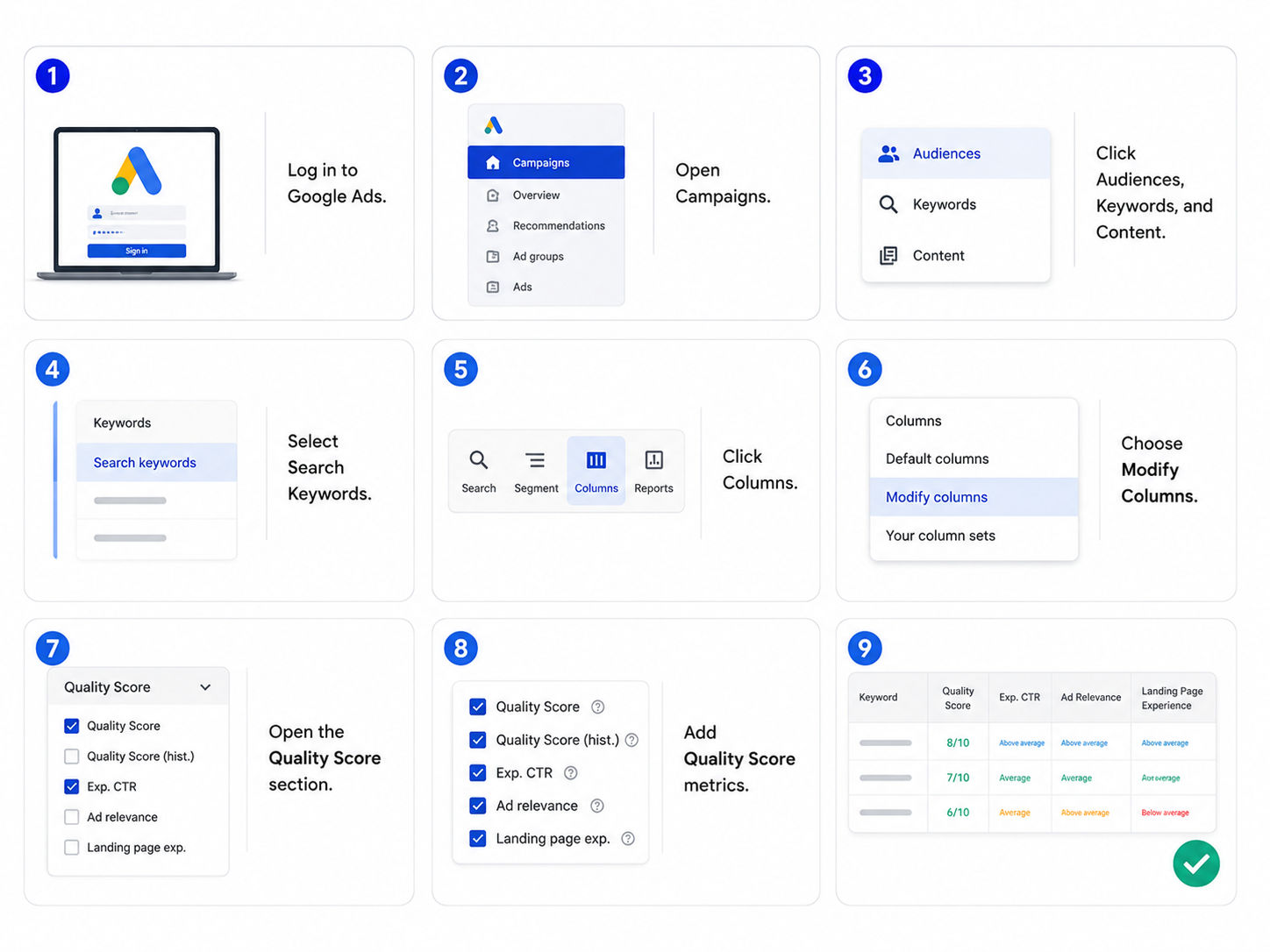
To check your quality score, in Google Ads do this:
Google allows advertisers to view
Metric |
Why It Matters |
| Quality Score | Overall diagnostic score |
| Expected CTR | Measures click likelihood |
| Ad Relevance | Evaluates keyword alignment |
| Landing Page Experience | Assesses page usefulness |
Google uses three labels:
Rating |
Interpretation |
| Above Average | Strong performance |
| Average | Acceptable |
| Below Average | Needs improvement |
Checking your Quality Score often can be a distraction. This is because it needs data to show changes that actually matter. If you check it all the time you will see a lot of changes that do not really mean anything.
For active campaigns:
Sometimes Google displays "—" rather than a score.
This usually happens when:
Google needs enough keyword-level activity before assigning a score.
Subscribe to upGrad's Newsletter
Join thousands of learners who receive useful tips
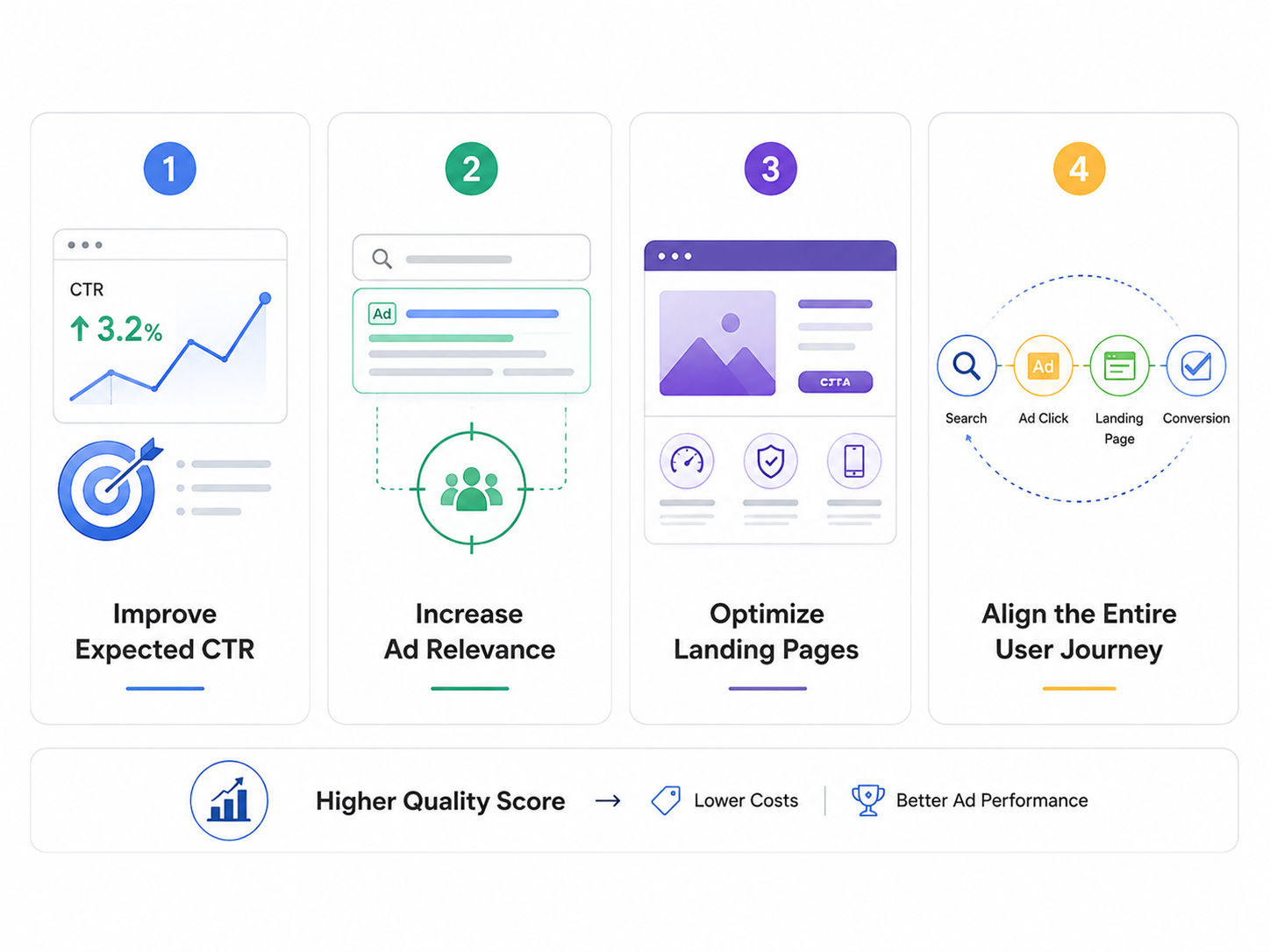
Improving the quality score in Google Ads is not really about tricks. It is more about making sure that the things you show to people are relevant to what they want.
The best way to make your quality score in Google Ads better is to make things easier and more useful for people who use Google Ads. This means creating an experience for Google Ads users.
Expected CTR measures the likelihood of a click.
Ways to improve it:
Example:
Instead of: "Marketing Training Program"
Try: "Online Digital Marketing Course with Certification"
The second version provides more context and relevance.
Google wants ads that closely match search intent.
Best practices:
The landing page experience is often the chance to grab attention.
Focus on:
One useful principle:
Keyword → Ad → Landing Page
Everything should feel connected.
Stage |
Example |
| Keyword | Online MBA |
| Ad | Online MBA Program Admission Open |
| Landing Page | Dedicated MBA Program Page |
The smoother a journey is the better the users’ experience.
Also Read: Retargeting Ads: A Complete Beginner’s Guide
A lot of people who have experience in advertising states that making sure the landing page is alignment and relevant is really important.
The best thing to do is not to chase a perfect 10/10 score. Instead, making every interaction on the landing page better for the users.
Understanding quality scores in Google Ads helps advertisers create better campaigns, stronger user experiences, and more efficient advertising strategies. Now if you know “what is quality score in Google Ads,” the three factors behind it, how to check quality score in Google Ads, and practical ways to improve it.
Rather than treating Quality Score as a vanity metric, use it as a diagnostic tool that highlights areas needing attention. The advertisers who consistently achieve strong results are not necessarily those with the highest bids. They are the ones who build relevant ads, organize keywords effectively, and deliver landing pages that genuinely help users find what they are looking for.
Want to explore more about quality scores in Google Ads? Book your free 1:1 personal consultation with our expert today.
Yes. While the visible Quality Score itself is a diagnostic metric, ad quality signals influence auction performance. Better relevance, expected CTR, and landing page experience can help improve competitiveness and campaign efficiency.
A score between 7 and 10 is generally considered strong. Scores in this range indicate that Google views the keyword, ad, and landing page experience as highly relevant compared with competitors targeting similar searches.
Not always. Google requires enough historical performance data before assigning a score. New keywords may temporarily display no Quality Score until sufficient impressions and engagement are collected.
It can contribute positively. Faster pages create a better user experience, particularly on mobile devices. Since landing page experience is a core Quality Score factor, performance improvements may support better ratings over time.
Quality Score is primarily associated with Search campaigns. Google provides keyword-level Quality Score diagnostics within Search campaigns where relevance, CTR expectations, and landing page experience can be evaluated.
Most advertisers benefit from weekly or monthly reviews. Frequent monitoring helps identify declining keyword performance, but daily checks are usually unnecessary because meaningful changes often require more data.
The highest score is 10 out of 10. Achieving this means Google considers the keyword, ad relevance, expected CTR, and landing page experience exceptionally strong compared to competitors.
Higher-quality experiences often improve efficiency. Better relevance and user engagement can help advertisers compete more effectively, which may contribute to stronger performance relative to ad spend.
Quality Score considers more than clicks. A keyword may have a strong CTR but still suffer from weak landing page experience or ad relevance. Reviewing all component ratings provides better insight.
No. Google generally retains historical Quality Score information for paused keywords. However, active keywords provide the most useful and current diagnostic insights for optimization decisions.
As AI-powered search experiences become more common, relevance remains critical. Advertisers who align keyword intent, ad messaging, and landing page content are more likely to create experiences that perform well across evolving search environments.
1011 articles published
We are an online education platform providing industry-relevant programs for professionals, designed and delivered in collaboration with world-class faculty and businesses. Merging the latest technolo...
Get Free Consultation
By submitting, I accept the T&C and
Privacy Policy
Level Up Your Digital Marketing Career Today!
Top Resources
MICA
Advanced Certificate in AI-Powered Digital Marketing & Communication from MICAMICA Executive Alumni Status
Certification
5 Specialisation
Classroom
4 Months
Certification
2 Months