Push vs Pull Marketing: Differences, Strategies & Examples
By Sriram
Updated on Jul 01, 2026 | 7 min read | 4.45K+ views
Share:

All courses
Certifications
More
By Sriram
Updated on Jul 01, 2026 | 7 min read | 4.45K+ views
Share:
Table of Contents
Push vs pull marketing involves two approaches to reaching customers. Push marketing promotes products by delivering messages directly through advertisements, emails, and sales promotions, while pull marketing attracts customers with valuable content, SEO, and engaging experiences that encourage them to discover the brand. Together, these strategies help businesses balance immediate visibility with long-term customer trust and sustainable growth.
In this blog, you'll learn the push vs pull marketing differences, understand how each strategy works, explore practical push vs pull marketing examples, and discover how to build a successful push vs pull marketing strategy for your business.
Learn how to combine push and pull marketing strategies to attract, engage, and convert customers. Discover upGrad's Digital Marketing courses and gain practical skills for today's competitive marketing landscape.
Understanding the push vs pull marketing differences helps businesses select the right promotional strategy based on their goals, audience behavior, and product lifecycle.
Feature |
Push Marketing |
Pull Marketing |
| Primary Goal | Promote products directly to customers | Attract customers through valuable content and brand awareness |
| Approach | Business initiates communication | Customer initiates interaction |
| Focus | Immediate visibility and sales | Long-term trust and customer relationships |
| Target Audience | Broad or predefined audience segments | Customers actively searching for information or solutions |
| Marketing Channels | email marketing, sales calls, retail promotions, trade shows |
SEO, blogs, social media, videos, webinars, podcasts, organic search |
| Customer Intent | May not be actively looking for the product | Usually has existing interest or purchase intent |
| Cost Structure | Often requires continuous advertising spend | Higher initial investment but can generate long-term organic traffic |
| Time to Results | Faster results | Gradual but sustainable growth |
| Brand Awareness | Builds awareness through repeated exposure | Builds awareness through educational and engaging content |
| Examples | TV ads, Google Ads, cold emails, in-store promotions | SEO articles, YouTube tutorials, case studies, organic social media content |
Also Read: Branding: When’s the Right Time to Start
Free Courses
Businesses use different marketing approaches depending on their goals, target audience, and the stage of the customer journey.
The two most common strategies are push marketing and pull marketing, each serving a distinct purpose in attracting and converting customers.
Push marketing is a strategy where businesses actively promote their products or services to potential customers. It uses channels such as paid advertisements, email campaigns, direct sales, retail promotions, and trade shows to generate immediate awareness and encourage quick purchases.
Pull marketing is a strategy that attracts customers by providing valuable content and building brand awareness. Businesses use SEO, blogs, videos, social media, webinars, and other educational resources to encourage customers to discover their brand when searching for information or solutions.
Must read: Digital Marketing Course Syllabus : Everything You Should Know
Digital Marketing Courses to upskill
Explore Digital Marketing Courses for Career Progression
MICA Executive Alumni Status
A push vs pull marketing strategy isn't about choosing one approach over the other,it's about understanding when each method is most effective. Let's start with push marketing.
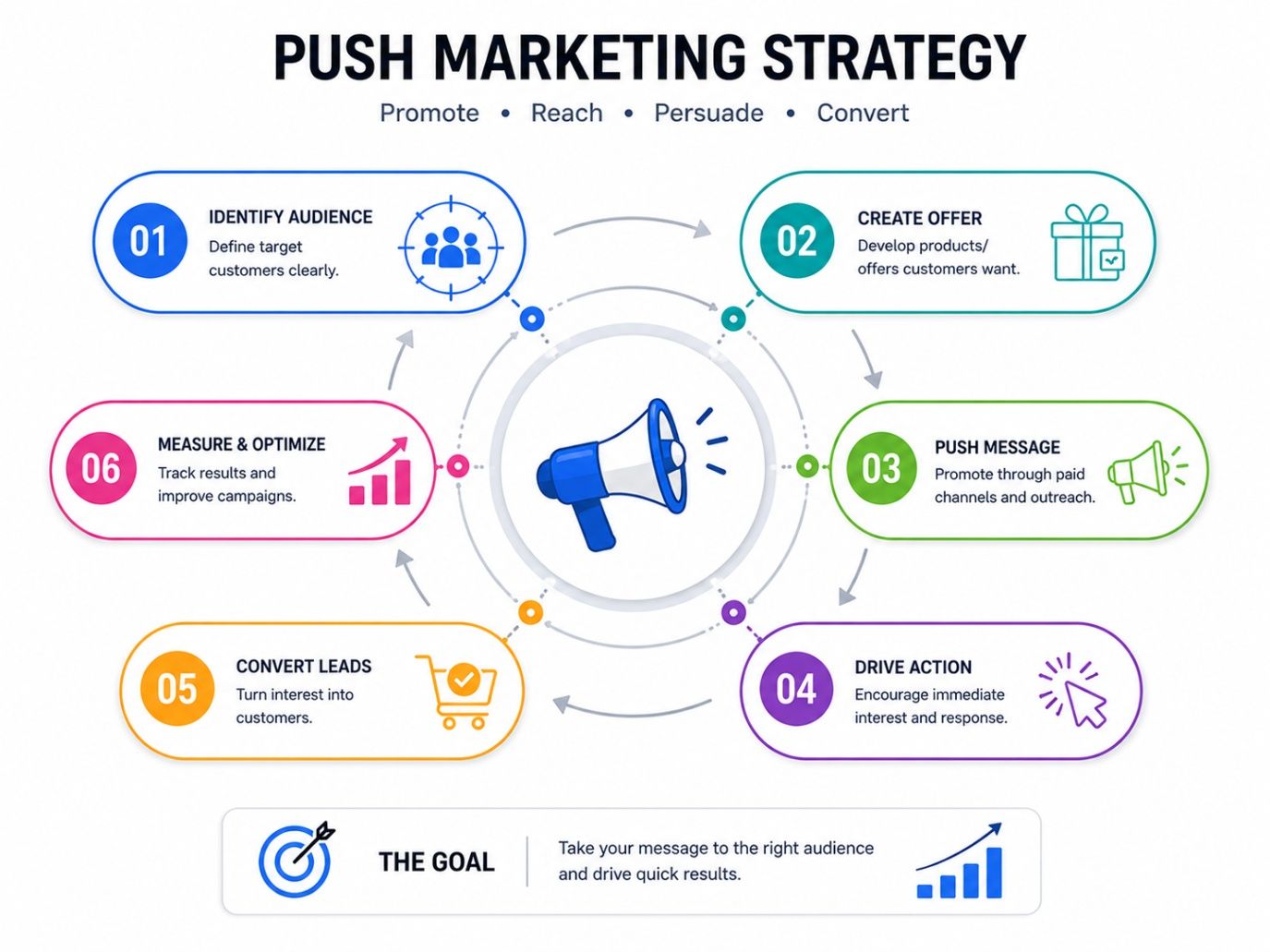
A push marketing strategy focuses on delivering products or services directly to potential customers. Businesses proactively communicate their offerings through paid promotions, sales outreach, and distribution channels rather than waiting for customers to discover them.
This strategy is particularly effective when launching new products, entering new markets, clearing inventory, or driving immediate sales.
Businesses use several channels to push products toward customers, including:
A well-executed push marketing strategy offers several advantages:
Despite its advantages, push marketing has some limitations:
Overall, push marketing is best suited for businesses that want rapid market exposure and immediate customer action.
Must Read: Digital Marketing Tutorials: A Complete Guide
Unlike push marketing, a pull marketing strategy focuses on attracting customers naturally by offering valuable information, engaging experiences, and solutions to their problems.

Instead of interrupting potential customers with advertisements, businesses create content and resources that encourage audiences to discover their brand independently.
This approach aligns with modern consumer behavior, where people research products online before making purchasing decisions.
Popular pull marketing tactics include:
A strong pull marketing strategy delivers long-term business value by:
Challenges of Pull Marketing
While effective, pull marketing requires patience and consistency:
Although slower than push marketing, pull marketing often creates a stronger foundation for long-term growth.
Also read : Branding vs Marketing: What's the Real Difference and Why It Matters
Subscribe to upGrad's Newsletter
Join thousands of learners who receive useful tips
Understanding push vs pull marketing examples makes it easier to see how businesses apply these strategies in real-world scenarios.
Push Marketing Examples |
Pull Marketing Examples |
| Google Ads promoting a new product | SEO blog articles answering customer questions |
| Facebook and Instagram paid advertisements | YouTube educational videos |
| Cold email campaigns | Informative newsletters with valuable insights |
| Television and radio commercials | Organic social media content |
| In-store discounts and promotional displays | Free ebooks, guides, and downloadable resources |
| Trade show exhibitions | Webinars and live educational sessions |
| Sales calls from business development teams | Customer success stories and case studies |
Ready to become a data-driven marketer? Learn how to create impactful marketing campaigns with upGrad's industry-aligned Digital Marketing programs.
Advanced Certificate in AI-Powered Digital Marketing & Communication from MICA
AI-Powered Marketing Strategies
When to Use Push vs Pull Marketing
Choosing between push and pull marketing depends on your business objectives, budget, customer behavior, and stage of growth.
Use Push Marketing When:
Use Pull Marketing When:
For most organisations, the most effective push vs pull marketing strategy combines both methods.
Push marketing generates immediate attention, while pull marketing nurtures trust and encourages repeat engagement.
The best marketing strategies combine push and pull marketing to attract new customers while building long-term relationships.
Push marketing creates awareness, while pull marketing nurtures interest and encourages conversions.
Choosing between push vs pull marketing depends on your business goals rather than one strategy being better than the other. Push marketing delivers immediate visibility, while pull marketing builds trust and long-term customer relationships.
By combining both approaches, businesses can create a balanced push vs pull marketing strategy that increases brand awareness, attracts qualified leads, and supports sustainable growth throughout the customer journey.
Want to explore more about Digital marketing? Book your free 1:1 personal consultation with our expert today.
Yes. Most successful businesses combine both approaches to reach customers at different stages of the buying journey. For example, you can use paid ads to generate immediate visibility while publishing SEO blogs and videos to attract long-term organic traffic. A balanced push vs pull marketing strategy helps you increase brand awareness, generate qualified leads, and improve customer retention.
A smartphone brand launching a new device is a good example. It may use Google Ads, social media ads, and email campaigns to promote the launch, which is push marketing. At the same time, it can publish buying guides, comparison blogs, and YouTube reviews to attract customers through search, which is pull marketing. Using both methods strengthens your push vs pull marketing efforts.
The 3-3-3 rule is a communication framework often used to make marketing messages easier to remember. It typically involves highlighting three key benefits, supporting them with three proof points, and ending with three clear calls to action or next steps. While not a universal marketing rule, it helps you create focused campaigns that are easier for customers to understand.
Coca-Cola uses both push and pull marketing. It works closely with retailers and distributors to ensure products are widely available, which reflects push marketing. At the same time, it invests heavily in branding, storytelling, sponsorships, and digital campaigns that encourage consumers to seek out the brand, making it a strong example of a combined marketing approach.
Your choice depends on your goals, budget, and timeline. If you need quick visibility or sales, push marketing can deliver faster results through paid campaigns. If you want to build long-term traffic and trust, pull marketing through SEO and content is a better investment. Many startups begin with paid promotion while gradually building their organic presence.
The four commonly used marketing strategies are market penetration, market development, product development, and diversification. Together, they help businesses decide whether to grow by selling existing products, entering new markets, introducing new products, or expanding into entirely new business areas. These strategies support broader business growth beyond promotional tactics.
Pull marketing is effective for both B2B and B2C businesses, but the execution differs. B2B companies often rely on whitepapers, webinars, and case studies to educate decision-makers, while B2C brands focus on blogs, videos, and social media content. The key is creating content that answers your audience's questions and supports their buying decisions.
Results vary depending on your industry, competition, and content quality. SEO and content marketing often take several months to generate consistent traffic. However, publishing helpful content regularly can build authority over time, leading to steady growth in organic visibility, qualified leads, and customer engagement.
Focus on metrics that align with your objectives. For push marketing, monitor impressions, click-through rates, conversions, and return on ad spend. For pull marketing, track organic traffic, keyword rankings, engagement, lead quality, and customer retention. Comparing these metrics helps you optimize your overall marketing strategy.
Yes. Small businesses can start with affordable paid campaigns for immediate visibility while consistently creating SEO-friendly blogs, videos, and social media content. Combining these efforts allows you to balance short-term lead generation with long-term organic growth, making push vs pull marketing a practical strategy even with limited resources.
AI is helping businesses personalize campaigns, automate customer interactions, and analyze marketing performance more effectively. In push marketing, AI improves audience targeting and ad optimization. In pull marketing, it supports content creation, keyword research, and customer insights. When used thoughtfully, AI helps marketers deliver more relevant experiences without replacing strategic decision-making.
730 articles published
Sriram K is a Senior SEO Executive with a B.Tech in Information Technology from Dr. M.G.R. Educational and Research Institute, Chennai. With over a decade of experience in digital marketing, he specia...
Get Free Consultation
By submitting, I accept the T&C and
Privacy Policy
Level Up Your Digital Marketing Career Today!
Top Resources
MICA
Advanced Certificate in AI-Powered Digital Marketing & Communication from MICAMICA Executive Alumni Status
Certification
5 Specialisation
Classroom
4 Months
Certification
2 Months