Inbound vs Outbound Marketing: Understanding the Strategies That Drive Digital Growth
By Sriram
Updated on Jun 22, 2026 | 6 min read | 4.54K+ views
Share:

All courses
Certifications
More
By Sriram
Updated on Jun 22, 2026 | 6 min read | 4.54K+ views
Share:
Table of Contents
Inbound marketing attracts potential customers through valuable content, SEO, and helpful experiences that encourage organic discovery. Outbound marketing actively reaches audiences using advertisements, cold outreach, and promotional campaigns. While inbound builds trust and long-term engagement, outbound delivers faster visibility and immediate reach. Most modern businesses combine both approaches to maximize customer acquisition and sustainable growth.
In this blog , you'll learn how both approaches work, where they fit in modern digital ecosystems, and how marketers combine them to create scalable growth engines. We'll also examine practical examples, tradeoffs, and implementation strategies used by businesses today.
Looking to build in-demand digital marketing skills? Explore upGrad's Digital Marketing courses and learn how to create, manage, and optimize campaigns that drive measurable business results.
Inbound marketing and outbound marketing are two very different ways of connecting with potential customers. One is bringing in users who are looking for solutions, the other is pushing messages to audiences.
Understanding these approaches is important as customer behaviour has drastically changed. Buyers are doing their own research on products before they ever talk to sales teams. At the same time, businesses continue to engage in proactive advertising to generate demand.
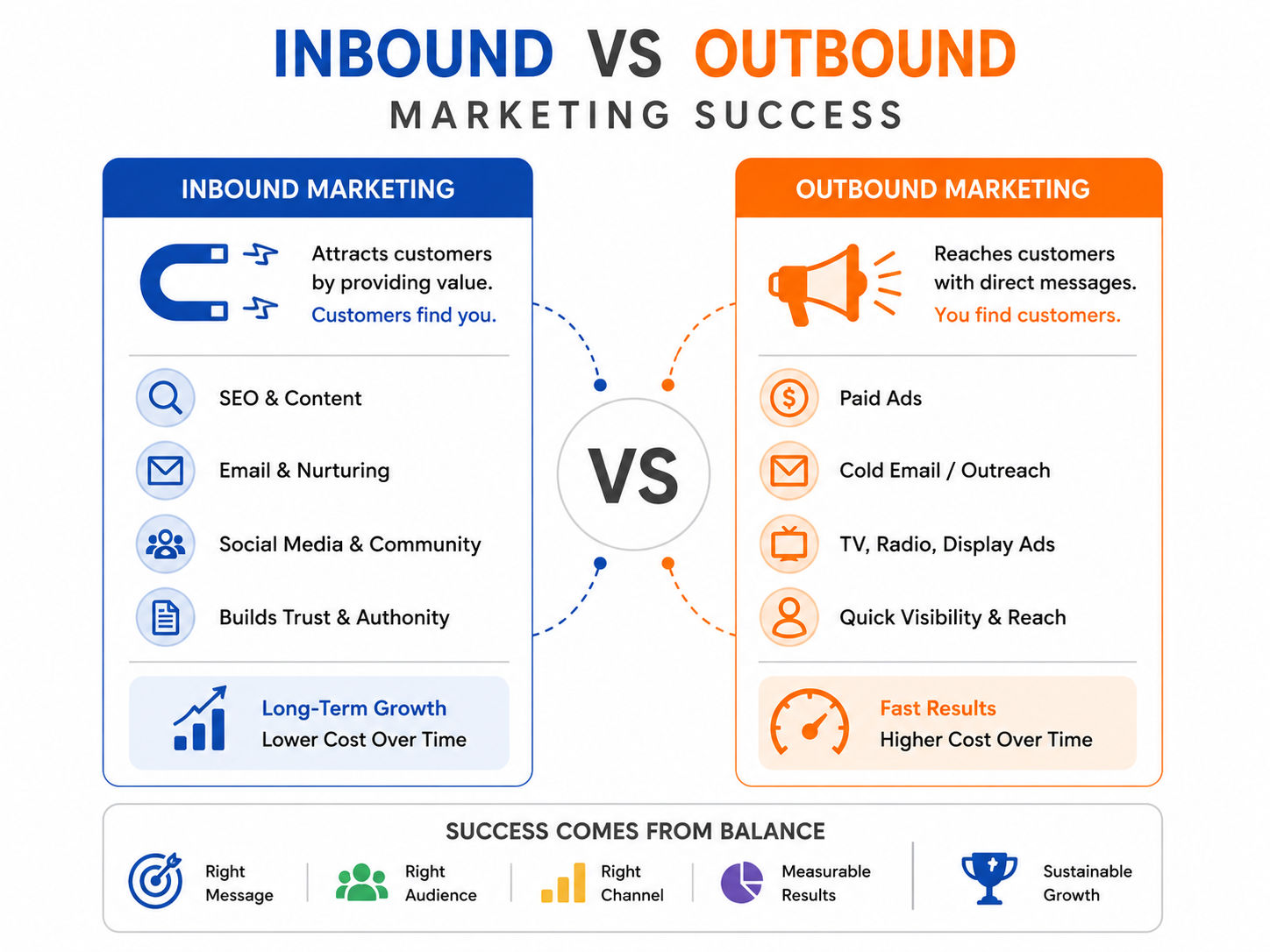
This table shows the key highlights of inbound vs outbound marketing
Category |
Inbound Marketing |
Outbound Marketing |
| Core Idea | Attracts customers by offering valuable content they actively search for | Reaches customers by pushing messages even if they are not searching |
| Strategy Type | Pull strategy (customer comes to the brand) | Push strategy (brand reaches the customer) |
| Customer Intent | High intent - users already looking for solutions | Low to medium intent -awareness is created first |
| How It Works | Builds visibility through organic discovery and trust-building content | Builds awareness through direct outreach and paid promotions |
| Key Channels | SEO, blogs, social media, email nurturing, webinars, communities | Paid ads, cold emails, display ads, TV/radio, sponsorships |
| Real Example | A user searches “best CRM for startups” and finds a helpful blog | A SaaS company runs LinkedIn ads targeting HR managers |
| Primary Goal | Long-term engagement and trust building | Fast reach and immediate visibility |
| Best Use Case | When customers research before buying | When quick leads or product launches are needed |
Free Courses
Inbound marketing creates compounding returns over time. As businesses publish valuable content and build authority, their visibility and customer trust continue to grow.
Here's why inbound marketing is highly scalable:
Current content continues to generate leads without any additional spend.
One of the biggest pros of Inbound vs outbound marketing is cost efficiency. Content creation needs upfront investment, but customer acquisition costs tend to decrease with growth in traffic.
While inbound marketing offers long-term benefits, it also comes with certain limitations that businesses must consider.
Some common challenges include:
For example, startups requiring immediate leads may struggle if they rely solely on inbound strategies without paid acquisition channels.
Must read: Digital Marketing Course Syllabus : Everything You Should Know
Digital Marketing Courses to upskill
Explore Digital Marketing Courses for Career Progression
MICA Executive Alumni Status
Outbound marketing still has a vital role in digital growth because companies usually need immediate visibility and faster lead generation. This is in contrast to inbound marketing which takes time to build momentum before it starts driving traffic and impressions. Outbound campaigns can do this almost instantly.
Such speed is especially useful for product launches, seasonal campaigns, and industries with high competition where rapid customer acquisition is essential.
Businesses use different outbound channels to directly approach potential customers and expand their market.
Some of the more popular outbound marketing strategies are:
For example, an online education platform launching a new AI course may run paid search campaigns to attract learners immediately. Unlike organic strategies, paid campaigns can generate traffic from day one.
Outbound marketing can be a fast way to generate results, but it also has its challenges, which marketers need to navigate carefully.
Some common limitations are:
A poorly targeted campaign can quickly consume marketing budgets without producing qualified leads. This makes audience segmentation and campaign optimization critical for success.
Also Read: Branding: When’s the Right Time to Start
Choosing between inbound and outbound marketing depends on a company's goals, budget, and growth stage. Some businesses need quick visibility, while others focus on building long-term customer relationships.
The table below highlights how inbound and outbound marketing strategies align with different business needs and scenarios.
Factor |
Inbound Marketing |
Outbound Marketing |
| Best For | Long-term growth and brand building | Fast customer acquisition and awareness |
| Customer Behavior | Customers actively search for solutions | Businesses proactively reach customers |
| Budget Requirement | Works well with limited budgets over time | Often requires higher ad spend |
| Growth Speed | Slower initially but compounds over time | Generates quicker results |
| Trust Building | High trust through valuable content | Lower trust initially |
| Common Channels | SEO, blogs, email marketing, webinars | Paid ads, cold emails, display ads |
| Ideal Industries | SaaS, education, professional services | Ecommerce, consumer apps, retail |
| Key Advantage | Sustainable organic growth | Immediate visibility and scale |
| Main Challenge | Takes time to show results | Rising advertising costs |
Do Read: What is SEO Content Writing? A Beginner’s Guide to Writing for Search Engines
The future of marketing is becoming increasingly customer-centric, data-driven, and personalized. As technology evolves, businesses will need to blend inbound and outbound strategies to deliver seamless experiences across multiple channels.
The Future of Inbound vs Outbound Marketing will focus less on choosing one approach and more on integrating both to maximize engagement, conversions, and long-term growth.
Inbound vs outbound marketing are not competing strategies but complementary approaches to customer acquisition and growth. Inbound marketing builds long-term trust through content, SEO, and engagement, while outbound marketing delivers faster visibility through advertising and direct outreach.
The most effective businesses combine both methods to reach customers at different stages of their journey. By balancing inbound vs outbound digital marketing, marketers can generate immediate results, reduce acquisition costs over time, and create sustainable growth in an increasingly competitive digital landscape.
Must Read: Top 10 Email Marketing Tools Successful Email Marketing Experts Use
Inbound vs outbound marketing mainly differs in how customers are reached. Inbound focuses on attracting users through content, SEO, and organic discovery, while outbound focuses on pushing messages through ads and direct outreach. In digital growth marketing, inbound builds long-term trust, but outbound helps you get faster visibility and early traction when you need immediate leads.
Startups with limited budgets often perform better with inbound vs outbound marketing because inbound relies more on time and content than ad spend. SEO blogs, educational posts, and social content can generate traffic without heavy investment. However, you may still need small outbound campaigns to test messaging or get early customers quickly.
Outbound marketing works better when you need fast results. If you are launching a new product, entering a competitive market, or targeting a very specific audience, outbound helps you reach people immediately. In inbound vs outbound marketing decisions, outbound becomes useful when waiting for organic growth is not practical for your business timeline.
Yes, most high-growth companies combine inbound vs outbound marketing instead of choosing one. Outbound ads bring users to your platform quickly, and inbound content helps convert and nurture them. For example, a user may click an ad first and later read your blog before converting. This combination improves conversion rates and reduces acquisition gaps.
Inbound marketing takes time because it depends on organic discovery. Search engines need time to rank your content, and audiences need repeated exposure before trust builds. In inbound vs outbound marketing comparisons, inbound is slower because it focuses on building authority through content, backlinks, and engagement rather than instant paid reach.
Outbound marketing faces challenges like rising ad costs, audience fatigue, and privacy restrictions. Many users ignore ads or block tracking, which reduces efficiency. In inbound vs outbound marketing strategies, outbound also struggles with trust because users often prefer organic content over direct promotional messages, especially in competitive digital markets.
Inbound vs outbound marketing uses different metrics. In inbound, you track organic traffic, engagement, and lead quality. In outbound, you focus on CTR, CPC, and ROAS. You should not compare them using the same metrics because inbound measures long-term value while outbound measures immediate performance and cost efficiency.
Industries with long decision cycles like SaaS, education, and consulting benefit more from inbound vs outbound marketing through inbound channels. Fast-moving industries like ecommerce, mobile apps, and retail often rely more on outbound ads. The right mix depends on how quickly your customers make decisions and how much research they do.
Yes, AI is changing inbound vs outbound marketing significantly. AI tools help create content faster, personalize ads, and improve targeting accuracy. In inbound, AI improves SEO and content planning. In outbound, it improves ad optimization and audience segmentation. This makes both strategies more efficient and data-driven than before.
Businesses continue using outbound marketing because it delivers immediate reach and predictable traffic. Even if costs are high, outbound helps test markets, launch products, and generate early revenue. In inbound vs outbound marketing planning, outbound acts as a fast-track channel while inbound builds long-term stability.
The future of inbound vs outbound marketing is integration. Businesses will not treat them separately. Instead, they will combine paid ads, SEO, content, and automation into one system. AI-driven personalization will blur the line between inbound and outbound, making customer journeys more connected, adaptive, and performance-focused in digital growth marketing.
727 articles published
Sriram K is a Senior SEO Executive with a B.Tech in Information Technology from Dr. M.G.R. Educational and Research Institute, Chennai. With over a decade of experience in digital marketing, he specia...
Get Free Consultation
By submitting, I accept the T&C and
Privacy Policy
Level Up Your Digital Marketing Career Today!
Top Resources
MICA
Advanced Certificate in AI-Powered Digital Marketing & Communication from MICAMICA Executive Alumni Status
Certification
5 Specialisation
Classroom
4 Months
Certification
2 Months