Best Leadership Skills for Resume with Examples
By upGrad
Updated on Aug 21, 2026 | 7 min read | 3.74K+ views
Share:

All courses
Certifications
More
By upGrad
Updated on Aug 21, 2026 | 7 min read | 3.74K+ views
Share:
Table of Contents
Key Highlights
Build the right leadership skills for your career with management certification courses. Courses are designed to teach how you can lead teams, make better decisions, and advance your career.
Popular Management Programs
Recruiters and ATS software scan resume for leadership skills in three places on a resume. And, these places are as follows:
So, now you know where to add your leadership skills, but what skills should you add. Below are leadership skills, differentiated by categories so you can choose the right skill for your resume.
| Category | Leadership Skills |
| People Skills | Communication, Team Building, Mentoring and Coaching, Conflict Resolution, Active Listening, Empathy, Feedback Delivery, Persuasion, Diplomacy, Networking, Diversity and Inclusion Leadership, Talent Development |
| Execution Skills | Delegation, Decision-Making, Problem-Solving, Project Management, Time Management, Accountability, Crisis Management, Resource Allocation, Performance Management, Remote Team Management, Multitasking, Process Improvement |
| Strategic Skills | Strategic Thinking, Visionary Thinking, Change Management, Risk Management, Goal Setting, Negotiation, Analytical Thinking, Innovation, Budget Management |
| Other Core Traits | Adaptability, Emotional Intelligence, Integrity, Cross-Functional Collaboration, Stakeholder Management |
Also read: Must-Have Skills for Leadership & Management Roles
Free Courses
The generic resumes do not get the attention of recruiters, so skip the boring pattern most people fall into. Use the formula,
Action Verb + What You Did + Measurable Result
Below we share how the formula works for different career stages. Choose whichever examples come closest to your own experience, add your real numbers too.
Freshers rarely have a management title to show, but that does not rule out strong leadership examples.
You can add skills in the resume,
For experienced professionals, showing skills through influence and results is a must. Here’s how you can present your skills in a resume:
If applying for managerial roles, add quantify team size, budget, or scope, and connect your leadership directly to business outcomes. Some examples you can use are:
Also read: How to Develop Leadership Skills for Career Growth
Use strong verbs more than adjectives. Action verbs show what you did in real, on the other hand adjectives only describe your qualities. For example:
Replace "responsible for" and "helped with" for verbs like the ones below.
1. Team Leadership Action Verbs
Led, directed, guided, supervised, mentored, coached, motivated, unified, empowered, championed, cultivated, inspired.
2. Management Action Verbs
Managed, delegated, coordinated, oversaw, organized, administered, allocated, streamlined, supervised, orchestrated, executed, implemented.
3. Strategy and Decision-Making Action Verbs
Devised, formulated, strategized, evaluated, prioritized, negotiated, initiated, pioneered, restructured, spearheaded, transformed, optimized.
Advance your leadership career with IIM Bangalore’s Certificate Programme in General Management for Young Leaders (YLP), designed to build practical management and leadership skills.
Sending the same resume to every job is one of the easiest ways to get filtered out. Instead of sharing the same skills with recruiters, try adding different skills based on the job description.
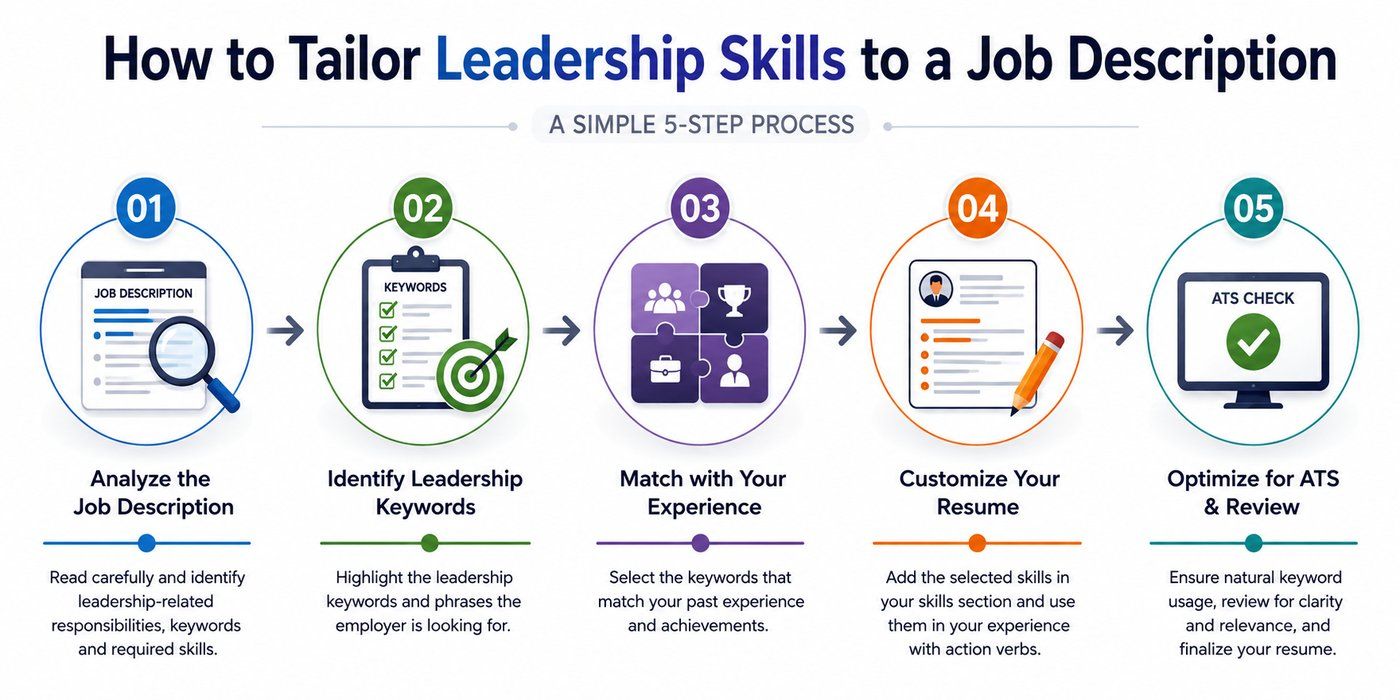
Here's how to tailor your leadership skills to each application.
Open the job description and highlight every word tied to leadership, such as manage, lead, cross-functional, stakeholder, mentor, and decision-making. So, these are the exact terms the ATS scans for, so you must add them to your resume.
Check for the job description language too. Also, check the job title and seniority level. A posting for "Team Lead" will focus more on delegation and coaching, while a posting for "Strategy Manager" will focus more on strategic thinking and decision-making. Adjust the skills as per the company’s requirements.
For each skill you are adding, find one real example from your own background that proves it. If the job description mentioned "cross-functional leadership" and you have only led within one team, then don't mislead in resume. Instead, highlight the closest possible situation you have handled. Like coordinating with another department on a shared deliverable.
If you're switching industries or moving from an individual contributor role to a management-track role. Focus on transferable examples, such as leading a project, training a peer, or managing a client relationship, even if your job title didn't say "manager."
Also read: 15 Expert Resume Writing Tips to Land Your Dream Job Faster
Adding leadership skills to your resume is not enough. How you present these skills also matters. Avoid these common mistakes to make your leadership experience more specific, credible, and impactful.
Also read: How to Build a Resume That Stands Out?
Only adding leadership skills in a resume are not enough; leadership skills for resume are more proof. Proof that you can guide people, make decisions, and bring outcomes. Whether you are writing your first resume as a fresher or refining one after years as a manager, the formula stays the same.
Pick the skills genuinely backed by your experience, describe them with strong action verbs and measurable results, and tailor the language to match each job description.
Take the next step in your career? Book a consultation call with upGrad to explore the right learning programme for your goals.
You can use action verbs like led, directed, or coordinated along with your results. The recruiters value leadership through outcomes and not labels. A bullet like "coordinated a 6-person team to launch a new company product" proves leadership without stating it directly.
Yes. Your summary should mention leadership in one line related to your biggest achievement. The skill section should list your specific competencies. Repeating skills across sections, phrased differently each time, reinforces your positioning without appearing repetitive to recruiters.
Leadership skills show influence and initiative, like motivating others or driving change. Management skills show operational control, like budgeting, scheduling, or process oversight. Most strong resumes have both, since employers want people who can inspire teams and run day-to-day operations.
Yes. Leading a volunteer group, sports team, or student club shows real leadership, especially for freshers or career changers. Mention the same way as work experience: action, context, and measurable outcome.
Highlight leadership from any activity during the gap, such as freelance projects, caregiving coordination, community organizing, or upskilling initiatives you led. Focus on transferable outcomes rather than justifying the gap and keeping the framing consistent with your other bullets.
Yes, often more so. Remote and freelance roles require self-direction, so skills like decision-making, accountability, and stakeholder communication matter even without a formal team. This shows how you manage clients, deadlines, or collaborators independently to prove leadership without daily supervision.
A separate heading only makes sense for senior or management roles where leadership is central to the job. For most resumes, folding leadership skills into a general skills section, plus proof in your experience of bullets, works better and looks less forced.
Update it before every application, not on schedule. Review the job description each time, swap in the most relevant skills and examples, and remove outdated or irrelevant ones. A leadership section tailored per role performs far better than a static one.
Mostly yes, but LinkedIn allows more context. Use your "About" section to tell a fuller leadership story, add skills to the dedicated Skills section for endorsements, and mirror the same measurable examples from your resume in your experience descriptions.
Titles don't always match responsibilities. Use your bullet points to describe the actual scope of what you led, such as team size or project ownership, rather than relying on the title alone. Recruiters read bullets closely, especially leadership claims.
Only if you can still speak to them confidently in an interview. If a skill is outdated or you can't recall specifics, drop it or pair it with a more recent example. Stale, unsupported claims hurt credibility more than omitting the skill.
1277 articles published
We are an online education platform providing industry-relevant programs for professionals, designed and delivered in collaboration with world-class faculty and businesses. Merging the latest technolo...
Get Free Consultation
By submitting, I accept the T&C and
Privacy Policy
Top Resources
Certification
3 Months
Certification
6 Months
O.P. Jindal Global University
Masters in International Accounting and Finance (Accredited by ACCA, UK)Master's Degree
12 Months