Free Java Certification Courses in 2026
By Rohan Vats
Updated on Jul 28, 2026 | 12 min read | 74.86K+ views
Share:

All courses
Certifications
More
By Rohan Vats
Updated on Jul 28, 2026 | 12 min read | 74.86K+ views
Share:
Table of Contents
Quick Overview:
Take the next step in your technology journey with upGrad's online data science courses. Learn Python, machine learning, AI, data analytics, and real-world problem-solving through hands-on projects designed for today's fast-growing tech industry.
Popular Data Science Programs
If you're thinking about leveling up your career with Java, there are some great and Free Java Certifications Course out there. Whether you're just starting or looking to go deeper, these Java free certification courses will help you build the skills you need and stand out in the tech field.
So let's kick -in!
| Platform / Provider | Course Name |
| upGrad | Core Java Basics – Free Certification Course |
| upGrad | Java Object-Oriented Programming – Free Certification |
| upGrad | Core Java Course |
| IBM | Object-Oriented Programming in Java |
| Oracle | Oracle Java Training and Certification |
Let’s explore what each course offers, who it’s best suited for, and how it can help you build solid Java programming skills, whether you’re just starting or aiming for full stack development.
Gain practical expertise in designing, building, and deploying AI-powered solutions with the Building AI Products, Systems & Services EPGC by IIT Kharagpur, offered through upGrad. Learn from industry experts and develop the skills needed to lead AI-driven innovation.
The Core Java Basics course is a beginner-friendly free Java certification course that helps you build a strong programming foundation. By the end of this course, you’ll be ready to write clean and efficient Java code.
Key Skills You'll Learn:
| Skill | Description |
| JDK Installation & Setup | Learn to install the Java Development Kit and run Java programs via the command line. |
| Writing Java Programs | Get hands-on experience with your first “Hello World” program and understand how Java code is executed. |
| IDE – IntelliJ | Use IntelliJ, a professional IDE, to streamline your Java development process. |
| Variables & Data Types | Master declaring, using variables, and exploring core data types like int, float, char, and boolean. |
| Functions & Modularity | Write reusable, efficient code using functions and internal Java methods. |
| Error Handling | Learn the basics of managing errors in your code for better reliability. |
Who Should Take This Course?
Also Read: Java Language History: Why Java Is So Popular and Widely Used Today
This free Java certification course by upGrad builds a solid foundation in programming with core Java concepts like syntax, object-oriented programming, platform independence (WORA), and real-world applications.
Key Skills You'll Learn:
| Skill | Description |
| Java Syntax & Basics | Understand the structure and syntax of Java programs. |
| Object-Oriented Programming | Learn core OOP principles like inheritance, encapsulation, and polymorphism. |
| Platform Independence (WORA) | Write code once and run it on multiple platforms without changes. |
| Core APIs & Packages | Work with essential Java packages for building real applications. |
| Application Use Cases | Explore how Java is used in tools and platforms like Selenium, Hadoop, and more. |
Who Should Take This Course?
Also Read: 50 Java Projects With Source Code in 2026: From Beginner to Advanced
The Java Object-Oriented Programming course by upGrad is a free certification designed to teach the core OOP principles in Java. The course helps you write modular, scalable, and maintainable code, useful for projects, interviews, and backend or full stack development.
Key Skills You'll Learn:
| Skill | Description |
| Abstraction | Learn to simplify complex systems by modeling classes and hiding unnecessary implementation details. |
| Classes | Understand how to define classes as templates for creating real-world entities with fields, constructors, and methods. |
| Objects | Practice creating and manipulating objects encapsulating data and behavior, simulating real-world scenarios. |
| Multiple Objects in a Class | Learn how objects maintain individual states, enabling scalable program logic through multiple class instances. |
| Constructors | Explore different types of constructors (default, parameterized, overloaded) to streamline and customize object creation. |
Also Read: Java Classes and Objects
Who Should Take This Free Certification?
Also Read: How to Become a Full Stack Developer in 2026? 8 Steps, Skills, and Careers
Get a Comprehensive Overview of Data Science Certification from upGrad.
The IBM Object-Oriented Programming in Java course is a beginner-friendly learning path to help you build Java skills in just three hours. By the end of this course, you’ll be ready to apply OOP principles to real Java applications.
Key Skills You'll Learn:
| Skill | Description |
| Java Programming Basics | Set up the Java environment and write your first Java program, gaining a solid understanding of Java syntax. |
| Exception Handling | Learn how to handle errors and exceptions effectively in your Java applications, ensuring more robust and stable code. |
| Inheritance & Abstraction | Understand and apply OOP concepts like inheritance and abstraction to make your code more modular and reusable. |
| Interfaces | Learn how to define and implement interfaces in Java, allowing you to create flexible and extensible code. |
| Nested Classes | Explore the concept of nested classes in Java, learning how to organize code efficiently and improve readability. |
Who Should Take This Certification?
Also Read: What are the Types of Inheritance in Java? Examples and Tips to Master Inheritance
The Oracle Java Training and Certification program is an industry-recognized pathway for mastering Java and Oracle technologies. It validates your ability to build secure, scalable, and high-performance applications.
Java & Oracle Skills You'll Learn:
| Skill | Description |
| Java SE Programming | Learn to write robust, maintainable Java code focusing on object-oriented principles. |
| Application Deployment | Understand how to deploy Java applications securely and efficiently on Oracle environments. |
| Oracle WebLogic Server | Learn to configure and manage this enterprise-grade application server. |
| Oracle SOA Cloud Service | Gain skills in integrating services using Oracle's SOA-based architecture. |
| WebCenter Portal Integration | Learn to use Oracle’s portal platform to build interactive web applications. |
Who Should Take This Certification?
Free Courses
A Java certification course is a structured training program that teaches you the fundamentals and advanced concepts of Java programming while validating your skills through a certificate. These courses cover topics such as Java syntax, object-oriented programming (OOP), data structures, exception handling, collections, multithreading, JDBC, and frameworks like Spring Boot. Completing a certification course helps learners demonstrate their Java proficiency to employers and strengthens their software development portfolio.
If you're just getting started, you can also enroll in a free Java course with certificate to learn the basics before moving on to advanced certifications. Many learners begin with a Java free course with certificate to build foundational programming skills without any upfront cost.
Java is beginner-friendly, so you don't need extensive programming experience to get started. However, having a few basic skills can make the learning process smoother and help you complete a certification course more effectively.
Before enrolling in a Java certification course, it helps to have:
If you're a complete beginner, starting with a free Java course with certificate or a Java free course with certificate is an excellent way to learn the fundamentals before progressing to intermediate and advanced Java development topics.
Data Science Courses to upskill
Explore Data Science Courses for Career Progression
IIIT Bangalore
Executive Post Graduate Certificate in Data Science & AIPlacement Assistance
There are numerous reasons to learn Java at present. Let's see some major reasons:
Universal Use:
Java powers millions of applications, from mobile apps and web platforms to enterprise-grade systems. A free Java certification course can help you start learning this versatile language, which is widely used in Android development, e-commerce apps, and large-scale IT solutions.
High Demand Across Industries:
Companies in finance, e-commerce, healthcare, and IT continue to seek professionals skilled in Java. Completing a Java online course free adds value to your resume and makes you job ready.
Versatile Skillset:
By learning Java through a free certification course, you gain expertise in:
Career Opportunities:
Roles such as Java Developer, Backend Engineer, Software Engineer, and Android Developer remain in high demand in 2026. A recognized free Java certification course can give you an edge for these roles.
Also Read: Careers in Java: How to Make a Successful Career in Java in 2026
Future-Proof Choice:
Java continues to evolve with strong community support, frequent updates, and compatibility with modern technologies like cloud computing, big data, and microservices. Enrolling in a Java online course free with certificate ensures you gain skills relevant for today and tomorrow.
Explore the benefits of a free Java certification course and see how it can boost your skills, career opportunities, and confidence in programming.
Also Read: Top 10 Java Frameworks Powering Modern Application Development
Also Read: Java Full Stack Developer Roadmap For 2026: Beginner Guide
Learning Java can open the door to numerous career opportunities across various industries. As one of the most widely used programming languages, Java skills are in high demand, and with the right certification, you can open doors to exciting roles in the tech world.
Here are some career paths you can pursue after completing a Java course:
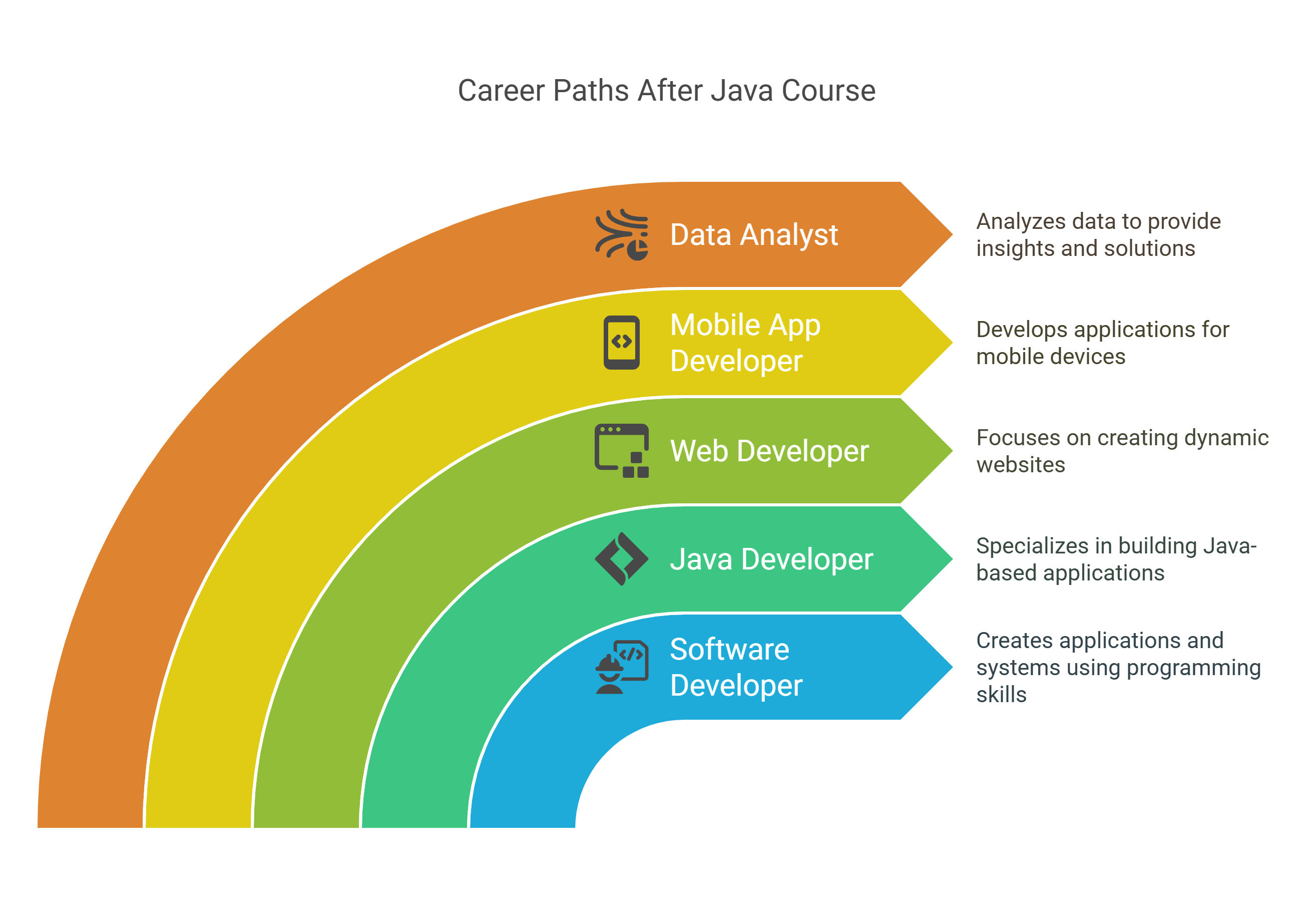
| Career Path | Role Description | Key Skills Required | Average Salary (₹) |
| Java Developer | Develop and maintain Java applications | Java, OOP, Database Integration | ₹5L/yr |
| Software Engineer | Design and implement software systems | Java, Problem Solving, Algorithm Design | ₹8L/yr |
| Backend Developer | Work on the server side of web applications | Java, Spring Framework, SQL | ₹6L/yr |
| Full-Stack Developer | Develop both client and server-side applications | Java, HTML/CSS, JavaScript, Databases | ₹6L/yr |
| Android Developer | Build Android mobile applications | Java, Android SDK, XML, UI/UX Design | ₹6L/yr |
| Java Architect | Design complex Java-based applications | Java, System Design, Enterprise Solutions | ₹21.5L/yr |
| DevOps Engineer | Combine software development with IT operations | Java, Cloud Platforms, Automation Tools | ₹8L/yr |
| Java QA Engineer | Test and validate Java applications | Java, Selenium, Unit Testing | ₹6L/yr |
| Database Administrator (DBA) | Manage and optimize databases | SQL, Java, Database Management Systems | ₹8L/yr |
| Cloud Engineer | Work on cloud-based applications and infrastructure | Java, AWS/Azure, Cloud Services | ₹7L/yr |
| Technical Lead/Project Manager | Lead development teams, manage projects | Java, Leadership, Project Management | ₹1L/mo |
| Data Scientist | Analyze complex datasets and build data models | Java, Data Analysis, Machine Learning | ₹12.0L/yr |
After completing a free Java course with a certificate, you’ll be well-equipped to explore these career paths and stand out in the competitive tech industry.
Whether you enroll in a paid program or start with a free Java course with certificate, following a structured roadmap will help you build strong programming skills. Many beginners choose a Java free course with certificate to learn the fundamentals before moving on to advanced concepts and industry-recognized certifications.
| Stage | What to Learn | Outcome |
|---|---|---|
| Step 1: Learn Java Fundamentals | Variables, data types, operators, loops, conditions, and input/output | Understand the basics of Java programming |
| Step 2: Master Object-Oriented Programming | Classes, objects, inheritance, polymorphism, abstraction, and encapsulation | Build a strong OOP foundation |
| Step 3: Learn Core Java Concepts | Arrays, strings, collections, exception handling, file handling, and multithreading | Write efficient and reliable Java programs |
| Step 4: Work with Databases | JDBC, SQL, and CRUD operations | Create database-driven applications |
| Step 5: Learn Popular Java Frameworks | Spring, Spring Boot, Hibernate, Maven, and REST APIs | Build enterprise-level applications |
| Step 6: Build Java Projects | Banking system, library management, student management, or e-commerce projects | Gain practical development experience |
| Step 7: Learn Testing and Version Control | JUnit, Git, GitHub, and debugging | Improve code quality and collaboration |
| Step 8: Earn a Java Certification | Complete a certification course and prepare for coding interviews | Validate your skills and become job-ready |
If you're new to programming, begin with a free Java course with certificate to understand the fundamentals. Once you're comfortable with the basics, progress to advanced Java topics, build real-world projects, and earn a professional certification to strengthen your resume.
Learning Java is rewarding, but beginners often face a few common obstacles. Understanding these challenges early can help you overcome them and progress faster, whether you're taking a paid program or a free Java course with certificate.
| Challenge | Why It Happens | How to Overcome It |
|---|---|---|
| Understanding OOP concepts | Classes, objects, inheritance, and polymorphism can feel abstract | Learn one concept at a time and build small OOP projects |
| Remembering Java syntax | Beginners often confuse syntax and language rules | Practice coding daily and write simple programs regularly |
| Debugging errors | Compiler and runtime errors can be difficult to interpret | Read error messages carefully and use debugging tools in your IDE |
| Working with collections | Choosing the right collection class can be confusing | Learn List, Set, Map, and their use cases through examples |
| Managing exceptions | Handling checked and unchecked exceptions requires practice | Solve coding exercises focused on exception handling |
| Learning frameworks | Frameworks like Spring Boot introduce many new concepts | Master Core Java before moving to frameworks |
| Staying consistent | Irregular practice slows learning and retention | Follow a structured roadmap and build projects consistently |
Many beginners start with a Java free course with certificate to learn the fundamentals at their own pace. Once you're confident with Core Java, move on to advanced topics, frameworks, and hands-on projects to become job-ready.
A Free Java Certification Course is an excellent starting point for anyone looking to build programming skills and begin a career in software development. It helps you learn Core Java, object-oriented programming, and practical coding through hands-on exercises at no cost. As you gain confidence, you can advance to frameworks, real-world projects, and professional certifications to improve your career opportunities in Java development.
If you're ready to take the next step in your career, connect with upGrad’s career counseling for personalized guidance. You can also visit a nearby upGrad center for hands-on training to enhance your digital marketing skills and open new career opportunities!
Most free Java courses are open to everyone, including students, fresh graduates, and working professionals. Whether you are a complete beginner with no coding experience or a professional looking to upskill, a free java certification course provides the foundational knowledge needed to start programming.
The duration varies depending on the learning platform, but many foundational courses like those from upGrad are self-paced. A typical java free certification course can range from a few weeks to a couple of months, allowing learners to balance their studies with other commitments like college or full-time jobs.
No, prior experience is generally not required. A well-structured java online course free with certificate usually starts with the basics, such as variables, loops, and data types, before moving on to advanced concepts like Object-Oriented Programming (OOP), making it suitable for absolute beginners.
Registration is typically simple: visit the educational platform (like upGrad), sign up with your email, and select the course. Once registered for a java certification course free of charge, you often get instant access to video lectures, coding assignments, and community forums.
Yes, professionals from non-technical backgrounds can benefit significantly. A free certification course in java is designed to be accessible, helping career switchers understand the logic behind software development and facilitating a transition into tech roles like junior developer or analyst.
The best free java certification covers essential topics including Java syntax, control flow statements, Object-Oriented Programming (OOP) principles (inheritance, polymorphism, encapsulation), exception handling, and basic data structures, providing a robust skillset for backend development.
Yes, a comprehensive free java certification often includes modules on backend development. You will learn how to connect applications to databases, handle server-side logic, and deploy basic applications, which are critical skills for becoming a Full-Stack or Backend Developer.
Absolutely. To ensure practical learning, a quality java free certification course includes coding exercises and real-world projects. These projects allow you to apply theoretical concepts to solve actual problems, which is essential for building confidence and a strong portfolio.
Yes, OOP is a core component of Java. Any reputable java online course free with certificate will dedicate significant time to teaching classes, objects, inheritance, and polymorphism, as these are the building blocks of scalable, enterprise-level Java applications.
Leading platforms like upGrad ensure their content is up-to-date. A java certification course free program is regularly refreshed to include the latest Java versions and industry best practices, ensuring you learn skills that are currently in demand by top tech employers.
Yes, the certificate serves as proof of your skills and commitment. When you complete a free java certification, adding the credential to your resume or LinkedIn profile validates your technical knowledge to recruiters, helping you stand out for entry-level programming roles.
The best free java certification is one that offers a balance of theory, practice, and a recognized certificate. Programs that include mentorship, doubt resolution, and project-based learning, like those from upGrad , are top contenders for learners in 2026.
Listing a java online course free with certificate on your resume demonstrates self-discipline and technical proficiency. It shows hiring managers that you have proactively acquired the necessary skills in core Java and OOP, making you a competitive candidate for software engineering internships and jobs.
While a course alone guarantees skills rather than a job, completing a free certification course in java significantly improves your employability. It equips you with the technical expertise needed to crack coding interviews for roles like Java Developer, Software Engineer, and Android Developer.
A java free certification course offers immense value by removing financial barriers to entry. While paid courses might offer more extensive career services, free courses provide the critical foundational knowledge and certification needed to kickstart your journey without any upfront investment.
Many platforms now incorporate community support or mentorship into their free offerings. In a java certification course free of cost, you may get access to discussion forums or Q&A sessions where you can clarify doubts regarding complex topics like recursion or multithreading.
Graduates of the best free java certification can pursue various career paths. Common roles include Junior Java Developer, Backend Engineer, Web Developer, and even Android App Developer, given that Android development relies heavily on Java fundamentals.
Choose a Java certification course that matches your skill level, career goals, and learning style. Whether you start with a free Java certification course or a paid program, look for an up-to-date curriculum, hands-on projects, instructor support, and a recognized certificate to gain practical, job-ready skills.
To select the right free certification course in java, look for a curriculum that matches your career goals (e.g., web dev vs. mobile dev), checks for "hands-on" project opportunities, and ensures the platform provides a verifiable certificate upon completion.
After completing a free Java certification course, focus on advanced Java concepts such as multithreading, collections, JDBC, Spring Boot, Hibernate, REST APIs, Git, SQL, and data structures & algorithms. Building real-world projects and preparing for coding interviews will further strengthen your software development skills.
References:
410 articles published
Rohan Vats is a Senior Engineering Manager with over a decade of experience in building scalable frontend architectures and leading high-performing engineering teams. Holding a B.Tech in Computer Scie...
Speak with Data Science Expert
By submitting, I accept the T&C and
Privacy Policy
Start Your Career in Data Science Today
Top Resources
Executive Diploma
12 Months
Master's Degree
18 Months
Bootcamp
6 Months