How to Build a Data Analyst Portfolio That Showcases Your Skills?

By upGrad

Updated on Nov 04, 2026 | 3 min read | 878.98K+ views

Share:

Key Takeaways:

  • According to the U.S. Bureau of Labor Statistics, there will be a 34% increase in data scientist roles between 2024 and 2034. Approximately 23,400 roles will open every year.
  • A ‘data analyst portfolio’ is a small number of projects that highlights skills in working with data.
  • When asked how to create a data analyst portfolio, all you need to do is identify real life problems, clean the data and identify any insights. Finally present the work clearly.
  • Storytelling is an important concept. Explain what you have found out and what it means.
  • Many beginners will now host their projects on GitHub or a free website.
  • In this blog we will explain why a portfolio is important, what should go in it, some of the best project ideas, tools to use and tips to present your work. We will also outline common mistakes to avoid.

Ready to Start Your Data Career? Learn SQL, Python, and data visualization through real projects and build a portfolio that gets noticed. Enroll in our online data science courses today!

What to Include in a Data Analyst Portfolio?

Data Analyst portfolio doesn't need to be very fancy. It just needs to show who you are, what you can do, and the work you've already done.

Here’s what to include:

1. About Me Section

  • Tell about yourself in a few short lines.
  • Mention what kind of data work you'd like to do.

2. Technical Skills and Tools Learned

3. Data Analytics Projects

  • Highlight any 3 - 5 projects that shows real effort. 
  • Use real data and put your code on GitHub.

4. Project Descriptions and Outcomes

  • Explain the problem, what you did, and what you found.
  • Add a few clear charts to back it up.

5. Certifications and Education

  • Share your degree, courses, and any data-related certificates.

Must Read: Data Analysis Courses in 2026

6. Resume and Contact Details

  • Make it easy to reach you with your resume, email, LinkedIn, and GitHub links.

Take your data career to the next level. Earn your online M.Sc. in Artificial Intelligence and Data Science and learn skills that employers want.

Free Courses

Explore courses related to Data Science
Case Study using Tableau, Python and SQL
10.58K+ learners
10 hrs of learning
Introduction to Tableau
8.5K+ learners
8 hrs of learning
Data Science in E-commerce: Pricing & Marketing Analytics

How to Make a Data Analyst Portfolio?

Breaking down the steps of creating a data analyst portfolio can seem difficult. The following steps will help to understand everything needed to create a data analyst portfolio which will be ready to show employers.

Step 1: Choose Portfolio Platform

  • Choose a place to put your work. This could be GitHub, a free website or Tableau Public.
  • Choose something that is easy to update. Also easy to navigate.
  • Keep it simple and clean.

Step 2: List Key Skills

  • List a few key skills you have. E.g. Excel, SQL, Python Programming, Power BI Tool.
  • Look at multiple job postings and take note of what skills they ask for.
  • Only choose a few skills and show off these skills.

Related Article: Data Analyst Syllabus: Skills and Tools to Learn

Step 3: Choose Relevant Projects

  • Choose projects that match the type of job you want.
  • Try to include a few different types of project. For example data cleaning, dashboard creation and insight identification.
  • Have around 3-5 good quality projects.

Step 4: Use Real-Life Data

  • Use public data.
  • This can be found on sites like Kaggle, data.gov and other city/state data sources.
  • Use messy data as there isn’t much perfect data in real life.
  • Choose something you are interested in. This could be sales, health, sports etc.

Step 5: Write Up Analysis Process

  • Write out the problem question, methods and tools.
  • Explain your reasoning in simple terms.
  • Include code with comments so people can understand easily.

Step 6: Include Visualizations and Conclusion

  • Include simple visualizations to help explain your results.
  • Write a short conclusion explaining your findings and why it was important.
  • State your findings. e.g. Trends, problems and useful tips.

Step 7: Finalize and Publish Portfolio

  • Order your projects. Starting with your best and most important.
  • Include an about me, resume and links to your social media.
  • Check through and publish online. Share the link on LinkedIn and when applying for jobs.

Data Science Courses to upskill

Explore Data Science Courses for Career Progression

background

Liverpool John Moores University

MS in Data Science

Double Credentials

Master's Degree18 Months

Placement Assistance

Certification6 Months

What are the Best Data Analyst Portfolio Projects to Include?

The best data analytics projects will showcase learned skills and abilities by solving real world problems. A mix of both easy and challenging projects will help to show employers how capable you are.

Some good project ideas include:

  • Sales Analysis: Analyze the sales data to find out which are your best selling products, months and slow periods.
  • Customer Churn Analysis: Understand why customers are leaving and what can be done to keep them.
  • Data Cleaning Project: Pick a messy dataset and clean it up by correcting any issues and missing data.
  • Dashboard (Tableau/Power BI): Create an easy to understand dashboard to show your key metrics for e.g. sales, profits, website views.
  • SQL Database Project: Write queries to answer business questions using a sample database.
  • Marketing Campaign Analysis: Find out which adverts and channels were the most successful.

Which are the Best Platforms to Showcase Data Analyst Portfolio?

Choosing the best platform to showcase work in very important for data analysts. Choosing the correct platform will make it easy to access projects. 

Here are some of the best options to consider:

Platform Key Features Best For
GitHub Code and project notes Technical projects
Tableau Public Interactive dashboards Data visualization
Kaggle Datasets and notebooks Data analysis projects
Power BI Interactive reports Business intelligence
Personal Website Custom portfolio pages Professional branding

Top Tips to Make an Excellent Data Analyst Portfolio

Portfolio should contain the best projects and be very clean. Here are some tips to making a best data analyst portfolio.

Tips to make a standout portfolio:

  • Quality over quantity: Show off a few good projects (3-5)
  • Be Descriptive: Describe what you were trying to achieve, how you went about it, what tools were used, what you learnt.
  • Use a Variety of Tools: Show your skills using SQL, Excel, Python, Power BI, Tableau etc.
  • Use Statistics: Use numbers to show your impact.
  • Simplicity is Key: Use clean and concise dashboards/visuals.
  • Keep it up to Date: Keep adding new work and improving your work.

Subscribe to upGrad's Newsletter

Join thousands of learners who receive useful tips

Promise we won't spam!

Common Mistakes to Avoid When Building a Data Analyst Portfolio

Even skilled analysts can make small mistakes that hurt their portfolio. The good news is that most of these are easy to fix. 
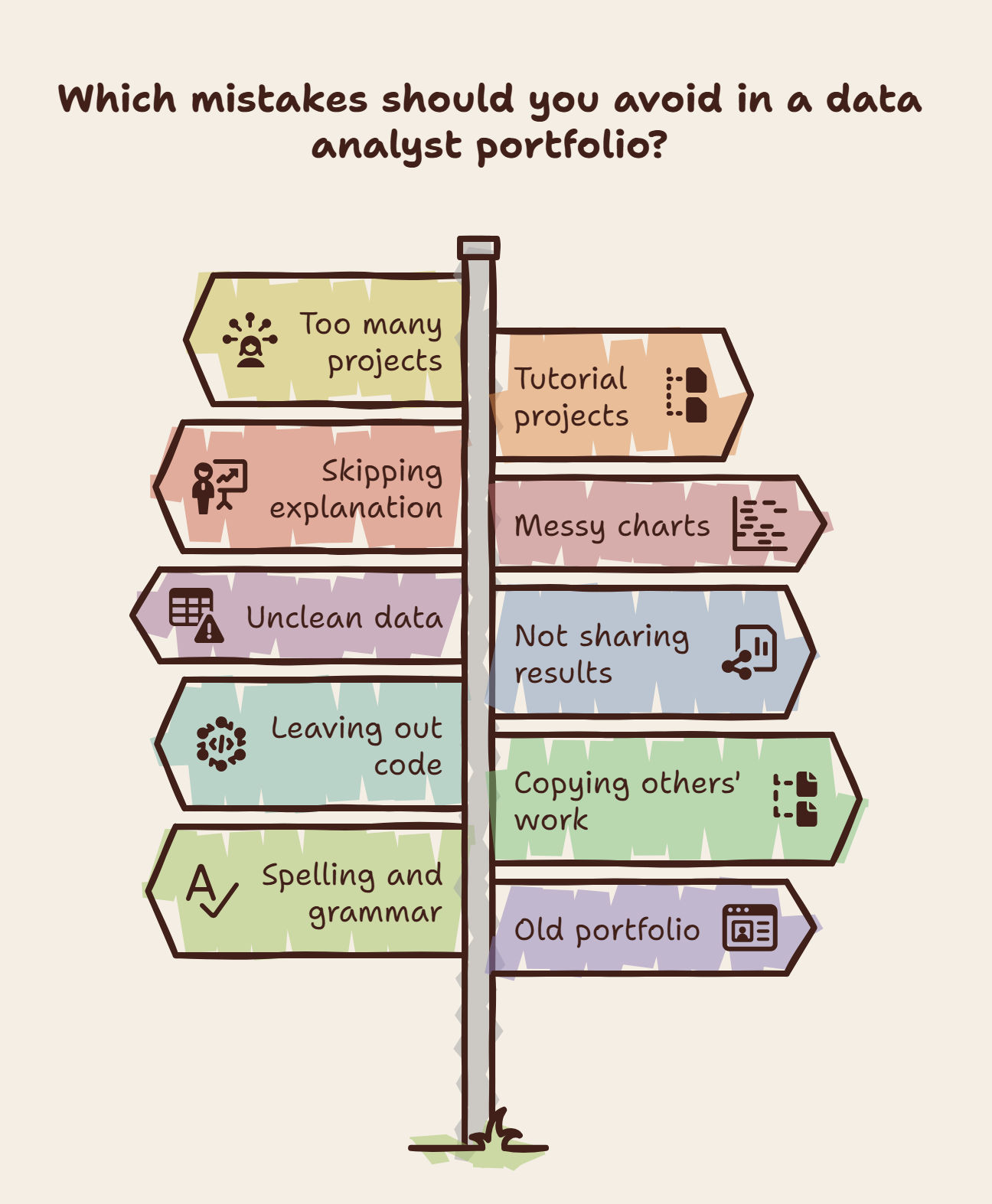
Mistakes to Avoid When Building a Data Analyst Portfolio

Conclusion

People don't have to be a perfect data analyst to have a great portfolio. They just want a few well done projects with clear descriptions and practical results. Keep it simple, use real data, provide code and explain each chart. Keep it up to date and don't make the same mistakes. Steady work will lead to great opportunities for work. 

Do you need help to create a portfolio? Schedule a free consultation with our experts today!

Frequently Asked Questions (FAQs)

1. What is the 80/20 rule?

This refers to the 80/20 rule where a small portion of effort creates most of the outcome. In data science this is commonly where around 80% of your time will be spent collecting, cleaning and tidying data whilst around 20% will be spent analyzing and creating charts.

2. Will AI take over Data Analysts jobs?

Not entirely. While AI can be used to make simple tasks quicker such as cleaning data and creating simple charts you will still need humans to understand the business problem, verify the results and explain what the numbers mean. Those who learn how to use AI tools will likely be at an advantage.

3. What are some good projects for a Data Analyst portfolio?

  • Sales trend analysis
  • Website traffic dashboard
  • Customer survey analysis
  • Data cleaning project showing before and after
  • Public data project (health, employment, housing etc)

4. What are the top 3 skills required for a Data Analyst?

  • SQL: To extract and sort data from databases.
  • Excel: For quick verification, simple calculations and basic reporting.
  • Data Visualization: To create clear charts from numbers using tools such as Tableau and Power BI.

5. How long does it take to create a Data Analyst portfolio?

Most beginners will be able to complete their first portfolio in between 4-8 weeks. Depending on the size of the data each project could take between a few days to a week. Starting off with 2 projects is totally fine!

6. Can I create a portfolio as a beginner with no work experience?

Absolutely! Personal projects are real evidence of your skills. Using free datasets from sites such as Kaggle and data.gov will be a great way to practise. Employers care more about having clear thinking and producing good outcomes rather than having a certain title.

7. Do I need a degree to be a Data Analyst?

Many employers will prefer to see someone with a degree in maths, business or computer science. However if you have strong skills and a good portfolio it can help those without a degree. Online courses and certifications can also help bridge the gap.

8. How often should I update my Data Analyst portfolio?

A good idea would be to have a quick look through every 3-6 months. Add new projects, remove any poor projects and ensure all links are working. It is also a good idea to update before applying for roles.

9. Should I have a portfolio over a CV?

No, they both have their own purpose. A CV will give a brief overview of your skills and experience whilst a portfolio will show real examples of your work. Both will give a complete picture to employers.

10. Where can I find free datasets to use in my projects as a beginner?

  • Kaggle
  • data.gov
  • City and State Open Data Websites
  • Google Dataset Search
  • Public reports from health and government groups

upGrad

1337 articles published

We are an online education platform providing industry-relevant programs for professionals, designed and delivered in collaboration with world-class faculty and businesses. Merging the latest technolo...

Speak with Data Science Expert

+91

By submitting, I accept the T&C and
Privacy Policy

Start Your Career in Data Science Today

Top Resources

Recommended Programs

Liverpool John Moores University Logo
bestseller

Liverpool John Moores University

MS in Data Science

Double Credentials

Master's Degree

18 Months

IIIT Bangalore logo

IIIT Bangalore

Executive Diploma in DS & AI

360° Career Support

Executive Diploma

12 Months

upGrad

Bootcamp

6 Months