Digital Marketing Process: A Step-by-Step Guide
By upGrad
Updated on Sep 16, 2026 | 6 min read | 1.49K+ views
Share:

All courses
Certifications
More
By upGrad
Updated on Sep 16, 2026 | 6 min read | 1.49K+ views
Share:
Table of Contents
Key Highlights
Learn the skills you need to succeed in marketing. Our digital marketing courses cover SEO, content marketing, content strategy, paid ads, and other relevant domains. Take the step and build the skills that employers are looking for.
Digital marketing process is a comprehensive way to promote products and services to the customers through digital channels. These channels include social media, search engines, email, mobile apps, and websites.
No traditional media like radio, TV, newspapers, billboards are used here.
The core of digital marketing is to identify the target audience. Businesses do their research about who the customers are, their personas, on which channel they spend most of their time. On the basis of this data, they create and share content or ads to reach the audience, make them aware about the brand, build interest, and convert them into buyers.
A well-defined digital marketing process helps the businesses maintain a record whether their digital marketing activities are working as per the goals or not.
The digital marketing process is a roadmap businesses use to map their online marketing efforts. It gives a clear picture of what they want to want to achieve, how they will achieve it and the time it will take.
Digital marketing process examples for your business are:
Also read: Fundamentals of Digital Marketing – What You Need to Know
Free Courses
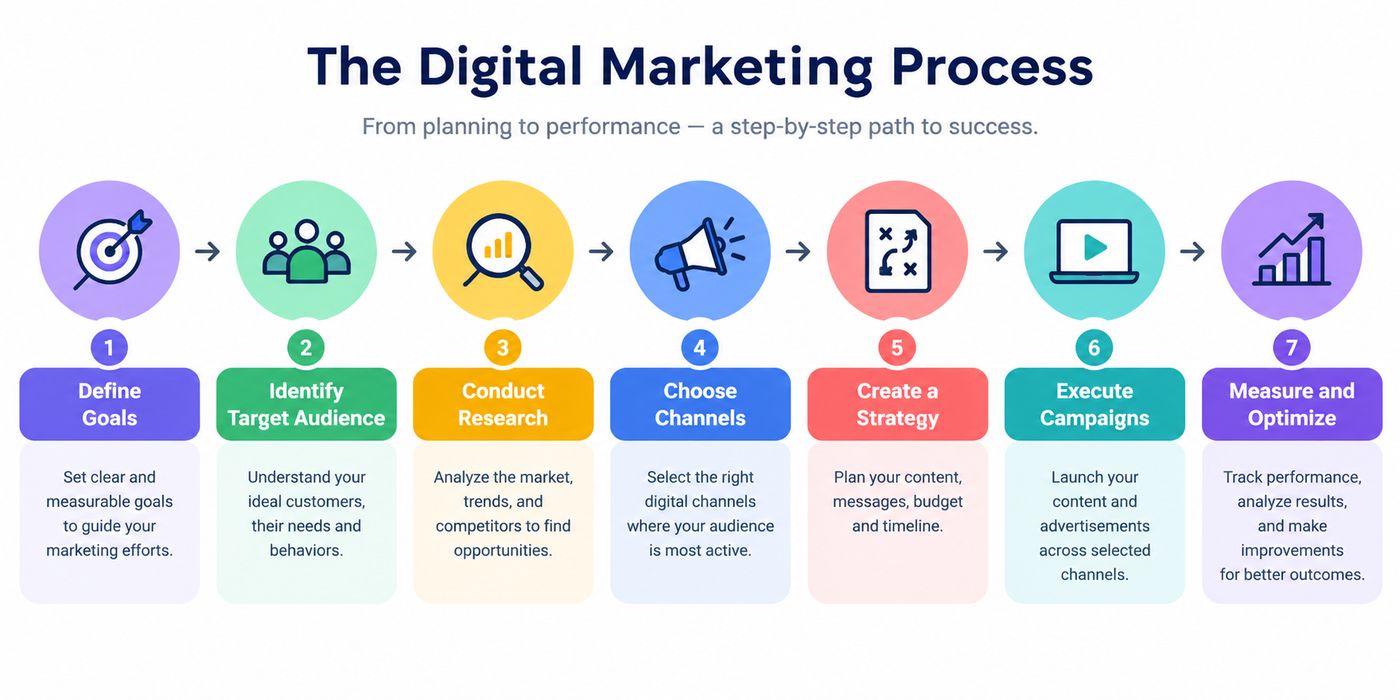
There are 7 digital marketing process steps, and these are as follows:
Before starting any marketing activity, a goal is required. A goal helps in understanding what to achieve in the short-term and long-term. Also, helps in analyzing if the goals are achieved within the set time limit or not.
Some of common digital marketing goals are:
The marketing goals should be clear and measurable. Most of the businesses use the SMART framework to set goals. SMART stands for:
For example: instead of setting goals like increasing website traffic. Write aims to increase organic traffic by 30% in the 4 months. When you have clear goals, choosing the right marketing strategies will become easy and chances to achieve the target becomes high.
The target audience is a group of people who can be interested in the product or service of a company. Having a target audience helps you in creating content as per their needs, which eventually increases the chances of conversion.
Some factors businesses can consider include:
Buyer persons are created for having more detailed information about the audience. Like if a company has management software, their target audience will be managers, team leaders, business owners. The more a business will understand its audience, the more it becomes easy to create better digital marketing campaigns.
Before creating a marketing plan, the business should research about the market, customers, competitors, and trends.
Market research can help in identifying:
With research, the businesses can understand how their competitors are promoting their products or services, what channels they are using, what is their budget, what are their loop holes and more.
In the market, there are multiple channels available and it is not necessary to use every channel. Which channel you should choose depends on several factors like :
Some common digital marketing channels include:
A digital marketing planning process acts as a roadmap for marketing activities. It defines what the business plans to do and how different activities will contribute to its goals.
An effective digital marketing strategy include:
At this stage, businesses implement the activities they planned during the strategy development process. Depending on the strategy, this may involve:
To execute the strategy successfully, the team members must coordinate with each other. Also, the businesses should maintain consistency in messaging, tone, identity and more.
With the help of a content calendar or marketing schedule, teams can organize activities and ensure the marketing activities are done on time.
It is the final step. Once you launch a campaign or any other marketing activity, your work is not done. Track the results to understand whether the marketing efforts are achieving business goals or not.
The metrics you will track will depend on your objectives. For example, if your focus is on achieving website traffic, then track visitor numbers, traffic sources. For lead generation track CTR, form filled and more.
After collecting data, marketers can analyze the results and identify:
Businesses can then optimize their campaigns.
Optimization may involve:
Following this step is important because digital marketing is a continuous process. Use the insights of one campaign to improve the future campaigns.
Check the digital marketing process flowchart below.
Digital Marketing Courses to upskill
Explore Digital Marketing Courses for Career Progression
MICA Executive Alumni Status
By tracking the right metrics will help you understand, if your digital marketing efforts are performing or not. Below are some of the common digital marketing metrics you should track.
In website traffic, you measure the number of visitors who visit your website. Analyze where visitors come from, such as:
With this information, marketers can put more effort into the channels that bring most of the traffic. And, improve the strategy for those channels which are not performing well.
The conversion rate is a metric that measures the percentage of users who complete a desired action. A conversion can be:
By measuring a click-through rate (CTR), you get to know how often users click on a link or advertisement after seeing it.
This metric is commonly used to measure the performance of email campaigns, paid advertisements, search advertisements, and social media campaigns.
Cost per lead shows how much you spend to generate one potential customer. Also, it can tell if the lead generation campaign is cost-effective or not.
A lower CPL means the campaign is working well and bringing in leads without overspending. A higher CPL might mean the targeting, messaging, or channel needs to be adjusted.
The engagement rate measures how audiences interact with digital content. Engagement metrics include likes, comments, shares, clicks, and saves. This metric best works for checking social media and content marketing performance.
Customer Acquisition Cost (CAC) is a metric that shows how much money you are spending, on average, to acquire one new paying customer. It is not just a lead, but an actual customer.
Return on Investment (ROI) is a metric that shows how much profit or value you are making as compared to what you spent on a campaign or activity. In digital marketing, it's used to check whether the money spent on marketing efforts is actually paying off or not.
Also read: Stages of Digital Marketing: A Complete Practical Guide
These are some of the best practices businesses can follow:
Also read: How to Create Social Media Campaigns? 6 Steps To Create Successful Campaigns
The digital marketing process provides businesses with a structured way to plan, execute, and improve their online marketing activities. It begins with defining clear goals and understanding the target audience. Businesses then conduct research, select suitable digital marketing channels, create a strategy, execute campaigns, and measure their results.
Following these steps can help businesses create more organized and effective marketing campaigns. A digital marketing planning process can help businesses make better marketing decisions, use resources effectively, and work toward long-term growth.
Ready to start your journey? Book a free consultation with upGrad today to find the best path for your career.
Any business, startup, entrepreneur, or marketing team can use a digital marketing process to organize and manage online marketing activities.
The timeline varies depending on the marketing channel, competition, campaign goals, and strategy. Some paid campaigns may show results quickly, while SEO and content marketing often take longer.
Yes. Businesses can start with cost-effective methods such as content marketing, SEO, email marketing, and organic social media based on their available resources.
Yes. Collaboration between marketing and sales teams can help ensure that marketing campaigns attract relevant prospects and support the overall customer journey.
Customer feedback helps businesses understand audience preferences, challenges, and expectations, which can improve marketing messages and campaign decisions.
Yes. Businesses can use marketing automation tools for tasks such as email campaigns, social media scheduling, lead nurturing, and reporting.
Understanding the customer journey helps businesses create relevant content and messages for customers at different stages, from awareness to purchase.
Content helps businesses educate, inform, engage, and build trust with their audience while supporting different marketing activities.
Businesses can use brand guidelines, content calendars, and clear messaging to maintain consistency across different platforms and campaigns.
Businesses and marketing professionals can improve their skills by gaining practical experience, analyzing campaign performance, learning new tools, and staying updated with industry changes.
No. The basic framework may be similar, but the approach can vary based on a business's industry, audience, goals, resources, and marketing channels.
1283 articles published
We are an online education platform providing industry-relevant programs for professionals, designed and delivered in collaboration with world-class faculty and businesses. Merging the latest technolo...
Get Free Consultation
By submitting, I accept the T&C and
Privacy Policy
Level Up Your Digital Marketing Career Today!
Top Resources
MICA
Advanced Certificate in AI-Powered Digital Marketing & Communication from MICAMICA Executive Alumni Status
Certification
5 Specialisation
Classroom
4 Months
Certification
2 Months