Social Media Content Calendar: Guide to Planning Better Content
By upGrad
Updated on Jun 17, 2026 | 8 min read | 2.65K+ views
Share:

All courses
Certifications
More
By upGrad
Updated on Jun 17, 2026 | 8 min read | 2.65K+ views
Share:
Table of Contents
A social media content calendar serves as a structured, forward-looking plan for your upcoming posts. It typically outlines key details such as publishing dates, times, platforms, content formats, captions, visual assets, links, and campaign tags. Having this in place helps maintain a consistent posting schedule and creates a more streamlined workflow.
A social media content calendar is really helpful for people who manage media. It does not matter if you are a student or a big company. Planning what you will post ahead of time helps you stay on track and make sure you are posting things on time. You will know what to post every day because you have already planned it out.
In this blog, you'll learn what a social media content calendar is, why it matters, how to create one, what to include, common mistakes to avoid, and the best tools you can use.
Explore upGrad's Online Digital Marketing Courses and gain practical insights on building an effective social media content calendar.
A social media content calendar is like a plan that helps you figure out what you want to post on media, where you want to post it and when you want to share it with everyone. This calendar is important because it keeps track of all your media activities in one place.
You can think of it as a timetable that helps you keep your posts in order across platforms like Instagram, LinkedIn, Facebook, X, YouTube, and TikTok.
If you do some research, you will find that people who make a plan for their social media content and write it down are more likely to have a marketing experience than people who just post things randomly on social media.
Also Read: Content Calendar: What is it & How to Create One?
Element |
Purpose |
| Publish date | Defines when content goes live |
| Platform | Identifies where content is posted |
| Content topic | Main idea of the post |
| Format | Reel, image, carousel, video, story, etc. |
| Caption copy | Draft content for posting |
| CTA | Desired audience action |
| Owner | Person responsible for the post |
| Status | Draft, review, approved, published |
| Performance metrics | Tracks results after publishing |
Read: How to Create Social Media Content Strategy? Everything You Need to Know
Free Courses
A content calendar for media helps the teams to stop just posting randomly at the last minute. Instead, plan strategic publishing; they can think about what they want to convey and plan their social media posts ahead of time. This way teams can use media in a smart way and get the most out of it.
Benefits include:
Also Read: Social Media Analytics: What It Is, How It Works, and Why It Matters
People often use these words interchangeably, but they are not the same thing.
For businesses, a social media content calendar dedicated to social media is used with a broader calendar that has all the marketing plans.
Social Media Content Calendar |
General Content Calendar |
| Focuses only on social channels | Covers all marketing channels |
| Includes post schedules | Includes blogs, emails, videos, webinars |
| Platform-specific | multi-channel planning |
| Short-term execution | Broader content strategy |
Also Read: Plan a Month of Content in One Sitting with Content Calendar Template
Digital Marketing Courses to upskill
Explore Digital Marketing Courses for Career Progression
MICA Executive Alumni Status
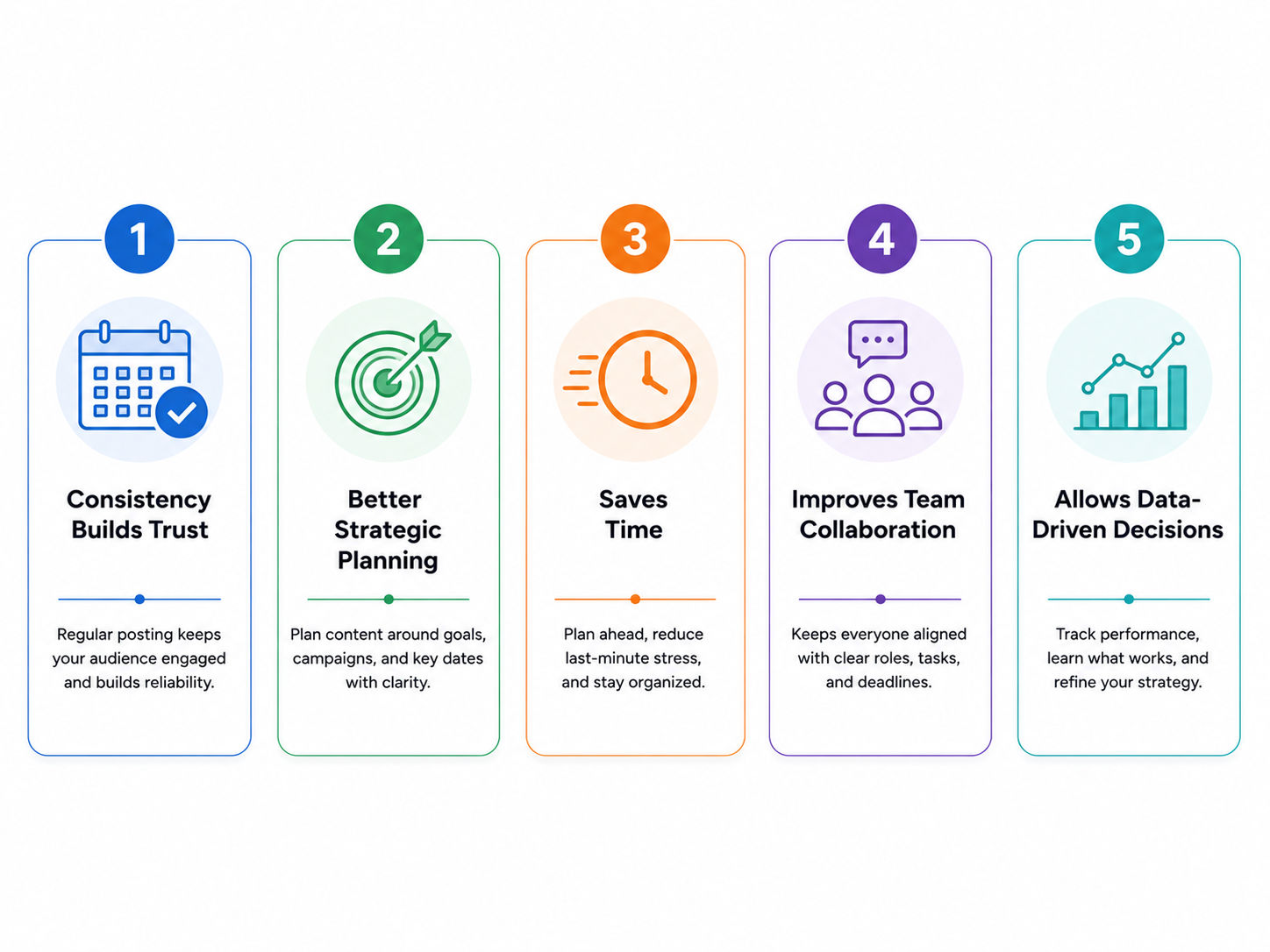
Many brands struggle to be consistent. One week they put up posts every day. The next week they are nowhere to be found.
This happens because they do not plan well. A social media content calendar helps with that problem by giving them a plan to follow while still letting them make changes when they need to.
Audiences want to watch content all the time. If you do not post content every week, people will lose interest in what you have to say. Your audience will stop paying attention to your content.
When you post content every week, your audience knows when to expect new content from you. When your posting schedule becomes unpredictable, audience engagement often drops.
A calendar helps you:
Without planning, content becomes reactive.
With a content calendar for social media, you can align posts with:
One thing that people often forget about is efficiency. Instead of creating posts every single day you can do something called batch tasks:
This approach reduces daily workload significantly.
For teams, visibility matters.
A shared calendar helps everyone understand:
Planning doesn't mean rigidity. A lot of people who work with social media consider calendars as plans that can be changed. They look at what's popular and how things are going, and they make changes to what they post throughout the month.
Social media managers do this because trending topics and performance insights can affect what they post on the media.
Also Read: Impact of Social Media on Businesses, Society, and Careers
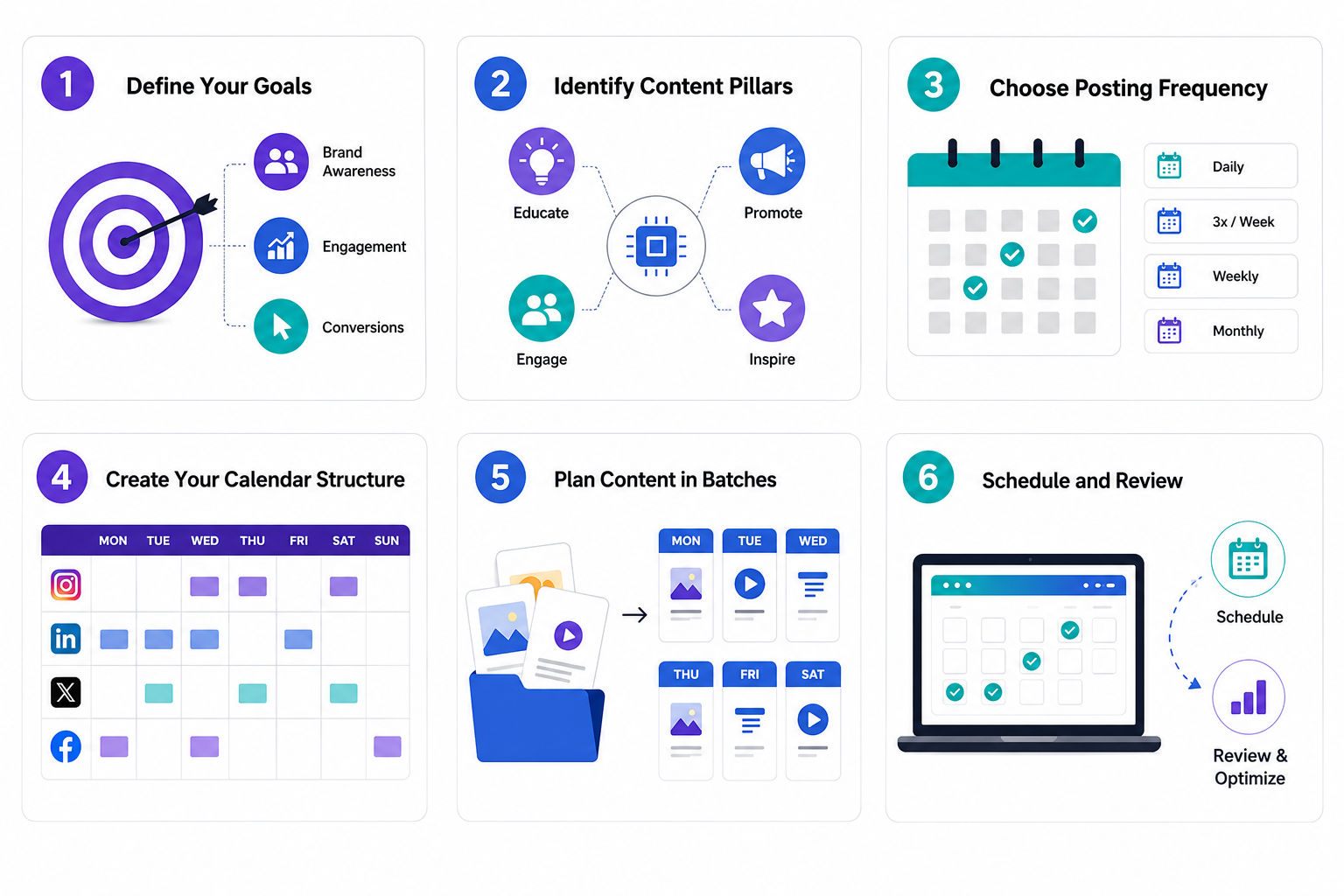
Planning media posts is not that hard. The point of doing this is not to make everything perfect.
The point is to keep planning all the time with the media content calendar. Creating a social media content calendar is about being consistent with the media content calendar.
Start by identifying your objective.
Common goals include:
Content pillars are the ideas that we come back for when we are making new content. These content pillars help us figure out what kind of content to create. We use these content pillars to make sure our content is consistent and makes sense.
For example:
Content Pillar |
Example |
| Educational | Tips and tutorials |
| Inspirational | Success stories |
| Promotional | Product updates |
| Community | User-generated content |
| Entertainment | Memes and trends |
Most brands perform well with 3 - 5 content pillars.
Start realistically.
For example:
Platform |
Weekly Frequency |
| 4–5 posts | |
| 3–4 posts | |
| 3–5 posts | |
| TikTok | 4–7 videos |
| X | Daily updates |
Frequency should match your resources and audience behavior.
Add columns such as:
Many creators schedule content weekly or monthly.
Batching helps you:
Schedule approved posts in advance.
Then review performance regularly and adjust future plans based on:
Also Read: Powerful Advantages of Social Media You Can’t Ignore
Subscribe to upGrad's Newsletter
Join thousands of learners who receive useful tips
Building a calendar is the start. The calendar is really useful when you keep up to date.
Planning is important, but social media changes quickly.
Reserve 15–20% of your calendar for:
Avoid posting only promotional content.
A healthy mix often includes:
Monitor metrics regularly.
Questions to ask:
Use these insights to refine future plans.
Include:
Planning ahead prevents rushed execution.
Also Read: 15 Major Social Media Trends in 2025
Several tools can help manage a social media content calendar effectively.
Tool |
Best For |
| Google Sheets | Beginners and small teams |
| Notion | Flexible planning |
| Trello | Visual workflows |
| Buffer | Scheduling and publishing |
| Sprout Social | Enterprise social management |
| Hootsuite | Multi-platform scheduling |
Also Read: 5 Tools Every Social Media Marketer Needs To Know About
A content calendar for media helps plan posts, in advance. It makes sure that content is posted regularly. This way you know what to post and when.
Date |
Platform |
Topic |
Format |
| June 1 | Industry tip | Carousel | |
| June 3 | Case study | Text post | |
| June 5 | Customer story | Reel | |
| June 8 | Behind-the-scenes | Video | |
| June 10 | Expert Insight | Article |
A social media content calendar is more than a scheduling document. It is a planning system that helps you create better content, maintain consistency, save time, and align social media efforts with business goals.
Whether you manage one account or multiple channels, a well-organized content calendar for social media brings clarity to your strategy. Start simple, focus on consistency. Review performance regularly. Over time, your calendar will become one of the most valuable assets in your social media workflow.
Want to explore more about social media content calendar? Book your free 1:1 personal consultation with our expert today.
A social media content calendar helps organize and schedule posts before they are published. It provides visibility into upcoming content and reduces last-minute planning. It also improves consistency and ensures content aligns with marketing goals. Teams can collaborate more efficiently and maintain a structured publishing process.
Most businesses plan content two to four weeks ahead. This provides enough structure while still allowing flexibility for trends and timely updates. The ideal planning window depends on your industry, content volume, and approval process. Many marketers update calendars weekly based on performance data.
Yes. Small businesses often have limited resources, making planning even more important. A content calendar helps maximize efficiency and reduce content-related stress. It allows owners and marketers to stay consistent without spending hours deciding what to post every day.
Planning focuses on deciding what content to create and why. Scheduling focuses on choosing the exact time and date for publishing. A social media content calendar combines both activities into one organized workflow that supports strategic execution.
Include any platform where your audience is active. Common options include Instagram, LinkedIn, Facebook, TikTok, YouTube, Pinterest, and X. Your calendar should reflect your specific marketing goals and audience preferences rather than trying to cover every platform.
Review your calendar weekly and update it monthly. Frequent reviews help you adapt to performance trends and changing audience interests. Regular updates also ensure campaigns, events, and promotions remain aligned with business priorities.
For many individuals and small teams, yes. Google Sheets and Excel provide affordable and flexible solutions for managing content schedules. As teams grow, dedicated tools may offer additional features such as approvals, analytics, and automated publishing.
Most brands use educational, promotional, community-focused, inspirational, and entertainment content pillars. The right mix depends on audience needs, business objectives, and platform-specific behavior. Testing helps identify what works best.
Track engagement, reach, clicks, conversions, shares, and follower growth. Compare results against your original objectives. A successful social media content calendar should improve consistency while contributing to measurable business outcomes.
Yes. AI tools can generate content ideas, draft captions, suggest posting schedules, and assist with planning workflows. However, human review remains essential to ensure relevance, accuracy, and brand alignment across all content.
The biggest mistake is treating the calendar as a rigid document. Social media changes quickly, and flexibility is important. A strong calendar provides structure while allowing adjustments based on trends, audience feedback, and performance insights.
1011 articles published
We are an online education platform providing industry-relevant programs for professionals, designed and delivered in collaboration with world-class faculty and businesses. Merging the latest technolo...
Get Free Consultation
By submitting, I accept the T&C and
Privacy Policy
Level Up Your Digital Marketing Career Today!
Top Resources
MICA
Advanced Certificate in AI-Powered Digital Marketing & Communication from MICAMICA Executive Alumni Status
Certification
5 Specialisation
Classroom
4 Months
Certification
2 Months