Digital Marketing Steps: A Step-by-Step Guide to Building an Effective Marketing Strategy
By Sriram
Updated on Jul 27, 2026 | 9 min read | 7.14K+ views
Share:

All courses
Certifications
More
By Sriram
Updated on Jul 27, 2026 | 9 min read | 7.14K+ views
Share:
Table of Contents
Key Highlights
Build in-demand skills in SEO, social media, content marketing, PPC, analytics, and AI-powered marketing with upGrad's Digital Marketing programs. Learn through real-world projects and expert mentorship.
Many businesses jump straight into running ads or posting on social media. That's where things often go wrong.
The digital marketing steps provide a logical sequence that helps businesses attract the right audience, build trust, generate leads, and convert visitors into customers. Instead of treating marketing as separate tasks, these steps connect every activity into one organized process.
Think of it as a roadmap. Each step builds on the previous one, making your marketing more focused and easier to measure. If you skip important stages such as audience research or goal setting, even a large marketing budget may produce disappointing results.
A quick overview of the digital marketing process :
Step |
Purpose |
Expected Outcome |
| Research | Understand the market and competitors | Better business insights |
| Audience Planning | Identify ideal customers | More relevant messaging |
| Strategy Development | Set objectives and priorities | Clear direction |
| Channel Selection | Choose suitable marketing platforms | Higher reach and engagement |
| Content Creation | Produce valuable content | Increased audience interest |
| Campaign Execution | Launch marketing activities | Traffic and lead generation |
| Performance Analysis | Measure results and improve | Better long-term performance |
This structured approach works for businesses of all sizes. A startup launching its first website and an established company entering a new market both benefit from following the same process. The difference usually lies in the scale, not the sequence.
Another advantage is consistency. Your team doesn't have to guess the next step digital marketing requires because every phase naturally leads to the next. That makes planning easier and reduces costly mistakes.
Also read: Digital Marketing Tutorial: A Step-by-Step Guide To Become an Expert
Free Courses
Starting digital marketing doesn't mean opening accounts on every platform or running advertisements immediately. It begins with understanding your business, your audience, and your goals. Following a structured process helps you avoid costly mistakes and makes every marketing activity more effective.
This step by step guide to digital marketing walks you through the seven essential stages. Each step builds on the previous one, so completing them in order creates a stronger foundation for long-term success.
Good marketing begins with good research. Before creating content or selecting channels, you need to understand your market, competitors, and customers. These insights help you make informed decisions instead of relying on assumptions.
Research should answer questions about demand, competition, and customer needs.
Research Area |
Purpose |
| Competitor Analysis | Understand market positioning |
| Customer Research | Identify audience needs |
| Keyword Research | Discover search demand |
| Industry Trends | Spot growth opportunities |
Not everyone is your ideal customer. Defining a target audience helps you create messages that resonate with the people most likely to buy your product or service.
A simple buyer persona is often enough to begin.
Audience Factor |
Example |
| Age | 25–40 |
| Profession | Small Business Owner |
| Goal | Increase online sales |
| Preferred Platform | Google Search and LinkedIn |
Must read: Digital Marketing Objectives: Full Guide with Types and Examples [2026]
Now that you know your audience, create a strategy that connects your business goals with your marketing activities. A strategy keeps every campaign aligned with the same objective.
Include these elements in your strategy.
Every marketing channel serves a different purpose. Choose the ones your audience already uses instead of trying to be active everywhere.
Goal |
Recommended Channel |
| Brand Awareness | Social Media |
| Organic Traffic | SEO |
| Lead Generation | Google Ads |
| Customer Retention | Email Marketing |
Once you've selected your channels, plan the content that will attract, educate, and convert your audience. Publishing consistently is far more effective than posting only when inspiration strikes.
Build a simple content calendar around your audience's questions and business goals.
Week |
Content Type |
Goal |
| Week 1 | Blog | Increase organic traffic |
| Week 2 | Video | Improve engagement |
| Week 3 | Nurture leads | |
| Week 4 | Case Study | Build trust |
For example, a travel agency can publish destination guides before promoting seasonal holiday packages. Helpful content builds trust first, making promotional campaigns more effective later.
With your content ready, begin publishing it across your selected channels. Launch gradually so you can monitor performance and make adjustments instead of changing multiple variables at once.
Your campaign could include:
Keep your messaging consistent across every platform. A customer who discovers your business through Google Search should experience the same tone and value proposition on your website and social media pages.
Marketing doesn't stop after launching a campaign. The best results come from continuous improvement based on real data.
Track key performance indicators regularly.
Optimization Workflow
Research → Strategy → Content → Launch → Measure → Optimize
Review your results every month and identify areas for improvement. Small changes to headlines, landing pages, or audience targeting often produce meaningful improvements over time. Following this continuous cycle makes every next step digital marketing more effective than the last.
Also read : Starting A Career In Digital Marketing: All You Need To Know
Research and audience insights give you direction. Now it's time to turn those insights into a practical plan. Learning how to create a digital marketing strategy means deciding what success looks like and how you'll achieve it.
Your strategy should stay simple. It doesn't need a lengthy document to be effective.
A strong strategy usually includes:
Here's a simple framework.
Strategy Component |
Example |
| Goal | Generate 300 qualified leads in six months |
| Audience | First-time home buyers |
| Channels | SEO, Email Marketing, Google Ads |
| Content | Buying guides, FAQs, case studies |
| KPI | Lead conversion rate |
Also Read: How to do Competitor Analysis? Step by Step Guide
Digital Marketing Courses to upskill
Explore Digital Marketing Courses for Career Progression
MICA Executive Alumni Status
The final planning step is selecting where you'll reach your audience. Many beginners believe they should be active on every platform. That's rarely the best approach.
Choose channels based on your audience, business goals, and available resources.
Here's a quick guide
Marketing Goal |
Recommended Channel |
| Build brand awareness | Social Media, YouTube |
| Increase website traffic | SEO, Content Marketing |
| Generate leads | Google Ads, LinkedIn |
| Drive repeat purchases | Email Marketing |
| Improve customer engagement | Instagram, Facebook Communities |
A B2B consulting company may focus on LinkedIn and SEO, while an online fashion store might get better results from Instagram and influencer marketing.
Choose channels based on your audience, goals, and budget. SEO and content marketing deliver long-term growth, while paid advertising offers faster visibility.
The goal isn't to be on every platform. It's to invest in the channels where your audience is most active. Once you've selected them, you can begin executing your digital marketing process step by step.
Ready to put these digital marketing steps into practice? Enroll in upGrad's Advanced Certificate in AI-Powered Digital Marketing & Communication from MICA and build job-ready skills in SEO, content marketing, social media, analytics, performance marketing, and AI-driven campaigns.
The terms digital marketing strategy and digital marketing process are often used interchangeably, but they serve different purposes. A strategy defines what you want to achieve and why, while the process explains how you'll achieve those goals through a series of planned actions.
Both work together. Without a strategy, your efforts lack direction. Without a process, even the best strategy is difficult to execute consistently.
Digital Marketing Strategy |
Digital Marketing Process |
| Defines business goals and marketing objectives | Outlines the step-by-step actions to achieve those goals |
| Focuses on planning and decision-making | Focuses on execution and optimization |
| Identifies the target audience and marketing channels | Covers campaign planning, launch, monitoring, and improvement |
| Sets long-term direction | Manages day-to-day implementation |
| Answers "What should we do?" | Answers "How should we do it?" |
A successful campaign combines both. Start with a clear strategy to define your objectives, then follow a structured digital marketing process to execute, measure, and refine your campaigns for better results.
Also read : Starting A Career In Digital Marketing: All You Need To Know
Not every customer is ready to buy immediately. Some people are discovering your brand for the first time, while others are comparing different options. That's why marketers use a funnel to understand customer behavior.
The digital marketing funnel stages show how people move from awareness to becoming loyal customers. Understanding these stages helps you deliver the right message at the right time.
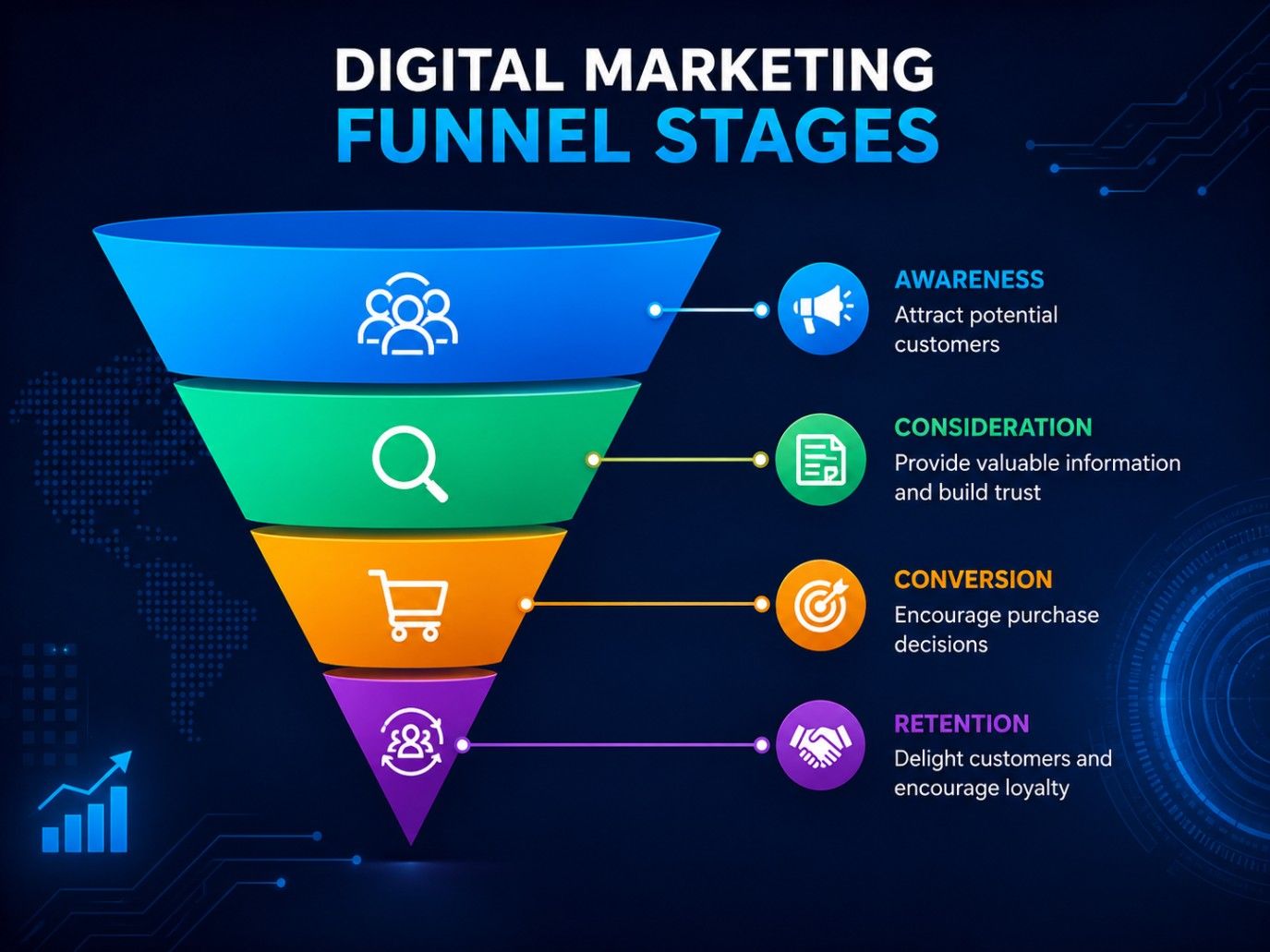
Imagine someone searching for "best laptops for students." Their journey doesn't end with a single search. They move through different stages before deciding to buy and may continue engaging with the brand even after the purchase.
Funnel Stage |
Customer Action |
Marketing Activity |
| Awareness | Searches for "best laptops for students" | SEO, blog articles, videos |
| Consideration | Compares laptop brands, features, and reviews | Comparison guides, product pages, case studies |
| Conversion | Purchases a laptop | Landing pages, paid ads, special offers |
| Retention | Buys accessories or returns for future purchases | Email marketing, customer support, loyalty programs |
Each marketing activity supports a specific stage of the funnel. Instead of focusing only on attracting visitors, businesses should guide customers through the entire journey to improve conversions and encourage long-term loyalty.
Understanding the process is easier when you see it in action. Here's a simple example of how a small business can apply the digital marketing steps to achieve a specific goal.
Imagine an online bakery that wants to increase birthday cake orders. Instead of running ads immediately, the owner follows a structured digital marketing process.
Step |
Bakery Action |
| Market Research | Identifies high-demand searches like "same-day cake delivery" and "custom birthday cakes." |
| Target Audience | Focuses on local families and working professionals within the delivery area. |
| Strategy | Sets a goal to increase online cake orders by 25% in six months. |
| Channel Selection | Chooses SEO, Instagram, and Google Business Profile to reach local customers. |
| Content Creation | Publishes cake galleries, birthday planning blogs, and customer testimonials. |
| Campaign Execution | Promotes content through weekly blog posts, Instagram Reels, and seasonal offers. |
| Performance Optimization | Uses Google Analytics to identify top-performing pages and improves similar content. |
This example shows that successful marketing isn't about using every available channel. It's about following the digital marketing process step by step, measuring results, and improving campaigns based on real customer behavior.
Also read : Digital Marketing for Small Business: A Complete Guide to Growing Your Business Online
Even a well-planned strategy can fall short if common mistakes creep into the process. Most of these issues aren't caused by a lack of budget. They happen because businesses skip important planning stages or stop measuring results too early.
The good news? They're easy to avoid once you know what to look for. As you follow the digital marketing steps, keep these pitfalls in mind.
Mistake |
Why It Hurts |
| Skipping market research | Creates campaigns based on assumptions |
| Targeting everyone | Weakens your message |
| Using every marketing channel | Spreads budget too thin |
| Ignoring SEO | Reduces long-term organic traffic |
| Publishing inconsistent content | Lowers audience trust |
| Not tracking performance | Makes improvement difficult |
| Giving up too early | Stops campaigns before they gain momentum |
Also read: Top Digital Marketing Channels for Maximum Reach and ROI
A successful digital marketing process focuses on consistency, continuous improvement, and data-driven decisions. Instead of chasing every trend, build a strong foundation and refine your strategy over time.
Follow these best practices:
Before launching your first digital marketing campaign, make sure you've completed these essential steps:
✓ Conduct market research to understand your audience and competitors.
✓ Define your target audience and create a buyer persona.
✓ Set clear and measurable marketing goals.
✓ Create a digital marketing strategy aligned with your objectives.
✓ Choose the right digital marketing channels for your business.
✓ Develop a content plan and prepare a publishing calendar.
✓ Launch your campaigns across your selected channels.
✓ Track key performance metrics such as traffic, conversions, and engagement.
✓ Review campaign performance using analytics tools.
✓ Optimize your strategy based on insights and repeat the process for future campaigns.
Following the digital marketing steps helps you create campaigns with a clear purpose instead of relying on guesswork. From setting goals and understanding your audience to choosing the right channels and creating valuable content, every stage plays an important role in achieving better marketing results.
Success comes from continuous improvement. Monitor campaign performance, learn from the data, and refine your strategy over time. By consistently applying the right digital marketing process, you can build stronger customer relationships, increase conversions, and achieve long-term business growth.
Ready to start your journey? Book a free consultation with upGrad today to find the best path for your career.
You don't need to master every marketing channel at once. Start with SEO, content marketing, social media, email marketing, and Google Analytics. Learning market research, audience targeting, and campaign measurement will also help you understand the digital marketing steps more effectively and build a strong foundation.
Start by understanding your business goals and target audience. Then learn the digital marketing process step by step by conducting market research, creating a strategy, choosing suitable marketing channels, developing content, launching campaigns, and measuring performance. Practical projects help reinforce these concepts faster than theory alone.
The seven common marketing steps include market research, identifying the target audience, setting goals, creating a strategy, selecting marketing channels, executing campaigns, and measuring results. Following these stages creates a structured workflow that helps businesses improve campaign performance and make informed marketing decisions.
SEO (Search Engine Optimization) is the process of improving a website's visibility in search engine results. It involves keyword research, technical optimization, content creation, and link building to attract organic traffic. SEO is one of the most effective long-term digital marketing channels because it continues generating traffic over time.
The most common types of digital marketing include SEO, content marketing, social media marketing, email marketing, pay-per-click (PPC) advertising, affiliate marketing, and influencer marketing. Businesses often combine several channels based on their goals, audience, and available budget instead of relying on a single method.
There's no single best type of digital marketing for every business. SEO works well for long-term organic growth, while PPC delivers faster visibility. Social media, email marketing, and content marketing each serve different purposes, so the right choice depends on your audience, objectives, and resources.
The seven pillars commonly include audience research, content marketing, SEO, social media marketing, email marketing, paid advertising, and analytics. Together, these pillars support customer acquisition, engagement, and retention while helping businesses build a consistent and measurable online marketing strategy.
The 3 C's of marketing refer to Customer, Company, and Competitor. Businesses use this framework to understand customer needs, evaluate their own strengths, and analyze competitors before developing a marketing strategy. It helps create campaigns that are both relevant and competitive.
The golden rule of marketing is to focus on customer needs before promoting products or services. Understanding your audience's challenges, creating valuable content, and delivering consistent experiences across channels often lead to stronger engagement, higher conversions, and long-term customer relationships.
The 3-3-3 rule is a marketing framework that varies by context, but it's commonly used to recommend focusing on three key messages, using three marketing channels, and reviewing performance every three months. It encourages businesses to simplify campaigns and improve results through regular optimization.
The eight widely recognized types of digital marketing are SEO, content marketing, social media marketing, PPC advertising, email marketing, affiliate marketing, influencer marketing, and mobile marketing. Choosing the right mix depends on your business goals, customer behavior, and where your audience spends time online.
695 articles published
Sriram K is a Senior SEO Executive with a B.Tech in Information Technology from Dr. M.G.R. Educational and Research Institute, Chennai. With over a decade of experience in digital marketing, he specia...
Get Free Consultation
By submitting, I accept the T&C and
Privacy Policy
Level Up Your Digital Marketing Career Today!
Top Resources
MICA
Advanced Certificate in AI-Powered Digital Marketing & Communication from MICAMICA Executive Alumni Status
Certification
5 Specialisation
Classroom
4 Months
Certification
2 Months