IELTS consists of four sections: Reading, Listening, Writing, and Speaking. Among these, the IELTS Reading test assesses your ability to understand information, identify key ideas, recognise specific details, and follow how ideas are developed across a passage.
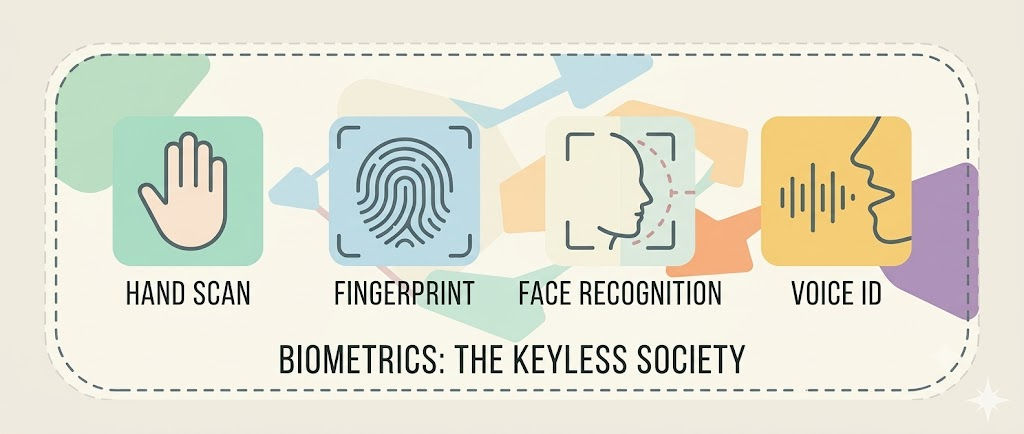
The Keyless Society looks at how biometric technology is being used to identify people and control access to different places and services. The passage covers systems such as fingerprints, hand scanners, voice prints, and face scanners, while also discussing concerns about privacy and the misuse of personal information.
The Keyless Society appears in Cambridge IELTS 2, Test 3, Reading Passage 3, covering Questions 27–40. For reference, here is the official The Keyless Society IELTS Reading answer key:
Question Numbers
The Keyless Society Reading Answers
1
iv
2
vii
3
viii
4
iii
5
ii
6
i
7
x
8
B
9
B
10
E
11
A
12
B
13
D
14
E
These are the answers for The Keyless Society IELTS Reading passage. You can now attempt the practice test below and then check your answers with the explanations to understand how each response is supported by the passage.
The Keyless Society IELTS Reading Passage for Practice
How can fingerprints, voices, hands, and faces be used instead of traditional keys and identity cards? The Keyless SocietyIELTS Reading Test dives into this by looking at how biometric technology is being used to identify people and control access to different places and services.
It also explains how these systems work, where they are being used, and why their growing use has raised concerns about privacy and the misuse of personal information.
Now, the following is a practice version inspired by the original IELTS Reading passage. Read it carefully before attempting the questions.
A
Students who want to enter the University of Montreal's Athletic Complex may need more than a regular identity card. Their identity has to be confirmed using an electronic hand scanner. In some California housing estates, having a key is not enough to enter a home, as the person's voice print must also be verified. In Japan, some bank customers may soon need to have their faces scanned before they can enter the building and withdraw money.
B
All of these are examples of biometrics, a technology that uses physical or biological characteristics to identify people. Biometrics have been used for more than a decade in some high-security government institutions in the United States and Canada. The technology is now becoming more common in everyday life.
More than 10,000 facilities, ranging from prisons to day-care centres, already use fingerprints or other physical features to check people's identities. Around 60 biometric companies worldwide earned at least $22 million in the previous year, and this total was expected to increase to at least $50 million by 1999.
C
Biometric security systems work by storing a digital record of a unique human feature. When an authorised person wants to enter a building or use a facility, the system scans the person's relevant characteristic and compares it with the information already stored.
Systems based on fingerprints, hands, voices, irises, retinas, and faces are already available. Other systems using typing patterns and even body odours are at different stages of development.
D
Fingerprint scanners are currently the most widely used type of biometric application. Their popularity is partly due to their increasing use by law-enforcement agencies over the past 20 years.
Sixteen American states now use biometric fingerprint verification systems to check whether people claiming welfare payments are genuine. In June, politicians in Toronto also voted to introduce a similar system, with a pilot project due to begin the following year.
E
The most widely used commercial biometric system so far is the handkey. This type of hand scanner reads the unique shape, size, and irregularities of a person's hands.
The handkey was originally developed for nuclear power plants. It became widely recognised after it was used to control access to the Olympic Village in Atlanta, where more than 65,000 athletes, trainers, and support staff used the system. Since then, it has been used in many other applications.
F
The biometric market is growing rapidly around the world. Malaysia, for example, is preparing to install biometric face scanners at all of its airports so that passengers can be matched with their luggage. In Japan, the country's largest manufacturer of cash dispensers is developing new machines that include iris scanners.
The first commercial biometric system was introduced in 1974. An American company used a hand reader to monitor employee attendance. However, biometric technology became commercially viable only in the past few years, when improvements made it possible for prices to fall. As the technology became more affordable, awareness of biometrics also increased.
G
Biometrics have also raised difficult questions about privacy and the possibility of misuse. Some people are concerned that governments and companies could use the technology to monitor individual behaviour.
For example, one policy analyst suggested that if someone's fingerprints were used to connect health-insurance records with credit-card information showing frequent purchases of cigarettes and fatty foods, their insurance payments could rise sharply. In Toronto, critics of the welfare fingerprinting plan also argued that it could stigmatise recipients because fingerprinting is widely associated with criminals.
H
Despite these concerns, support for biometrics is increasing in Toronto and in many other communities. As the world becomes increasingly crowded and complicated, biometrics may become a technology whose use is becoming more widely accepted.
Looking to strengthen your IELTS preparation before you take the test? Get practical guidance with upGrad’sfree IELTS course and work on your skills at your own pace.
The Keyless Society Reading Practice Questions
Now that you have read the passage, it is time to test your understanding. The questions below ask you to identify the main idea of each paragraph and locate specific information about the people, places, and organisations mentioned in the passage.
Pay attention to how the questions may use different words to express the same information.
Questions 1–7: Matching Headings
The reading passage contains 8 paragraphs labelled A–H.
Choose the most suitable heading for paragraphs B–H from the list below.
Write the correct Roman numeral i–x in boxes 1–7.
Note: There are more headings than paragraphs, so you will not use all of them.
List of Headings
Roman numeral
Heading
i
Concerns about the misuse of biometric information
ii
The growing popularity of biometric technology
iii
The commercial success of one particular system
iv
How biometric technology works
v
The increasing use of fingerprint identification
vi
New uses for biometric technology
vii
The development of biometric technology
viii
Problems caused by biometric identification
ix
The possible future of biometric technology
x
The cost of introducing new security systems
Choose a Heading for Each Paragraph:
Question
Paragraph
Your Answer
1
Paragraph B
______
2
Paragraph C
______
3
Paragraph D
______
4
Paragraph E
______
5
Paragraph F
______
6
Paragraph G
______
7
Paragraph H
______
Questions 8–14: Matching Information
Look at the following groups of people and the list of biometric systems below.
Match each group with the biometric system mentioned in the passage.
Write the correct letter A–F in boxes 8–14.
Note: Some biometric systems may be used more than once.
Groups of People
8. Students entering a university sports facility
9. Athletes staying at a major international sporting event
10. Passengers travelling through Malaysian airports
11. People applying for welfare payments
12. Employees whose attendance is being recorded
13. Residents entering homes in California
14. Customers using banks in Japan
List of Biometric Systems
A. Fingerprint scanner B. Hand scanner C. Iris scanner D. Voice print E. Face scanner F. Typing pattern
The Keyless Society Reading Answers with Explanation
Once you have attempted the questions, use the The Keyless Society reading answers with location below to check your responses and understand where each answer comes from in the passage.
The explanations also point out possible traps and show you how to identify the main idea or specific detail you need.
Answers 1–7: Matching Headings
Answer 1: ii. The growing popularity of biometric technology
Explanation: Paragraph B explains how biometrics have moved from high-security government institutions into everyday use. It also gives figures showing the growing number of facilities and companies using the technology. You may focus on the financial figures, but the main idea is the wider growth of biometrics.
Answer location: Paragraph B
Answer 2: iv. How biometric technology works
Explanation: Paragraph C explains the basic process behind biometric systems. You are told that a digital record of a unique feature is stored and then compared with a person's scanned characteristic. The paragraph also lists different biometric systems, but the main focus is how the technology operates.
Answer location: Paragraph C
Answer 3: v. The increasing use of fingerprint identification
Explanation: Paragraph D focuses on fingerprint scanners and explains why they have become widely used. It then gives examples from American states and Toronto. You might choose a heading about welfare payments because they are mentioned, but welfare verification is only an example of the wider use of fingerprints.
Answer location: Paragraph D
Answer 4: iii. The commercial success of one particular system
Explanation: Paragraph E focuses on the handkey, explaining what it does, where it was first developed, and how its use at the Olympic Village helped it become widely recognised. You may notice several applications, but the paragraph is mainly about the success and spread of this particular commercial system.
Answer location: Paragraph E
Answer 5: vii. The development of biometric technology
Explanation: Paragraph F traces the development of biometrics from the first commercial system in 1974 to newer applications. It also explains how improvements reduced prices and made the technology commercially viable. You might focus on Malaysia or Japan, but these are examples supporting the broader development of the technology.
Answer location: Paragraph F
Answer 6: i. Concerns about the misuse of biometric information
Explanation: Paragraph G moves away from the benefits of biometrics and focuses on privacy and possible misuse. You are given examples of personal information being connected and welfare recipients being stigmatised. These examples explain why people are concerned about how biometric data could be used.
Answer location: Paragraph G
Answer 7: ix. The possible future of biometric technology
Explanation: Paragraph H considers the growing acceptance of biometrics despite earlier concerns. The final sentence suggests that the technology may become more widely accepted in the future. You may consider a heading about privacy, but those concerns are discussed mainly in Paragraph G, not H.
Answer location: Paragraph H
Answers 8–14: Matching Information
Answer 8: B. Hand scanner
Explanation: Paragraph A states that students entering the University of Montreal's Athletic Complex may need their identity confirmed using an electronic hand scanner. You may notice that the passage mentions several systems in the same paragraph, so match the university sports facility specifically with the hand scanner.
Answer location: Paragraph A
Answer 9: B. Hand scanner
Explanation: Paragraph E explains that the handkey, a type of hand scanner, was used to control access to the Olympic Village in Atlanta. More than 65,000 athletes, trainers, and support staff used the system. This directly connects the athletes in the question with a hand scanner.
Answer location: Paragraph E
Answer 10: E. Face scanner
Explanation: Paragraph F says that Malaysia is preparing to install biometric face scanners at all its airports so that passengers can be matched with their luggage. You might consider an iris scanner because Japan is also mentioned, but that system is being developed for cash dispensers, not airline passengers.
Answer location: Paragraph F
Answer 11: A. Fingerprint scanner
Explanation: Paragraph D states that sixteen American states use biometric fingerprint verification to check whether people claiming welfare payments are genuine. You should connect the welfare claimants with fingerprints rather than the handkey, which is discussed separately in Paragraph E.
Answer location: Paragraph D
Answer 12: B. Hand scanner
Explanation: Paragraph F explains that the first commercial biometric system was a hand reader used by an American company to monitor employee attendance. You may be tempted to choose a system such as typing patterns because it is mentioned in the passage, but those systems are still described as being in development.
Answer location: Paragraph F
Answer 13: D. Voice print
Explanation: Paragraph A explains that in some California housing estates, having a key is not enough to enter a home because the person's voice print must also be verified. The question refers specifically to residents entering homes, so you can match this detail directly with voice print.
Answer location: Paragraph A
Answer 14: E. Face scanner
Explanation: Paragraph A says that some bank customers in Japan may need to have their faces scanned before entering the building and withdrawing money. You may notice that Paragraph F also mentions iris scanners in Japan, but those are being developed for cash dispensers rather than bank entry.
How to Approach The Keyless Society IELTS Reading Questions?
The Keyless Society can be tricky because several paragraphs mention different biometric systems, while some headings may seem similar. Focus on the main idea for headings and the exact person, place, or situation for matching information.
Here are a few simple ways to approach The Keyless Society Reading Questions:
1. Start with the Main Idea, Not a Single Detail
For Matching Headings
Before choosing a heading, ask yourself:
“What is this paragraph mainly about?”
Do not select a heading just because you spot one matching word. A paragraph may mention several examples, but only one idea usually connects them.
Keep in mind: Example ≠ main idea
If one detail takes up only part of the paragraph, check whether the rest of the paragraph supports the same heading.
2. Build the Connection: Person → Place → System
For Matching Information
Instead of searching for the biometric system immediately, break the question into three parts:
Look for
Example
Who?
Olympic athletes
Where?
Olympic Village
Which system?
Hand scanner
This makes the answer easier to find because the passage may describe the same system in a different way.
One useful reminder: The same answer can be used more than once. In this passage, both university students and Olympic athletes are connected with hand scanners.
3. Watch for Paraphrasing
IELTS rarely gives you the exact wording from the passage in the question. Look for the same meaning, even when the words change.
In the question
In the passage
People applying for welfare payments
People claiming welfare payments
Employees whose attendance is being recorded
A hand reader used to monitor employee attendance
Residents entering homes
People entering homes in California housing estates
So, your job here is to match the idea, not the exact wording.
4. Use the Question Type to Decide How You Search
Matching Headings
Paragraph → Main idea → Heading
The answers follow the paragraph order from B to H, so once you find the main idea of one paragraph, move forward rather than starting from the beginning again.
Matching Information
Person/group → Situation → Biometric system
Here, the information is spread across the passage. The questions are not arranged according to where the answers appear.
5. Use Names and Places as Scanning Clues
Some details in The Keyless Society are much easier to scan than general words such as biometrics or security.
Look out for distinctive clues such as:
California → voice print Olympic Village → hand scanner Malaysia → face scanner Toronto → fingerprint scanner Japan → face scanner / iris scanner
These details can take you to the right part of the passage quickly.
But check the full sentence before answering. Japan, for example, is connected with two different biometric uses, so the exact situation in the question matters.
Looking for more IELTS Reading practice? Read these answer guides to practise different passage topics and question types:
The Keyless Society shows how biometric technology is changing the way people are identified and given access to different places and services. As you work through the questions, focus on the specific clues and connections in the passage instead of looking for exact words from the questions.
When you check your answers in The Keyless Society Reading Answers, pay attention to how you reached the answer. This will help you recognise paraphrased information, separate main ideas from supporting details, and become more confident when handling different IELTS Reading question types.
1. What is The Keyless Society IELTS Reading passage about?
The Keyless Society explains how biometric technology is used to identify people and control access to different places and services. It covers fingerprints, hand scanners, voice prints, and face scanners, along with concerns about privacy and possible misuse.
2. How can I use The Keyless Society Reading Answers for IELTS practice?
Read the passage and attempt all the questions before checking the answers. Then use the "The Keyless Society Reading Answers" section to review your responses and understand where each answer is supported in the passage.
3. What question types are included in The Keyless Society IELTS Reading passage?
The practice test includes Matching Headings and Matching Information. The two tasks require different approaches, so focus on the main idea for headings and look for specific people, places, or situations for matching information.
4. How can The Keyless Society IELTS Reading Answers help me improve?
Use the answers as a learning tool rather than simply checking whether you are right or wrong. Look at the supporting information and understand why an answer fits. This can help you recognise paraphrases and avoid similar mistakes in future IELTS Reading tests.
5. How should I approach Matching Headings in The Keyless Society Reading passage?
Focus on what each paragraph is mainly trying to explain. Do not choose a heading just because one word matches. If a paragraph contains several examples, look for the broader idea that connects those details.
6. Can the same answer be used more than once in The Keyless Society IELTS Reading passage?
Yes. The Matching Information instructions allow an option to be used more than once. In The Keyless Society, for example, a hand scanner is connected with both university students and Olympic athletes, so you should not reject an answer simply because you have already used it.
7. How can I find answers faster in The Keyless Society IELTS Reading passage?
Use distinctive names, places, and situations as scanning clues. Details such as California, Malaysia, Toronto, and the Olympic Village can help you reach the relevant paragraph quickly. Once you find the clue, read the surrounding sentence to confirm the answer.
8. Why are some answers easy to confuse in The Keyless Society IELTS Reading Answers?
Several biometric systems appear in the passage, and some places are connected with more than one system. Japan is a good example because the passage mentions both face scanning and iris scanners. Always check the exact situation described in the question.
9. How important is paraphrasing in The Keyless Society IELTS Reading passage?
Paraphrasing is important because the questions may express information differently from the passage. For example, “people applying for welfare payments” refers to people “claiming welfare payments” in the passage. Focus on the meaning instead of searching for identical words.
10. Should I check The Keyless Society Reading Answers after every question?
It is better to complete the full set before checking your answers. This gives you a clearer idea of your performance and makes it easier to identify which question type or part of the passage caused difficulty when you review your mistakes.
11. How should I review my mistakes in The Keyless Society IELTS Reading passage?
Return to the relevant part of the passage and compare it with the question. Check whether you missed a scanning clue, misunderstood a paraphrase, selected a supporting detail instead of the main idea, or overlooked an important part of the situation.
upGrad Abroad Editorial Team |5019 articles published
We are a dedicated team of study-abroad experts, ensuring intensive research and comprehensive information in each of our blogs. With every piece written, we aim at simplifying the overseas education ...
Refer Your Friend & Earn upto ₹15000
Help your friend upgrade to a Global Career and earn rewards together.