IELTS consists of 4 sections: Reading, Listening, Writing, and Speaking. Out of these, the IELTS Reading test includes passages followed by questions that test your ability to understand information, identify key ideas, and find specific details.
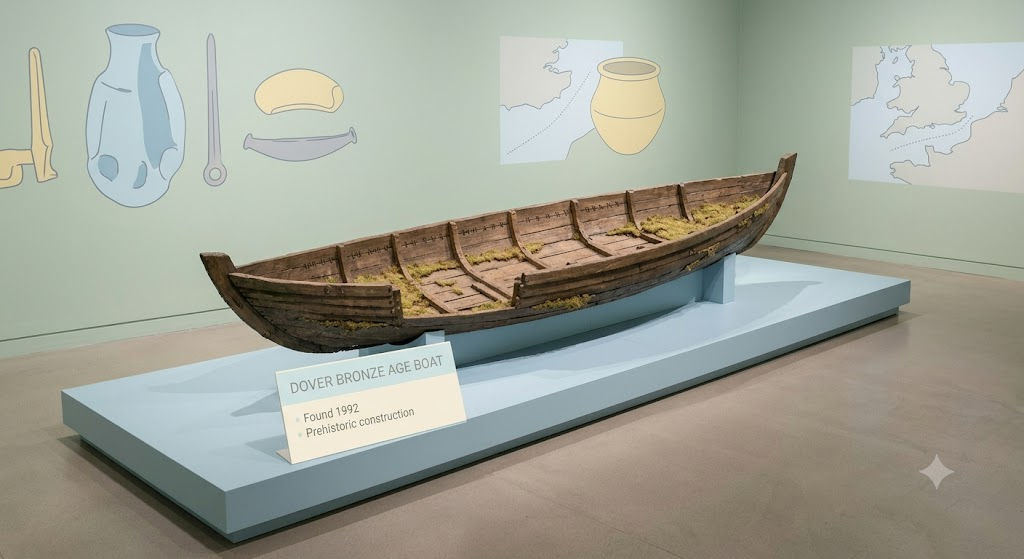
The Dover Bronze Age Boat is an IELTS Reading passage about the discovery of a prehistoric boat in Dover and the research carried out to understand its construction, history, and significance. It also covers the later reconstruction of the boat and its exhibition in France.
The passage is divided into seven sections, from A to G, covering the discovery, construction, research, reconstruction, and exhibition of the boat.
For your reference, here is the Dover Bronze Age Boat IELTS reading answer key:
Question Numbers
The Dover Bronze Age Boat Reading Answers
1
Boat
2
Conference
3
Plans
4
Launch
5
Exhibition
6
TRUE
7
TRUE
8
FALSE
9
NOT GIVEN
10
6 metres
11
Moss
12
Hull shape
13
Cost and time
These are the IELTS Reading answers for Test 1. You can now attempt the practice test below and then check your answers with the explanations to understand how they are supported by the passage.
The Dover Bronze Age Boat IELTS Reading Passage for Practice
The Dover Bronze Age Boat is one of the IELTS Reading test passages provided here for practice. It covers the discovery of a Bronze Age boat in Dover, the research carried out on it, and the later reconstruction and exhibition project.
One strategy that may work for you is to scan the questions before you start reading. Notice the dates, events, names, and other specific details mentioned in them. These can act as useful clues when you need to find the answers in the passage.
We have created this IELTS Reading practice test for you. Read the passage carefully and try to answer the questions that follow:
The Dover Bronze Age Boat IELTS Reading Passage
A. The Discovery of the Boat
In 1992, construction work was underway in central Dover as part of a project to connect the ancient port with the Channel Tunnel. The Canterbury Archaeological Trust was working alongside the construction workers when an unexpected discovery was made.
Around six metres below the level of the modern streets, a wooden structure was found at the bottom of a deep shaft. It was surrounded by waterlogged material, which had helped protect the wood. Archaeologists identified the structure as a prehistoric boat. About nine metres of it were recovered, although one end extended beyond the area being excavated.
B. How the Boat Was Built and Abandoned
The boat had been constructed from four carefully carved oak planks. The two planks forming its bottom were joined along the centre with wooden wedges. The planks were also stitched together, with yew being used for the stitching. Moss was placed along the joins to keep the seams watertight and was secured using wedges and yew stitches.
Evidence from the recovered end showed that some of the timbers had been removed in ancient times. There were also signs that the upper side planks were missing. These findings suggested that the boat had not simply been damaged by accident. Instead, it had been intentionally dismantled, broken up, and thrown away. Archaeologists even considered whether this could have been a form of “ritual killing” of the boat.
C. A Wider Interest in the Boat
The boat became important for more than its construction techniques. It also offered an opportunity to understand the society and culture of the Bronze Age. At the time, ancient boats had often been studied mainly from a technological point of view, with less attention given to their wider social and cultural significance.
In 2002, ten years after the boat was discovered, the Dover Bronze-Age Boat Trust organised an international conference. The event included technical discussions about the boat as well as presentations on its social, economic, and religious context. Researchers from other countries also participated, leading to wider discussions about possible cultural connections between communities.
D. Plans to Reconstruct the Boat
Within seven years of its discovery, the boat had been conserved and placed on display. However, several questions about its original construction were still unresolved, partly because one end of the boat was missing. Experimental archaeology offered a way to investigate these questions by testing ideas through reconstruction.
The possibility of returning to the original excavation site to search for the missing northern end was also considered. However, the archaeologists could not carry out this search because of practical and financial difficulties. There was another problem as well: they could not be certain that the missing timbers had survived after the environmental conditions around the site had changed.
E. The Reconstruction Project
By 2004, archaeologists had prepared detailed plans for reconstructing the boat. Evidence from the project suggested that Bronze-Age communities existed on both sides of the English Channel and that the sea may have helped connect these communities rather than simply separating them. The archaeologists also wanted people to understand this shared cultural heritage.
Although the project had begun in England, it was planned as a wider European collaboration. The project involved reconstructing the boat as well as creating an exhibition and developing educational and public outreach activities. In early 2005, discussions were held with archaeological organisations, universities, and heritage groups on both sides of the Channel.
There was considerable enthusiasm for the project. Its official launch took place at an international seminar in France in 2007. Financial support was secured in 2008, and the BOAT 1550BC project officially began in June 2011.
F. Building the Replica
A small team began work on the reconstructed boat in early 2012 on the Roman Lawn outside Dover Museum. This was not the first reconstruction attempt. In 1996, a full-scale section of the boat had been recreated so that researchers could test replica tools and understand how Bronze-Age construction methods might have worked.
For the 2012 reconstruction, particular attention was given to determining the shape of the hull. Modern power tools were used to shape the oak, while prehistoric-style tools were then used to complete the finishing work. The team chose to make the replica at half scale because of limitations involving cost and time.
The method of stitching also had to be adapted. Synthetic stitching was used because the researchers were uncertain whether the original stitching method could be successfully reproduced at a smaller scale. The limited time available for the project was another factor in this decision.
G. The Exhibition
The exhibition featuring the reconstructed boat opened in July 2012 at the Castle Museum in Boulogne-sur-Mer. It was given the title Beyond the Horizon: Societies of the Channel & North Sea 3,500 years ago.
The exhibition included Bronze Age objects, discoveries made through recent commercial archaeology projects, and other important artefacts. The reconstructed boat was placed at the centre of the exhibition, where it represented the maritime connections between communities around the English Channel and the North Sea.
Now, let’s move on to the questions and see how well you can apply your reading skills.
Looking to strengthen your IELTS preparation before you take the test? Get practical guidance with upGrad’sfree IELTS course and work on your skills at your own pace.
The Dover Bronze Age Boat Reading Questions
The questions below cover three common IELTS Reading question types: Chart Completion, True/False/Not Given, and Short Answer Questions. Each type requires you to look for information in a slightly different way, so read the instructions and word limits carefully before you begin.
Questions 1–5: Chart Completion
Complete the chart below.
Choose ONE WORD ONLY from the passage for each answer.
Year
What happened
1992
Road work in Dover led to the discovery of a prehistoric ______.
2002
Ten years after the discovery, an international ______ brought together researchers studying the boat.
2004
Archaeologists prepared detailed ______ for testing their ideas through reconstruction.
2007
The reconstruction project was formally given its ______ during a seminar in France.
2012
Visitors could see the completed replica as the main feature of a museum ______ in Boulogne-sur-Mer.
Questions 6–9: True, False, Not Given
Do the following statements agree with the information given in the passage?
In boxes 6–9, write:
TRUE if the statement agrees with the information
FALSE if the statement contradicts the information
NOT GIVEN if there is no information about this
6. The condition of the boat suggested that people had intentionally dismantled it.
7. Discussions at the 2002 conference went beyond the technical features of the boat.
8. Archaeologists managed to locate the missing northern section during a later search.
9. The 2004 research established that Bronze-Age communities on opposite sides of the Channel used a common language.
Questions 10–13: Short Answer Questions
Answer the questions below.
Choose NO MORE THAN THREE WORDS AND/OR A NUMBER from the passage for each answer.
10. What was the approximate depth of the excavation where the boat was found?
11. Which material was inserted into the joins to stop water from entering the boat?
12. During the 2012 reconstruction, what feature were the researchers mainly trying to understand?
13. What two practical limitations resulted in the replica being made at half scale?
The Dover Bronze Age Boat Reading Answers with Explanation
Below, you will find the Dover Bronze Age Boat Reading Answers with location, along with explanations showing where the relevant information can be found in the passage. This can help you check your answers and understand how each response is supported.
Answers 1–5: Chart Completion
Answer 1: Road
Explanation: Paragraph A explains that construction work was taking place in central Dover in 1992 as part of a project connected with the Channel Tunnel. This was road construction, which led to the discovery of the boat.
You might focus on the Channel Tunnel because it is mentioned in the same part of the passage. However, the question asks what type of construction work was taking place, so road is the answer.
Answer location: Paragraph A – The Discovery of the Boat
Answer 2: Conference
Explanation: Paragraph C mentions that the Dover Bronze-Age Boat Trust organised an international conference in 2002, ten years after the boat was discovered. Researchers used the event to discuss the boat's technical features as well as its social, economic, and religious context.
The word international in the question can help you locate this part of the passage. The question asks what kind of event was held, so conference is the correct answer.
Answer location: Paragraph C – A Wider Interest in the Boat
Answer 3: Plans
Explanation: In Paragraph E, you find that archaeologists had prepared detailed plans for reconstructing the boat by 2004. These plans formed part of the wider effort to understand the boat through reconstruction.
You may notice that the passage also talks about experimental archaeology and the actual reconstruction. However, the question asks what was prepared in 2004, which points to plans.
Answer location: Paragraph E – The Reconstruction Project
Answer 4: Launch
Explanation: Paragraph E follows the project through several important dates. It states that the project's official launch took place at an international seminar in France in 2007.
You will also see 2008 and 2011 in the same paragraph, referring to financial support and the official start of BOAT 1550BC. These are different stages of the project, so make sure you match the correct event with 2007.
Answer location: Paragraph E – The Reconstruction Project
Answer 5: Exhibition
Explanation: Paragraph G explains that an exhibition opened at the Castle Museum in Boulogne-sur-Mer in July 2012. The reconstructed boat was placed at the centre of this exhibition along with Bronze Age objects and other archaeological discoveries.
The question refers to the event in which the reconstructed boat was featured, so exhibition is the correct answer.
Answer location: Paragraph G – The Exhibition
Answers 6–9: True, False, Not Given
Answer 6: TRUE
Explanation: Paragraph B gives evidence that the boat had been intentionally taken apart, broken, and discarded. This supports the statement that archaeologists concluded that people had deliberately dismantled it.
You might initially think that the missing and damaged sections resulted from an accident. However, the passage specifically explains that the evidence pointed to deliberate action.
Answer location: Paragraph B – How the Boat Was Built and Abandoned
Answer 7: TRUE
Explanation: Paragraph C explains that the 2002 conference covered more than the boat's construction and technology. Discussions also included its social, economic, and religious context.
This matches the statement because the conference clearly went beyond technical matters. The key point is the difference between studying how the boat was built and discussing its wider cultural significance.
Answer location: Paragraph C – A Wider Interest in the Boat
Answer 8: FALSE
Explanation: This question requires careful reading of what actually happened. Paragraph D says that archaeologists considered returning to the site to search for the missing northern end, but the search could not be carried out because of practical and financial difficulties.
So, the northern end was not later recovered. The statement says that archaeologists successfully found it, which directly contradicts the passage.
Answer location: Paragraph D – Plans to Reconstruct the Boat
Answer 9: NOT GIVEN
Explanation: Paragraph E says that the evidence suggested Bronze-Age communities existed on both sides of the English Channel and that the sea may have helped connect them. However, nothing in the passage tells you what language these communities spoke.
You should not assume that connected communities necessarily spoke the same language. Since the passage gives no information about their language, the correct answer is NOT GIVEN.
Answer location: Paragraph E – The Reconstruction Project
Answers 10–13: Short Answer Questions
Answer 10: 6 metres
Explanation: Paragraph A gives the depth of the discovery directly. It states that the wooden structure was found around six metres below the level of the modern streets.
There is another number in this paragraph: around nine metres of the boat were recovered. You need to distinguish between these two details. Six metres refers to the depth, while nine metres refers to the amount of the boat that was recovered.
Answer location: Paragraph A – The Discovery of the Boat
Answer 11: Moss
Explanation: Paragraph B explains that moss was placed along the joins between the wooden planks to make the seams watertight. This helped prevent water from entering through the gaps.
You will also find yew and wedges in the same paragraph. These were involved in joining and securing the planks, but the question specifically asks which material made the seams watertight. That makes moss the correct answer.
Answer location: Paragraph B – How the Boat Was Built and Abandoned
Answer 12: Hull shape
Explanation: Paragraph F states that the 2012 reconstruction focused on understanding the shape of the boat's hull. The team used modern power tools for some of the carving and prehistoric-style tools for the finishing work.
You may find details about tools and stitching while looking through this paragraph, but neither answers the question. The question asks which part or feature the team was trying to understand, so the answer is hull shape.
Answer location: Paragraph F – Building the Replica
Answer 13: Cost and time
Explanation: Paragraph F explains that the team made the replica at half scale because of cost and time limitations. These two factors led them to choose not to build a full-scale version.
You need both parts of the answer here. Writing only cost or only time would leave the answer incomplete because the question asks for the two limitations that influenced the decision.
Answer location: Paragraph F – Building the Replica
How to Approach The Dover Bronze Age Boat IELTS Reading Questions?
The Dover Bronze Age Boat includes Chart Completion, True/False/Not Given, and Short Answer Questions. The passage contains several dates, measurements, construction details, and reconstruction stages, so similar information can be easy to confuse.
A clear approach for each question type can help you locate the right part of the passage and understand the Dover Bronze Age Boat Reading Answers without rereading everything.
Use Dates and Events for Chart Completion
The Chart Completion questions become easier when you use the years as location clues. The passage follows the project chronologically, so the date can quickly take you to the relevant paragraph.
What to do:
Find the year mentioned in the question.
Read the sentences around it.
Identify the related event.
Check that the word fits the sentence.
Follow the ONE WORD ONLY instruction.
For example, 2002 takes you to the international conference, while 2004 takes you to the detailed reconstruction plans.
Do not choose the first relevant-looking word. Read the complete sentence to confirm the answer.
Read the Statement Carefully for True, False, Not Given
For True, False, Not Given questions, focus on what the whole statement means, not just individual keywords.
What to do:
Identify the main claim.
Find the relevant paragraph using dates, names, or distinctive terms.
Check whether the passage supports or contradicts the claim.
Choose Not Given when the information is not provided.
Watch for changes such as considered versus actually carried out.
Example from The Dover Bronze Age Boat:
The passage says archaeologists considered searching for the missing northern end, but the search could not be carried out because of practical and financial difficulties.
If a question says that the section was successfully located, it contradicts the passage.
Similarly, the passage discusses cultural connections between communities on both sides of the Channel but does not say they used a common language.
Use Numbers to Find Short Answer Questions
Numbers can help you locate the right part of the passage but check what each number refers to.
Paragraph A gives two measurements:
“Around six metres below the level of the modern streets…”
It later states:
“About nine metres of it were recovered…”
The six metres refers to the depth, while nine metres refers to the amount of the boat recovered.
Check the detail connected to the number before choosing your answer.
Match Materials with Their Purpose
The boat's construction involves several materials, so matching a material by name alone can be misleading.
Paragraph B mentions:
Oak planks
Wooden wedges
Moss
Yew stitches
For example, moss was placed along the joins to keep the seams watertight, while wedges and yew stitches helped secure the construction.
Reading the purpose of each material helps you separate similar details.
Match Reconstruction Details with the Right Stage
The reconstruction sections contain different details about the hull, tools, scale, stitching, cost, and time.
For example, Paragraph F includes:
Shape of the hull
Modern power tools
Prehistoric-style tools
Half-scale construction
Synthetic stitching
Cost and time limitations
If a question asks what the researchers were trying to understand, look for the detail about the shape of the hull, rather than the tools used.
Read the surrounding sentences once you find the relevant stage.
Look for Paraphrased Information
The questions may express an idea differently from the passage. This is especially important when describing how the boat was abandoned.
The passage says the boat was intentionally dismantled, broken up, and thrown away. A question may describe this as the boat being deliberately dismantled.
Do not search only for exact words. Look for the same meaning and use dates, names, or other details to confirm the location.
Follow the Word Limit in Short Answer Questions
The Chart Completion questions require ONE WORD ONLY, while the Short Answer Questions require NO MORE THAN THREE WORDS AND/OR A NUMBER.
For example:
✓ Boat ✓ Conference ✓ 6 metres ✓ Hull shape ✓ Cost and time ✗ The shape of the hull- too many words if the required answer is Hull shape
Even when the passage contains a longer phrase, your answer must stay within the given word limit.
Looking for more IELTS Reading practice? Read these answer guides to practise different passage topics and question types:
For The Dover Bronze Age Boat, accuracy comes from understanding how the information connects across the passage. Dates, measurements, construction details, and changes in the reconstruction project can all act as useful clues, but you still need to check what each detail actually refers to.
As you practise, take a moment to review why an answer is correct instead of only checking whether it matches the answer key. This can help you become more comfortable with different IELTS Reading question types and build stronger reading skills for your study abroad plans.
1. What is The Dover Bronze Age Boat passage about?
The Dover Bronze Age Boat describes the discovery of a prehistoric boat in Dover, its construction using Bronze-Age techniques, the research surrounding it, and the later reconstruction and exhibition of a replica in France.
2. How many questions are there in The Dover Bronze Age Boat Reading Test?
The Dover Bronze Age Boat Reading Test contains 13 questions. They cover Chart Completion, True/False/Not Given, and Short Answer Questions, with different instructions and word limits for each section.
3. What are the answers for the Dover Bronze Age Boat IELTS Reading Test 1?
The answers for Test 1 are provided in the answer key, covering all 13 questions. You can also check the explanations to understand how each answer is supported by information from the passage.
4. What question types are included in The Dover Bronze Age Boat?
The passage includes Chart Completion, True/False/Not Given, and Short Answer Questions. Each question type requires you to locate information differently, so following the instructions and word limits is important.
5. How difficult is the Dover Bronze Age Boat IELTS Reading passage?
The passage includes dates, measurements, construction methods, research findings, and project details. Some questions may require careful reading because related information appears in different sections of the passage.
6. How can I improve my score in IELTS Reading using this passage?
Try answering the questions without looking at the key first. After checking your answers, review the explanations and identify whether your mistakes came from locating information, understanding paraphrasing, or following the question instructions.
7. What should I look for while reading The Dover Bronze Age Boat?
Look for dates, names, measurements, materials, and changes in the reconstruction project. These details can help you locate the relevant section quickly, but you should always check the surrounding information before choosing an answer.
8. How can I practise the Dover Bronze Age Boat Reading passage?
Read the passage once and attempt all the questions without checking the answers. Once you finish, compare your responses with the answer key and review the explanations for questions you found difficult.
9. What is the word limit for The Dover Bronze Age Boat questions?
The Chart Completion questions require ONE WORD ONLY, while the Short Answer Questions require NO MORE THAN THREE WORDS AND/OR A NUMBER. Always check the instructions before writing your answers.
10. How can The Dover Bronze Age Boat Reading Answers with explanation help?
The explanations show how the answers connect with information in the passage. Reviewing this reasoning can help you understand question patterns and apply similar reading strategies to other IELTS Reading passages.
11. Can I use The Dover Bronze Age Boat for IELTS Reading practice?
Yes. You can use the passage as a timed IELTS Reading practice exercise, attempt all 13 questions, and then check the answer key and explanations to review your performance.
upGrad Abroad Editorial Team |4974 articles published
We are a dedicated team of study-abroad experts, ensuring intensive research and comprehensive information in each of our blogs. With every piece written, we aim at simplifying the overseas education ...
Refer Your Friend & Earn upto ₹15000
Help your friend upgrade to a Global Career and earn rewards together.